1) other things equal, canadian imports of u.s. goods:
a.create a supply of canadian dollars in the foreign exchange market.
b.create a supply of u.s. dollars in the foreign exchange market.
c.reduce the demand for u.s. dollars.
d.have no effect on the u.s. dollar price of canadian dollars.
2) In the U.S. balance of payments, U.S. purchases of assets abroad are a(n):
A.U.S. dollar outflow.
B.U.S. dollar inflow.
C.current account item.
D.inpayment.
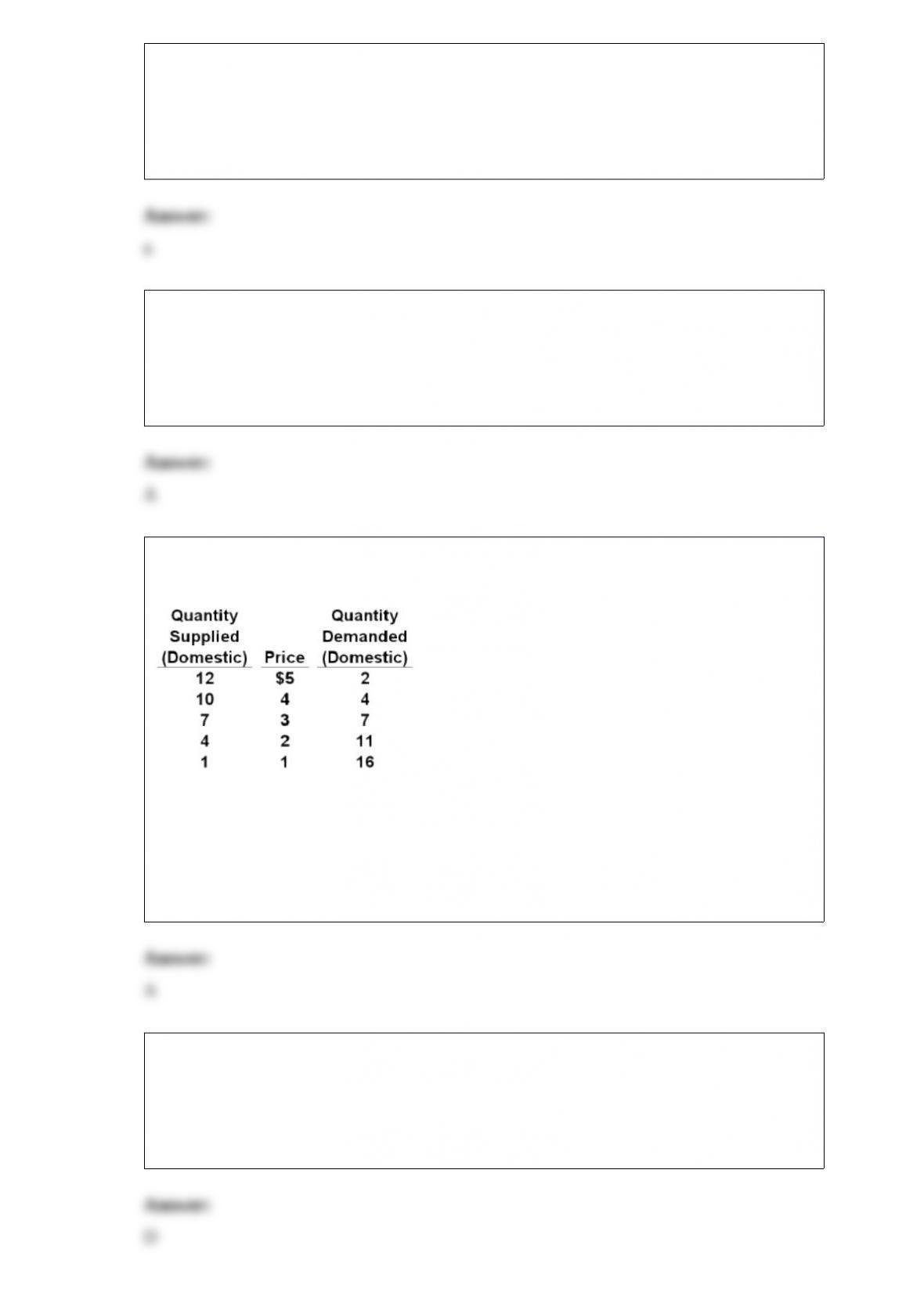
3) The following domestic supply and demand schedules for a product. Suppose that the
world price of the product is $1.
Refer to the above data. With a $1 per unit tariff, prices (revenue per unit) received by
domestic and foreign producers respectively will be:
A.$2 and $1.
B.$1 and $2.
C.$2 and $2.
D.$3 and $2.
4) Population growth remains high in most DVCs because:
A.religious and sociocultural considerations favor large families.
B.children may provide economic security for aging parents.
C.children provide agricultural labor in rural areas.
D.all of these reasons.
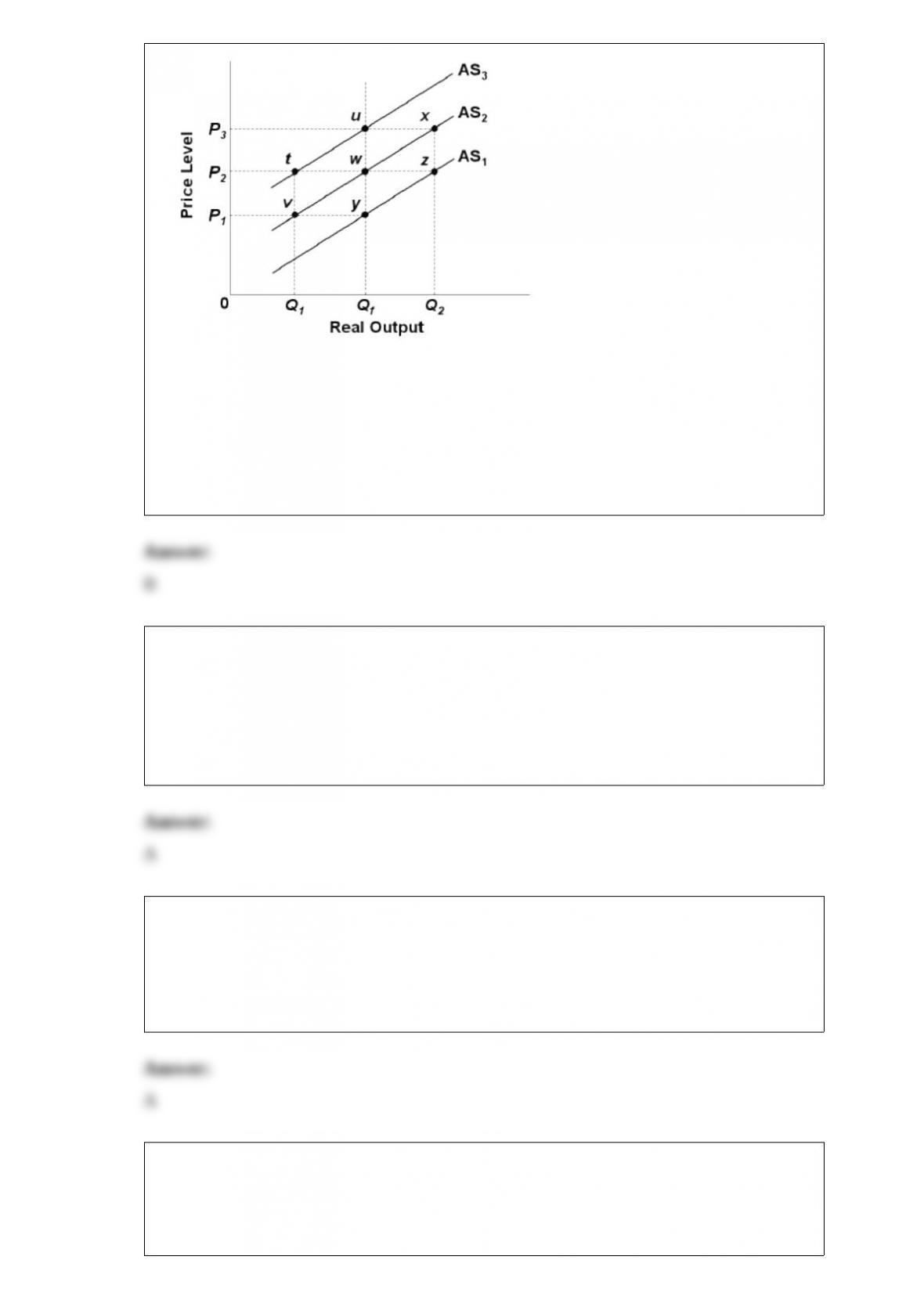
5)
Refer to the above diagram and assume the economy is operating at equilibrium point
w. In the short run, an increase in the price level from P2 to P3 would move the
economy from point w to point:
A.v
B.x
C.u
D.z
6) If the demand for a product is perfectly elastic and supply is upsloping, a $1 excise
tax per unit on suppliers will:
A.not raise price at all.
B.lower price by $1.
C.raise price by more than $1.
D.raise price by $1.
7) Which of the following is (are) characteristic of DVCs?
A.a large percentage of the labor force is in agriculture
B.high levels of saving and investment
C.high labor productivity
D.high levels of training
8) which of the following individuals is most likely to migrate to switzerland, assuming
that all face equally good prospects of securing a good job after arrival?
a.ricardo is 25 years old, single, and currently lives in italy.
b.ivan is 50 years old, married, and currently lives in russia.
c.maria is 40 years old, married with three children, and currently lives in mexico.
d.tran is 35 years old, single, speaks only vietnamese and a little english, and currently
lives in vietnam.
9) The low per capita outputs of the DVCs are explained by:
A.insufficient saving and investment.
B.over investment in human capital.
C.slow population growth.
D.excessively rapid technological advance.
10) the slope of a line parallel to the horizontal axis is:
a.zero.
b.one.
c.infinite.
d.one-half.
11) which of the following institutional structures is most likely to promote growth?
a.a well-enforced system of patents and copyrights.
b.a competitive market system.
c.an educational system that produces large numbers of literate, well-educated
graduates.
d.all of these.
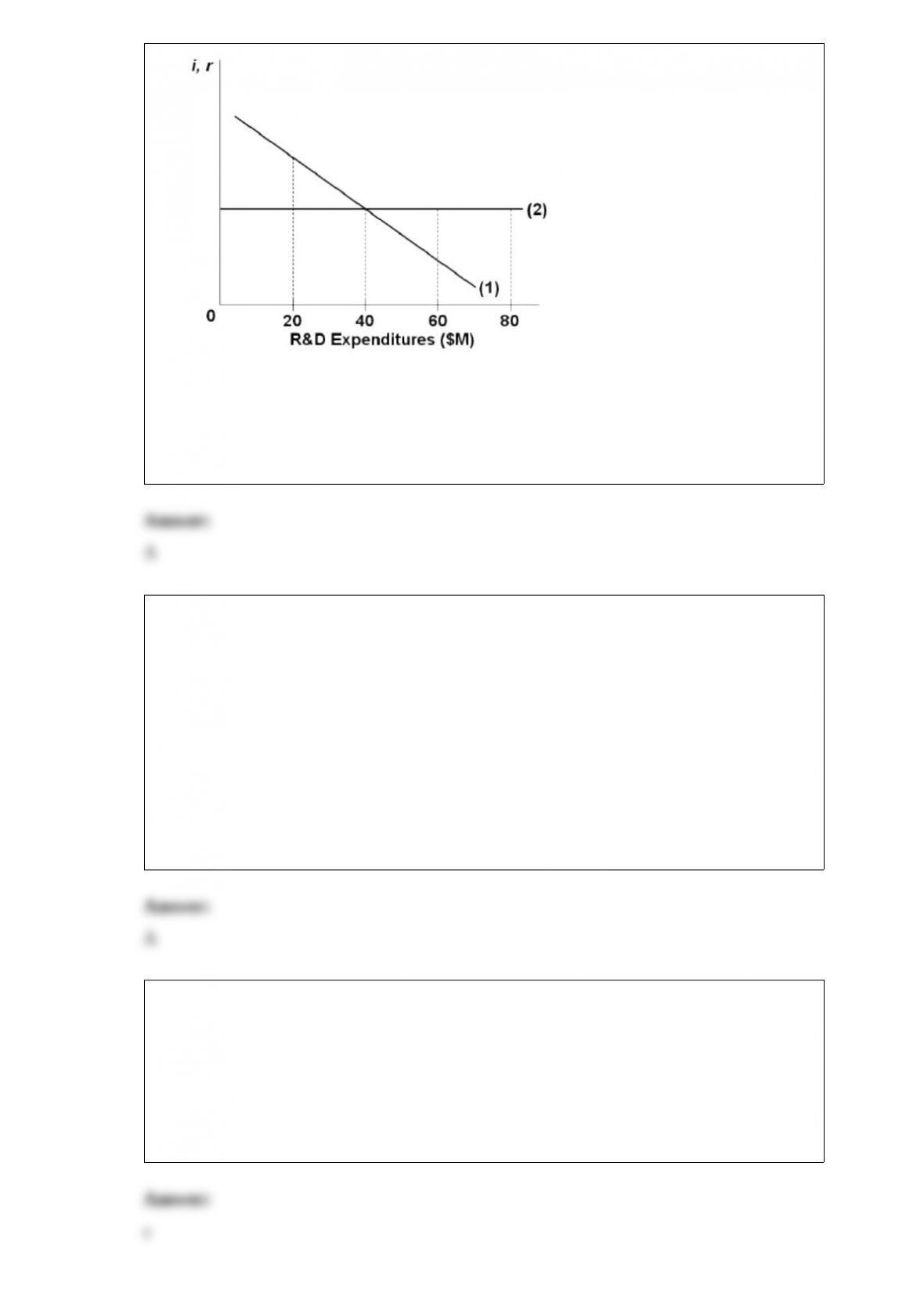
12)
In the above diagram, at $40 million of R&D expenditure, the expected rate of return:
A.equals the interest rate cost of funds.
B.is greater than the interest rate cost of funds.
C.is less than the interest rate cost of funds.
D.is negative.
13) The following information about the cost ratios for two products-fish (F) and
chicken (C)-in countries Singsong and Harmony. Assume that production occurs under
conditions of constant costs and these are the only two nations in the world.
Singsong: 1F = 2C
Harmony: 1F = 4C
Refer to the above information. In Singsong the domestic real cost of each chicken:
A.is 1/2 a fish.
B.is 2 fish.
C.increases with the level of fish caught.
D.decreases with the level of fish caught.
14) if the unemployment rate is 9 percent and the natural rate of unemployment is 5
percent, then the:
a.frictional unemployment rate is 5 percent.
b.cyclical unemployment rate and the frictional unemployment rate together are 5
percent.
c.cyclical unemployment rate is 4 percent.
d.natural rate of unemployment will eventually increase.
15) A pure monopolist sells output for $4.00 per unit at the current level of production.
At this level of output, the marginal cost is $3.00, average variable costs are $3.75, and
average total costs are $4.25. The marginal revenue is $3.00. What is the short-run
condition for the monopolist and what output changes would you recommend?
16) Define worker-hours and labor productivity. What factors are behind labor
productivity?
17) What are tying contracts? How are tying contracts treated by antitrust enforcers?
18) What is the history behind the idea of a fractional reserve banking system?
19) How does inflation affect peoples standards of living and savings?
20) An airline is flying between two cities. The airline has the following costs
associated with the flight:
Crew $4000
Fuel 1000
Plane daily insurance 2000
Landing fee 1000
Plane daily depreciation $2000
The airline has an average of 40 passengers paying an average of $200 for this flight.
Do you think the airline should be flying between the two cities? Evaluate from a
short-run and long-run perspective.
21) What are the limitations to the diversification for stability argument for trade
protection?
22) How is elephant preservation affected by property rights?

23) What has been the recent view of antitrust laws?