
In the principal-agent relationship, the agent is
A) the owner of a resource that has hired another party to act on his behalf.
B) the person who is placed in control over resources that are not his own, with a
contractual obligation to use these resources in the interests of some other party.
C) the person who is placed in control over resources that are not his own and agrees to
compensate the resource owner in the event of outcomes that do not satisfy the resource
owner.
D) the person who places his resources in professional hands in exchange for the
professional’s promise to act on the resource owner’s behalf.
The sale of Treasury securities by the Federal Reserve will, in general,
A) not change the money supply.
B) not change the quantity of reserves held by banks.
C) increase the quantity of reserves held by banks.
D) decrease the quantity of reserves held by banks.
What can be done to deal with the principal-agent problem?
A) threaten to liquidate the firm
B) link top manager salaries to the profits of the firm or the price of the firm’s stock
C) have the CEO be a rotating position
D) forbid managers from owning any company stock
Suppose that when the price of hamburgers decreases, the Landry family decreases their
purchases of chicken nuggets. To the Landry family,
A) hamburgers and chicken nuggets are complements.
B) hamburgers and chicken nuggets are inferior goods.
C) hamburgers and chicken nuggets are normal goods.
D) hamburgers and chicken nuggets are substitutes.
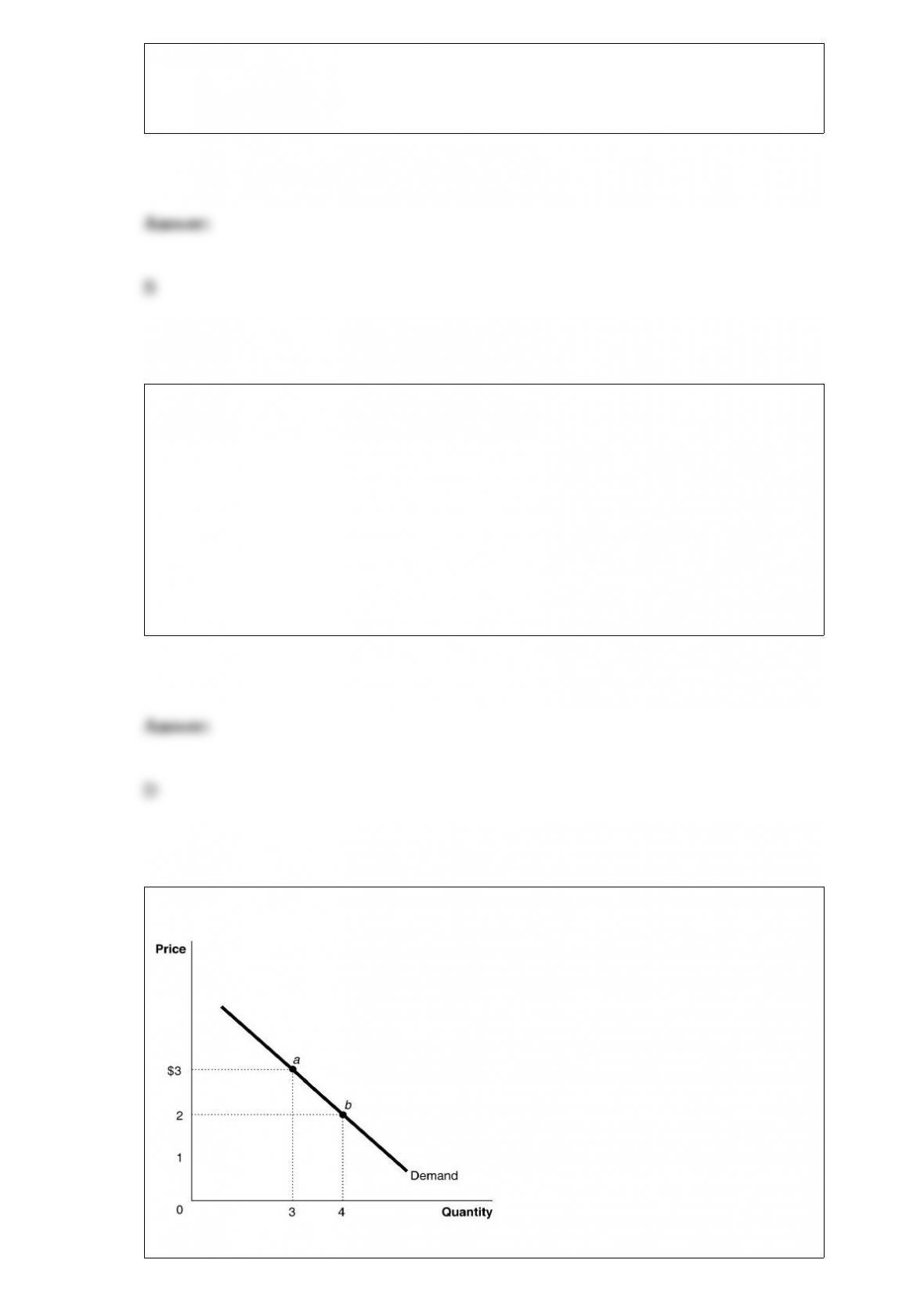
Figure 10-2
Figure 10-2 represents the demand for ice
cream cones. When the price of ice cream cones increases from $2 to $3, quantity

demanded decreases from 4 ice cream cones to 3 ice cream cones. This change in
quantity demanded is due to
A) the price and output effects.
B) the income and substitution effects.
C) the law of diminishing marginal utility.
D) the fact that marginal willingness to pay falls.
Suppose there is no unemployment in the economy and society decides that it wants
more of one good. Which of the following statements is true?
A) It can only achieve this with an advance in technology.
B) It can increase output without giving up another good.
C) It can only achieve this with an increase in resource supplies.
D) It will have to give up production and consumption of some other good.
When the price of a good rises, consumers buy a smaller quantity because of the
________ effect and the ________ effect.
A) substitution; income
B) normal; inferior
C) substitute; complement;

D) supply; demand
If the Commerce Department adjusts the growth rate of GDP downward for the first
quarter of 2014, and the Bureau of Labor Statistics adjusts the number of hours worked
upward for the first quarter of 2014, what will the Bureau of Labor Statistics do in
terms of revising the figures on the growth rate of labor productivity for the first quarter
of 2014?
A) The BLS will adjust the growth rate downwards.
B) The BLS will adjust the growth rate upwards.
C) The BLS will not change the growth rate of productivity.
D) The BLS will adjust the level of labor productivity upward and the growth rate
downward.
Article Summary. In 2012, Colorado and Washington legalized marijuana for
recreational use, and one of the major selling points in each state’s pro-marijuana
campaign was the possibility of generating millions of dollars in tax revenue from
sales which could be used for funding general education. The Colorado legislature
was weighing a proposal to tax marijuana at 30 percent, of which 15 percent would
be a sales tax on consumers and 15 percent an excise tax on growers. Washington
has set a tax rate of 44 percent on consumers and 25 percent each for growers and
retailers. Since the legalization of marijuana is relatively new, projecting the
economic impact of its sale is difficult, leading to many questions as to the
quantities that will be produced and sold and what actual tax revenues will be
generated. Source: Elizabeth Dwoskin, “Colorado and Washington Try to Figure
Out How to Tax Marijuana,” Bloomberg Businessweek, April 26, 2013.
Suppose the sale of marijuana is legalized in Florida, and the state decides to charge a
tax of $50 per ounce on each sale, with the state claiming that retailers will bear the
entire burden of this tax. Draw a graph illustrating the situation where retail outlets
would bear the entire tax burden of $50 per ounce of marijuana. Explain what would
need to be true about the demand for marijuana for retailers to bear the entire burden of
this tax, and if this would likely occur if marijuana sales were legalized.
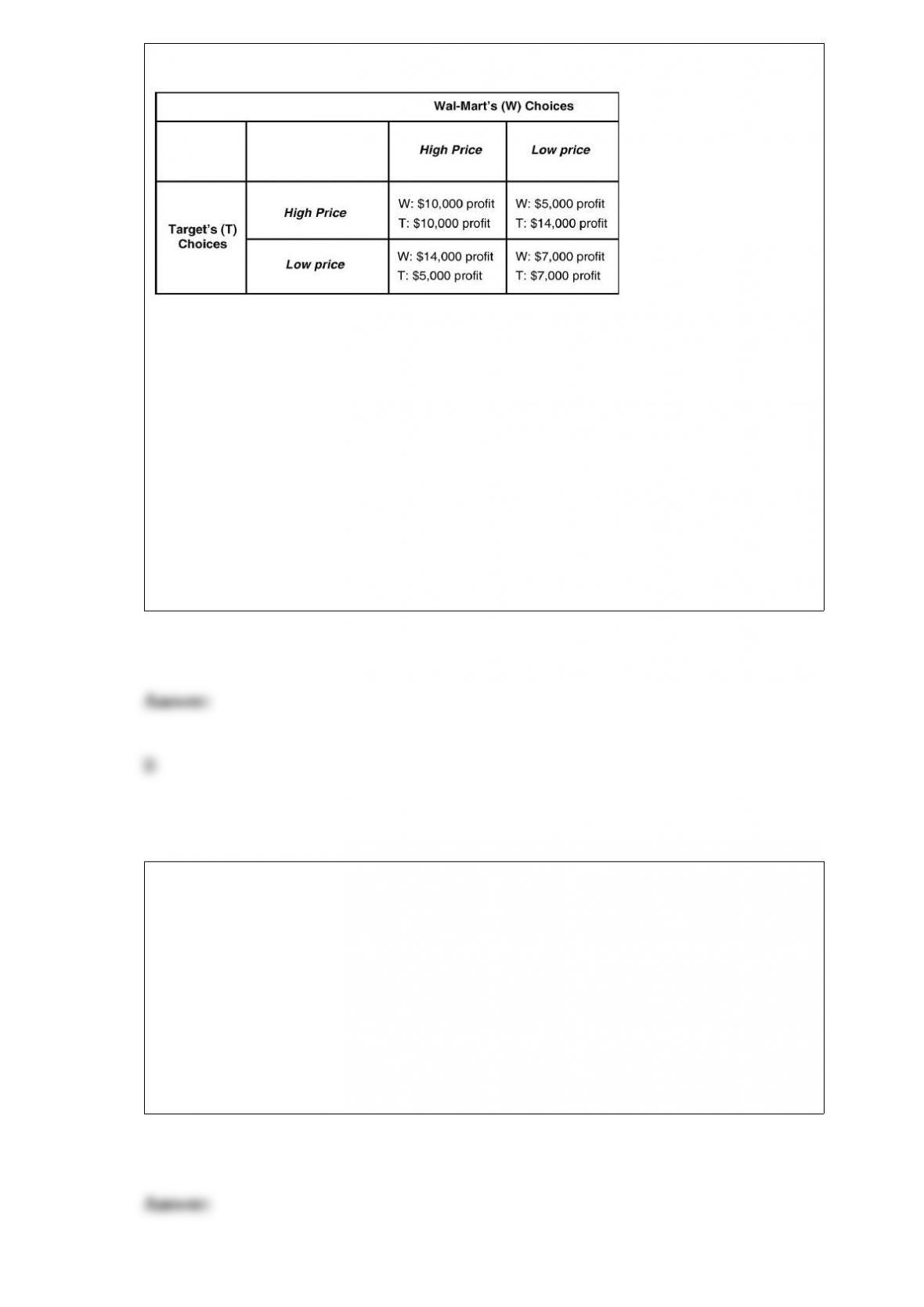
Table 14-2
Table 14-2 shows the
payoff matrix for Wal-Mart and Target from every combination of pricing strategies for
the popular PlayStation 3. At the start of the game each firm charges a low price and
each earns a profit of $7,000. Suppose pricing PlayStations is a repeated game in which
Wal-Mart and Target will be selling the game system in competition over a long period
of time. In this case, what is the most likely outcome?
A) a noncooperative equilibrium in which each firm charges the high price
B) a cooperative equilibrium in which each firm charges the high price
C) a noncooperative equilibrium in which each firm charges the low price
D) a cooperative equilibrium in which each firm charges the low price
Firms that participate in regular open market transactions with ________ are called
primary dealers.
A) commercial banks
B) Treasury banks
C) the Federal Reserve
D) mortgage lenders

To increase the money supply, the Federal Reserve could
A) raise the discount rate.
B) decrease income taxes.
C) raise the required reserve ratio.
D) conduct an open market purchase of Treasury securities.
E) lower transfer payments.