
The Clayton Act is an antitrust law that was passed to
A) outlaw monopolization.
B) address loopholes in the Sherman Act.
C) prohibit charging buyers different prices if the result would reduce competition.
D) toughen restrictions on mergers by prohibiting mergers that reduce competition.
Anything owed by a person or a firm is
A) an asset.
B) a liability.
C) a bond.
D) equity.
If a firm is in an antitrust court case being accused of monopolizing a product, the firm
would hire an economist to show
A) the cross-price elasticity of demand between the firm’s good and another is negative.
B) the cross-price elasticity of demand between the firm’s good and another is positive.
C) the price elasticity of demand for the firm’s good is highly inelastic.
D) the income elasticity of the firm’s good is inferior.

Edward Lazear analyzed data provided by the Safelite Group, the nation’s largest
installer of auto glass, after the company changed the way it paid its glass installers
beginning in the mid-1990s. Instead of paying workers hourly wages, Safelite began to
pay workers on the basis of how many windows they installed. Which of the following
describes what Lazear concluded from his analysis of Safelite’s data?
A) Although workers installed more windows under the new system, Lazear found that
there was also an increase in the number of workmanship-related defects. Lazear
attributed this to workers taking short-cuts in order to earn higher wages. As a result,
productivity did not improve and Safelite went back to paying hourly wages.
B) Lazear found that worker productivity increased with the new system; about half of
the increase in productivity was due to workers who continued with the company and
half was due to new workers being more productive than those who left the company.
C) Although worker productivity improved, the increase in hourly wages resulted in a
significant decline in Safelite’s profits.
D) Because of a principal-agent problem, worker productivity was not affected by the
new compensation system. However, Lazear attributed this to management problems
that had nothing to do with Safelite’s compensation system.
An industry’s long-run supply curve shows
A) the relationship in the long run between market price and quantity supplied.
B) how the government determines the price of the product.
C) how average productivity is changing.
D) greater than normal profit.

Which of the following statements is false?
A) Marginal cost will equal average total cost when marginal cost is at its lowest point.
B) When marginal cost is less than average total cost, average total cost will fall.
C) When marginal cost is greater than average total cost, average total cost will rise.
D) Marginal cost will equal average total cost when average total cost is at its lowest
point.
In the United States, out-of-pocket spending on health care was ________ percent of all
health care spending in 2011.
A) 2
B) 11
C) 33
D) 51
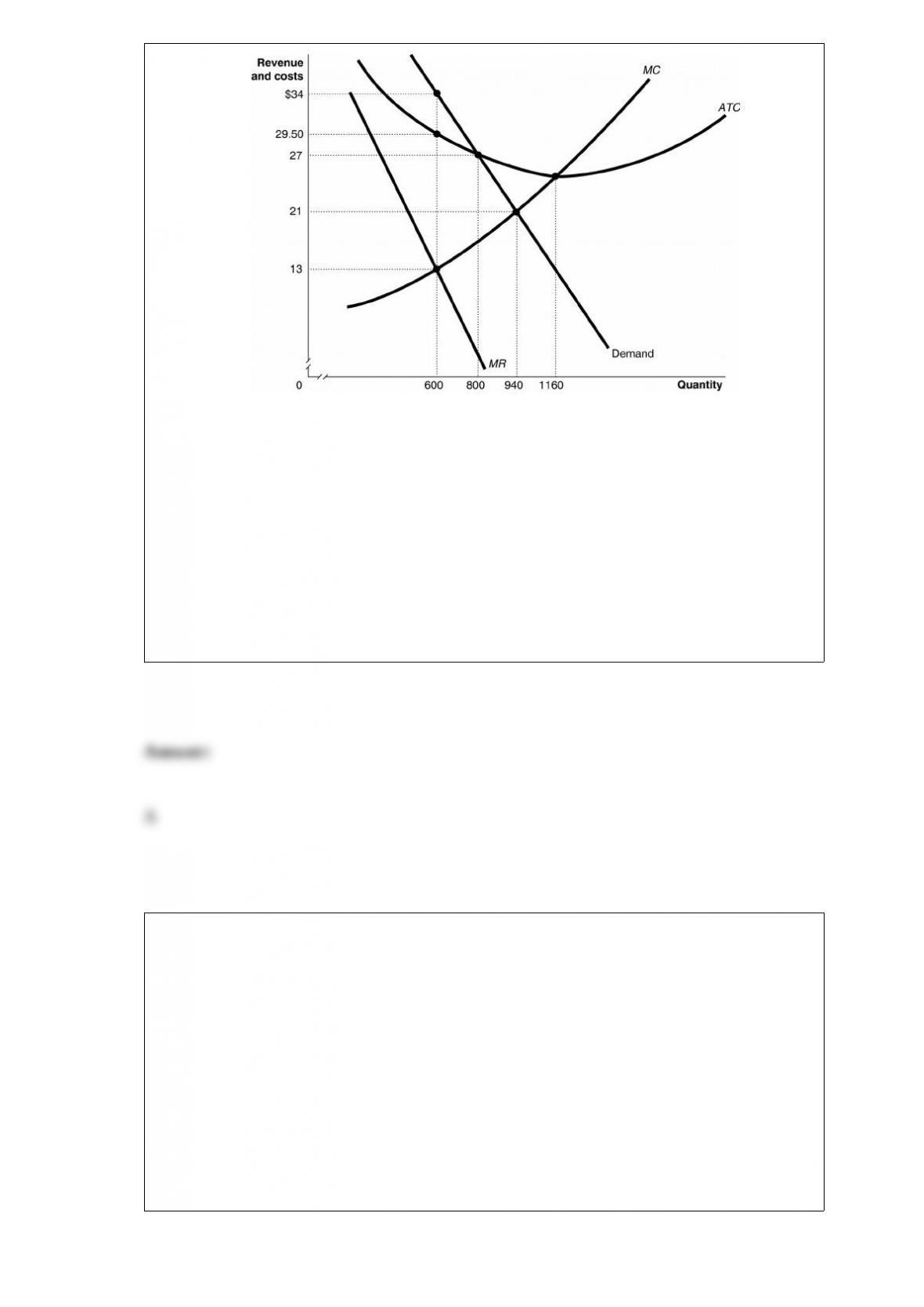
Figure 15-4 Figure
15-4 shows the demand and cost curves for a monopolist.
What is the profit-maximizing/loss-minimizing output level?
A) 600 units
B) 800 units
C) 940 units
D) 1,160 units
Suppose the majority of the shares of Ford stock were sold to a Japanese firm.
Assuming all else remains constant, this will
A) increase the balance of the U.S. financial account.
B) increase foreign direct investment in the United States.
C) increase the balance of the U.S. current account.
D) decrease net portfolio investment in the United States.
E) create a capital outflow in the United States.
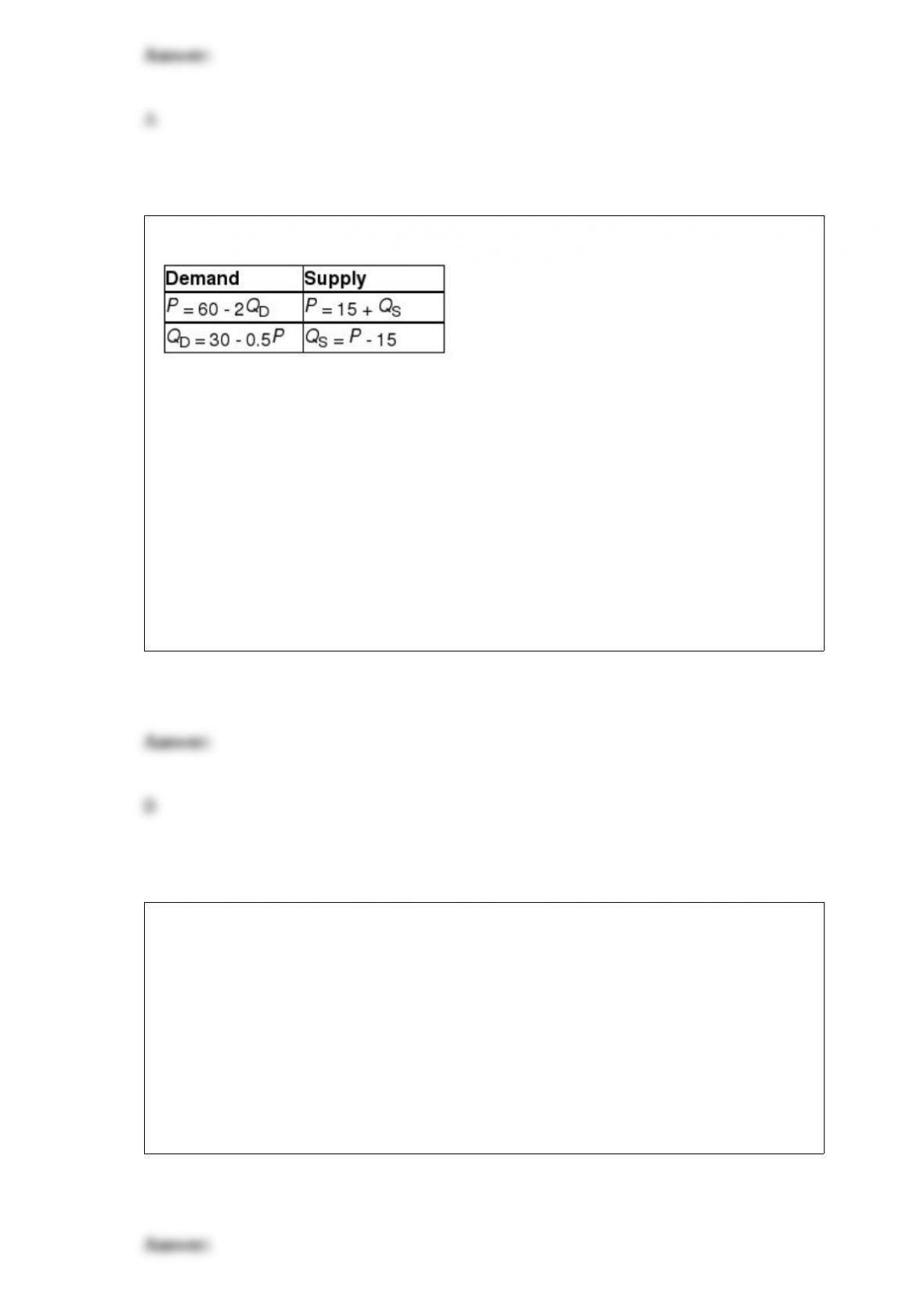
Table 4-7
The equations above describe the demand and supply for Pauline’s Pickled
Pomegranates. The equilibrium price and quantity for Pauline’s Pickled Pomegranates
are $30 and 15 thousand units. What is the value of producer surplus?
A) $50 thousand
B) $112.5 thousand
C) $225 thousand
D) $337.5 thousand
Voluntary exchange increases economic efficiency
A) because neither the buyer nor the seller would agree to a trade unless they both
benefit.
B) because voluntary exchange only takes place with government permission.
C) because it is free and consequently does not cost anything.
D) because it allows wealthy individuals to act altruistically and give to the poor.

Suppose that real GDP for 2012 was $10,000 billion and real GDP for 2013 was
$11,000 billion. What is the rate of growth of real GDP between 2012 and 2013?
A) 1%
B) 2%
C) 5%
D) 10%
When members of Congress vote to pass new legislation, they will
A) always vote for the alternative favored by a majority of the voters.
B) fail to consistently represent the underlying preferences of voters.
C) always vote for the alternative favored by a plurality of the voters if there is no
majority position.
D) always fail to represent the underlying preferences of voters.
One reason that Iceland recovered from the financial crisis which began in 2007 more
quickly than did countries like Greece, Spain, and Italy is that Iceland does not use the

euro, and the value of its currency was able to ________ versus the euro, which
increased its ________.
A) decline; exports
B) decline; imports
C) rise; exports
D) rise; imports