1) (Last Word) Classical macroeconomics was dealt severe blows by:
A.the Great Depression and Keynes’s macroeconomic theory.
B.the Second World War and the writings of Milton Friedman.
C.Adam Smith and his idea of the invisible hand.
D. the strong recovery after the Second World War and Alvin Hansen’s stagnation
thesis.
2) the scientific method is:
a.not applicable to economics, because economics deals with human beings.
b.also known as the economic perspective.
c.analysis that moves from broad generalizations called laws to theories and then to
hypotheses.
d.used by economists and other social scientists, as well as by physical scientists and
life scientists.
3) If the MPS is .25 and the economy has a recessionary expenditure gap of $5 billion,
then equilibrium GDP is:
A.$5 billion below the full-employment GDP.
B.$5 billion above the full-employment GDP.
C.$20 billion below the full-employment GDP.
D.$20 billion above the full-employment GDP.
4) The problem of cyclical asymmetry refers to the idea that:
A.a restrictive monetary policy can force a contraction of the money supply, but an
expansionary monetary policy may not achieve an increase in the money supply.
B.the monetary authorities have been less willing to use an expansionary monetary
policy than they have a restrictive monetary policy.
C.cyclical downswings are typically of longer duration than cyclical upswings.
D.an expansionary monetary policy can force an expansion of the money supply, but a
restrictive monetary policy may not achieve a contraction of the money supply.
5) Suppose an asset originally costs $200 and earns an interest rate of 10%. Use this
information to answer the following questions.
(a)What value will the asset have after the first year?
(b)What value will the asset have after five years if the interest is compounded?
(c)Suppose the asset can be held for a maximum of 15 years. What is the final value of
this asset?
(d)If the asset is held the maximum length of time (15 years), what is its total rate of
return? How does it compare to its interest rate?
6) if the equation y = -10 + 2.5x was plotted:
a.the vertical intercept would be -10
b.the slope would be -7.5
c.it would graph as a downsloping line
d.the slope would be -10
7) assume a purely competitive firm is maximizing profit at some output at which
long-run average total cost is at a minimum. then:
a.the firm is earning an economic profit.
b.there is no tendency for the firm’s industry to expand or contract.
c.allocative but not productive efficiency is being achieved.
d.other firms will enter this industry.
8) answer the next question(s) on the basis of the following national income data. all
figures are in billions of dollars.
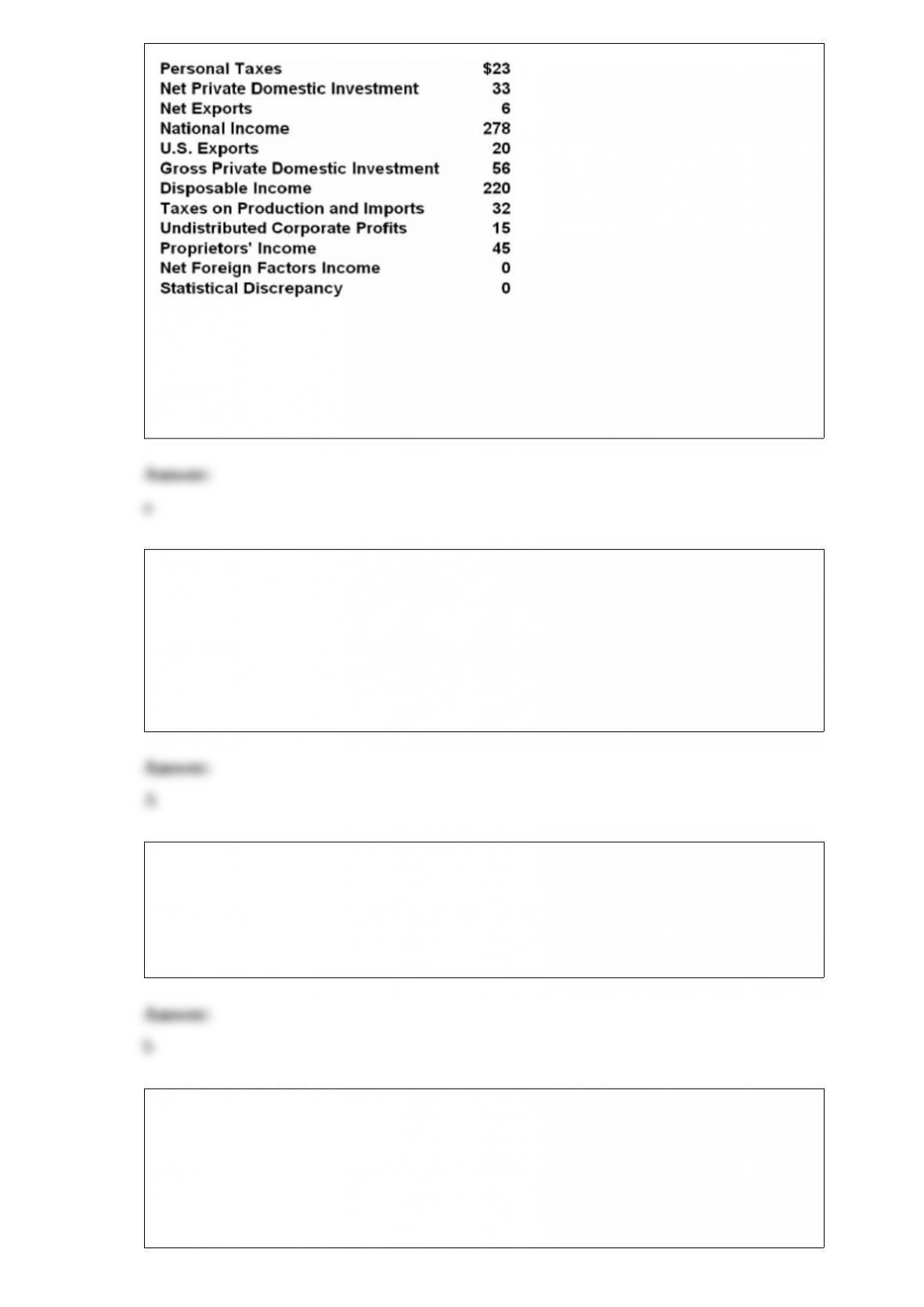
refer to the above data. personal consumption expenditures:
a.cannot be calculated.
b.are $231.
c.are $225.
d.are $205.
9) The substitution effect indicates that a profit-seeking firm will use:
A.more of an input whose price has fallen and less of other inputs in producing a given
output.
B.more of all inputs if production costs fall.
C.more of those inputs whose marginal productivity is the greatest.
D.less of an input whose price has fallen and more of other inputs in producing a given
output.
10) (consider this) in terms of a reservoir analogy, the:
a.outflow below the dam is the stock of capital.
b.inflow from the river is gross investment.
c.level of water in the reservoir is depreciation.
d.level of water in the reservoir is net investment.
11) (1) The composite index of leading indicators turns downward for three consecutive
months, suggesting the possibility of a recession; (2) Economists reach agreement that
the economy is moving into a recession; (3) A tax cut is proposed in Congress; (4) The
tax cut is passed by Congress and signed by the President; (5) Consumption spending
begins to rise, aggregate demand increases, and the economy begins to recover.
Refer to the above information. The operational lag of fiscal policy is reflected in
event(s):
A.1 and 2.
B.2 and 3.
C.3 and 4.
D.5.
12) according to economist donald boudreaux:
a.private property eliminates the possibility that resource arrangements will be random.
b.the market system threatens to do irreparable harm to the world’s ecosystem.
c.arranging resources under the market system is much like shuffling a deck of cards.
d.the market system works wondrously for advanced industrial nations but not for
developing nations.
13) “Income receivers should be paid in accordance with the value of output each
produces.” This statement is consistent with the:
A.monopoly theory of income distribution.
B.marginal productivity theory of income distribution.
C.least-cost, but not profit-maximizing, combination of inputs.
D.concept of compensating wage differences.
14) the pursuit of self-interest:
a.is highly detrimental to the market system.
b.means the same as ‘selfishness.”
c.is reflected in the behavior of firms, but not in the behavior of consumers.
d.gives direction to the market system.
15) an important economic problem associated with pure monopoly is that, at the profit
maximizing outputs, resources are:
a.overallocated because price exceeds marginal cost.
b.overallocated because marginal cost exceeds price.
c.underallocated because price exceeds marginal cost.
d.underallocated because marginal cost exceeds price.
16) which of the following explanations is given for why labor supply (on a per capita
basis) is greater in the united states than in france and other rich leader countries?
a.france and other rich leader countries have more generous unemployment and welfare
programs than the united states.
b.the united states has lower tax rates than france and other rich leader countries.
c.the united states has a longer legal work-week than france and other rich leader
countries.
d.all of these.
17) in moving along a stable supply curve which of the following is not held constant?
a.the number of firms producing this good
b.expectations about the future price of the product
c.techniques used in producing this product
d.the price of the product for which the supply curve is relevant
18) The crowding-out effect is:
A.strongest when the economy is at full employment.
B.strongest when the economy is in a deep recession.
C.weakest when there is demand-pull inflation.
D.equally strong, regardless of the state of the macroeconomy.