
Which of the following statements applies to a monopolist but not to a perfectly
competitive firm at their profit maximizing outputs?
A) Marginal revenue is less than price.
B) Marginal revenue equals marginal cost.
C) Price equals marginal cost.
D) Average revenue equals average cost.
Whereas relocating production to low-cost locales traditionally meant production of
goods almost exclusively, it increasingly applies to the production of ________.
A) domestic products
B) perishables
C) services
D) global brands
An isocost line shows
A) all the possible combinations of two inputs that a firm can use to produce its output.
B) all the possible combinations of two inputs a firm can use that have the same total

cost.
C) all the possible combinations of two inputs a firm can use that have the same
marginal cost.
D) all the possible combinations of two inputs with constant returns to scale.
In long-run equilibrium, compared to a perfectly competitive market, a
monopolistically competitive industry produces a ________ level of output and charges
a ________ price.
A) higher; lower
B) lower; lower
C) lower; higher
D) higher; higher
Table 14-4

Alistair Luggage and Baine Baggage are the only firms selling luggage in the upscale
town of Montecito. Each firm must decide on whether to increase its advertising
spending to compete for customers. If one firm increases its advertising budget but the
other does not, then the firm with the higher advertising budget will increase its profit.
Table 14-4 shows the payoff matrix for this advertising game.
Refer to Table 14-4. Does Baine have a dominant strategy and if so, what is it?
A) Yes, Baine should increase its advertising budget.
B) Yes, Baine should keep its advertising budget as is.
C) There are two dominant strategies: if Alistair increases its advertising budget, then
Baine’s best bet is to keep its budget the same but if Alistair does not increase its
spending then Baine should raise its advertising budget
D) No, there is no dominant strategy.
Which of the following is a microeconomics question?
A) How much will be saved and how much will be produced in the entire economy?
B) What will the level of economic growth be in the entire economy?
C) What factors determine the price of carrots?
D) What determines the average price level and inflation?

How does the long run equilibrium of a monopolistically competitive industry differ
from that of a perfectly competitive industry?
A) A firm in monopolistic competition will earn economic profits but a firm in perfect
competition earns zero profit.
B) A firm in monopolistic competition will charge a price higher than the average cost
of production but a firm in perfect competition charges a price equal to the average cost
of production.
C) A firm in monopolistic competition does not take full advantage of its economies of
scale but a firm in perfect competition produces at the lowest average cost possible.
D) A firm in monopolistic competition produces an allocatively efficient output level
while a firm in perfect competition produces a productively efficient output level.
Suppose a firm uses labor and capital to produce output. The last unit of labor hired has
a marginal product of 12 units of output, and the last unit of capital employed has a
marginal product of 20 units. Use the optimal combination of inputs rule to calculate
the price of capital if the price of labor is $6 per unit. The price of capital is
A) $2.
B) $10.
C) $20.
D) impossible to determine with the information given.
Trina’s Tropical Fish Store sells goldfish for $2 each and angelfish for $10 each. What
is the opportunity cost of buying a goldfish?
A) 5 angelfish
B) 1/5 of an angelfish
C) $10
D) $2
Table 13-3
Table 13-3 shows the demand and cost schedules for a monopolistically competitive
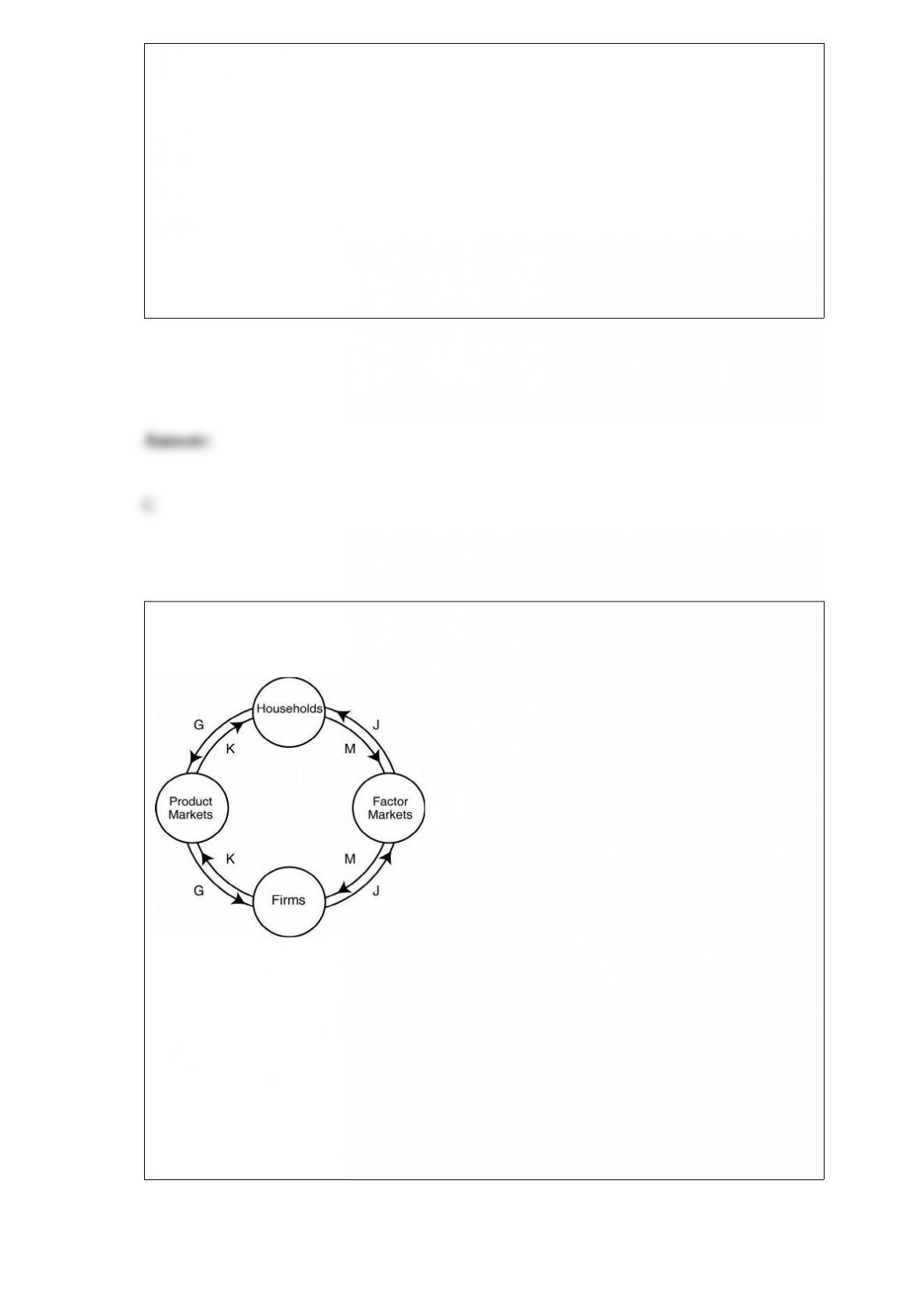
firm.
Refer to Table 13-3. What are the profit-maximizing/loss-minimizing output level and
price?
A) Q=0 (firm should not produce)
B) Q=3; P=$18
C) Q=4; P=$17
D) Q=5; P=$16
Figure 2-14
Refer to Figure 2-14. Which two arrows in the diagram depict the following
transaction: Barney earns $250 for selling scissors and razors to Floyd’s Barber Shop.
A) J and M
B) K and G
C) K and M
D) J and G

Which of the following does not arise from price discrimination?
A) an increase in producer surplus
B) an increase in consumer surplus
C) an increase in quantity sold
D) an increase in profits
Which of the following statements is true?
A) An increase in supply causes a change in equilibrium price; the change in price does
not cause a further change in demand or supply.
B) A decrease in supply causes equilibrium price to rise; the increase in price then
results in a decrease in demand.
C) If both demand and supply increase there must be an increase in equilibrium price;
equilibrium quantity may either increase or decrease.
D) If demand decreases and supply increases one cannot determine if equilibrium price
will increase or decrease without knowing which change is greater.
Suppose Tinsel Town Videos lowers the price of its movie club membership by 10
percent and as a result, CineArts Videos experienced a 16 percent decline in its movie
club membership. What is the value of the cross-price elasticity between the two movie
club memberships?
A) -1.6
B) -0.625
C) 0.625
D) 1.6
Figure 18-4
Refer to Figure 18-4. Rank the above panels in terms of most unequal income
distribution to least unequal income distribution.
A) Panel A, Panel B, Panel C
B) Panel B, Panel C, Panel A

C) Panel A, Panel C, Panel B
D) Panel C, Panel B, Panel A
Many economists criticize protectionism because it causes losses to consumers and
eliminates jobs in domestic industries that use protected products. Why, then, do some
people support protectionism?
A) The criticisms of economists are based on theory. In fact, protectionism increases
consumer and producer surplus as well as employment.
B) Supporters of protectionism in high-income countries believe that wages will fall as
a result of competition with firms from developing countries.
C) Supporters of protectionism believe free trade will cause their countries to lose their
comparative advantage.
D) Supporters of protectionism believe that free trade will lead to inflation.
Table 2-9

Table 2-9 shows the number of labor hours required to produce a canoe and a sailboat in
Guatemala and Honduras.
Refer to Table 2-9. Honduras has a comparative advantage in the production of
A) canoes.
B) sailboats.
C) both products.
D) neither product.
Carolyn spends her income on popular magazines and music CDs. If the price of a CD
is four times the price of a magazine and if Carolyn is maximizing her utility, she buys
A) both goods until the marginal utility of the last CD purchased is four times the
marginal utility of the last magazine purchased.
B) both goods until the marginal utility of the last magazine purchased is four times the
marginal utility of the last CD purchased.
C) four times as much magazines as CDs.
D) four times as much CDs as magazines.
The typical labor supply curve is upward-sloping but it is possible for the curve to be
backward bending – negatively sloped – at very high wage levels. Which of the

following would cause a backward bending supply curve?
A) This would occur when the income effect from an increase in the wage becomes
larger than the substitution effect.
B) This would occur when the substitution effect from an increase in the wage becomes
larger than the income effect.
C) This would occur if leisure is an inferior good.
D) This would occur when a large number of workers choose leisure rather than
employment at low wages; only a very large increase in the wage will lead these
workers to prefer employment to leisure.
In the United States, health care spending per person based on income per person is
________ the average for most other countries.
A) slightly lower than
B) significantly higher than
C) significantly lower than
D) comparable to
Which of the following statements concerning the federal corporate income tax is true?

A) It is an efficient tax because it imposes a small excess burden relative to the tax
revenue it raises.
B) The incidence of the corporate income tax can be determined by using demand and
supply analysis.
C) Determining the incidence of the corporate income tax is complicated because it is
not certain how corporations respond to the tax.
D) The corporate income tax is an example of the benefits-received principle.
Along a downward-sloping linear demand curve
A) the marginal utility from the consumption of each unit of the good and the total
utility from consuming larger quantities increase.
B) the marginal utility from the consumption of each unit of the good and the total
utility from consuming larger quantities remain constant.
C) the marginal utility from the consumption of each unit of the good falls and the total
utility from consuming larger quantities increases.
D) the marginal utility from the consumption of each unit of the good rises and the total
utility from consuming larger quantities remain constant.
Which of the following is a consequence of the voting paradox?
A) A majority of voters elect a candidate that does not represent the preferences of the
voter who is in the political middle.
B) Politicians support small groups of individuals and firms that benefit from special
interest legislation, rather than a much larger group of voters who pay the cost for this
legislation.
C) Individuals and firms who benefit from government actions engage in rent seeking.
D) The collective preferences of voters are not transitive and voting outcomes are
inconsistent.
Figure 12-1
Refer to Figure 12-3. If the firm is producing 500 units
A) it is making a profit.
B) it is making a loss.
C) it should maintain its output to maximize profit.
D) it should increase its output to maximize profit.

Which of the following displays these two characteristics: nonrivalry and excludability?
A) public goods
B) private goods
C) quasi-public goods
D) common resources
Table 2-11
Table 2-11 shows the number of labor hours required to produce a motorcycle and a
guitar in Ireland and Scotland.
Refer to Table 2-11. What is Ireland’s opportunity cost of producing one guitar?
A) 0.2 motorcycle
B) 5 motorcycles
C) 8 motorcycles
D) 32 motorcycles
Which of the following is used to argue that the self-interest of public policymakers will
often lead to actions that are inconsistent with the preferences of the voters they
represent?
A) the voting paradox
B) the median voter theorem
C) rent seeking
D) transitivity of voters’ preferences
Figure 9-2

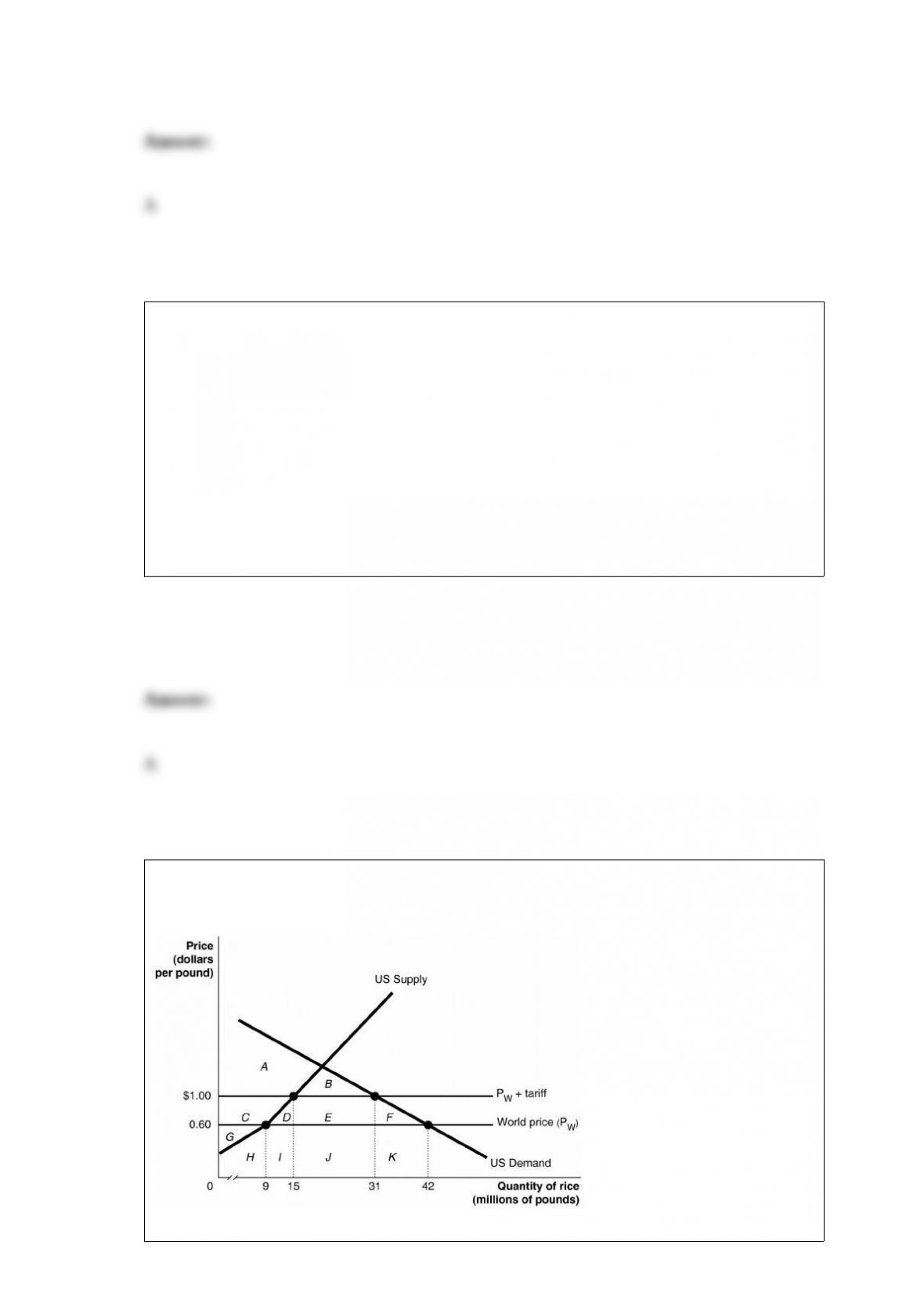
Suppose the U.S. government imposes a $0.40 per pound tariff on rice imports. Figure
9-2 shows the impact of this tariff.
Refer to Figure 9-2. The tariff revenue collected by the government equals the area
A) D + E + F.
B) E.
C) B + D + E + F.
D) C + D + E + F.
If you were to ask your employer for a raise, which of the following would be your
most effective argument?
A) “I have a job offer at another firm that will pay me more than my current wage.”
B) “I am willing to work more hours each week.”
C) “Increases in my productivity have resulted in greater revenue and profits for your
business.”
D) “My marginal product is greater than my current wage.”
Figure 3-8

Refer to Figure 3-8. The graph in this figure illustrates an initial competitive
equilibrium in the market for sugar at the intersection of D1 and S1 (point A). If there is
an increase in the price of fertilizer used on sugar cane and there is a decrease in tastes
for sugar-sweetened soft drinks, how will the equilibrium point change?
A) The equilibrium point will move from A to B.
B) The equilibrium point will move from A to C.
C) There will be no change in the equilibrium point.
D) The equilibrium point will move from A to E.
Figure 16-5
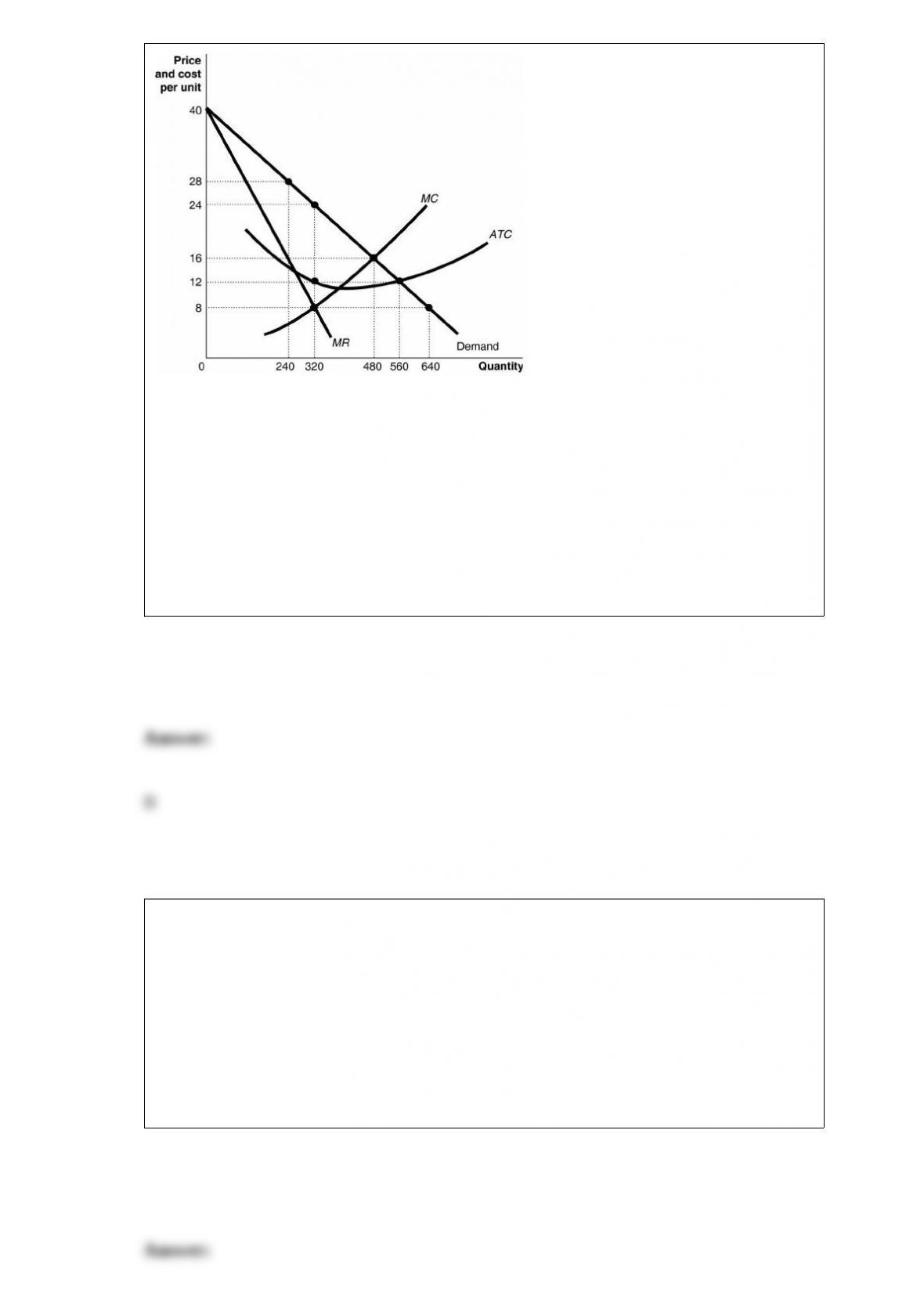
Refer to Figure 16-5. Suppose the firm represented in the diagram decides to practice
perfect price discrimination. What is the profit-maximizing quantity?
A) 320 units
B) 480 units
C) 560 units
D) 640 units
A firm would decide to shut down if its production resulted in
A) MR < ATC.
B) ATC > AVC.
C) AFC > AVC.
D) MR < AVC.

If the price of orchids falls, the substitution effect due to the price change will cause
A) an increase in the demand for orchids.
B) an increase in the demand for roses, a substitute for orchids.
C) an increase in the quantity demanded of orchids.
D) an increase in the quantity supplied of orchids.