If the supply curve and the demand curve for lettuce both shift to the left by an equal
amount, what can we say about the resulting changes in equilibrium price and quantity?
a. The price will increase, but the quantity may increase or decrease.
b. The price will increase, and the quantity will increase.
c. The price will decrease, and the quantity will increase.
d. The price will stay the same, but the quantity will increase.
e. The price will stay the same, but the quantity will decrease.
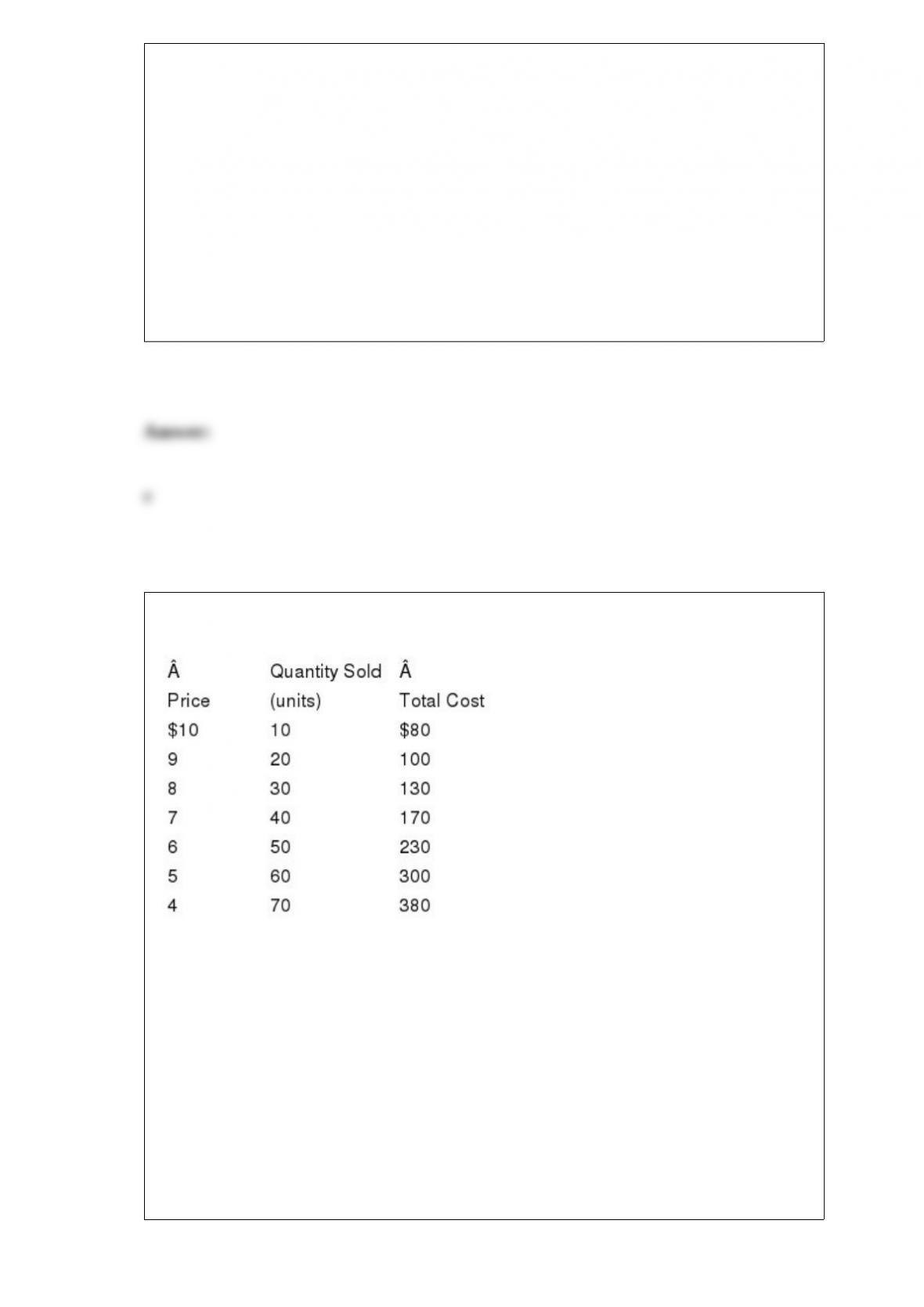
Exhibit 24-9
Assuming that the firm is maximizing profits, the marginal cost of the last unit
produced equals
a. $4.
b. $40.
c. $5.
d. $50.
e. $6.
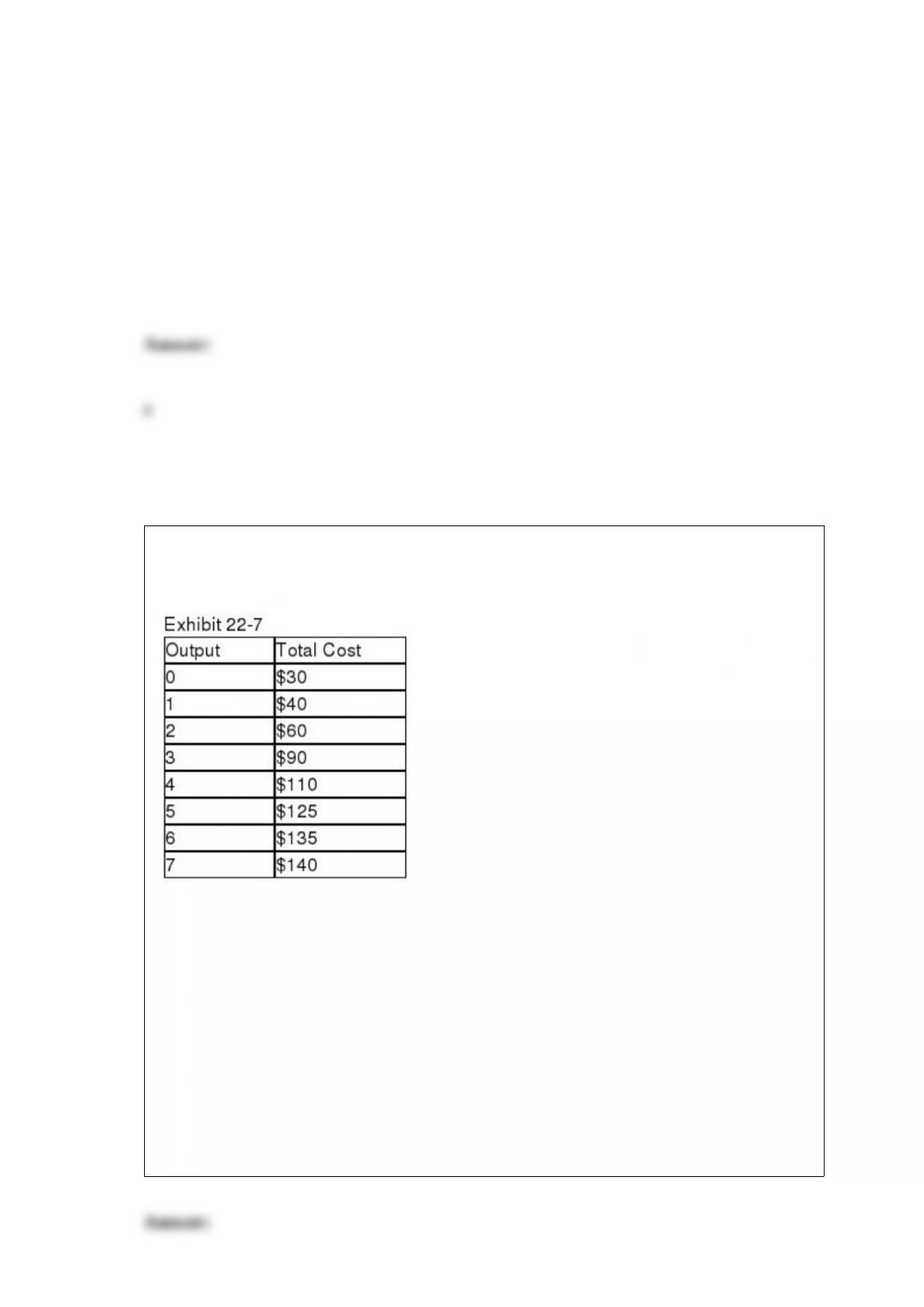
The average fixed cost of producing 5 units of output is
a. $16.25.
b. $4.00.
c. $11.15.
d. $6.00.
e. There is not enough information to answer this question.

An inferior good is
a. any good that consumers think is of low quality.
b. a good for which the quantity demanded increases as its price decreases.
c. a good for which the demand rises as income falls.
d. a good for which the demand rises as income rises.
e. any good that a producer cannot sell a large quantity of, even at a low price.
Suppose the production of a good results in negative externalities. If society produces
the output consistent with the intersection of the demand curve and the marginal private
cost curve, then
a. the socially optimal level of output will be produced.
b. society will incur a net social cost.
c. society will want more output produced, and producers will be willing to satisfy this
desire at a price that society deems acceptable.
d. all of the above
e. There is not enough information to answer this question.
Exhibit 39-4
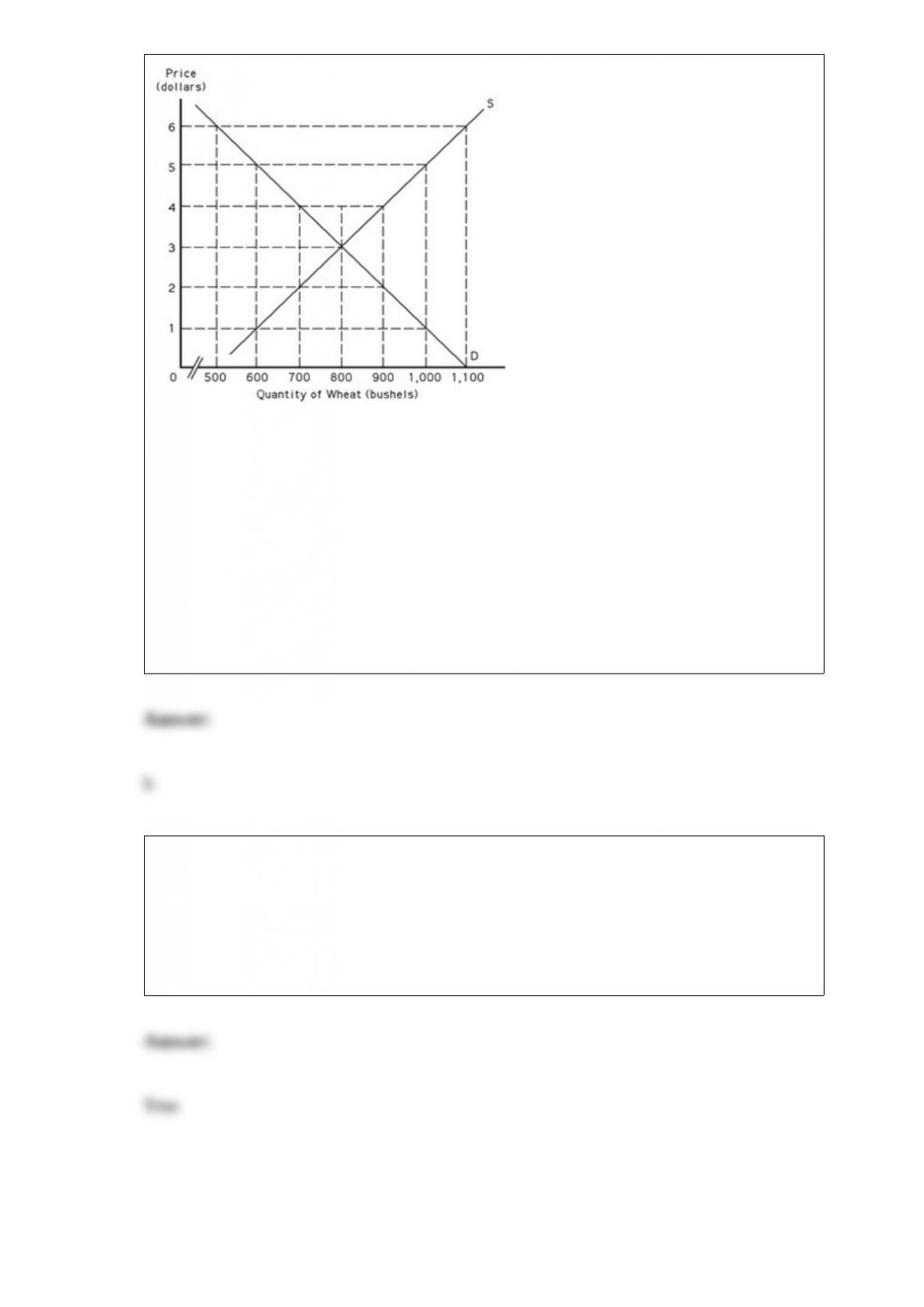
Under a price support program of $4 per bushel, how many bushels of surplus wheat
does the government purchase?
a. 0
b. 200
c. 700
d. 900
One of the ways in which some monopolistic competitors try to become more like
monopolists is through the use of designer labels.
a. True
b. False

The profit-maximizing natural monopoly will
a. set price equal to marginal cost.
b. produce the quantity of output at which MR = MC.
c. charge the highest price per unit for the quantity of output it chooses to produce.
d. necessarily face higher production costs if it is unregulated than if it is regulated.
e. b and c
The change in output that results from changing a variable input by one unit, holding all
other inputs fixed, is called the marginal __________ product of the variable input.
a. physical
b. value
c. average
d. explicit
A util is an artificial construct used as a means of measuring the
a. price of a good.
b. satisfaction one receives from the consumption of a good.
c. costs of producing a good.
d. difference between the price and the value of a good.

Suppose a producer decides that if the price of her product is $32, the quantity supplied
will be 1,000 units, and if the price is $35, the quantity supplied will be 1,300. The price
elasticity of supply for the good is approximately
a. +1.91.
b. -2.91.
c. +0.34.
d. -0.34.
e. +2.91.
One reason that helps to explain the law of demand is the law of
a. diminishing marginal utility.
b. diminishing marginal returns.
c. increasing opportunity costs.
d. supply.
If a 7 percent increase in the price of a commodity results in a 12 percent increase in the
quantity supplied, supply is said to be
a. perfectly elastic.
b. elastic.
c. unit elastic.
d. inelastic.
e. perfectly inelastic.

A divisive society is one in which members of society work together for the common
good.
a. True
b. False
If government removes two people from a prisoner’s dilemma setting (and, in the
process, requires that the two persons pay taxes for the service that government
provides), itholds that on net
a. each of the two persons is better off.
b. each of the two persons is worse off.
c. one person is better off and the other person is worse off.
d. a, b, or c
e. none of the above