1) the largest component of total expenditures in the united states is:
a.net exports.
b.government purchases.
c.consumption.
d.gross investment.
2) Many economists are critical of the minimum wage because they believe that it:
A.hurts the efforts of labor unions.
B.reduces the number of available job opportunities.
C.conflicts with policies designed to equalize the distribution of income.
D.causes labor shortages in affected markets.
3)
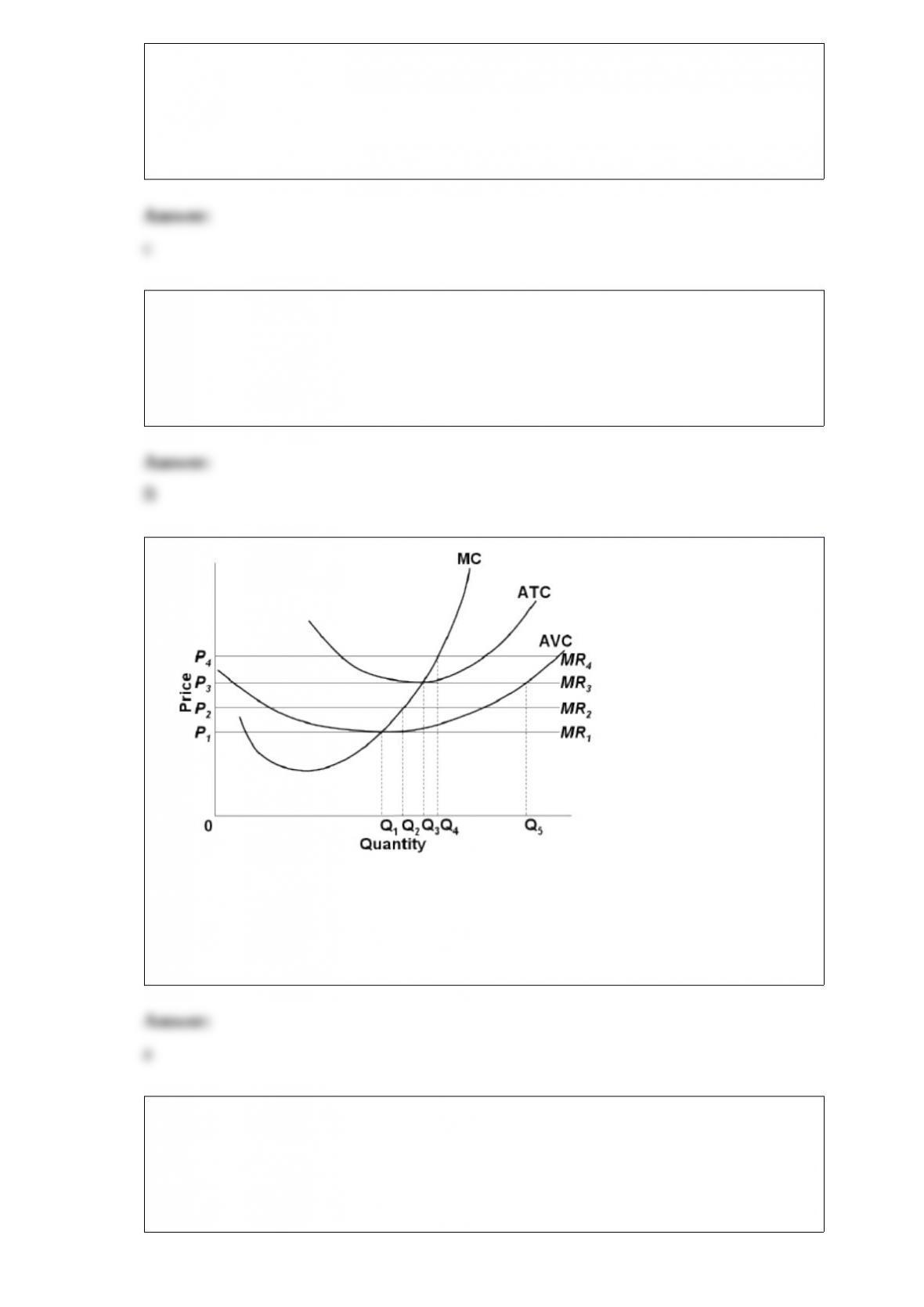
refer to the above diagram. the firm will shut down at any price less than:
a.p1
b.p2
c.p3
d.p4
4) The demand for agricultural products:
A.has a price elasticity coefficient of about .20 to .25.
B.is elastic with respect to income but inelastic with respect to price.
C.has been decreasing about 8 percent per year.
D.has been rising more rapidly than the national income.
5) if the existence of health insurance increases one’s incentive to use the health care
system more intensively, this is an illustration of:
a.the adverse selection problem.
b.the moral hazard problem.
c.the benefits-received principle.
d.the coase theorem.
6) the demand for commodity x is represented by the equation p = 100 – 2q and supply
by the equation p = 10 + 4q.
refer to the above information. if demand changed from p = 100 – 2q to p = 130 – q, the
new equilibrium price is:
a.$90
b.$110
c.$96
d.$106
7) Describe the positive and negative views of the economics of advertising.
The arguments over advertising focus on three major questions: (a) Is advertising
persuasion or information? (b) Does advertising promote monopoly power or
competition? (c) Does advertising contribute to economic waste or economic
efficiency?
8)
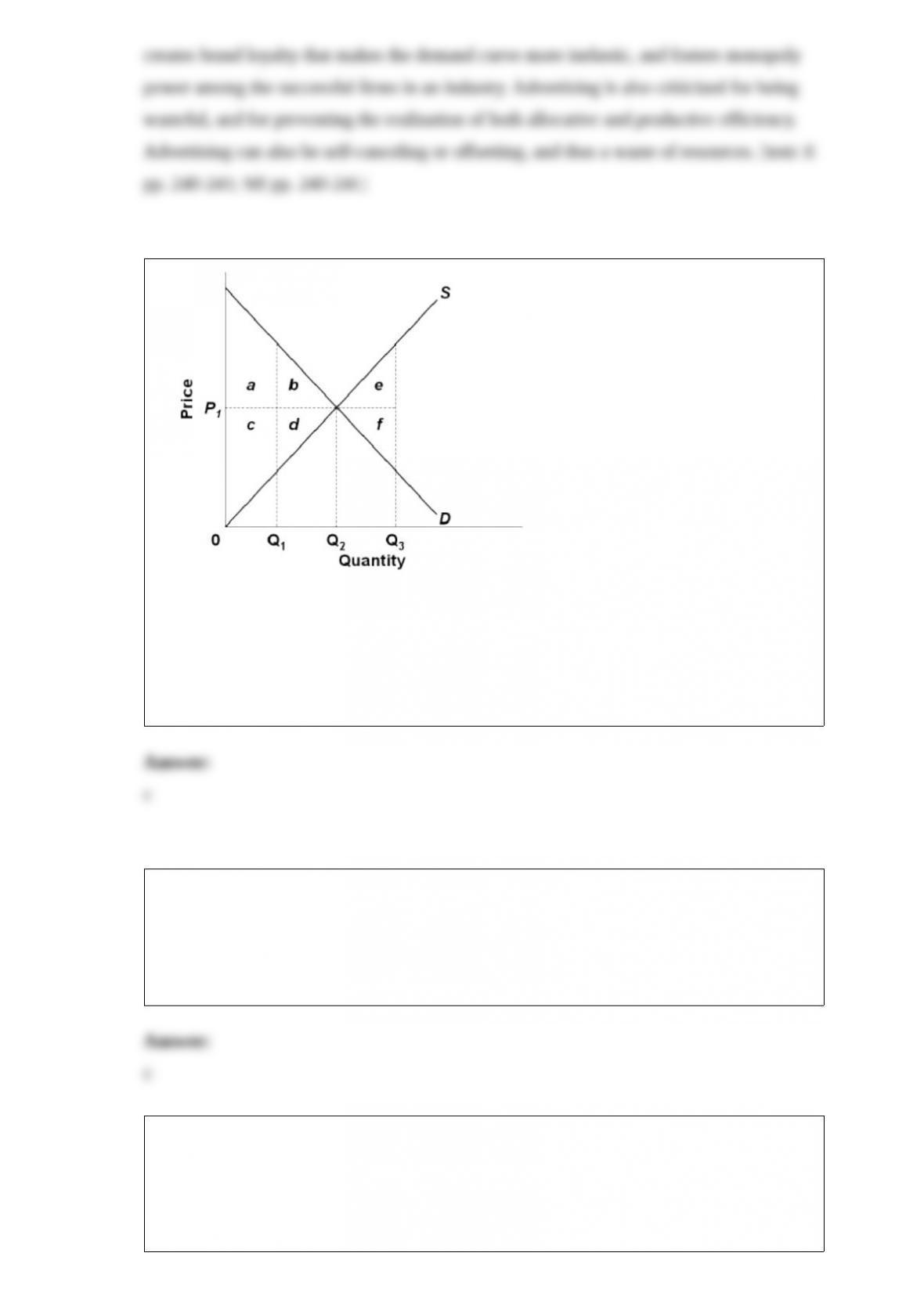
refer to the above diagram. assuming equilibrium price p1, producer surplus is
represented by areas:
a.a + b.
b.a + b + c + d.
c.c + d.
d.a + c.
9) if a profitable firm’s fixed costs somehow were zero:
a.mc and atc would be equal at all levels of output.
b.afc would become negative as output increases.
c.avc and atc would coincide.
d.atc would be zero at all output levels.
10) An economist who favors smaller government would recommend:
A.tax cuts during recession and reductions in government spending during inflation.
B.tax increases during recession and tax cuts during inflation.
C.tax cuts during recession and tax increases during inflation.
D.increases in government spending during recession and tax increases during inflation.
11) in terms of absolute volume of imports and exports, the world’s leading trading
nation is:
a.france.
b.japan.
c.the united states.
d.south korea.
12)
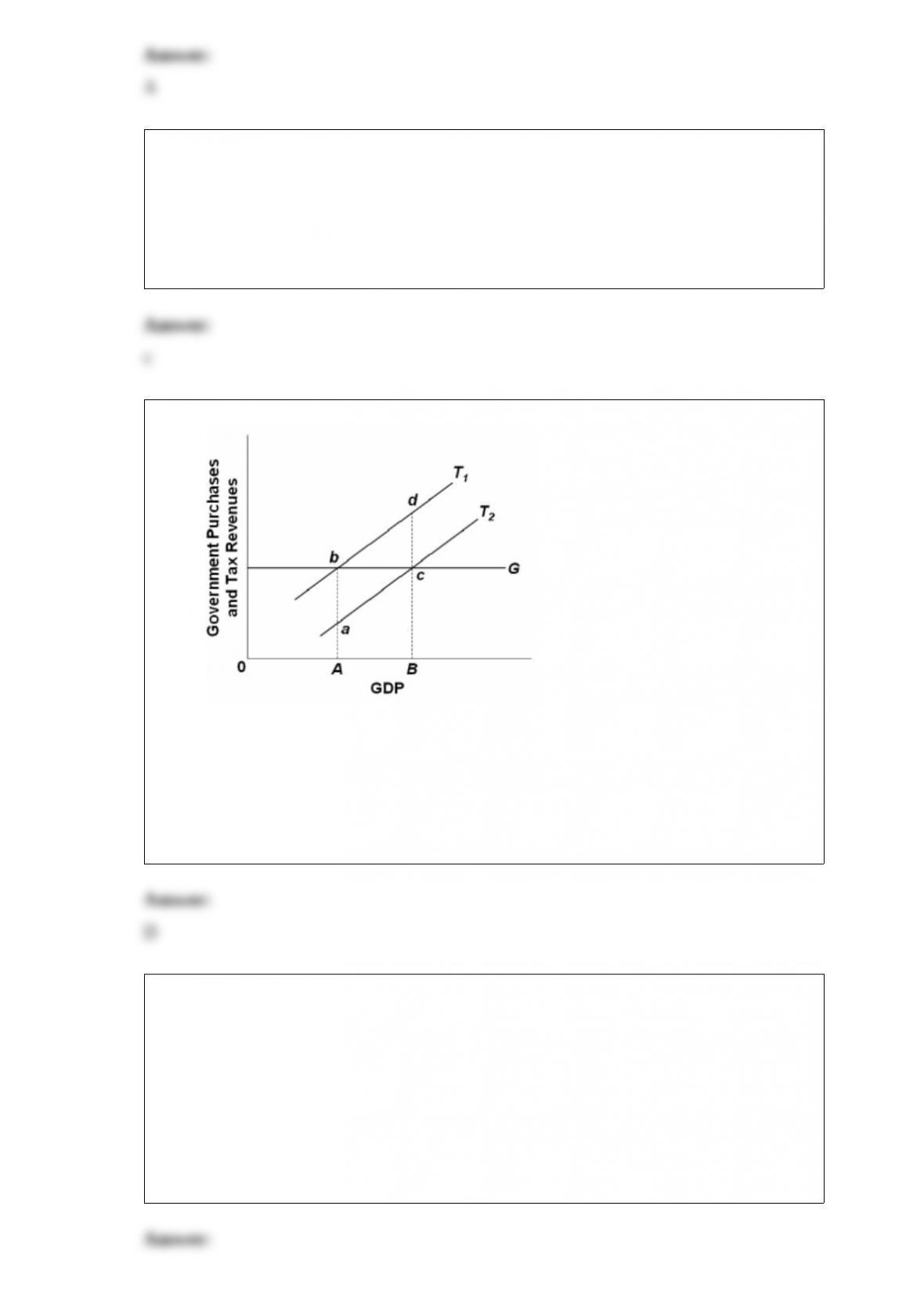
Refer to the above diagram. Assume that G and T1 are the relevant curves, the economy
is currently at B, and the full-employment GDP is A. This economy has a(n):
A.standardized budget surplus.
B.actual budget deficit.
C.standardized budget deficit.
D.actual budget surplus.
13) In general, the:
A.number of firms in the industry is far more important than the industry’s scientific
character and extent of technological opportunities.
B.greater is an industry’s concentration ratio, the higher its R&D expenditures in
relation to sales.
C.industry’s scientific character and extent of technological opportunities often is more
important than the industry’s concentration ratio.
D.higher the industry’s interest cost of borrowing funds for R&D, the greater is the
industry’s progressiveness.
14) if the economy adds to its inventory of goods during some year:
a.gross investment will exceed net investment by the amount of the inventory increase.
b.this amount should be ignored in calculating that year’s gdp.
c.this amount should be subtracted in calculating that year’s gdp.
d.this amount should be included in calculating that year’s gdp.
15) which of the following will enable a nation to obtain a combination of consumer
goods and capital goods outside its production possibilities curve?
a.full employment.
b.international specialization and trade.
c.full production.
d.productive efficiency.