
If the economy of Gwondanaland is growing more rapidly than the economy of Japan,
most likely
a. Japan has more current investment than Gwondanaland.
b. Japan has more government spending than Gwondanaland.
c. Japan spends more on capital goods than Gwondanaland.
d. Gwondanaland has lower current consumption than Japan.
e. Gwondanaland has lower current investment than Japan.
Aggregate demand is the total demand for the final goods and services produced in an
economy.
a. True
b. False
Before the Great Depression of the 1930s, most economists believed that
a. only active government policy could prevent recessions or inflation.
b. a capitalist economy had a natural tendency to cure recessions or inflation.
c. a capitalist economy had a natural tendency to inflation.

d. recessions and depressions were inevitable until the economy broke down
completely.
The equation M V = P Y is called the
a. multiplier formula.
b. transactions formula.
c. equation of exchange.
d. balanced exchange formula.
The slope of a curved line at a particular point is
a. always greater than the slope of a straight line at the same point.
b. always smaller than the slope of a straight line at the same point.
c. defined as the slope of the straight line representing the average values for the entire
curve.
d. defined as the slope of the straight line that is tangent to the curve at that point.
Which of the following characteristics of a PPF indicates that tradeoffs must be made?
a. the downward slope
b. the upward slope
c. the constant slope
d. the curvature
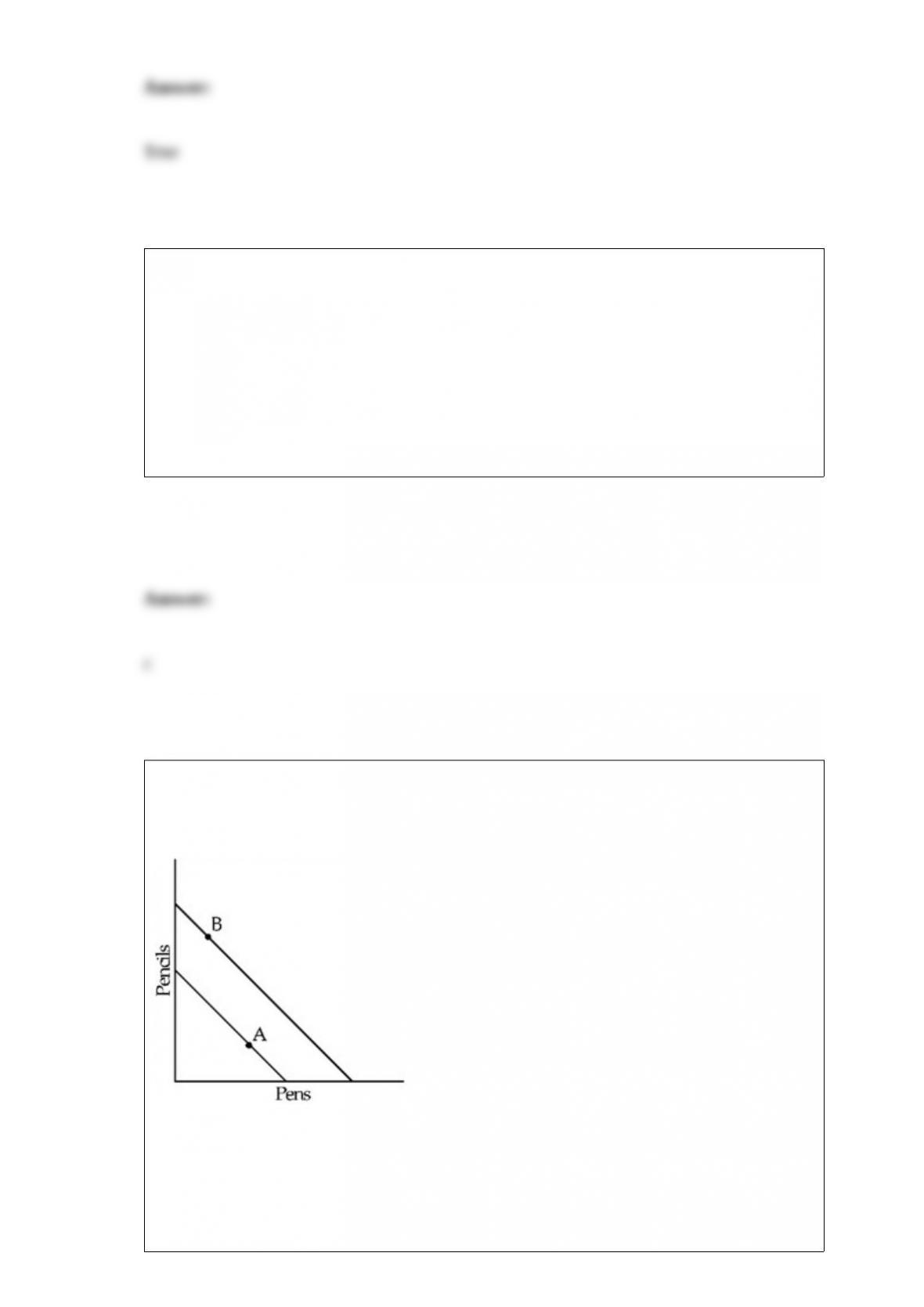
Table 4-1
Use this table for the following questions.

Refer to Table 4-1. At $4, what is the shortage?
a. 0
b. 1,500
c. 3,000
d. 4,500
e. 6,000
As the federal funds rate rises, the banks’ opportunity cost of holding excess reserves
falls.
a. True
b. False
In the context of stock markets, “the tail wags the dog” means that the failure of the
stock market can drag down the entire economy.
a. True
b. False
Economists would describe a labor union as a
a. trade organization.
b. necessity for competitive labor markets.
c. labor monopoly.
d. pure monopsony.
Figure 5-14
Martha initially buys the combination of pens and pencils shown as A in Figure 5-14.
After the prices of both goods change, she buys combination B. It must be true that
a. Martha prefers A to B.

b. Martha prefers B to A.
c. Martha is indifferent between A and B.
d. Martha’s preferences between A and B cannot be determined from the information
given.
Regarding the relationship between marginal profit and average profit, which of the
following statements is NOT true?
a. If the average profit is rising, the marginal profit figure must be rising.
b. If marginal profit is lower than average profit, then average profit must decrease
when profit increases.
c. If marginal profit is below average profit, the average profit decreases.
d. All of these statements are true.
The largest single portion of state and local budgets is devoted to
a. State and local defense.
b. Health and public welfare programs.
c. State and local unemployment compensation.
d. Education.
e. Interest payments on state and local debt.
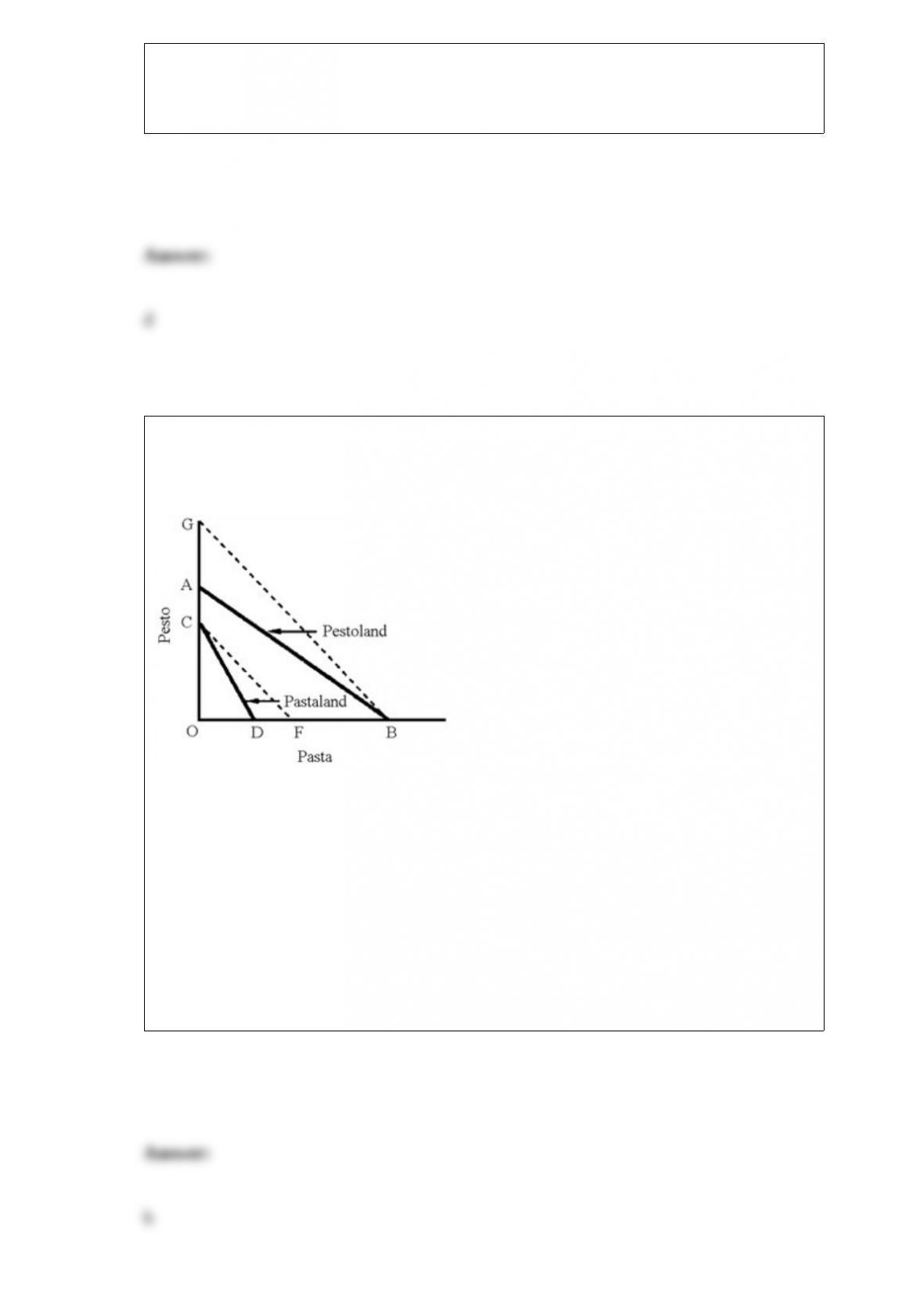
Figure 22-7
In Figure 22-7, AB represents the production possibilities of Pestoland and CD that of
Pastaland. Pestoland has a comparative advantage in pasta because it
a. gets more pasta from a given decline in pesto than Pastaland does.
b. gets more pesto from a given decrease in pasta production.
c. can produce more pasta than Pastaland.
d. can produce more pasta and pesto than Pastaland.

An employer would never operate on the upward-sloping part of an MRP curve because
a. he would not be maximizing profits.
b. he would be hiring workers at wages above MRP.
c. the number of workers is too large to get economies of scale.
d. he would then have too little capital per worker.
The idea of horizontal equity in taxation implies that
a. equally situated individuals should be taxed equally.
b. unequally situated individuals should be taxed unequally.
c. benefits should be given first to those individuals who need them most.
d. the greatest tax burden should be borne by the wealthiest individuals.
Horizontal equity means that equally situated individuals should be taxed equally.
a. True

b. False
Education accounts for the largest share of state and local government spending.
a. True
b. False
When people suddenly want to buy something, supply increases.
a. True
b. False
The marginal productivity principle demonstrates that distribution under a capitalist

system is ethically valid.
a. True
b. False
There are generally, in most areas, a large number of qualified physicians whose
services are highly personalized. In addition to price, factors such as age, sex, location,
and personality influence the choice of physician. Thus, the market is best described as
a. perfectly competitive.
b. a differentiated oligopoly.
c. a monopoly.
d. monopolistically competitive.
The Social Security system in the United States today is
a. actuarially sound.
b. composed of a private pension fund into which workers have paid and who will
withdraw their invested funds upon retirement.
c. currently in no danger of running out of money in the long run.
d. no longer a “pay as you go” system.
The theory of economic rent can be used to explain high incomes received by movie
stars and athletes.
a. True
b. False
Define the following terms and explain their importance to the study of
macroeconomics:
a. exchange rate
b. depreciation
c. devaluation
d. fixed exchange rates
Although finished goods are scarce, the inputs to produce them are not scarce.
a. True
b. False
Setting price equal to marginal cost in a natural monopoly will lead to
a. excess profits for the firm.
b. losses for the firm.
c. zero profits for the firm.
d. One cannot tell without further information.

If demand is elastic, a rise in price will decrease total expenditure.
a. True
b. False
The United States need never pay off the national debt; it can simply refinance the debt
when it comes due. The flaw in thinking that the government must pay it off is based on
the fallacy of
a. benefit-cost ratio.
b. post hoc, ergo propter hoc.
c. composition.
d. a priori expectations.
An active stabilization policy designed to limit the size of government would

a. raise G to eliminate a recessionary gap and lower taxes to eliminate an inflationary
gap.
b. raise G to eliminate a recessionary gap and raise taxes to eliminate an inflationary
gap.
c. reduce taxes to eliminate a recessionary gap and raise G to eliminate an inflationary
gap.
d. reduce taxes to eliminate a recessionary gap and reduce G to eliminate an inflationary
gap.
In a competitive labor market
a. wages would be determined by supply and demand.
b. the demand curve for labor is derived like the demand curve for any other input.
c. the demand curve for labor is the downward-sloping portion of the MRP curve.
d. All of the above answers are correct.
Critics of the Fed’s unconventional policies in 2009 and 2010 argued that determining
which financial institutions would be bailed out and which would be allowed to fail was
a political decision that rightfully belonged to Congress.
a. True

b. False
In 2015, Richard buys a 2003 Chevrolet minivan from a neighbor. Will this be counted
in the GDP for 2015?
a. Yes
b. No
c. Yes, if sales tax is paid
d. No, because the purchase was from an individual not a dealer
The concept of government as redistributor is
a. approved by many, but questioned by many as well.
b. generally rejected as against “the American way.”
c. largely approved by a vast majority of Americans.
d. unnecessary in the United States because income disparities are small.
e. a conservative idea that many liberals reject.

Total utility
a. diminishes as the quantity consumed of a good increases.
b. increases as long as more goods are acquired.
c. increases as long as marginal utility increases.
d. increases as long as marginal utility is positive.
e. diminishes as consumption of some good rises.
One example of qualitative easing, or unconventional monetary policy, is a purchase by
the Fed of Treasury bonds.
a. True
b. False