
European firms wishing to purchase American goods and services are ______ the
foreign exchange market.
A. suppliers of U.S. dollars in
B. demanders of Euros in
C. supplied dollars by the European Central Bank for use in
D. demanders of U.S. dollars in
The costs of investment depend on the ______ and the _______.
A. marginal product of capital; relative price of the firm’s output
B. price of new capital goods; real interest rate
C. relative price of the firm’s output; real interest rate
D. taxes levied on the revenue generated; relative price of the firm’s output
The number of unemployed divided by the labor force equals the:
A. labor-force participation rate.
B. employment rate.

C. unemployment rate.
D. duration rate.
The demand curve for public goods is constructed by
A. summing each voter’s desired quantity of the public good at various reservation
prices.
B. surveying voters on how much of a particular public good they would use at various
reservation prices.
C. summing each voter’s reservation price for a given level of public good.
D. dividing the total cost of providing the public good by the number of potential users.
For a given inflation rate if a resolution of international disputes leads to a cutback in
government military spending, then the ______ shifts _____.
A. aggregate demand curve; right
B. aggregate demand curve; left
C. aggregate supply curve; upward
D. aggregate supply curve; downward
If the marginal cost of treating an illness is zero, the optimal amount of treatment to
receive is the amount
A. for which the marginal benefit is zero.
B. that cures the illness.
C. for which average benefit is zero.
D. for which the total benefit is zero.
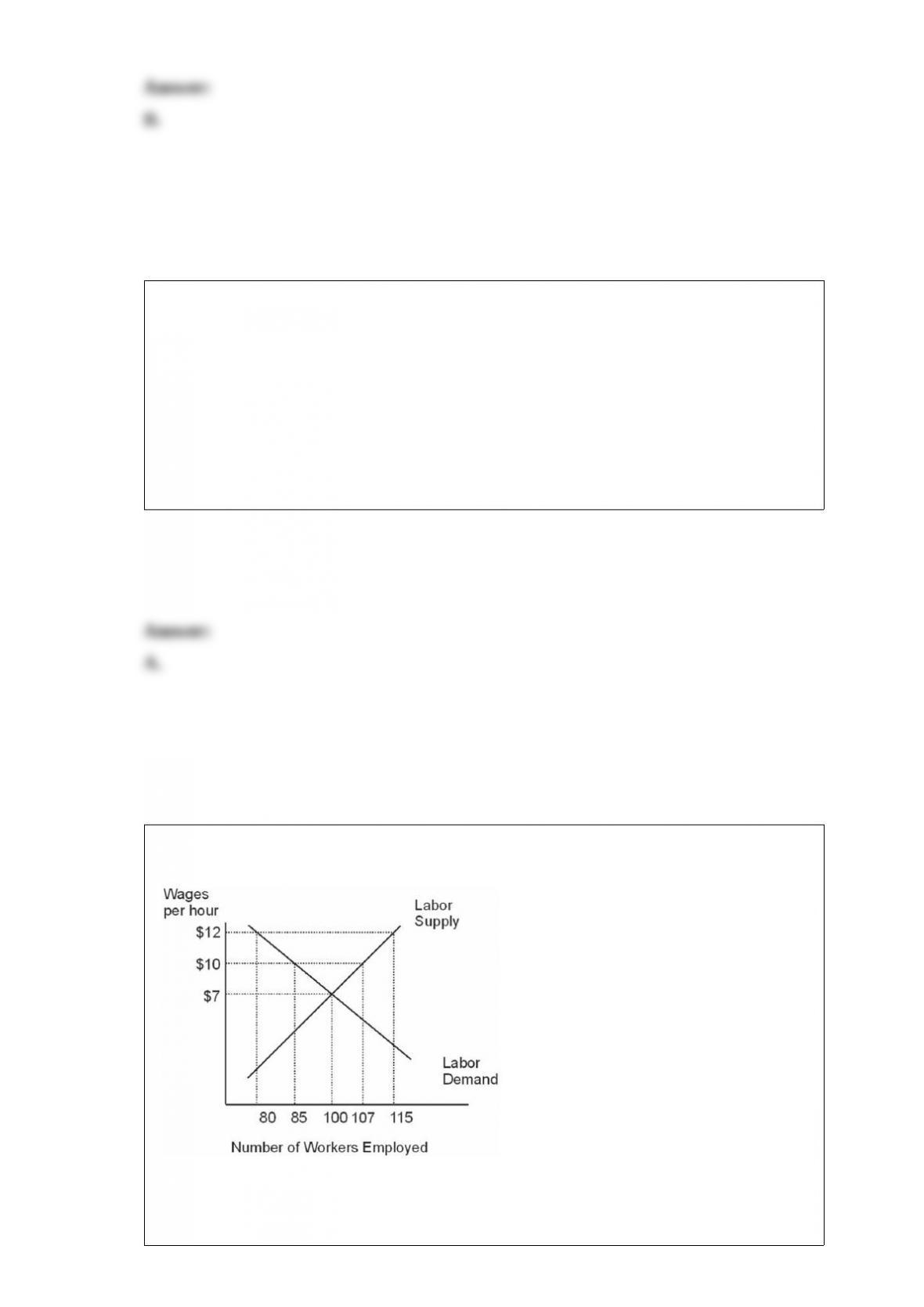
Based on the labor market diagram above, if the minimum wage is increased from $10
to $12 per hour, the numbered of unemployed workers will increase by ______

workers.
A. 5
B. 8
C. 13
D. 15
If Scout has an absolute advantage over Dill:
A. Scout has more money than Dill.
B. the problem of scarcity applies to Dill, but not to Scout.
C. the problem of scarcity applies to Scout, but not to Dill.
D. Scout can accomplish more in a given period of time than can Dill.
Structural unemployment will decrease when:
A. the minimum wage is increased.
B. the minimum wage is decreased.
C. unemployment insurance benefits are increased.

D. union wages are increased.
Curly just graduated from State U and has three job offers: teaching at a prestigious
private high school nine months a year with summers off, working forty hours a week at
a bank in a small city, and working more than sixty hours a week for a high-powered
investment firm on Wall Street (in New York City).
Suppose all of the jobs paid exactly the same annual salary, and that most people prefer
leisure to work, all else equal. If that were the case,
A. there would be a shortage of high school teachers.
B. there would be a surplus of Wall Street investment advisors.
C. there would be a surplus of high school teachers.
D. people would naturally sort themselves into the job that best suits their talents.
If the Boskin Commission’s conclusion that the CPI ______ the “true” inflation rate is
correct, then indexing Social Security benefits to the CPI is ______ the federal
government billions of dollars.
A. understates; costing
B. overstates; costing
C. understates; saving

D. measures; saving
The demand for a good is elastic with respect to price if the price elasticity of demand
is:
A. equal to one.
B. greater than one.
C. less than one.
D. equal to zero.
Suppose a market is in equilibrium. The area between the demand curve and the market
price is:
A. the total economic surplus.
B. producer surplus.
C. consumer surplus.

D. the surplus loss.
In the short-run, if the Federal Reserve increases interest rates, then consumption and
investment ______, planned aggregate expenditure ______, and short-run equilibrium
output _______.
A. increase; increases; increases
B. increase; increases decreases
C. increase; decreases; decreases
D. decrease; decreases; decreases
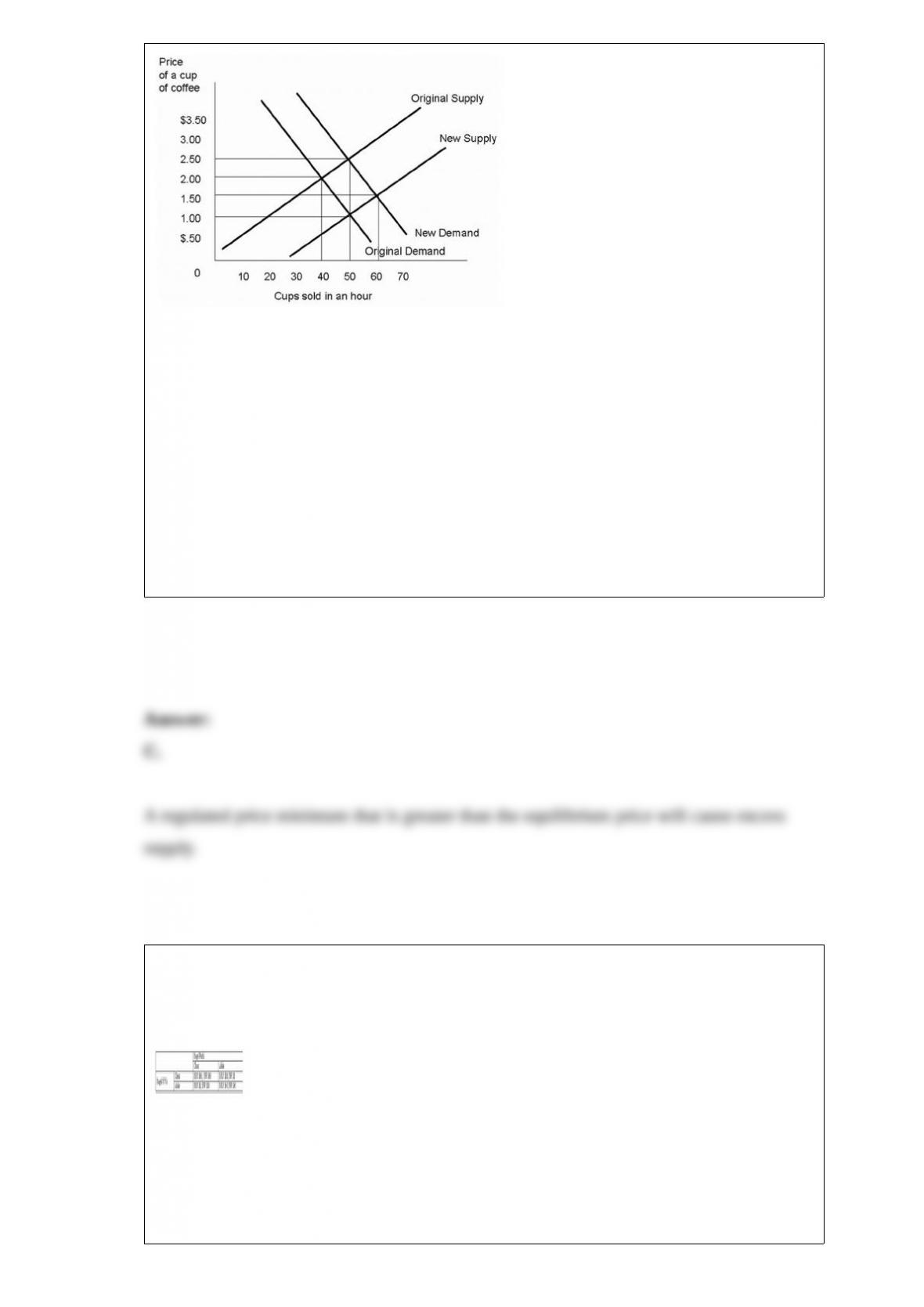
Refer to the figure above. Suppose the coffee lobby convinced the legislature to impose
a price control requiring that coffee prices must be at least $2.50, and that the original
demand curve and original supply curve were applicable. The most likely result would
be:
A. a short term excess demand for coffee, followed by an increase in price.
B. excess demand for coffee that would not correct itself because price is set by law.
C. excess supply of coffee that would not correct itself because price is set by law.
D. new equilibrium at a price of $2.50 and a quantity of 50 cups.
The market for bagels contains two firms: BagelWorld (BW) and Bagels’R’Us (BRU).
The owners of the two firms decide to fix the price of bagels. The table shows the total
profits the firms will earn if they abide by the price setting agreement or if they cheat on
the agreement.
Refer to the figure above. Suppose a new element was introduced into the agreement: if
one firm cheats today, the other firm will cheat tomorrow, but if one firm abides today,
the other will abide tomorrow. This strategy pattern is known as:
A. the prisoner’s dilemma.

B. cartel-like behavior.
C. tit-for-tat.
D. mutual cooperation.
Hotelling’s model has been used to describe differentiation in the political “market”.
Suppose that 100 voters are evenly arrayed between the extreme left and the extreme
right on the political spectrum, and that all voters vote, and they always vote for the
candidate closest to them on this spectrum. The numbers on this spectrum represent the
number of voters lying to the left of the number. So, at the midpoint, fifty voters lie to
the left and fifty to the right. At the extreme right end, all 100 voters lie to the left.
Refer to the information given above. To an economic naturalist, this model would help
to explain why political candidates:
A. take more extreme positions than are held by the general population.
B. move toward more centrist positions during a campaign season.
C. work to bring federally funded projects to their home districts.
D. are loyal to their political parties.

In an open economy with a given level of real interest rates and risk, an increase in real
interest rates abroad will ______ capital inflows and ______ the equilibrium domestic
real interest rate.
A. increase; increase
B. increase; decrease
C. decrease; decrease
D. decrease; increase
In the United States the real wages of the least-skilled, least educated workers have
______ and the wages of best-educated, highest skilled workers have ______.
A. increased; increased
B. declined; increased
C. increased; declined
D. declined; remained constant
The current U.S. income tax system requires taxpayers to pay a higher marginal tax rate
on higher levels of taxable income. Suppose that the tax rate is 10% on the first $15,000
of taxable income, 15% on the next $45,000 of taxable income, 30% on the next
$60,000 of taxable income, and 35% on taxable income above $120,000.
An income tax system like the one described is
A. progressive.
B. regressive.
C. proportional.
D. progressive when income is low, then regressive.
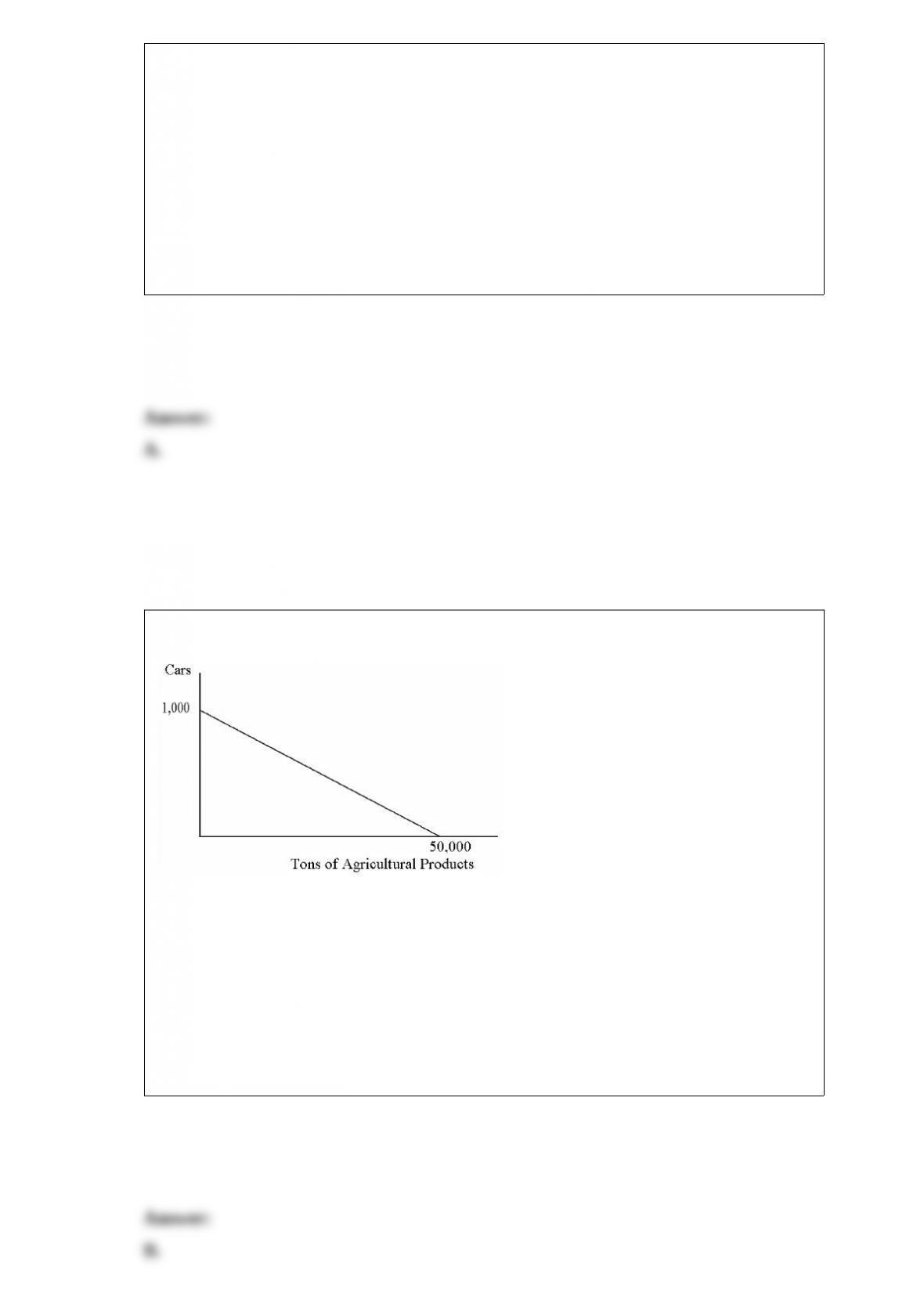
This graph describes the production possibilities on the island of Genovia:
Assuming efficient production, If 500 cars are produced in Genovia:
A. 50,000 tons of agricultural products are also being produced.
B. 25,000 tons of agricultural products are also being produced.
C. 45,000 tons of agricultural products are also being produced.
D. 40,000 tons of agricultural products are also being produced.

When a baker exchanges a pie for dollars, this is an example of dollars serving as:
A. barter.
B. a medium of exchange.
C. a unit of account.
D. a store of value.
Suppose that there are just two firms in a small market.
Acme Manufacturing’s Total Costs equal $100 + $3 × Quantity.
Generic Industries’ Total Costs equal $500 + $3 × Quantity.
Refer to the information given above. Suppose that Acme and Generic face the same
demand function, that they are both pursuing a profit-maximization policy, and that
both companies are earning positive economic profits at that quantity. Which statement
is true?
A. Acme will produce more output than Generic.
B. Generic will produce more output than Acme.
C. Acme and Generic will produce the same quantity and will have the same profits.
D. Acme and Generic will produce the same quantity, but Acme will have higher
profits.

If you wish to maintain a constant purchasing power when you retire, you should
choose retirement income options that are:
A. deflated.
B. nominal.
C. indexed.
D. inflated.
Prior to January 2000, the demand for money increased as people anticipated Y2K
problems. To offset this increase in money demand, the Fed would have had to ______
the money supply, which would have put ______ pressure on nominal interest rates.
A. increase; downward
B. increase; upward
C. decrease; downward
D. decrease; upward

The measure of the cost of a standard basket of goods and services in any period
relative to the cost of the same basket of goods and services in the base year is called
the:
A. cost-of-living indicator.
B. consumption production index.
C. consumer production index.
D. consumer price index.
The political concern expressed about the North American Free Trade Agreement
(NAFTA) was that:
A. prices to U.S. consumers would fall.
B. wages in Mexico would rise.
C. highly skilled workers in the United States would lose their jobs.
D. unskilled workers in the United States would lose their jobs.
In the basic Keynesian model, a decrease in government purchases:
A. reduces short-run equilibrium output.
B. increases short-run equilibrium output.
C. reduces potential output.
D. increases potential output.
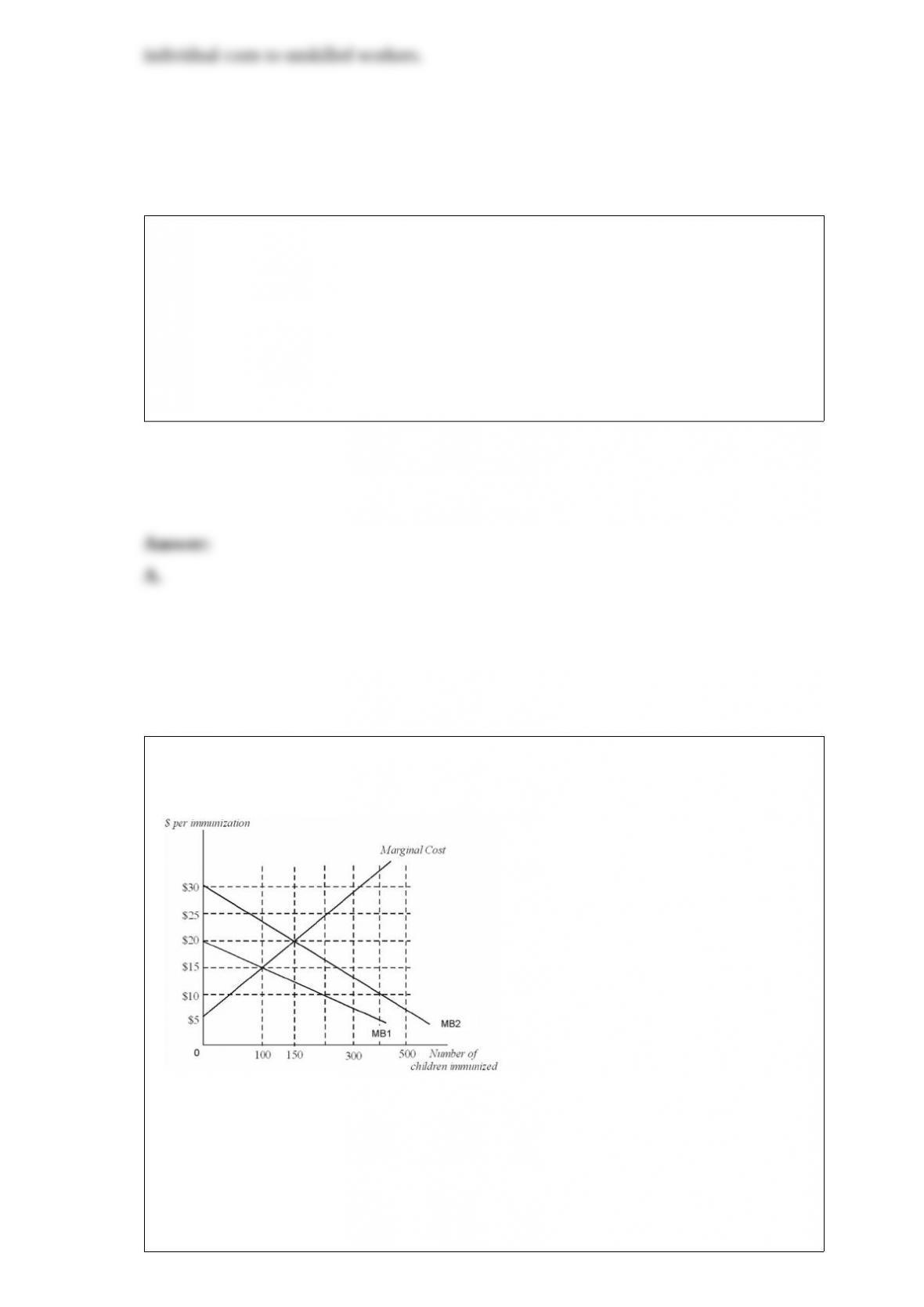
This graph illustrates the marginal cost, marginal private benefit, and marginal social
benefit of immunization against a contagious childhood disease.
In this graph MB1 measures ___ and MB2 measures ____
A. efficient demand; subsidized demand
B. social demand; private demand
C. private demand; social demand

D. risky demand; riskless demand
Real GDP is not a perfect measure of economic well being because it excludes the value
of all of the following EXCEPT:
A. leisure time.
B. goods and services available in the market economy.
C. nonmarket economic activity.
D. goods and services produced in the underground economy.
Factories and machines are examples of:
A. consumption goods.
B. non-market goods.
C. value-added goods.
D. capital goods.

When the nominal exchange changes from 120 yen per dollar to 110 yen per dollar, the
dollar has:
A. appreciated.
B. depreciated.
C. become overvalued.
D. become undervalued.
Refer to the figure above. Player A can infer that Player B will:
A. always choose the Left strategy.
B. always choose the Right strategy.
C. choose Left when A chooses Up and choose Right when A chooses Down.
D. Player A cannot infer anything about what Player B will do given this matrix.

If an individual producer is willing to produce one unit of a good for $2.50 but finds he
can sell it for $7.50, he has a producer surplus of:
A. $10.00.
B. $7.50.
C. $5.00.
D. $6.25.
Refer to the figure above. Player B can infer that Player A will:
A. always choose the Down strategy.
B. always choose the Up strategy.
C. choose Down when B chooses Left and choose Up when B chooses Right.
D. choose Up when B chooses Left and Down when B chooses Right.