
Imports are goods and services bought domestically but produced in other countries.
Policies based on positive economic ideas tend to decrease economic efficiency and
reduce equity.
The incidence of a tax depends on whether the government collects the tax from buyers
or sellers.
The overall mortality rate in the United States has declined for the past 30 years.

The minimum wage is an example of a price ceiling.
When diminishing marginal utility sets in, total utility must be negative.
At a long-run macroeconomic equilibrium, real GDP is always equal to potential GDP.
Ceteris paribus, a decrease in the government’s budget deficit will increase domestic
investment and net foreign investment.
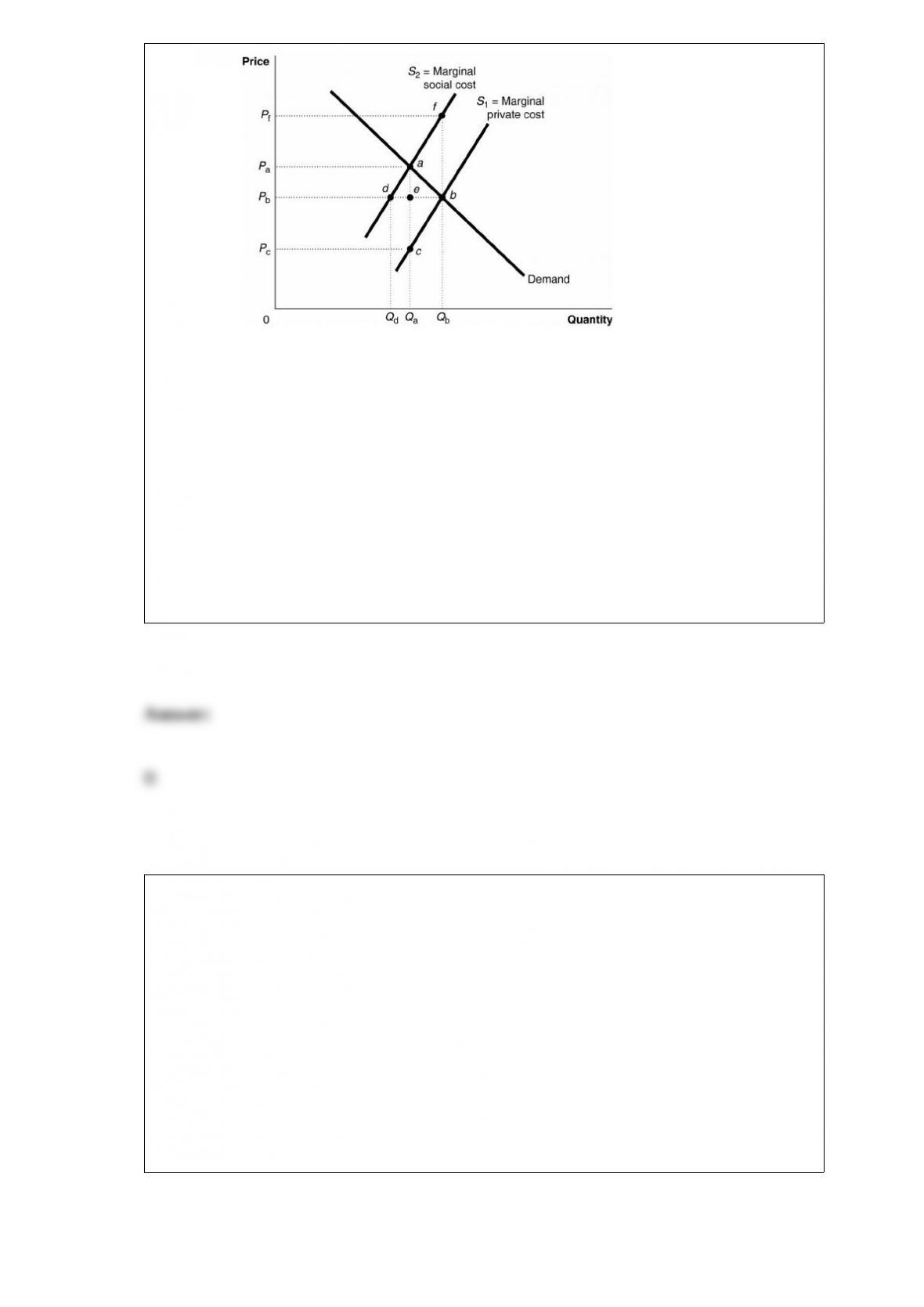
Figure 5-2 Figure 5-2 shows a
market with a negative externality.
The size of marginal external costs can be determined by
A) S2+ S1at each output level.
B) S2– S1at each output level.
C) the supply curve S2.
D) the supply curve S1.
The substitution effect of a price change refers to
A) the change in quantity demanded that results from a change in price making a good
more or less expensive relative to other goods that are substitutes.
B) the shift of a demand curve when the price of a substitute good changes.
C) the movement along the demand curve due to a change in purchasing power brought
about by the price change.
D) the shift in the demand curve due to a change in purchasing power brought about by
the price change.

Which of the following characteristics iscommon to monopolistic competition and
perfect competition?
A) Firms produce identical products.
B) Entry barriers into the industry are low.
C) Each firm faces a downward-sloping demand curve.
D) Firms take market prices as given.
Most employees ________ on the value of health insurance provided by employers, and
most people ________ when buying individual health insurance policies.
A) pay taxes; get a tax break
B) pay taxes; do not get a tax break
C) do not pay taxes; get a tax break
D) do not pay taxes ; do not get a tax break

In each of the following situations, list what will happen to the equilibrium price and
the equilibrium quantity for a particular product, which is a normal good. a. The
population increases and the price of inputs increase
b. The price of a complement increases and technology advances
c. The number of firms in the market increases and income increases
d. Price is expected to increase in the future
e. Consumer preference increases and the price of a substitute in production decreases
Labor productivity is
A) the quantity of output produced in one hour by several workers.
B) the quantity of capital one worker can produce in one day.
C) the quantity of output produced by one worker or by one hour of work.
D) the quantity of output produced in one hour by one machine.
A decrease in ________ can put your job at risk if aggregate expenditures fall.
A) consumer confidence
B) the natural rate of unemployment
C) the inflation rate
D) the length of a business cycle
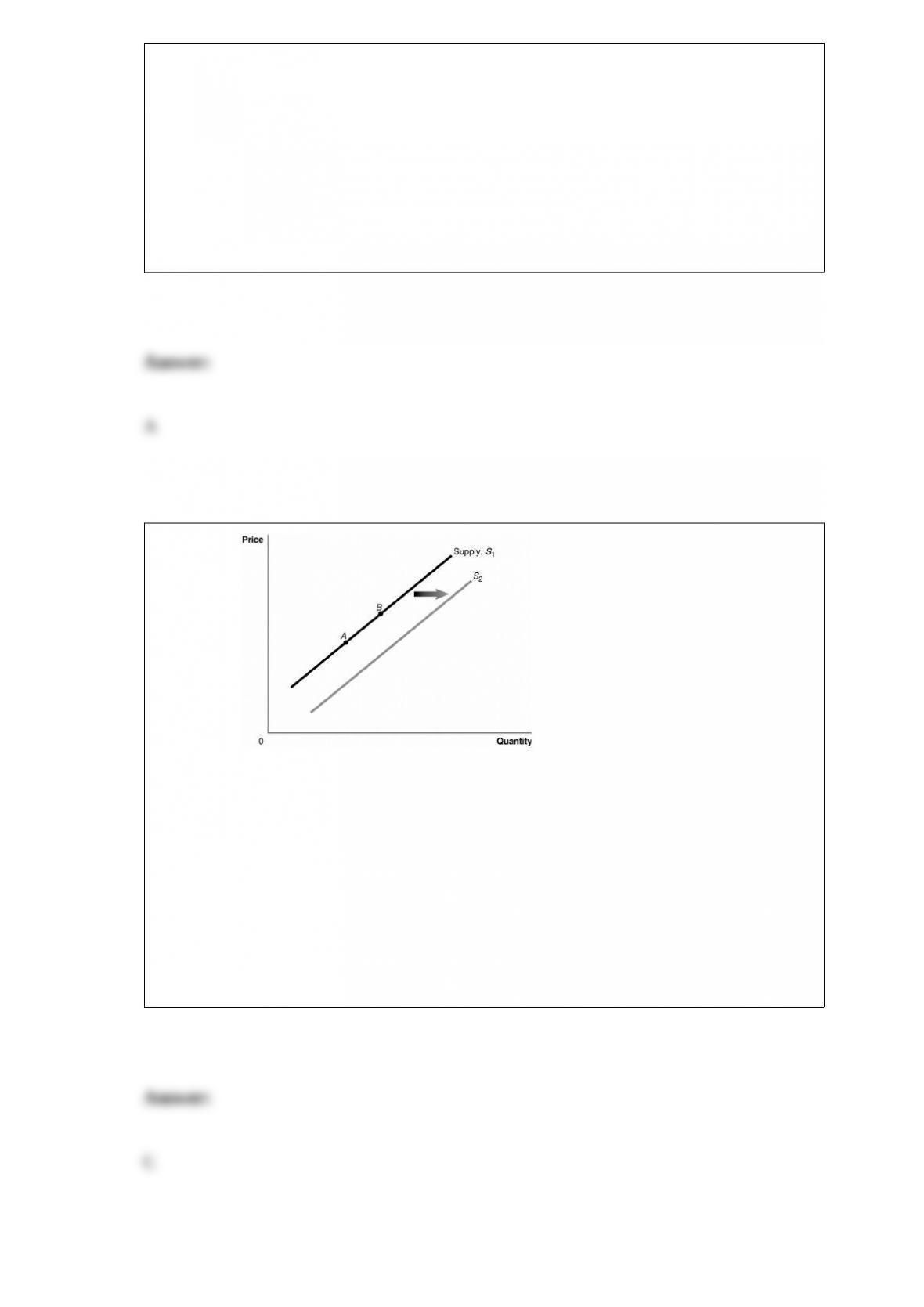
Figure 3-2
A technological advancement would be represented by a movement from
A) A to B.
B) B to A.
C) S1 to S2.
D) S2 to S1.

The recession of 2007-2009 would most likely be represented in a production
possibilities frontier graph by
A) a point inside the frontier.
B) a point outside the frontier.
C) a point on the frontier.
D) an intercept on either the vertical or the horizontal axis.
Wage differentials between occupations can be explained by all of the following except
A) the fact that some occupations require higher levels of human capital than others.
B) the fact that some occupations are more desirable than others.
C) the market power of different employers.
D) the relative differences between demand and supply in various occupations.
Minimum wage laws cause unemployment because the legal minimum wage is set
A) below the market wage, causing labor demand to be greater than labor supply.
B) below the market wage, causing labor demand to be less than labor supply.
C) above the market wage, causing labor demand to be greater than labor supply.
D) above the market wage, causing labor demand to be less than labor supply.

E) too low.
In the United States, the average person mostly patronizes firms that operate in
A) perfectly competitive markets.
B) monopolistically competitive markets.
C) oligopoly markets.
D) monopoly markets.
Collusion
A) is rampant in perfect competition as all firms charge the same price.
B) reduces market concentration in an industry.
C) among firms is difficult to maintain because it eliminates long run economic profit.
D) is more difficult when there are many firms producing differentiated products in an
industry.

Suppose a developing country experiences a reduction in machinery and capital
equipment as foreign entrepreneurs decrease the amount of investment in the economy.
As a result,
A) the long-run aggregate supply curve will shift to the right.
B) the long-run aggregate supply curve will shift to the left.
C) the economy will move up along the long-run aggregate supply curve.
D) the economy will move down along the long-run aggregate supply curve.
How are sunk costs and fixed costs related?
A) They are not related in any way.
B) Sunk costs cannot be recovered and fixed costs can be avoided by shutting down.
C) In the short run they are equal to each other.
D) In the long run they are equal to each other.
Suppose a competitive firm is paying a wage of $12 an hour and sells its product at $3
per unit. Assume that labor is the only input. If the last worker hired increases output by
three units per hour, then to maximize profits the firm should
A) not change the number of workers it currently hires.

B) lay off some of its workers.
C) hire additional workers.
D) There is not enough information to answer the question.
What are the four categories of aggregate expenditure?
Even though it is generally true that the more goods and services people have, the better
off they are, GDP provides only a rough measure of well-being. Assuming language is
not an issue, what other factors besides GDP might you consider when deciding where
to live and work?

Suppose that the required reserve ratio is 10 percent and you withdraw $25,000 from
Comerica Bank. What is the deposit multiplier? What is the total decrease in deposits in
the banking system? What is the change in the money supply?
What is the difference between explicit collusion and implicit collusion?
Why are there superstar baseball players but no superstar chiropractors?

Explain whether it is possible for a country to have a comparative advantage in the
production of a product without having an absolute advantage in the production of that
product.