1)
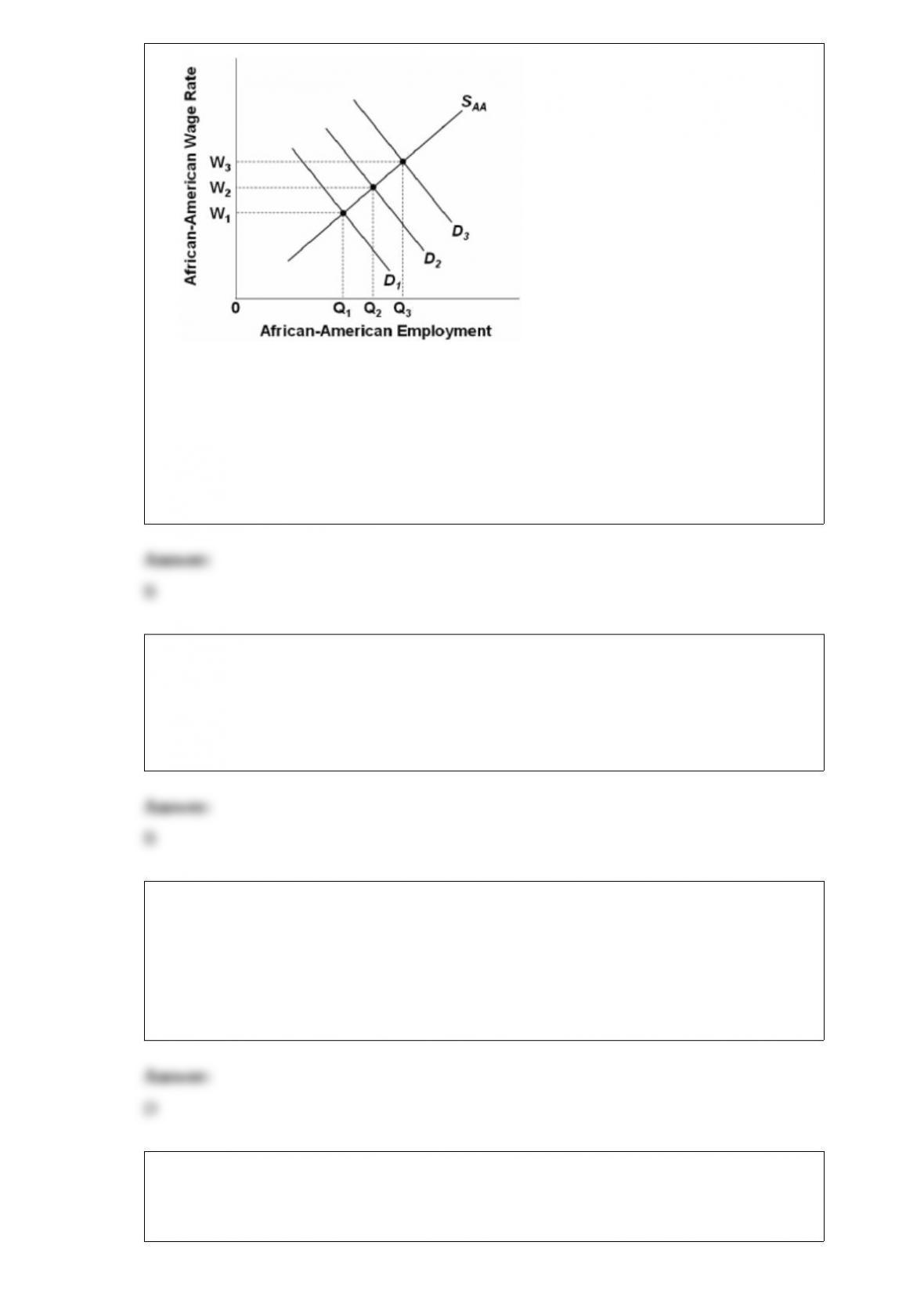
Refer to the above diagram. Which of the following would be consistent with a
decrease in racial prejudice against African-Americans and thus in the discrimination
coefficients of employers, taken as a group?
A.a shift in the labor demand curve from D3 to D2.
B.an increase in the African-American wage rate from W1 to W2.
C.a reduction in African-American employment from Q3 to Q2.
D.a decrease in the African-American wage rate from W2 to W1.
2) Economic rent is:
A.nonexistent in a static, purely competitive economy.
B.the price paid for a resource that has a perfectly inelastic supply.
C.the price paid for a resource that has a perfectly elastic supply.
D.equal to the pure rate of interest if all markets are competitive.
3) Which of the following groups is most likely to support the World Trade
Organization (WTO)?
A.anarchists.
B.extreme environmentalists.
C.labor union leaders in industrially advanced countries.
D.economists.
4) the basic tax rate on taxable corporate income is:
a.15 percent.
b.22 percent.

c.35 percent.
d.52 percent.
5) The following information for the Moolah Bank.
Assume that the listed amounts constitute this bank’s complete set of accounts.
Moolah’s:
A.assets are $1000.
B.liabilities are $300.
C.net worth is $100.
D.annual profit is $200.
6) the vertical distance between a firm’s atc and avc curves represents:
a.afc, which increases as output increases.
b.afc, which decreases as output increases.
c.marginal costs, which decrease as output decreases.
d.marginal costs, which increase as output increases.

7)
refer to the above diagram. if society is currently producing 9 units of bicycles and 4
units of computers and it now decides to increase computer output to 6, the cost:
a.will be 4 units of bicycles.
b.will be 2 units of bicycles.
c.will be zero because unemployed resources are available.
d.of doing so cannot be determined from the information given.
8) Suppose you have a $2000 bond that makes an annual interest payment of $75. Use
this information to answer the following questions.
(a)Suppose the current interest rate is 6%. What would be the market price of the bond?
(b)Suppose the current interest rate fell to 3.75%. What would be the market price of
the bond?
(c)Suppose the current interest rate fell even further to 2%. What would be the market
price of the bond?
9) which of the following statements is correct?
a.the pure monopolist will maximize profit by producing at that point on the demand
curve where elasticity is zero.
b.in seeking the profit-maximizing output the pure monopolist underallocates resources
to its production.
c.the pure monopolist maximizes profits by producing that output at which the
differential between price and average cost is the greatest.
d.purely monopolistic sellers earn only normal profits in the long run.
10)
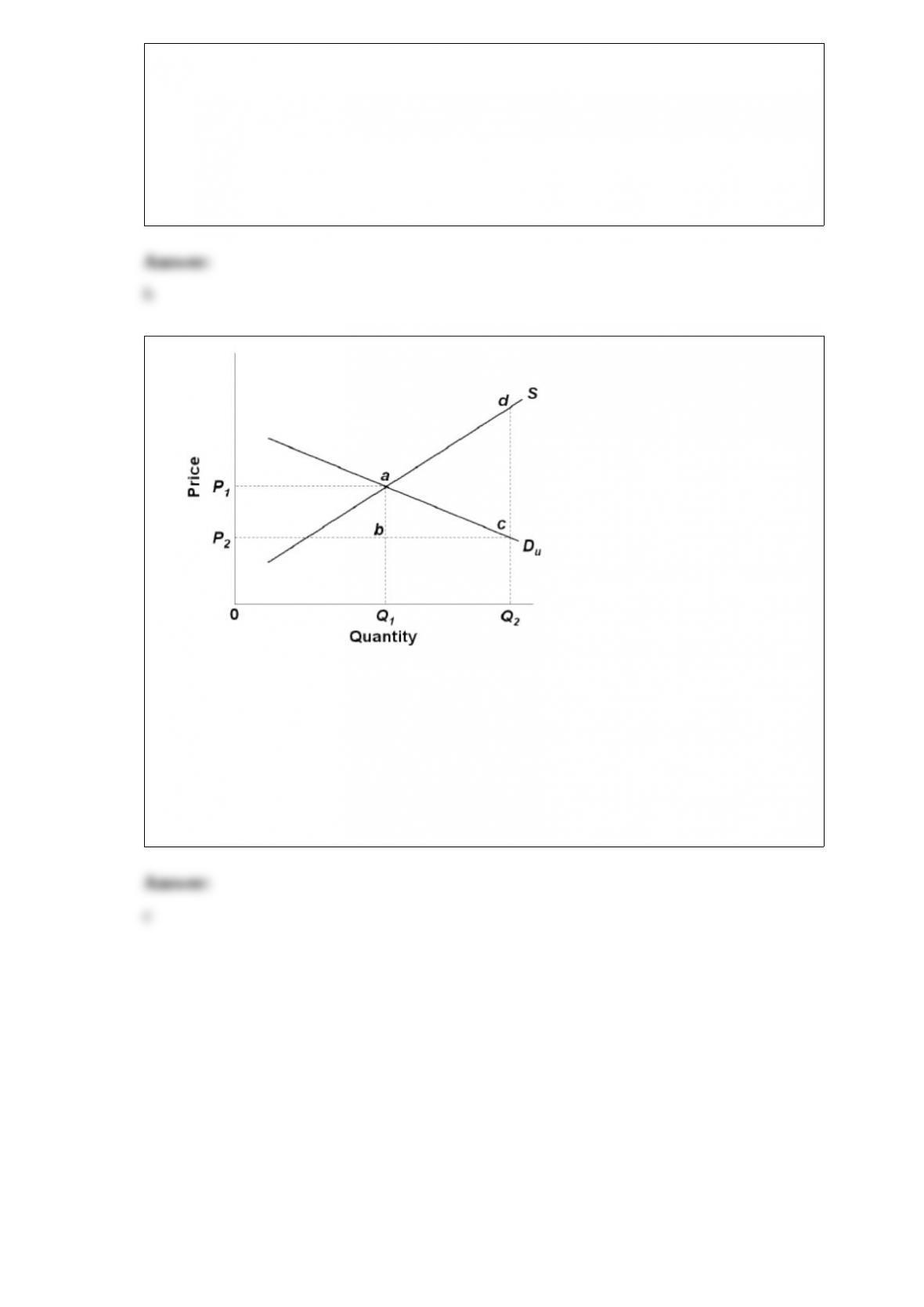
refer to the above demand and supply diagram that relates to the health care market. if
suppliers provide the quantity of health care demanded and insurance pays one-half of
the equilibrium price of the health care good or service depicted above, the immediate
price to the consumer and the quantity of health care consumed would be:
a.p1 and q1.
b.p1 and q2.
c.p2 and q2.
d.p2 and q1.
11)
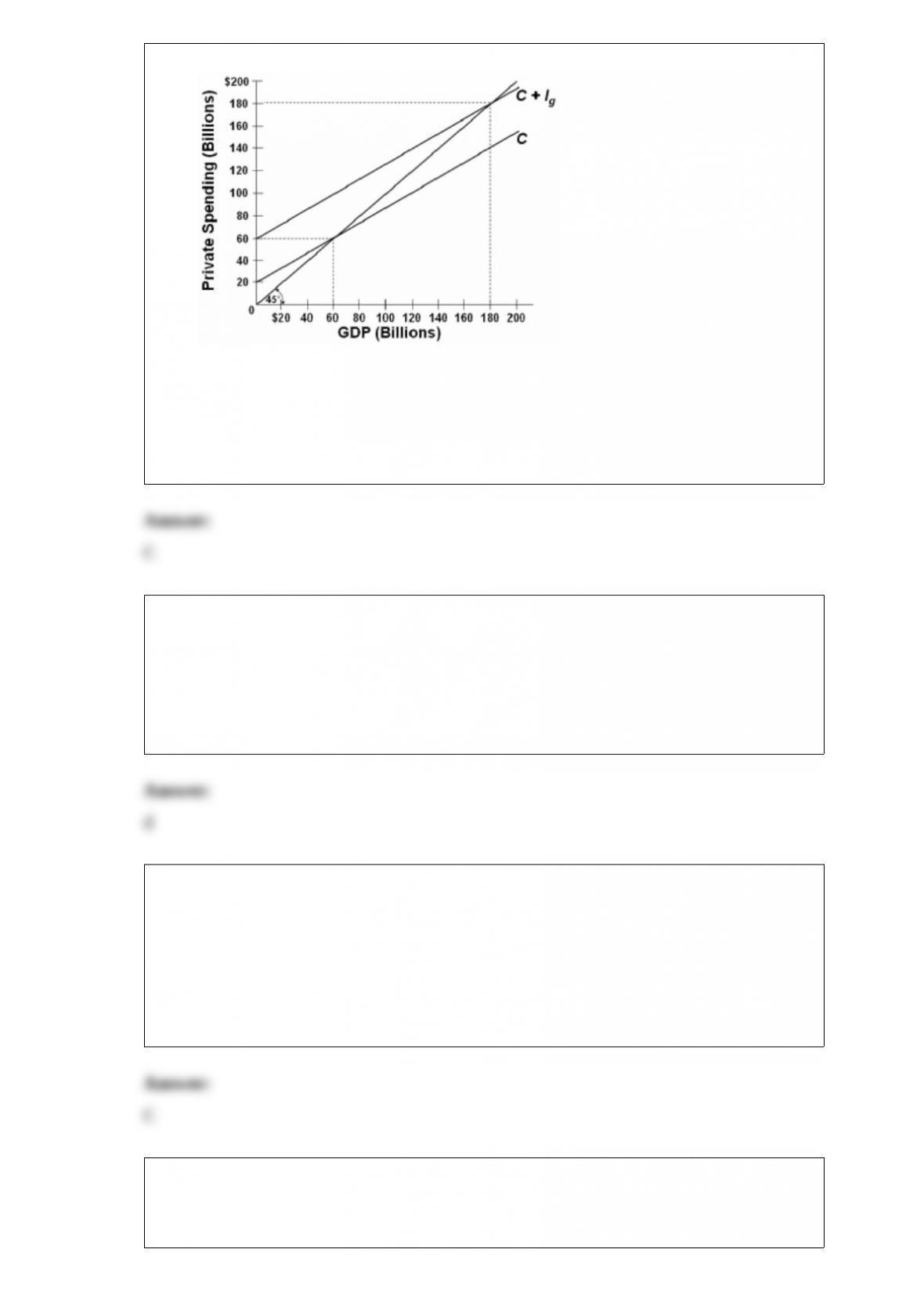
Refer to the above diagram for a private closed economy. In this economy investment:
A.decreases as GDP increases.
B.increases as GDP increases.
C.is $40 billion at all levels of GDP.
D.is $60 billion at all levels of GDP.
12) over time, the equilibrium price of a gigabyte of computer memory has fallen while
the equilibrium quantity purchased has increased. based on this we can conclude that:
a.decreases in the demand for computer memory have exceeded increases in supply.
b.decreases in the supply of computer memory have exceeded increases in demand.
c.increases in the demand for computer memory have exceeded increases in supply.
d.increases in the supply of computer memory have exceeded increases in demand.
13) Economic discrimination puts the economy inside its production possibilities curve
because discrimination:
A.redistributes income from low-paid to high-paid persons.
B.promotes present consumption rather than production of capital goods.
C.arbitrarily blocks women and certain minorities from higher-productivity, higher
wage jobs and thus keeps the economy from producing its maximum output.
D.often causes inflation, which reduces the nation’s real output.
14) a nondiscriminating pure monopolist finds that it can sell its fiftieth unit of output
for $50. we can surmise that the marginal:
a.cost of the fiftieth unit is also $50.
b.revenue of the fiftieth unit is also $50.
c.revenue of the fiftieth unit is less than $50.
d.revenue of the fiftieth unit is greater than $50.
15) If the amount of money in circulation is $180 billion and the value of the economy’s
total output is $540 billion, then the:
A.circulation period of money must be one-fourth of a year.
B.velocity of money is 4
C.average price per final good sold is $3.
D.velocity of money is 3
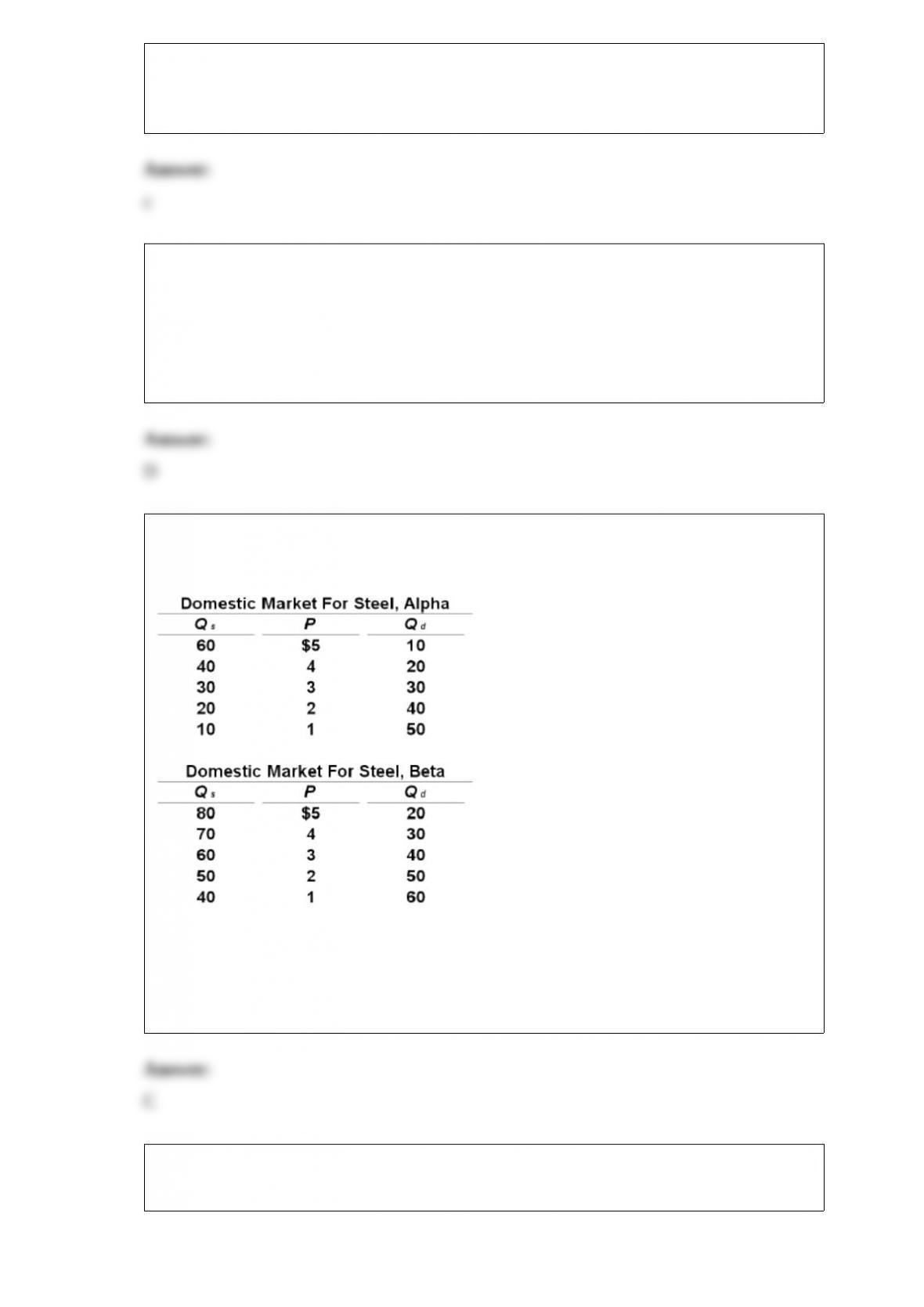
16) The following data for the hypothetical nations of Alpha and Beta. Qs is domestic
quantity supplied and Qd is domestic quantity demanded.
Refer to the above data. The equilibrium world price of steel must be between:
A.$5 and $4.
B.$4 and $3.
C.$3 and $2.
D.$2 and $1.
17) Assume that the firm is hiring labor in a purely competitive market.
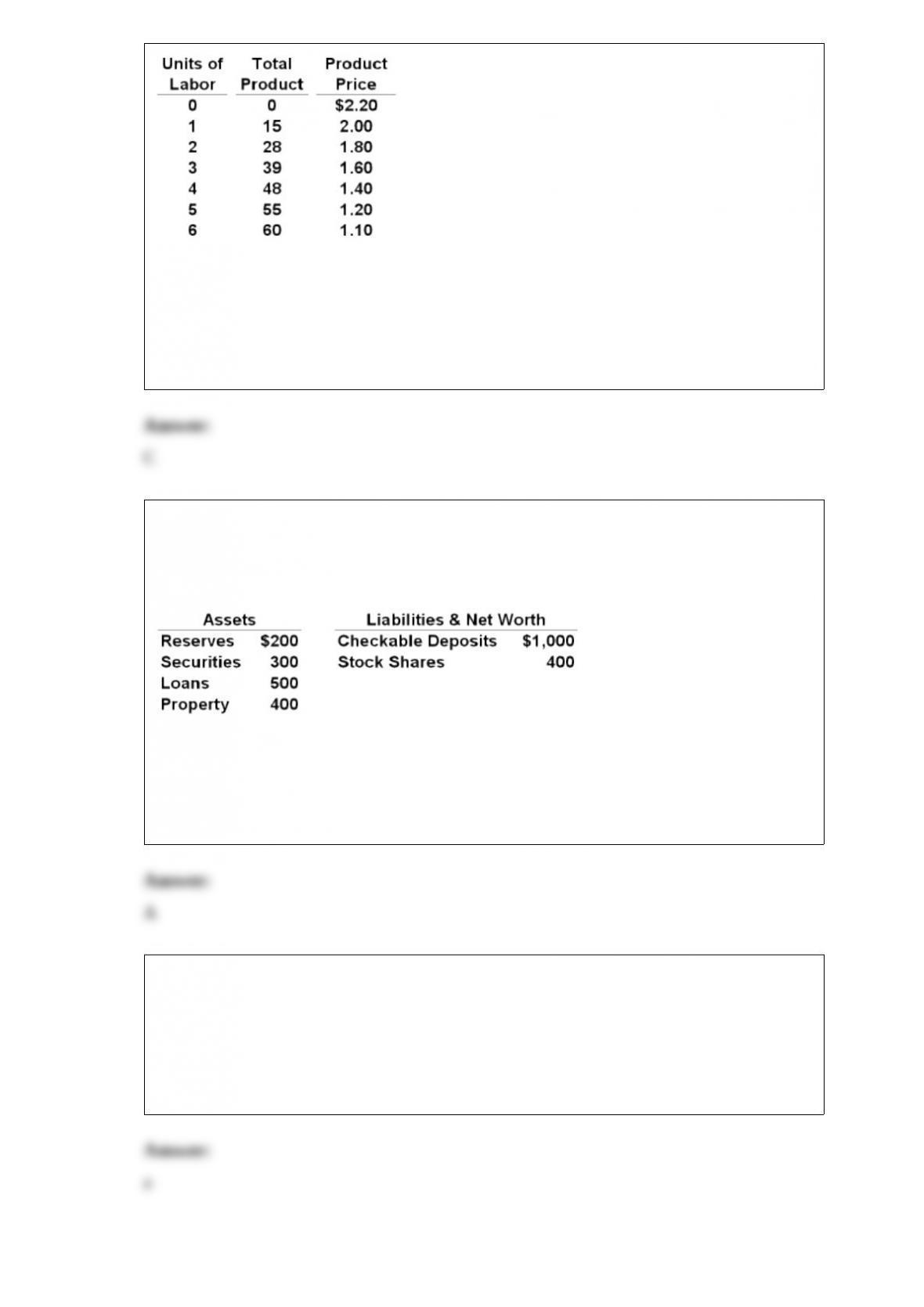
Refer to the above data. If the wage rate is $11, how many workers will the firm choose
to employ?
A.5
B.4
C.3
D.2
18) The following consolidated balance sheet of the commercial banking system.
Assume that the reserve requirement is 20 percent. All figures are in billions and each
question should be answered independently of changes specified in all preceding ones.
Refer to the above data. The monetary multiplier for the commercial banking system is:
A.5.
B.10.
C.15.
D.20.
19) if a regulatory commission forces a natural monopoly to charge a price equal to its
marginal cost:
a.the monopoly may incur a loss.
b.resource allocation will be worsened.
c.output will decrease.
d.the firm will earn only a normal profit.