
1) Consumer surplus is
a.a concept that helps us make normative statements about the desirability of market
outcomes.
b.represented on a graph by the area below the demand curve and above the price.
c.a good measure of economic welfare if buyers’ preferences are the primary concern.
d.All of the above are correct.
2) Public schools, which educate most students through high school, are paid for
primarily by
a.state governments.
b.local governments.
c.the federal government.
d.taxpayers directly.
3) James earns a degree from a top university and is hired by a prominent firm because
executives at the firm believe that graduates of this university must have a high ability
level or they would not have graduated. Which of the following theories of education
do the executives believe?
a.signaling theory
b.human-capital theory
c.compensating-differentials theory
d.All of the above are correct.
4) Which of the following is likely to have the most price inelastic demand?
a.yoga mats
b.prescription medicine
c.protein powder
d.gym memberships
5) As more people become self-employed, which allows them to determine how many
hours they work per week, we would expect the deadweight loss from the Social
Security tax to
a.increase, and the revenue generated from the tax to increase.
b.increase, and the revenue generated from the tax to decrease.
c.decrease, and the revenue generated from the tax to increase.
d.decrease, and the revenue generated from the tax to decrease.
6) The goal of the consumer is to
a.maximize utility.
b.be on the highest indifference curve.
c.maximize satisfaction.
d.All of the above are the goals of the consumer.
7) Which of the following is not correct?
a.Critics argue that minimum-wage laws hurt the very people they are intended to help.
b.Minimum-wage laws may increase unemployment among the groups of workers
affected by the minimum wage.
c.If the demand for unskilled labor is relatively inelastic, the higher wage will produce
more unemployment than if the demand for unskilled labor is relatively elastic.
d.Minimum-wage laws may benefit teenagers from middle-class families, so the policy
is not a precise way to help the poor.
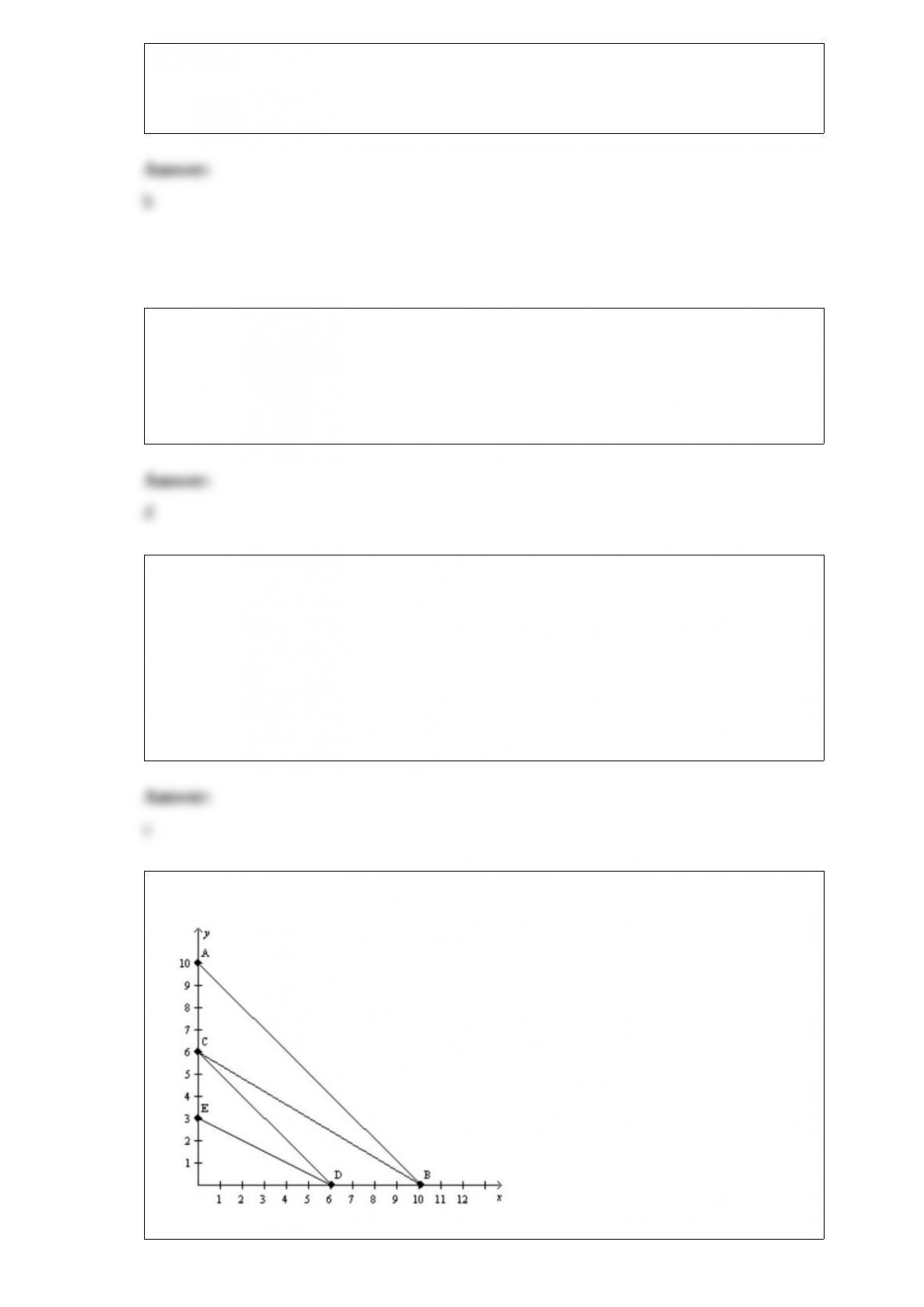
8) Figure 21-8

Refer to Figure 21-8. You have $300 to spend on good X and good Y. If good X costs
$30 and good Y costs $50, your budget constraint is
a.AB.
b.BC.
c.CD.
d.DE.
9) When labor supply increases,
a.the marginal productivity of workers always increases.
b.profit-maximizing firms reduce employment.
c.wages increase as long as labor supply is upward sloping.
d.wages decrease as long as labor demand is downward sloping.
10) Raising the welfare of the worst-off person in society is an important goal of which
political philosophy?
a.utilitarianism
b.liberalism
c.libertarianism
d.secularism
11) The median voter
a.is the voter exactly in the middle of the distribution.
b.is the voter whose preferred outcome beats any other proposal in a two-way race.
c.always has more than half the votes on his side in a two-way race.
d.All of the above are correct.
12) A firm in a monopolistically competitive market is similar to a monopoly in the
sense that
(i)they both face downward-sloping demand curves.
(ii)they both charge a price that exceeds marginal cost.
(iii)free entry and exit determines the long-run equilibrium.

a.(i) only
b.(ii) only
c.(i) and (ii) only
d.(i), (ii), and (iii) only
13) Maddy purchases 2 pounds of beans and 3 pounds of rice per month when the price
of beans is $2 per pound. She purchases 1 pounds of beans and 4 pounds of rice per
month when the price of beans is $3 per pound. Maddy’s for beans and rice is
a.0.71, and they are substitutes.
b.-0.71, and they are complements.
c.1.4, and they are substitutes.
d.-1.4, and they are complements.
14) The nation of Farmland forbids international trade. In Farmland, you can exchange
1 pound of beef for 2 pounds of pepper. In other countries, you can exchange 1 pound
of beef for 4 pounds of pepper. These facts indicate that
a.Farmland has a comparative advantage, relative to other countries, in producing beef.
b.other countries have an absolute advantage, relative to Farmland, in producing beef.
c.the price of beef in Farmland exceeds the world price of beef.
d.if Farmland were to allow trade, it would export pepper.
15) Factors of production are
a.used to produce goods and services.
b.also called output.
c.abundant in most economies.
d.assumed to be owned by firms in the circular-flow diagram.
16) Scenario 8-2
Roland mows Karla’s lawn for $25. Roland’s opportunity cost of mowing Karla’s lawn
is $20, and Karla’s willingness to pay Roland to mow her lawn is $28.
If Karla hires Roland to mow her lawn, Roland’s producer surplus is
a.$2.
b.$3.
c.$5.
d.$25.
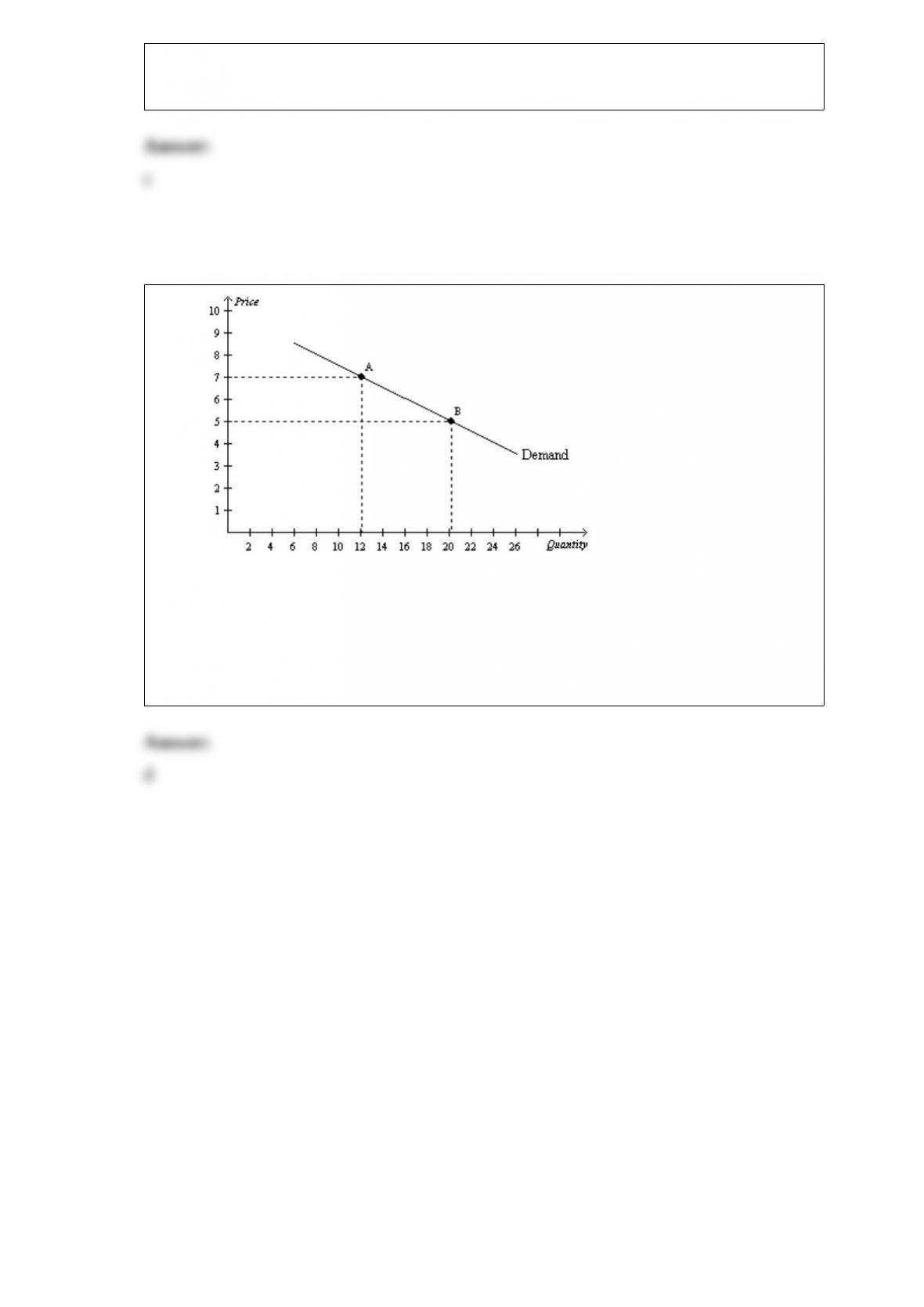
17)
Between point A and point B on the graph, demand is
a.perfectly elastic.
b.inelastic.
c.unit elastic.
d.elastic, but not perfectly elastic.