
Which of the following directly (as opposed to indirectly) raises the price of agricultural
products?
a. marketing quota system
b. acreage allotment program
c. paying farmers not to produce
d. price supports
e. all of the above
Third-degree price discrimination is sometimes called discrimination among buyers.
a. True
b. False
Refer to Exhibit 23-1. The dollar amounts that go in blanks (C) and (D) are,
respectively,
Exhibit 23-1 (1) (2) (3)
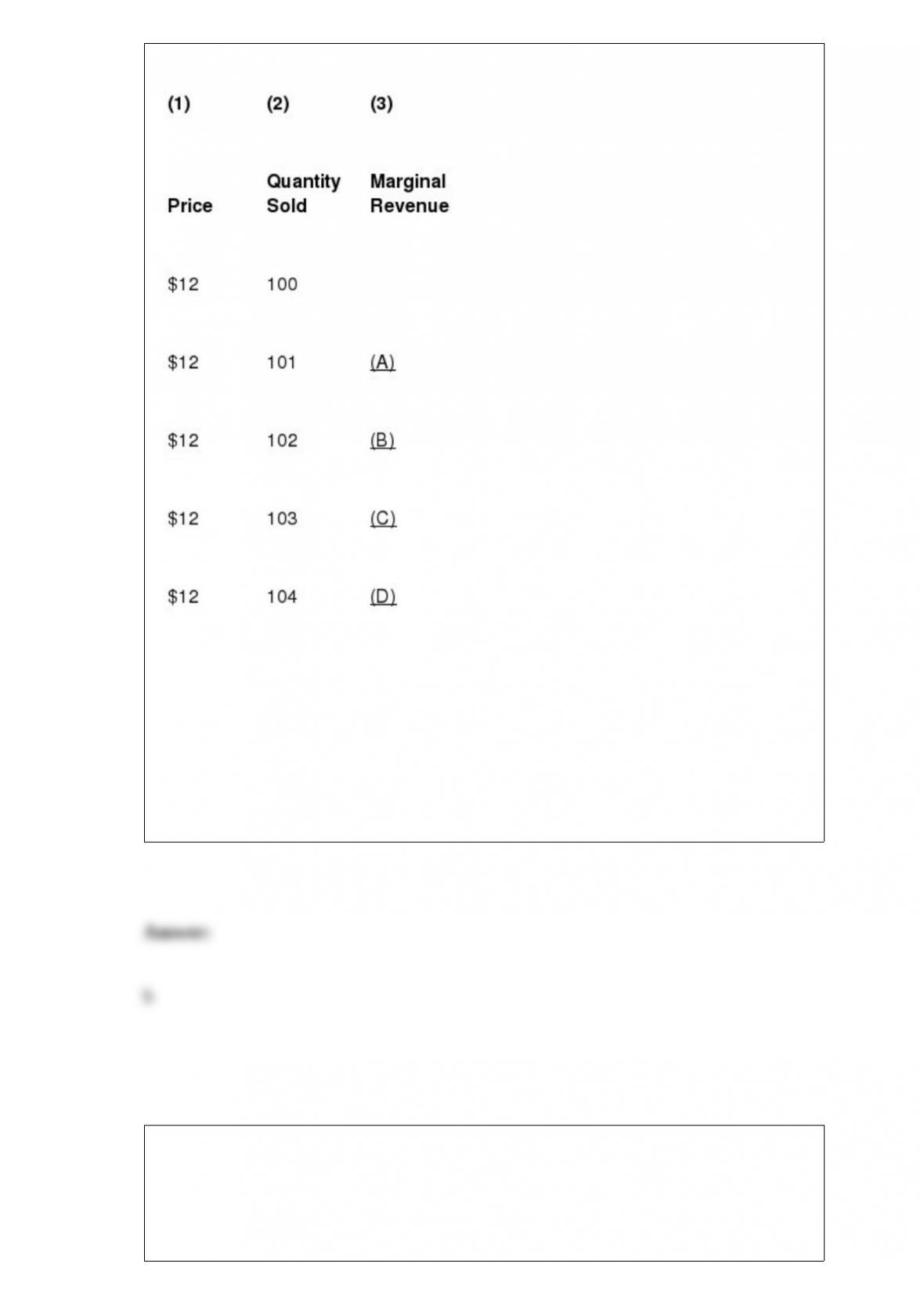
a. $1 and $12.
b. $12 and $12.
c. $8.58 and $8.67.
d. $4 and $3.
In the theory of perfect competition,
a. the market demand curve is horizontal.
b. the single firm faces a horizontal demand curve.

c. the single firm faces a downward-sloping demand curve.
d. the market demand curve is downward sloping.
e. b and d
Unit cost refers to
a. average variable cost.
b. average fixed cost.
c. marginal cost.
d. average total cost.
e. c or d
Refer to Exhibit 34-8. Assume that the current price of sugar in the United States is
$300 per ton (which includes a $100 per ton tariff on sugar imports). The removal of the
$100 per ton tariff would cause a(n) __________ in imports of __________ million
tons.
Exhibit 34-8
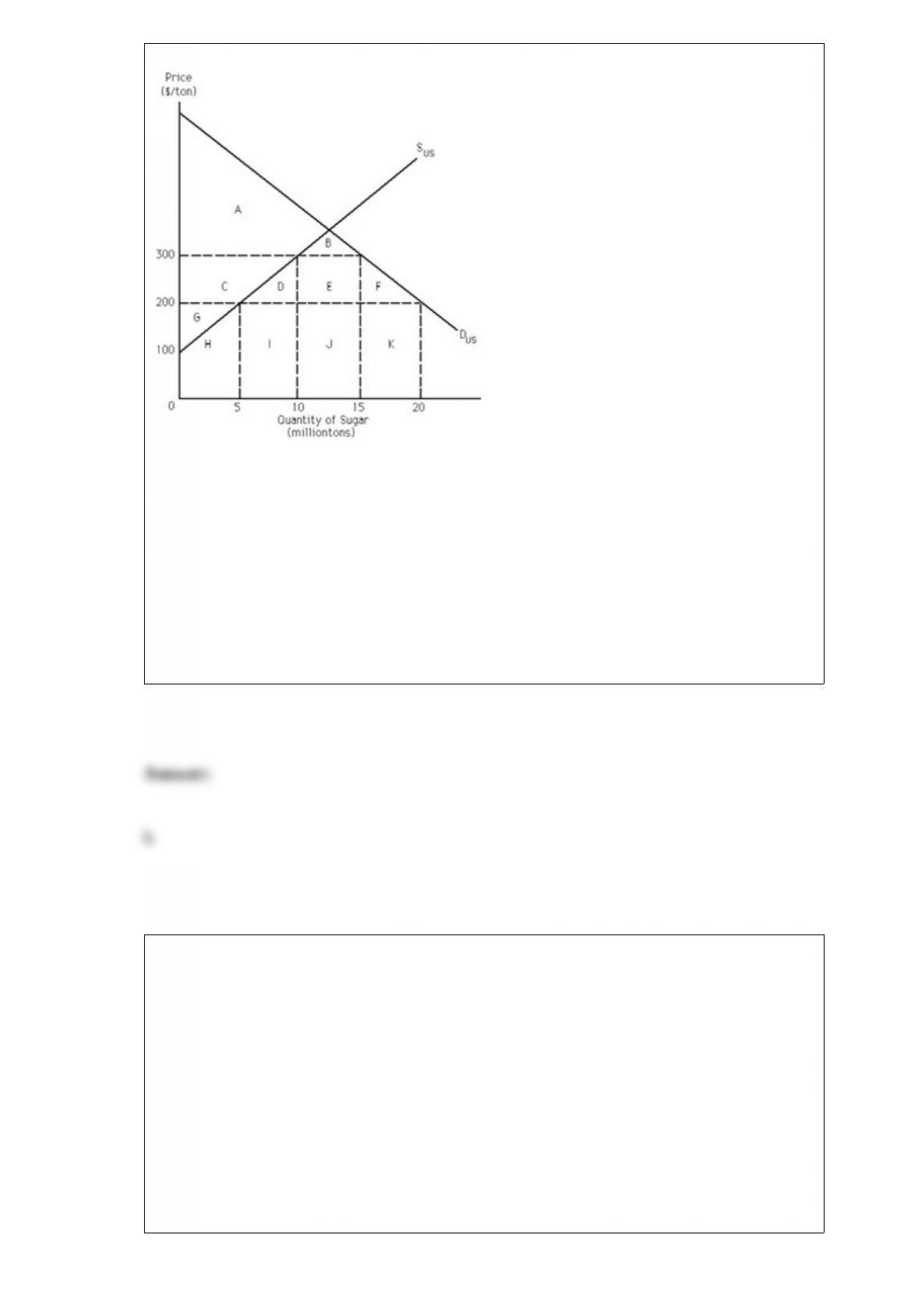
a. increase; 5
b. increase; 10
c. increase; 15
d. decrease; 5
e. decrease; 10
Which of the following statements isfalse?
a. A perfectly competitive firm is resource-allocative efficient, but a monopolistic
competitive firm is not.
b. An oligopolistic firm is not resource-allocative efficient.
c. An oligopolist produces that quantity of output at which price is equal to marginal
cost.
d. A monopolistic competitive firm produces a quantity of output at which price is
greater than marginal cost.

Suppose the government decides that milk producers are not earning a high enough
price for their milk to maintain an adequate standard of living and that the solution to
the problem is to guarantee the milk producers a minimum price. We would expect that
a. consumers will have to pay a higher price per gallon of milk and will not be able to
consume as much as they did before.
b. the government will have to purchase the surplus milk on the market and then find a
means of storing this milk.
c. the dairy farmers will enjoy a higher standard of living at the expense of taxpayers
and consumers.
d. all of the above
With a price elasticity of demand of 0.45, when the price of soybeans falls by 10
percent, the quantity demanded of soybeans rises by approximately _____________
percent.
a. 4.50
b. 45.0
c. 0.45
d. 0.56

An increasing-cost industry is characterized by
a. an upward-sloping long-run supply curve.
b. a downward-sloping long-run supply curve.
c. a perfectly elastic long-run supply curve.
d. perfectly elastic short-run and long-run supply curves.
e. a perfectly elastic short-run supply curve and an upward-sloping long-run supply
curve.
If the price of good A decreases by 10 percent and the quantity demanded of good B
decreases by 10 percent, this is evidence that goods A and B are
a. substitutes for one another.
b. complement goods to one another.
c. both inferior goods.
d. both normal goods.
e. not related.
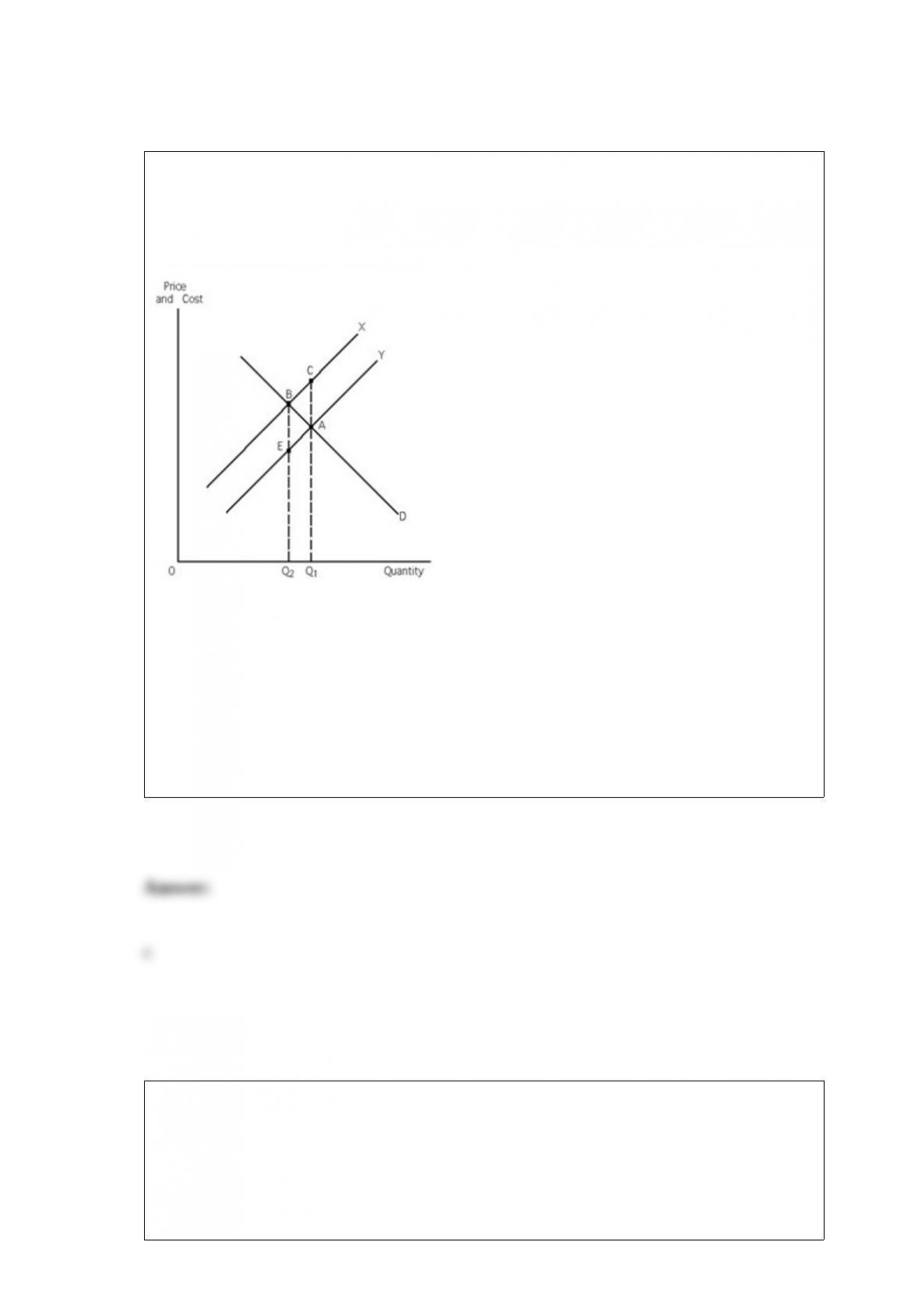
Refer to Exhibit 31-l. If the exhibit represents a negative externality situation, the
benefit of expanding output from Q2 to Q1 is the area of
Exhibit 31-1
a. ABC.
b. Q2BCQ1.
c. Q2BAQ1.
d. Q2EAQ1.
For wage rates to be the same in various labor markets, four conditions must exist: (1)
demand for every type of labor must be __________; (2) no special __________
aspects to any job; (3) all labor is ultimately __________ and can __________ be
trained for different types of employment; and (4) all labor is mobile at __________.
a. heterogeneous; money; homogeneous; costlessly; minimum cost

b. the same; nonpecuniary; homogeneous; costlessly; zero cost
c. high; training; homogeneous; costlessly; zero cost
d. high; nonpecuniary; heterogeneous; costlessly; minimum cost
e. none of the above
If the cross elasticity of demand coefficient between goods X and Y is negative, then
goods X and Y must be
a. complements.
b. substitutes.
c. normal goods.
d. inferior goods
If a person’s asset income rises and his or her transfer payments (received) decline, it
follows that that person’s
a. overall income rises.
b. overall income falls.

c. overall income stays constant.
d. labor income will rise as his or her asset income rises.
e. none of the above
Points inside (below) the production possibilities frontier (PPF) are
a. unattainable.
b. attainable, but productive inefficient.
c. preferable to points that lie on the PPF.
d. attainable and productive efficient.
“My opponent in this election says she wants a balanced federal budget, but won’t say
how it would be achieved.” This candidate is trying to
a. challenge his or her opponent’s commitment to balancing the budget.
b. get his or her opponent to say something that will allow a label of “left-wing” or
“right-wing” to be attached on her.
c. accuse the opponent of going exclusively after the median voter, who is never
interested in ends, only means.
d. accuse the opponent of going after the votes of the rationally ignorant.
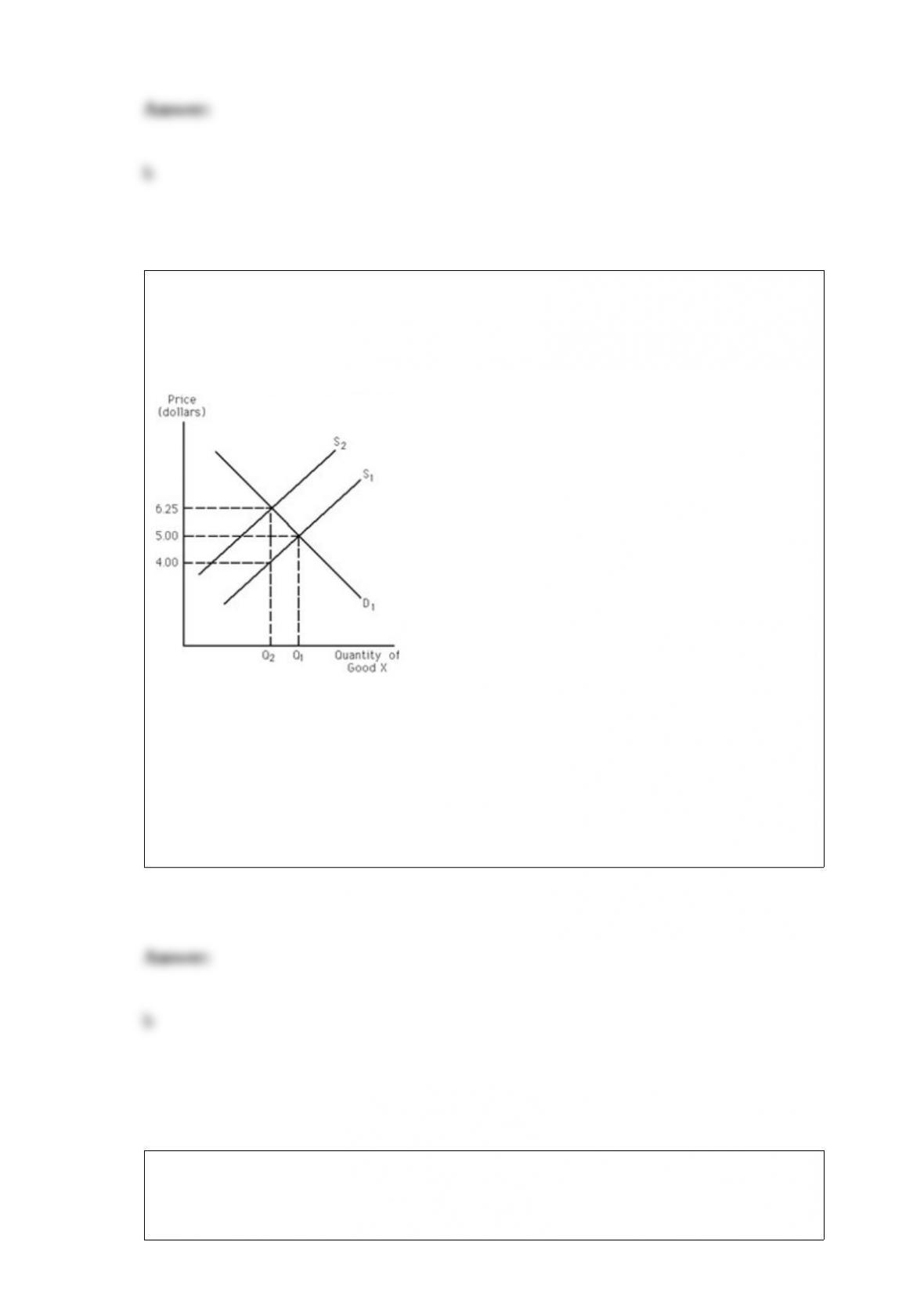
Refer to Exhibit 20-2. The market for good X is initially in equilibrium at $5. The
government then places a tax on the producers of good X, taxing them on each unit of
good X they sell. As a result, the supply curve
Exhibit 20-2
a. shifts (down and) rightward from S2 to S1.
b. shifts (up and) leftward from S1 to S2.
c. does not shift from S1.
d. There is not enough information to answer the question.
One thing a monopoly firm has to do that a perfectly competitive firm does not have to
do is

a. search for its profit-maximizing price.
b. advertise.
c. minimize its losses.
d. produce the quantity of output at which P = MC.
e. produce a high-quality product.
For a perfectly competitive firm, profit maximization (or loss minimization) occurs at
the level of output at which
a. MR = MC.
b. MR = AVC.
c. P = ATC.
d. MR = ATC.
The national defense argument for trade restriction holds that
a. the president should have the authority to erect trade barriers in case of war or
national emergency.
b. free trade is a danger to the national defense because open borders increase the

likelihood that spies will get into the country.
c. a country should produce those goods necessary for national defense purposes even if
it doesn’t have a comparative advantage in them.
d. if your enemy erects trade restrictions, so should you.