
The following appeared in a Florida newspaper a week after a hurricane hit the state.
“Floridians are relieved that the storm produced no fatalities but homeowners face
weeks, if not months, of rebuilding. Matters are made worse by the soaring prices of
plywood and other building materials that always follow in a hurricane’s path.
Complaints of profiteering and price gouging have not deterred firms from raising their
prices by over 100 percent.” Which of the following offers the best explanation for the
price increases referred to in the article?
A) The hurricane reduced the number of suppliers of building materials.
B) The hurricane created an artificial shortage of building materials.
C) The hurricane caused an increase in the demand for building materials.
D) There was a reduction in supply as firms shipped plywood and other materials to
locations not affected by the storm.
Wilbur Rickhiser, a financial advisor, recently told one of his clients: “The biggest
mistake you can make is to hold onto a stock for too long in order to avoid a loss. Let’s
say you bought a stock for $50 per share but that six months later the price fell to $40
after a poor earnings report. Many of my clients in this situation will hold the stock,
hoping the price will later rise above $50. In most cases like this the price does not rise
and may even fall. You must know when to cut your losses.” Which of the following is
the best explanation for Rickhiser’s advice?
A) People sometimes buy stocks because other people are buying them or they want to
appear to be fashionable.
B) People sometimes make mistakes when they buy stocks because of the endowment
effect.
C) People sometimes make mistakes when they buy stocks or when they buy goods and
services: they ignore the monetary opportunity costs of their choices.
D) People often fail to ignore the sunk costs of their decisions. The cost of the stock
bought at $50 per share is a sunk cost.

Alan Krueger conducted a survey of fans at the 2001 Super Bowl who purchased tickets
to the game for $325 or $400. Krueger found that (a) 94 percent of those surveyed
would not have paid $3,000 for their tickets, and (b) 92 percent of those surveyed
would not have sold their tickets for $3,000. These results are an example of
A) rational consumer behavior.
B) the endowment effect.
C) the fallacy of composition.
D) the failure to ignore sunk costs.
The law of one price
A) states that consumers can only buy one good or service at a time.
B) is a law passed by Congress that prohibits firms from selling a product at two
different prices in the same market at the same time.
C) states that consumers will pay any price for a product that has a perfectly inelastic
demand curve.
D) states that identical products should sell for the same price everywhere.

Consider the following factors:
a. culture
b. religion
c. customs
d. prices
e. income
Which of the factors above are likely to influence the choices consumers make?
A) a, d, and e only
B) all the factors except b
C) all the factors except c
D) d and e only
E) all the factors listed
Which of the following statements is true?
A) Japan is more dependent on foreign trade than is the United States.
B) Imports and exports account for over one-half of the GDP of Belgium.
C) France is the leading exporting country, accounting for 10 percent of total world
exports.
D) Because the cost of labor used on farms is so high, the United States exports very
little of its wheat, rice and corn crops.
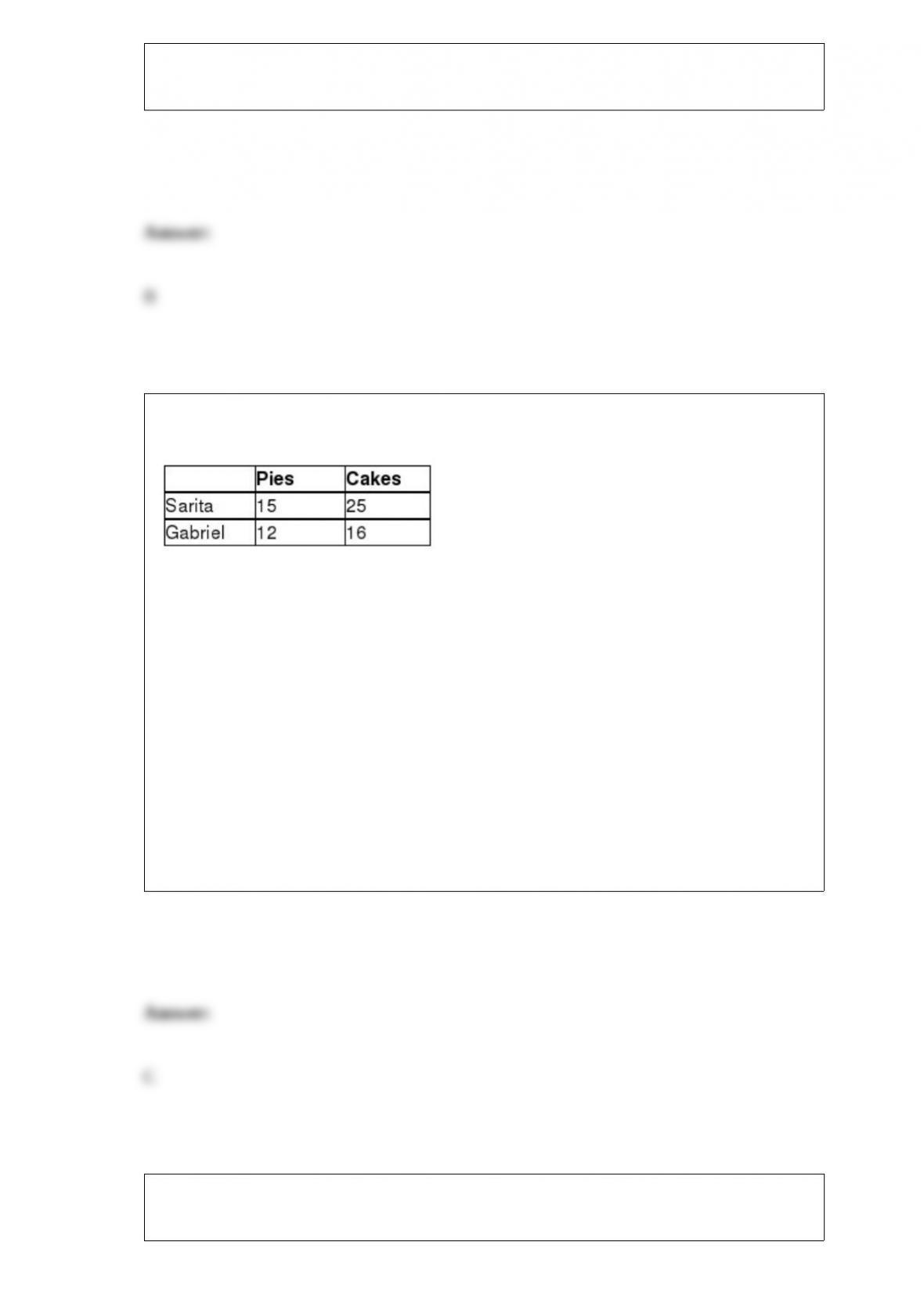
Table 9-2
Sarita and Gabriel own S&G Bakery. Table 9-2 lists the number of pies and cakes Sarita
and Gabriel can each bake in one day.
Refer to Table 9-2. Select the statement that accurately interprets the data in the table.
A) Sarita has an absolute advantage in baking cakes and Gabriel has an absolute
advantage in baking pies.
B) Sarita has an absolute advantage in baking pies and Gabriel has an absolute
advantage in baking cakes.
C) Sarita has an absolute advantage in baking pies and cakes.
D) Gabriel has an absolute advantage in baking pies and cakes.
Which of the following questions or statements regarding medical school is normative?

A) How do changes in expected future incomes affect the decisions of medical students
about which specialty to choose?
B) Medical students who enter specialized fields make a larger contribution to society
than do student who enter primary care.
C) What role does tuition play in a student’s decision about whether to attend medical
school?
D) Have tuition increases had a large effect or a small effect on the number of
applications to medical school?
Suppose you have surveyed a few industries and obtained information about the income
elasticity of demand for their products. If you expect that the economy is headed for a
long recession, you would advise people to look for jobs in an industry with
A) a high positive income elasticity coefficient such as 5.
B) a low positive income elasticity coefficient such as 0.8.
C) a “high” negative income elasticity coefficient such as -4.
D) a “low” negative income elasticity coefficient such as -0.2.
Over longer periods of time, increases in oil prices provide firms with incentives to
explore and recover oil. What does this indicate about the long-run price elasticity of
supply for oil?

A) The elasticity coefficient is likely to be higher in the long run than in the short run.
B) The elasticity coefficient is likely to be lower in the long run than in the short run.
C) The elasticity coefficient approaches 0 in the long run as supplies are depleted.
D) The elasticity coefficient is unstable in the long run because oil supplies may be
depleted.
The De Beers Company, one of the longest-lived monopolies, is facing increasing
competition. One source of competition comes from people who might resell their
previously owned diamonds. Why is De Beers worried that people might resell their
previously owned diamonds?
A) because De Beers will not be able to guarantee the quality of previously owned
diamonds and fears that its reputation might be harmed
B) because the availability of previously owned diamonds would increase the market
demand for diamonds and dilute De Beers’ monopoly
C) because previously owned diamonds would be a close substitute to newly mined
diamonds and therefore reduce De Beers’ market power
D) because the availability of previously owned diamonds would make the market
demand curve for diamonds more inelastic and force De Beers to lower its price
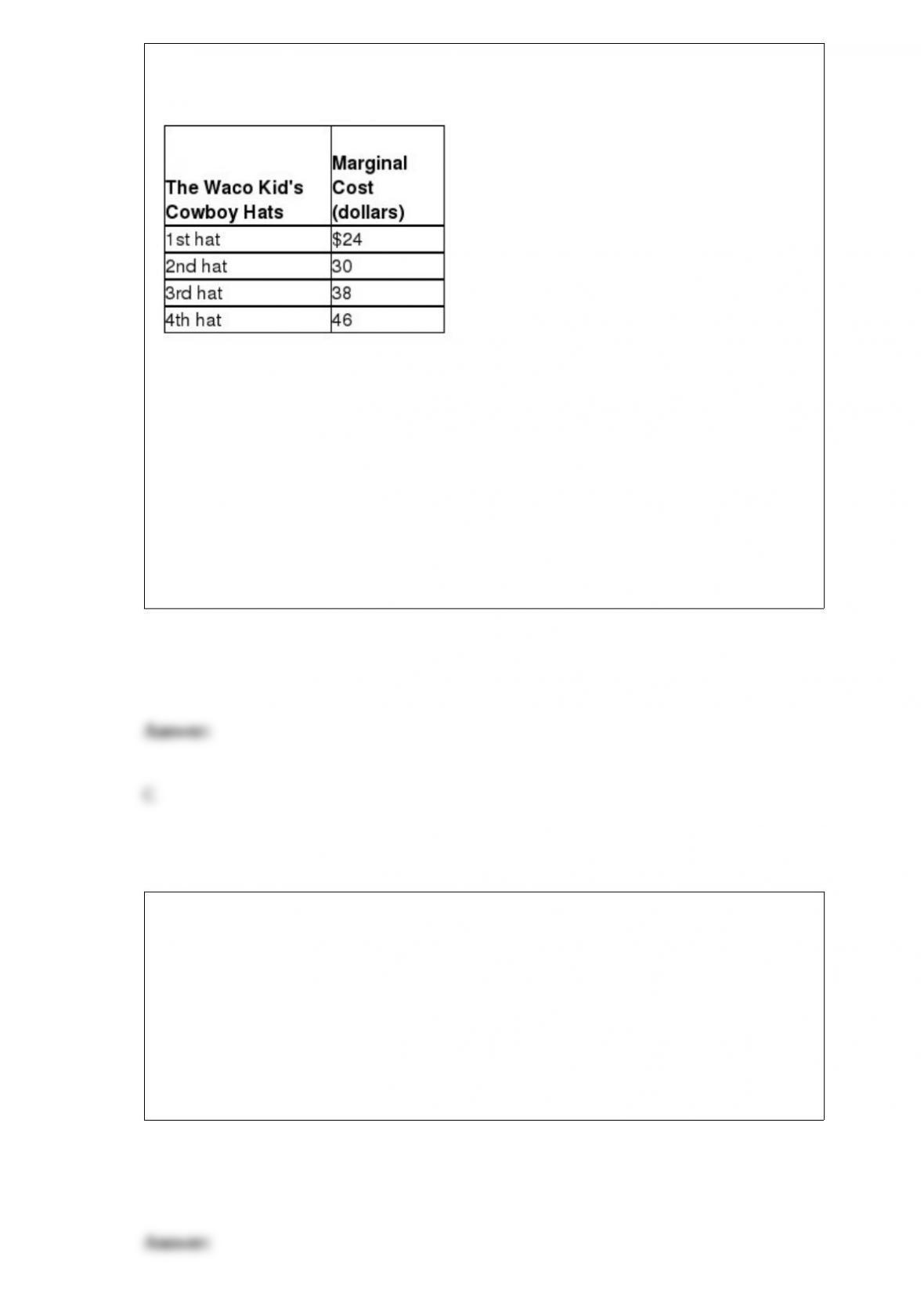
Table 4-3
Refer to Table 4-3. The table above lists the marginal cost of cowboy hats by The Waco
Kid, a firm that specializes in producing western wear. If the price of cowboy hats
increases from $38 to $46
A) consumers will buy no cowboy hats.
B) the marginal cost of producing the third cowboy hat will increase to $46.
C) producer surplus will rise from $22 to $46.
D) there will be a surplus of cowboy hats.
An explicit cost is
A) a nonmonetary opportunity cost.
B) a cost specifically related to government rules and regulations.
C) a cost that involves spending money.
D) a cost unique to corporations.
In 2014, over 75 percent of the revenue of the U.S. federal government was raised
through
A) individual income and social insurance taxes.
B) property and social insurance taxes.
C) sales and corporate income taxes.
D) individual income and property taxes.
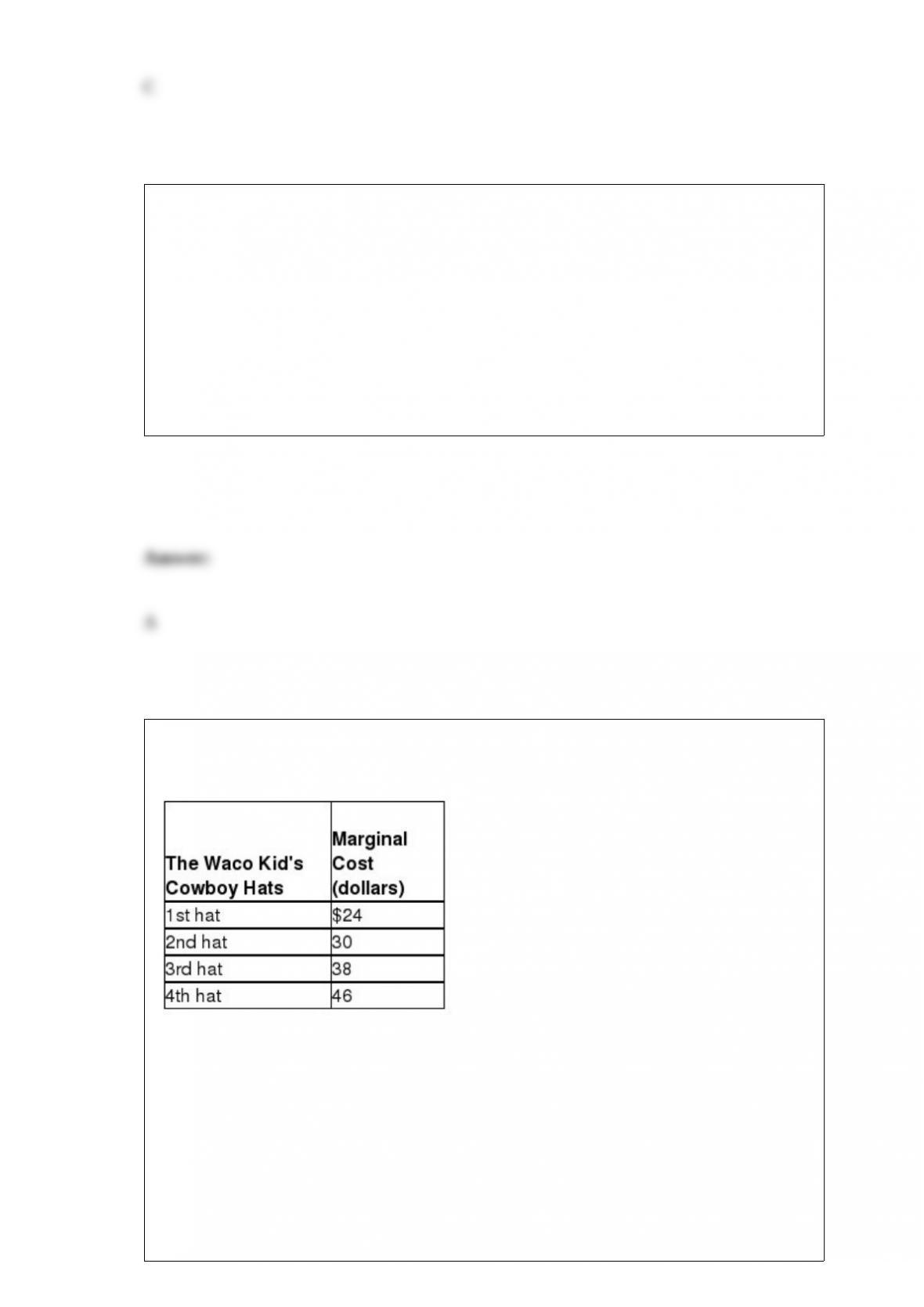
Table 4-3
Refer to Table 4-3. The table above lists the marginal cost of cowboy hats by The Waco
Kid, a firm that specializes in producing western wear. If the price of cowboy hats
decreases from $38 to $30
A) consumer surplus will rise by $6.
B) the marginal cost of producing the third cowboy hat will fall to $30.
C) producer surplus will fall from $22 to $6.

D) producer surplus will rise from $8 to $24.
A four-firm concentration ratio measures
A) the fraction of an industry’s sales accounted for by the four largest firms.
B) the production of any four firms in an industry.
C) how the four largest firms became so concentrated.
D) the fraction of employment of the four largest firms in an industry.
Figure 13-11
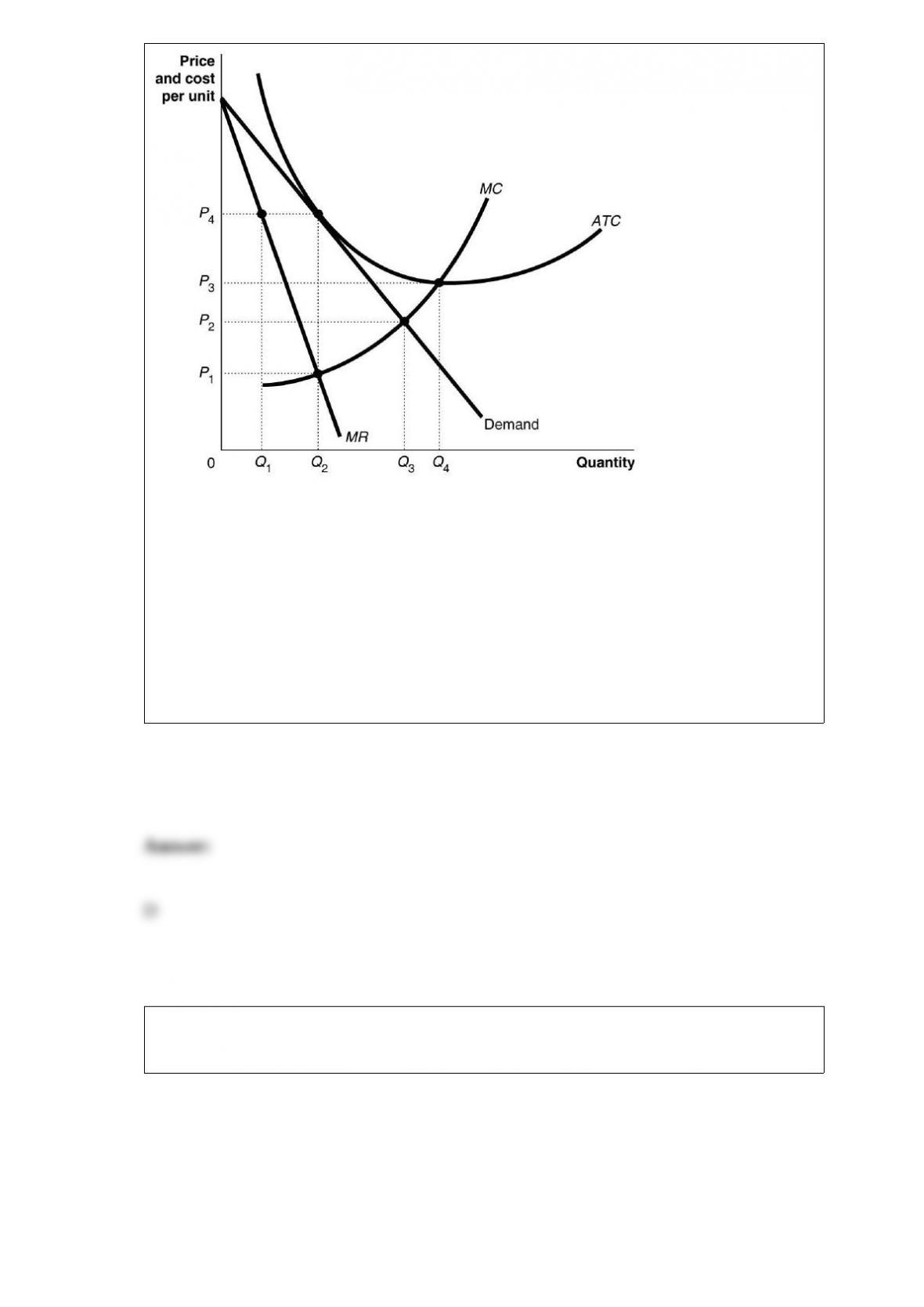
Refer to Figure 13-11. What is the monopolistic competitor’s profit maximizing price?
A) P1
B) P2
C) P3
D) P4
Figure 11-15
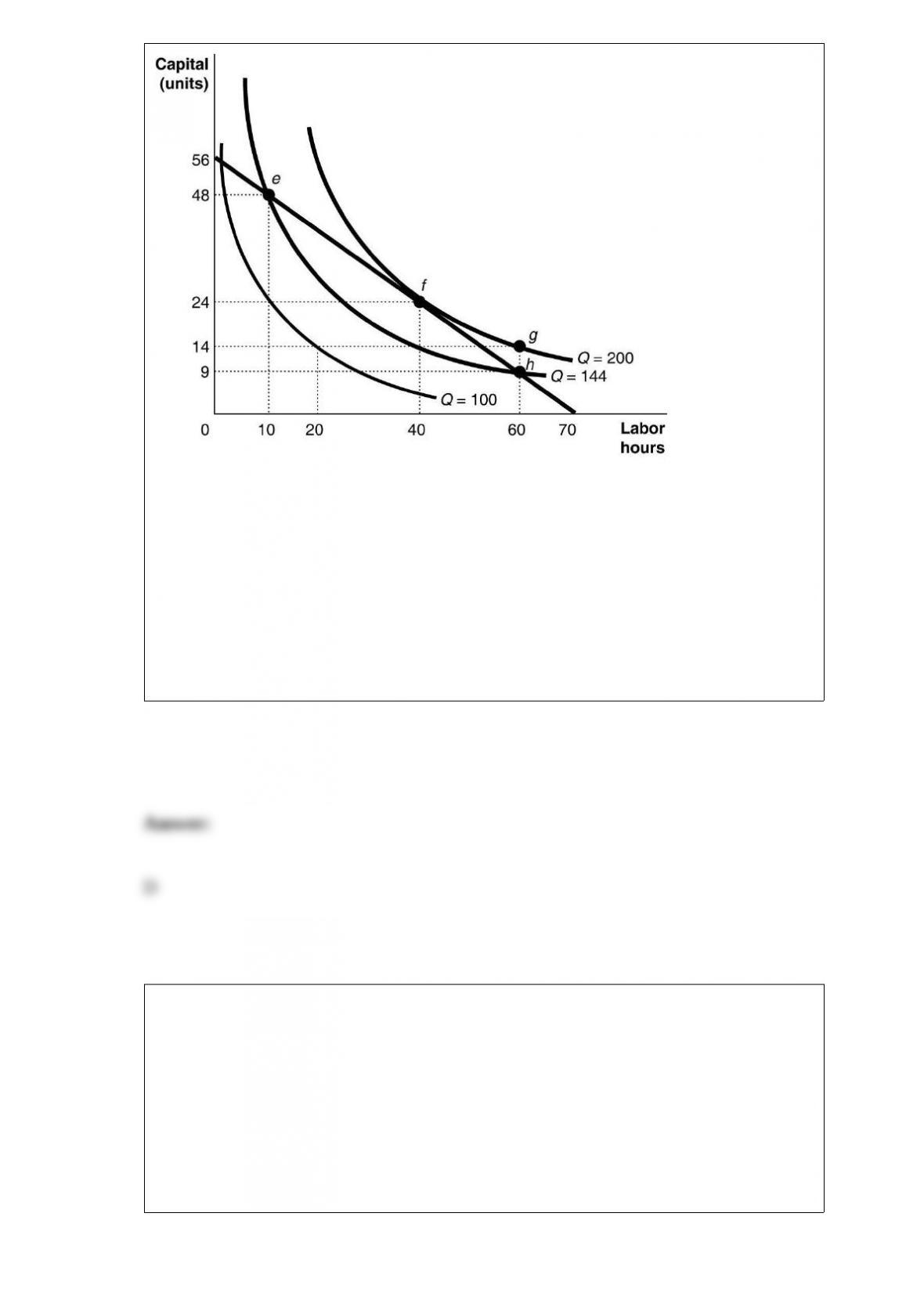
Refer to Figure 11-15. Suppose Hilda hires labor at $8 per hour and capital costs $10
per unit. What is the minimum cost of producing 200 gooseberry pies?
A) $3,600
B) $1,120
C) $592
D) $560
A market comprised of only two firms is called a
A) competitive market.
B) duopoly.
C) monopoly.
D) monopolistically competitive market.

Which of the following is a factor of production?
A) a necklace produced by a jewelry manufacturer
B) 50 shares of Google stock
C) the security guard at the local bank
D) $1,000 in casino chips
Which of the following is the best example of a perfectly competitive firm?
A) a corn farmer in Illinois
B) a Taco Bell restaurant
C) the Ford Motor Company
D) United Parcel Service (UPS)
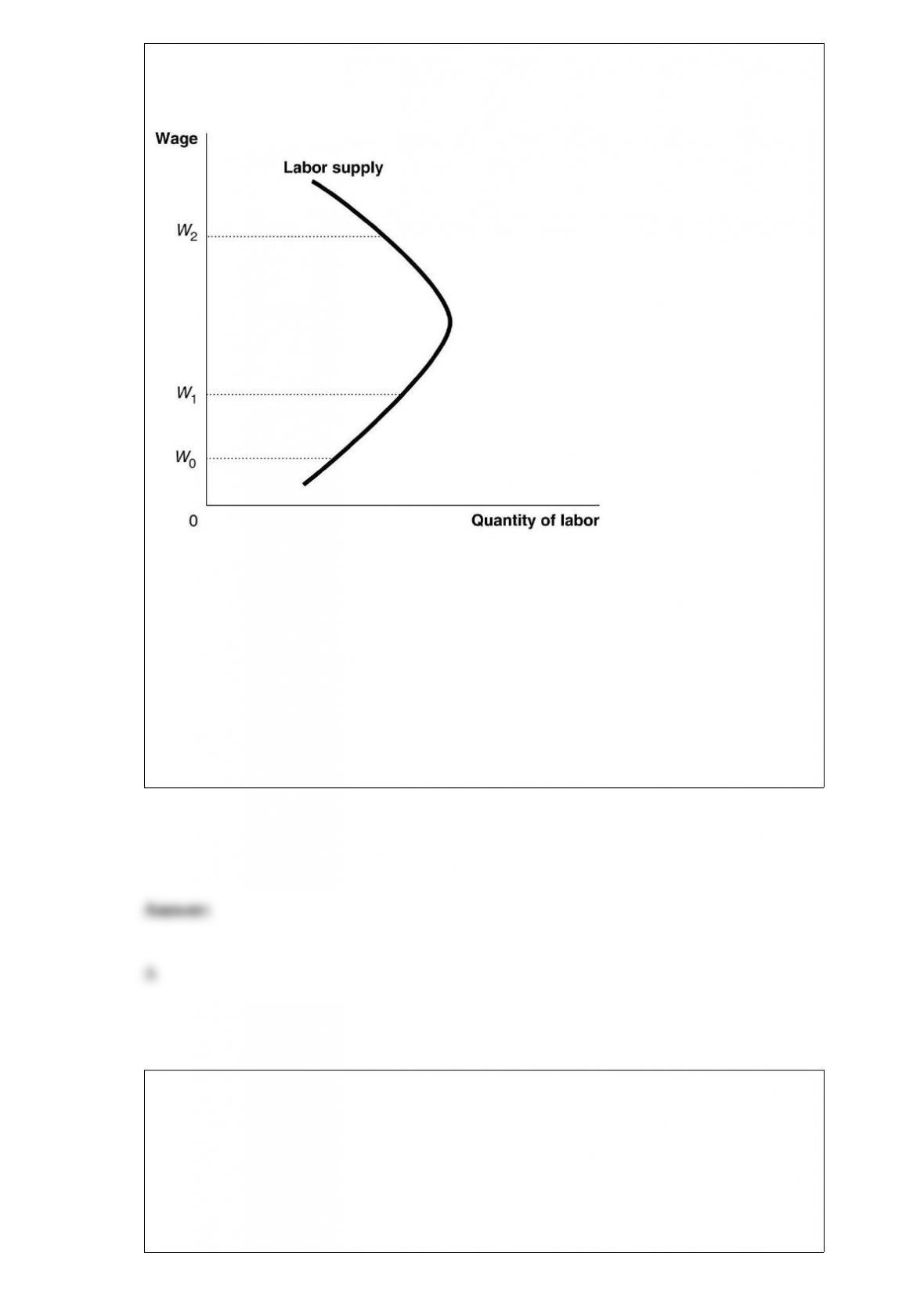
Figure 17-4
Refer to Figure 17-4. Which of the following is true if the wage rate increases from W1
to W2?
A) The income effect becomes larger than the substitution effect.
B) The substitution effect becomes larger than the income effect.
C) The income effect and the substitution effect are equal.
D) The supply curve is unit elastic.
Which of the following would explain why accounting profit might be greater than
economic profit?
A) A firm has implicit costs as well as explicit costs.
B) A firm has only explicit costs.
C) A firm’s net income is greater than its accounting profit.
D) A firm’s net income is less than its accounting profit.
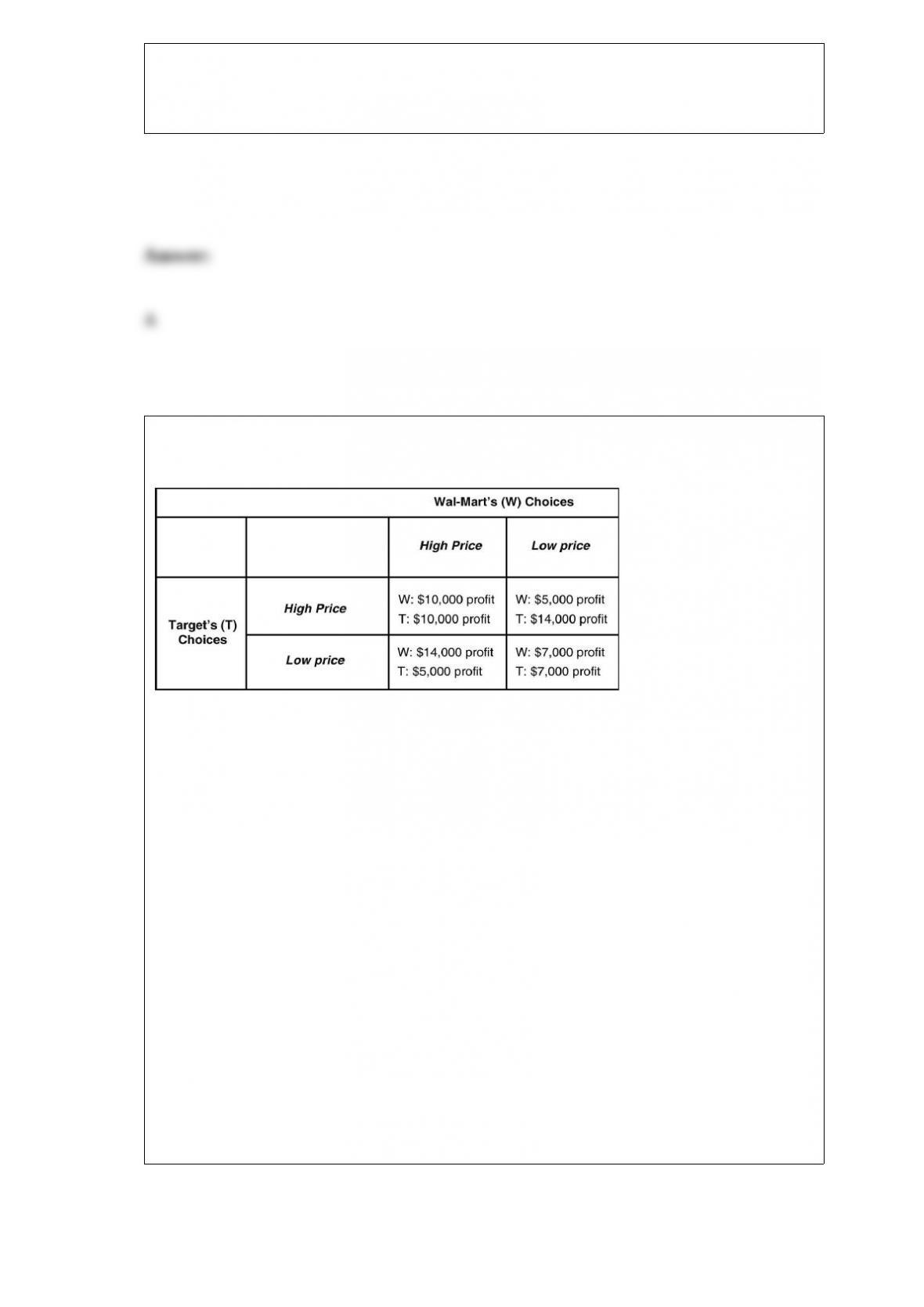
Table 14-2
Table 14-2 shows the payoff matrix for Wal-Mart and Target from every combination of
pricing strategies for the popular PlayStation At the start of the game each firm charges
a low price and each earns a profit of $7,000.
Refer to Table 14-2. Is the current strategy in which each firm charges the low price and
earns a profit of $7,000 a Nash equilibrium? If not, why and what is the Nash
equilibrium?
A) No, it is not a Nash equilibrium because each firm can do better by charging the high
price. The Nash equilibrium occurs when each firm charges the high price and earns a
profit of $10,000.
B) No, the current situation is not a Nash equilibrium; it is a dominant strategy
equilibrium. There is no Nash equilibrium in this game.
C) No, the current situation is not a Nash equilibrium. The Nash equilibrium for each
firm is to have the other charge a high price and for the firm in question charge a low
price.
D) Yes, the current situation is a Nash equilibrium.

If there are no externalities, a competitive market achieves economic efficiency. If there
is a negative externality, economic efficiency will not be achieved because
A) too little of the good will be produced.
B) too much of the good will be produced.
C) a deadweight loss will occur that is equal to the area under the demand curve for the
good.
D) economic surplus is maximized.
Economists working at federal government agencies have estimated that the marginal
social cost of carbon is about
A) $2 per ton.
B) $9 per ton.
C) $21 per ton.
D) $47 per ton.

Only one of the following statements is correct. The statements compare perfectly
competitive (PC) markets and monopolistically competitive (MC) markets. Which
statement is correct?
A) Productive efficiency is achieved in both PC and MC markets. Allocative efficiency
is achieved only in MC markets.
B) Allocative efficiency is achieved in both PC and MC markets. Productive efficiency
is achieved only in PC markets.
C) Productive efficiency and allocative efficiency are both achieved in PC markets.
Neither is achieved in MC markets.
D) Allocative efficiency is achieved only in PC markets. Productive efficiency is
achieved only in MC markets.
a. What are the two effects of an increase in the wage rate on an individual’s labor
supply decision? Briefly explain each effect.
b. Explain how a labor supply curve could be backward bending.

As a consumer consumes more and more of a product in a particular time period,
eventually marginal utility
A) rises.
B) is constant.
C) declines.
D) fluctuates.
Suppose the United States has a Gini coefficient of 0.4 and Sweden has a Gini
coefficient of 0.25. Which of the following statements is true?
A) The distribution of income is more equal in the United States.
B) The distribution of income is more equal in the Sweden.
C) Income distribution is changing faster in the United States.
D) Without information on population, it is not possible to compare income distribution
between countries.