
A change in the price level will cause a shift in the expenditure schedule.
a. True
b. False
Which of the following could explain a fall over time in the price of the depletable
resource aloe?
a. The productivity of aloe mines fell.
b. New deposits of aloe were discovered.
c. Demand for aloe increased over time.
d. All of the above are correct.
Define the following terms and explain their importance to the study of economics.
a. price elasticity
b. complements
c. substitutes
d. cross elasticity
e. supply elasticity
Over the last several years and until recently, the United States has had lower
unemployment rates than most European countries.
a. True
b. False

An efficient solution to a pricing problem
a. makes both buyers and sellers better off than any other possible solution.
b. may not be the socially “fair” solution.
c. occurs when producers’ total cost of production equals consumers’ total utility from
the output produced.
d. maximizes the output of the good being priced.
One of the conclusions of A. C. Pigou was that
a. a system of mandatory controls is the only effective means to control pollution.
b. a system of charges can be an effective means to control pollution.
c. pollution will wither away if a socialist system is in place.
d. pollution cannot be adequately addressed in a price system.
If price rises, what happens to quantity supplied for a product?

a. It increases.
b. It decreases.
c. It does not change.
d. Quantity supplied is constant, but supply increases.
Capital gains tax cuts inevitably benefit
a. low-income workers.
b. retired persons.
c. workers in large cities.
d. high-income stock owners.
Sugarcane can be used for producing both sugar and ethanol. New regulations in certain
countries now allow a higher level of ethanol in gasoline. An economist would expect
sugarcane prices to ____, and quantity sold to ____.
a. rise; rise.
b. fall; fall.
c. rise; fall.
d. fall; remain the same.
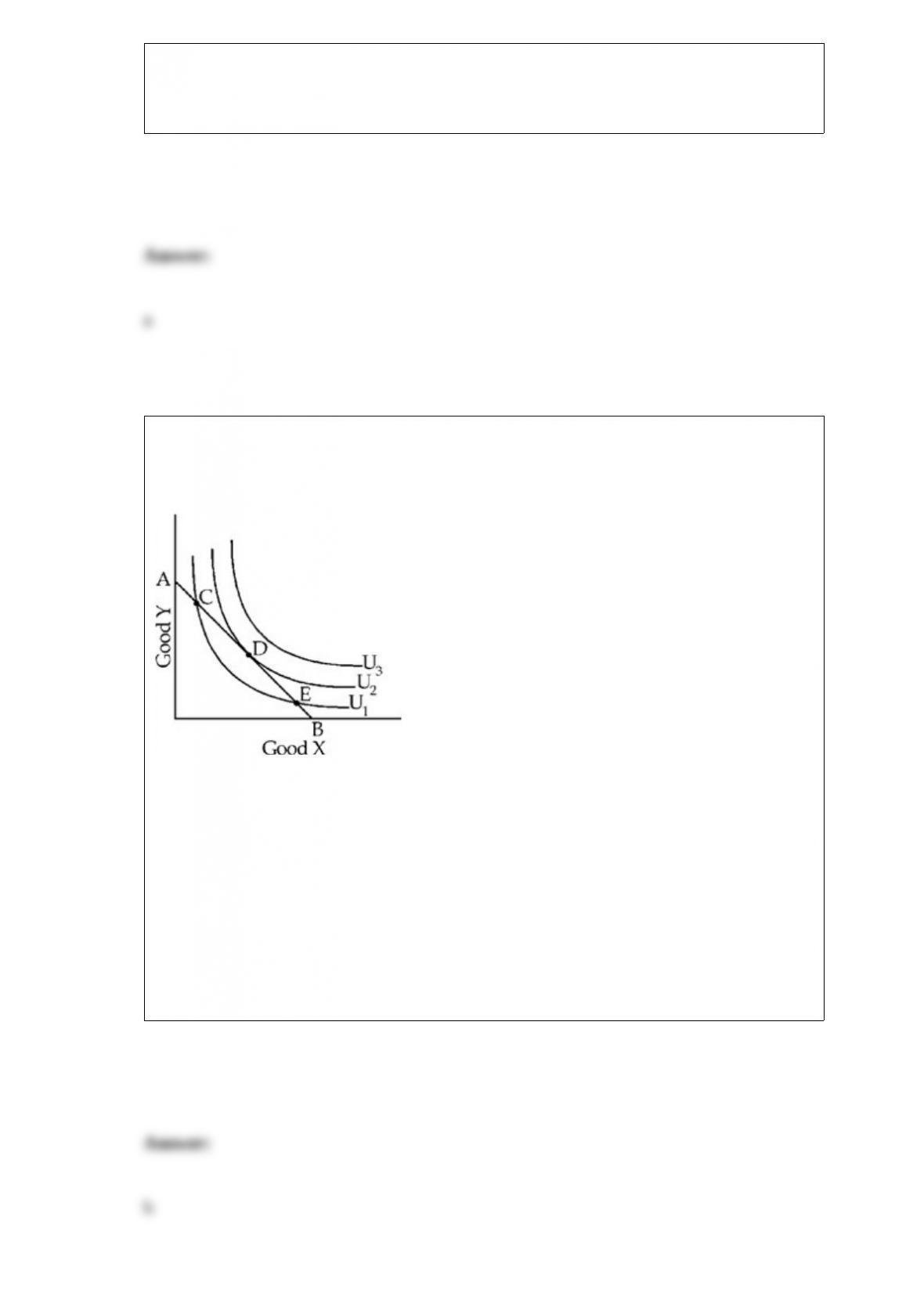
Figure 5-13
In Figure 5-13, the consumer can afford any combination of X and Y represented by a
point
a. on line AB only.
b. on or below line AB.
c. on or above line AB.
d. anywhere on the graph.
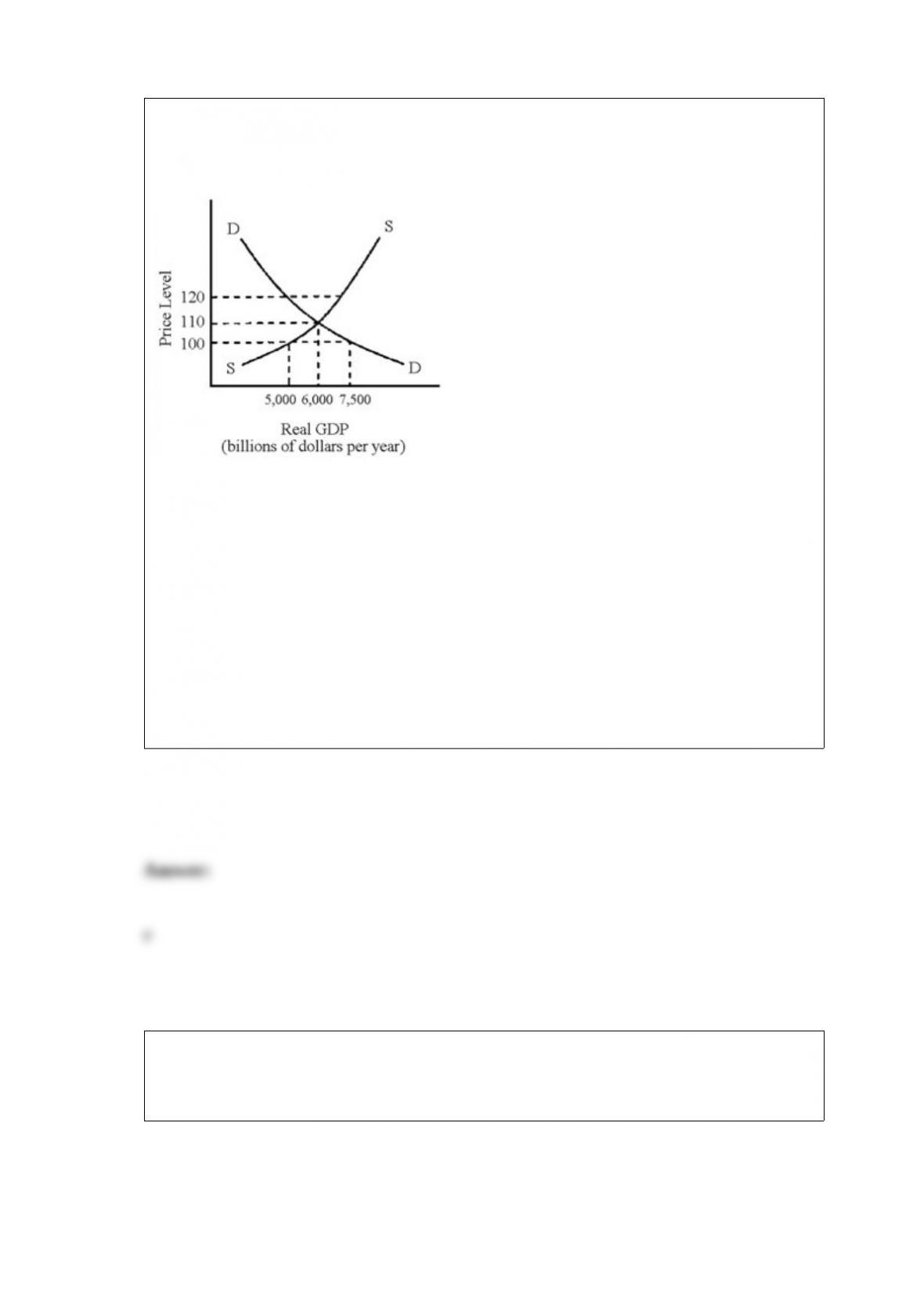
Figure 10-1
If the price level in Figure 10-1 were 100,
a. firms would have to lower their prices.
b. inventories would be accumulating.
c. shortages of goods would exist.
d. aggregate quantity demanded would exceed aggregate quantity supplied.
e. both c and d would occur.
Figure 5-15
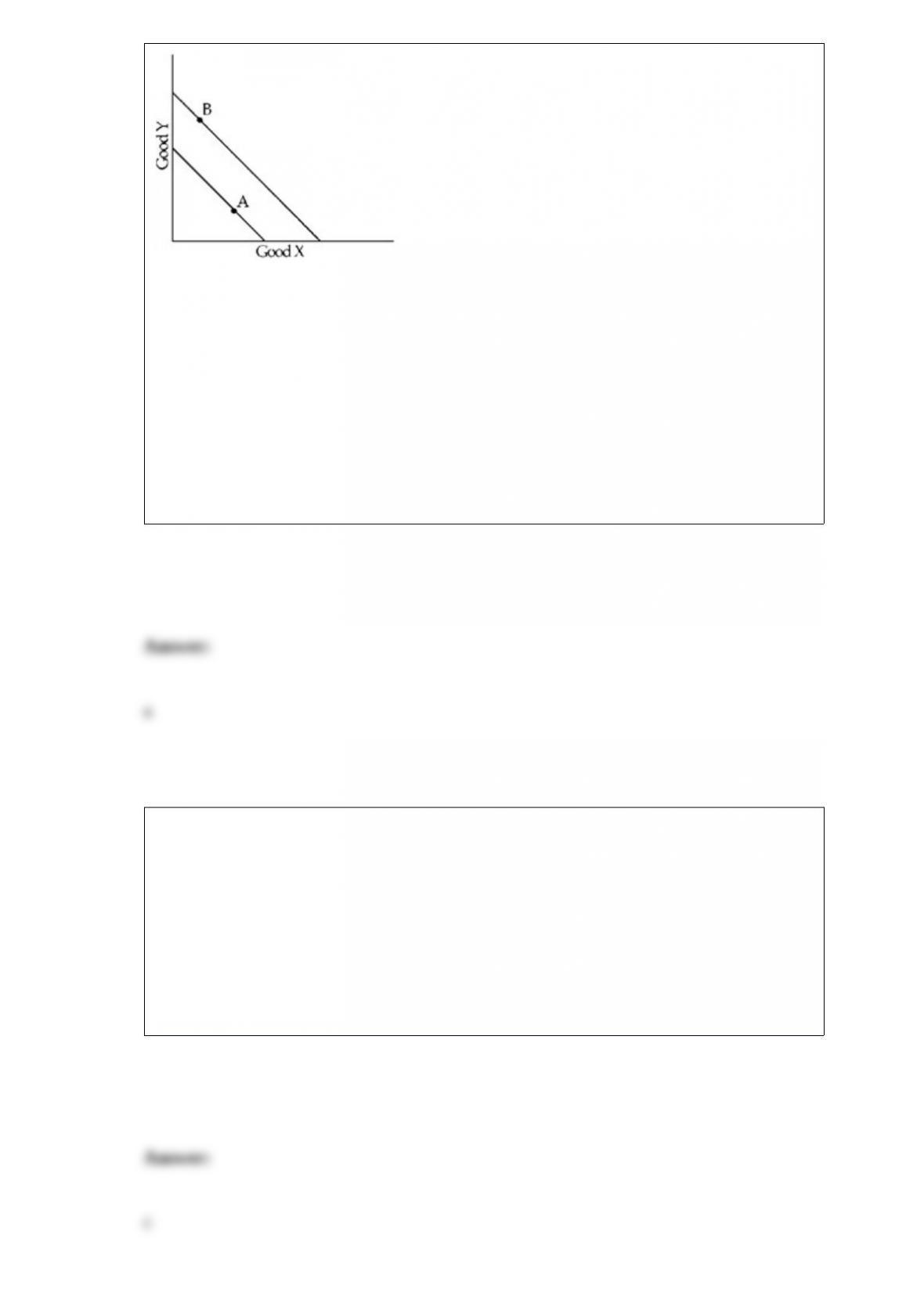
Hal initially consumes the combination marked as A in Figure 5-15. After his income
increases, Hal consumes combination B. We can conclude that Hal views
a. X as an inferior good and Y as a noninferior good.
b. X as a noninferior good and Y as an inferior good.
c. both X and Y as noninferior goods.
d. both X and Y as inferior goods.
Economic models are often expressed in
a. equations.
b. words.
c. graphs.
d. physical objects..

In the long run, any firm may enter or leave a perfectly competitive market.
a. True
b. False
In many regulated industries, marginal cost will be
a. below average cost.
b. above total cost.
c. above marginal fixed cost.
d. below incremental cost.
Although all points on the PPF are efficient, that alone does not tell us which point is
“best” for the society.
a. True
b. False

In practice, money supply and short-term interest rates are determined by the
a. Treasury and Commerce departments.
b. Federal Open Market Committee.
c. Board of Governors.
d. House and Senate.
State and local governments typically spend most of their budgets on providing
a. education.
b. public goods.
c. public welfare programs.
d. police protection and administrative services.

A shift in the demand curve for sailboats resulting from an increase in incomes will lead
to
a. higher prices of sailboats.
b. lower prices of sailboats.
c. a corresponding shift in the supply curve for sailboats.
d. lower output of sailboats.
e. no change in the price of sailboats.
Which of the following will reduce the velocity of circulation of the money stock?
a. The inflation rate increases.
b. The interest rate falls.
c. Credit cards are used more frequently.
d. More employees are paid once a week instead of once a month.
The main difference between direct and indirect taxes is that
a. indirect taxes are automatically deducted from workers’ paychecks and direct taxes
are not.

b. direct taxes are paid to state and local governments and indirect taxes are paid to the
federal government.
c. direct taxes are taxes levied on people and indirect taxes are taxes levied on activities
undertaken by people.
d. direct taxes are usually proportional and indirect taxes are usually progressive.
Modern paper money is fiat money because it is backed only by the faith the holder has
in the government that issued it.
a. True
b. False
The government banking regulation that places an upper limit on the money supply is
a. deposit insurance by the FDIC.
b. reserve requirements on bank deposits.
c. periodic bank examinations and audits.
d. limitations on the types of assets that a bank may own.

Increases in the prices of imported energy in 2002-2008 caused the aggregate supply
curve to shift inward.
a. True
b. False
Which of the following was not a criticism of the unconventional monetary policy used
by the Fed in 2009 and 2010?
a. tendency towards higher unemployment
b. tendency towards higher inflation
c. usurping authority which should be allocated to Congress
d. determining which banks would be allowed to fail

The program of unemployment insurance in the United States was created during the
a. Great Depression.
b. Reagan recession.
c. Kennedy administration.
d. Great Society.
Which of the following decisions cannot be taken by a firm in a perfectly competitive
market?
a. Market exit decision
b. Market price of the product
c. Quantity of output it can produce
d. Entering a market
Total profit is maximized if the slope of the total profit curve is
a. positive.
b. negative.

c. increasing.
d. zero.
Why is fiscal policy less effective in an open economy than in a closed economy?
a. Expansionary fiscal policy raises demand for imports, which reduces aggregate
demand.
b. Expansionary fiscal policy raises interest rates, which raises the value of the
currency, and reduces aggregate demand.
c. Expansionary fiscal policy raises the value of the currency, which reduces demand
for exports.
d. Expansionary fiscal policy has all the above effects.
The reason that some corporations grow so big is:
a. double taxation
b. that they are a separate entity from their owners
c. that they have limited liability
d. none of these
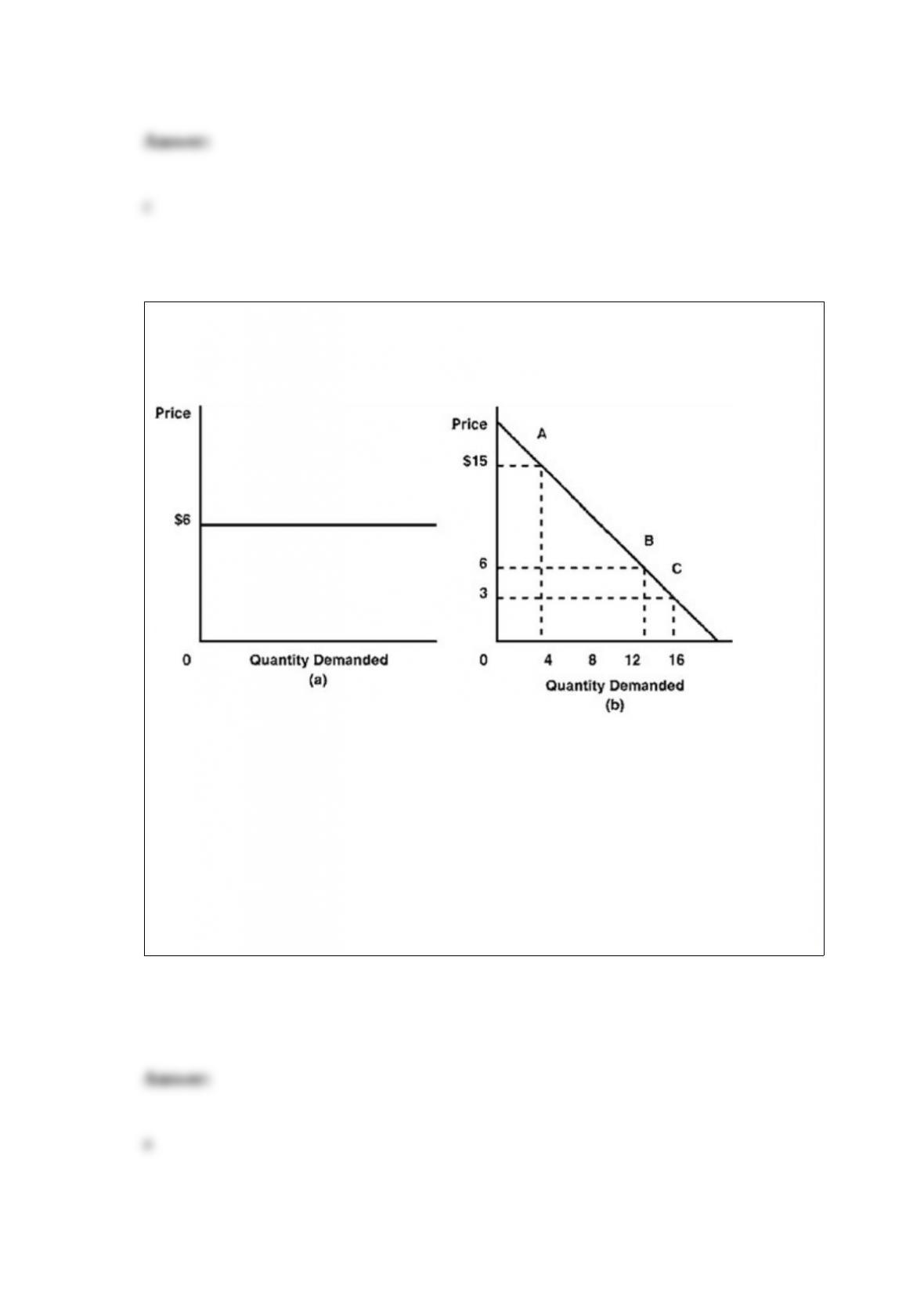
Figure 6-3
In Figure 6-3(a), at any price above $6, quantity demanded
a. falls to zero.
b. becomes infinitely large.
c. is equal to price.
d. is equal to the elasticity of demand.
One difference between the assets included in M1 and those added to calculate M2 is
that items in M1 are
a. better stores of value than those added to compute M2.
b. more liquid than those added to compute M2.
c. less liquid than those added to compute M2.
d. larger than those added to compute M2.