1) the law of diminishing marginal utility states that:
a.total utility is maximized when consumers obtain the same amount of utility per unit
of each product consumed.
b.beyond some point additional units of a product will yield less and less extra
satisfaction to a consumer.
c.price must be lowered to induce firms to supply more of a product.
d.it will take larger and larger amounts of resources beyond some point to produce
successive units of a product.
2) Suppose a single firm has the marginal revenue product schedule for a particular type
of labor given in the following table.
(a)Assume there are 150 firms with the same marginal-revenue-product schedules for
this particular type of labor. Compute the total or market demand for this labor by
completing column 1 in the table below.
(b)What will be the equilibrium wage rate and how many workers will be hired?
(c)What will be the marginal labor cost and wage rate for the individual firm? How
many workers will the firm employ?
(d)How would the imposition of a $9 minimum wage rate change the total amount of
labor hired in this market?
3)
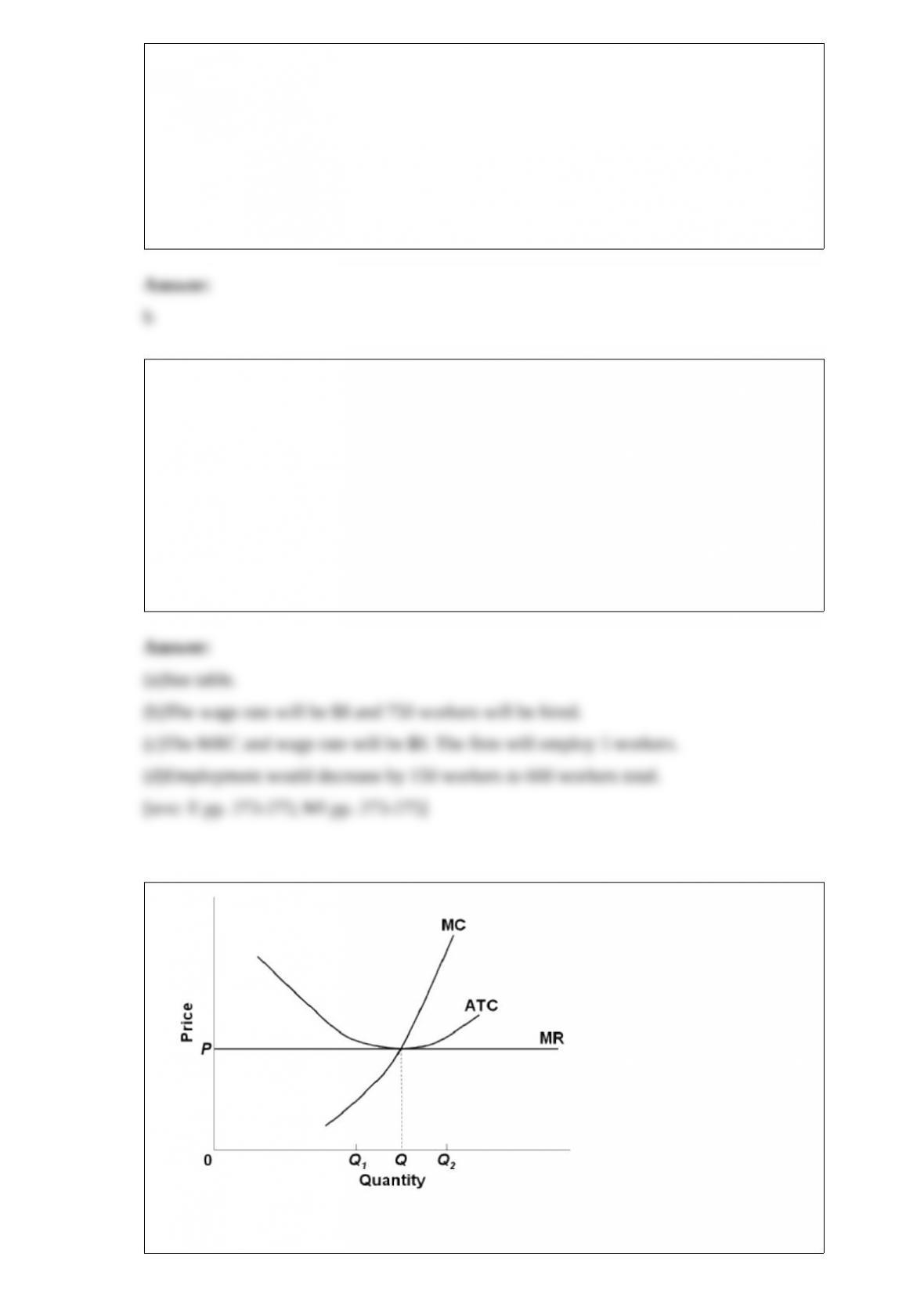
refer to the above diagram. at output level q1:
a.neither productive nor allocative efficiency are achieved.
b.both productive and allocative efficiency are achieved.
c.allocative efficiency is achieved, but productive efficiency is not.
d.productive efficiency is achieved, but allocative efficiency is not.
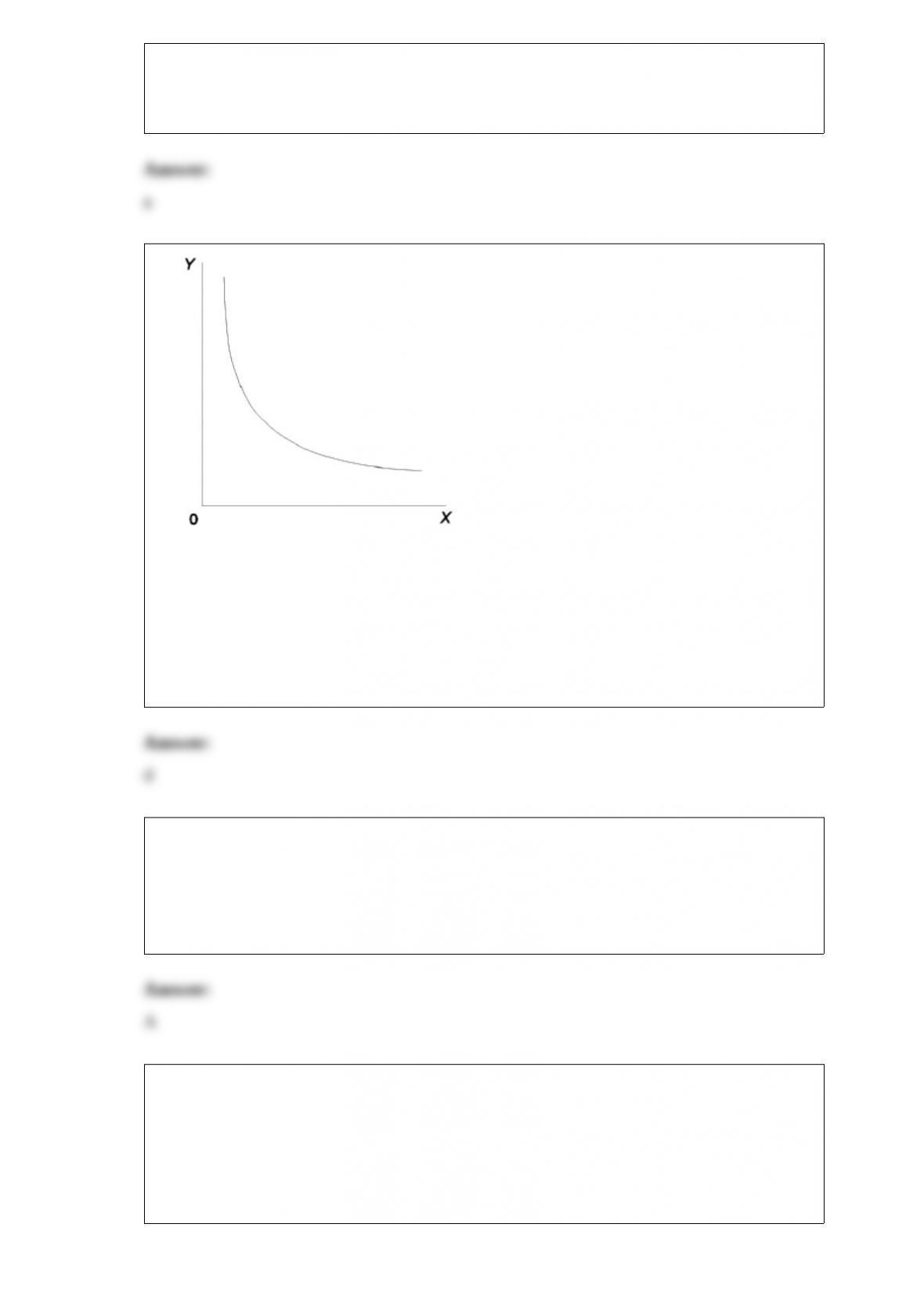
4)
the indifference curve in the above diagram yields juan 100 units of utility. if juan’s
money income were to increase by 20 percent, the indifference curve would:
a.shift leftward.
b.shift rightward.
c.become steeper.
d.not be affected.
5) Since 1950, U.S. farm exports have:
A.increased as a percentage of U.S. farm output.
B.declined as a percentage of U.S. farm output.
C.average about 10 percent of U.S. farm output.
D.averaged about 50 percent of U.S. farm output.
6) suppose we find that the price elasticity of demand for a product is 3.5 when its price
is increased by 2 percent. we can conclude that quantity demanded:
a.increased by 7 percent.
b.decreased by 7 percent.
c.decreased by 9 percent.
d.decreased by 1.75 percent.
7) In recent years, the governments of the IACs have:
A.forgiven a portion of the debt owed by some low-income DVCs.
B.substantially reduced foreign aid to the DVCs.
C.substantially reduced their contributions to the World Bank.
D.discouraged skilled DVC workers from emigrating to the IACs.
8) The equality-efficiency tradeoff suggests that:
A.welfare programs stimulate incentives to work.
B.inefficiencies result when income is transferred from rich to poor.
C.noncash transfers are superior to cash transfers.
D.economic growth is the best means of reducing poverty.
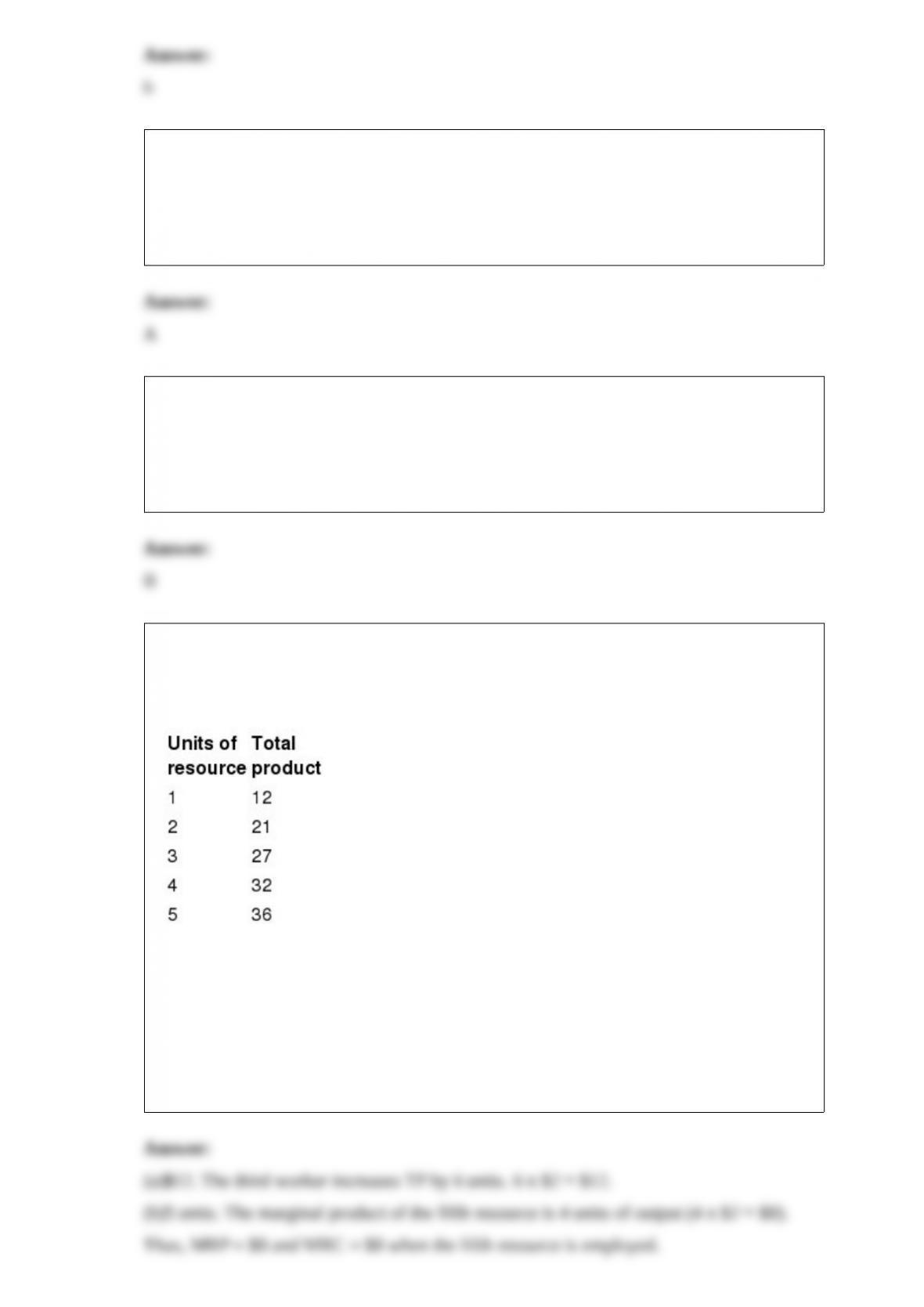
9) Use the following total-product schedule for a resource to answer the next three
questions. Assume that the quantities of other resources the firm employs remain
constant.
(a)If the firms product sells for a constant $2 per unit, what is the marginal revenue
product of the third unit of the resource?
(b)If the firms product sells for a constant $2 per unit and the price of this resource is
$8, how many units of the resource will the firm employ?
(c)If the firm can sell 12 units of output at a price of $1.00 per unit and 21 units of
output at a price of $0.80 per unit, what is the marginal revenue product of the second
unit of the resource?
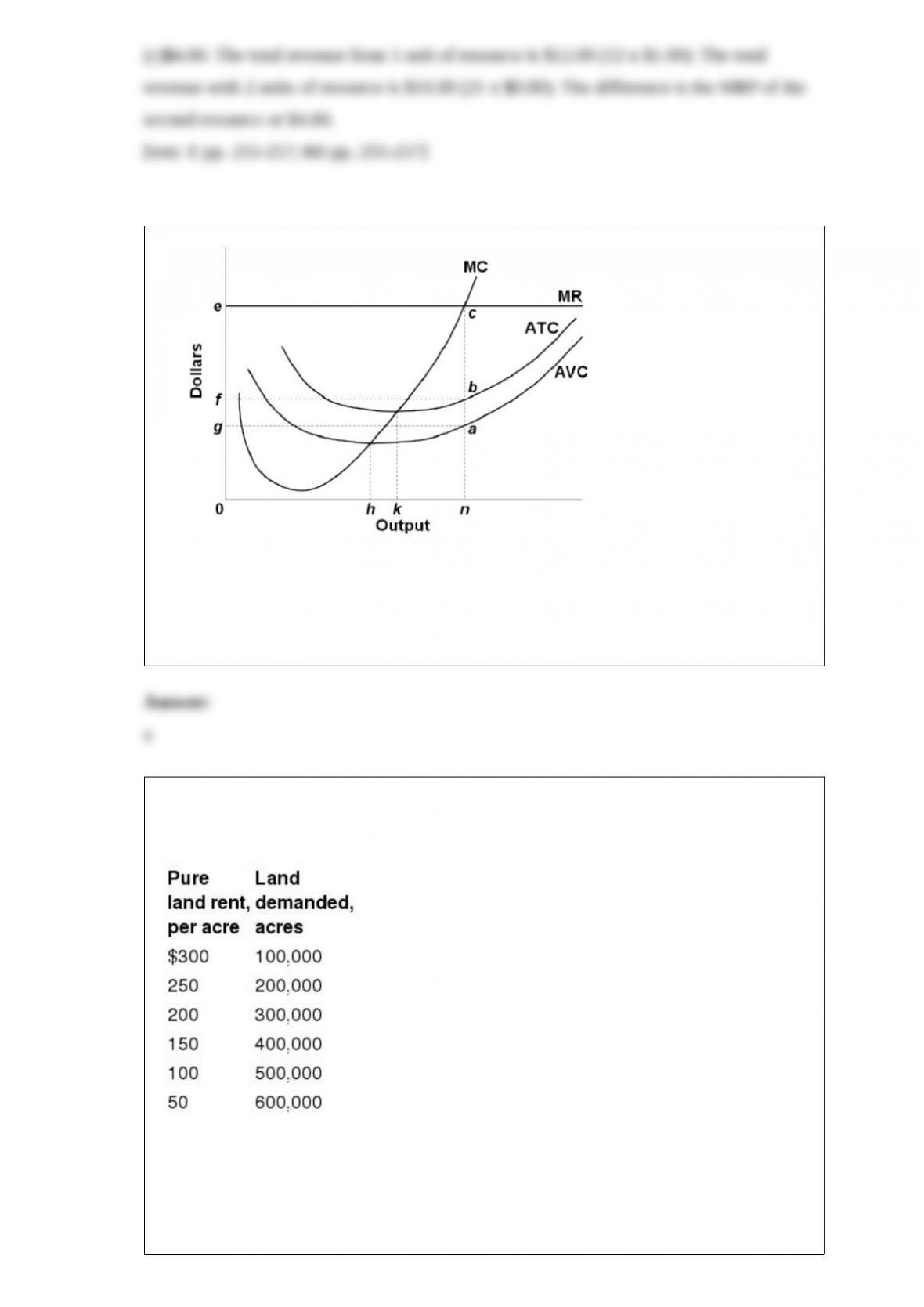
10)
refer to the above diagram. for any level of output, total fixed cost:
a.is fgab
b.is 0gan
c.is ba
d.is efbc
11) Assume that the quantity of a certain type of farmland is 300,000 acres and the
demand for this land is that given in the table below.
(a)What will be the economic rent and how much land will be rented?
(b)If the productivity of the land decreases such that 200,000 less acres are demanded at
each price, what will the economic rent be and how much land will be supplied?
(c)Given the new demand schedule in (b), if landowners were taxed at a rate of $50 per
acre for their land, what would be the pure rent on this land after taxes and how many
acres would be rented?
12) other things equal, a price discriminating monopolist will:
a.realize a smaller economic profit than a nondiscriminating monopolist.
b.produce a larger output than a nondiscriminating monopolist.
c.produce the same output as a nondiscriminating monopolist.
d.produce a smaller output than a nondiscriminating monopolist.
13) ben says that “an increase in the tax on beer will raise its price.” holly argues that
“taxes should be increased on beer because college students drink too much.” we can
conclude that:
a.ben’s statement is normative, but holly’s is positive.
b.holly’s statement is normative, but ben’s is positive.
c.both statements are normative.
d.both statements are positive.
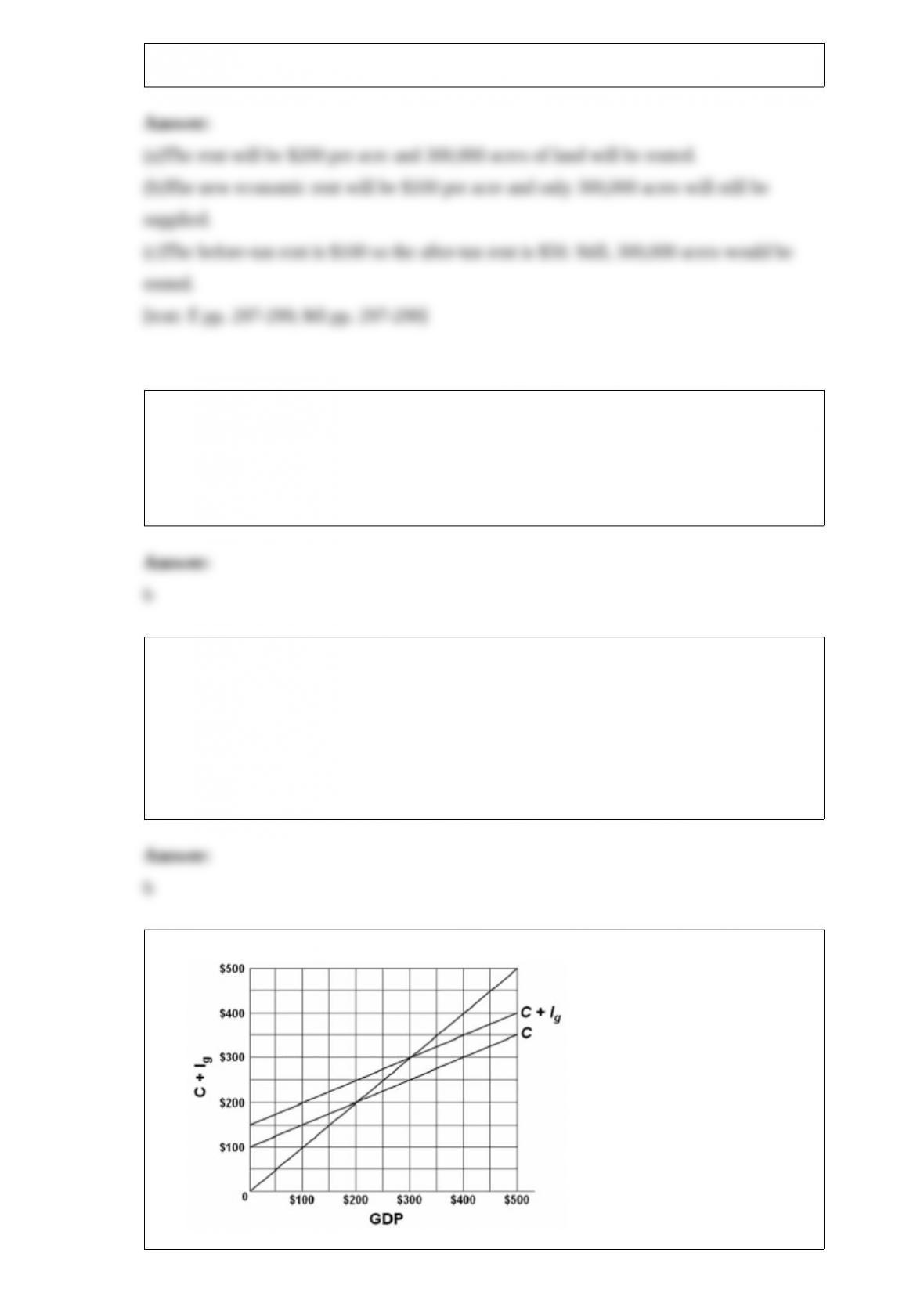
14)

Refer to the above diagram for a private closed economy. The equilibrium level of GDP
is:
A.$400.
B.$300.
C.$200.
D.$100.
15) Author Joe Writer receives $2 per book sold. This payment is a(n):
A.piece rate.
B.royalty.
C.bonus.
D.example of profit-sharing.
16) american critics of the wto argue that free international trade and investment will:
a.reduce u.s. imports.
b.reduce employment in developing nations.
c.undermine environmental and labor protections in the united states.
d.increase immigration from low-income to high-income nations.
17) Mainstream economists question the new classical assumption that:
A.excessive growth of the money supply is a cause of inflation.
B.the price level is determined by aggregate demand and aggregate supply.
C.demand creates its own supply.
D.wages and prices are equally flexible upward and downward.