
A significant increase in the toll rates on a major turnpike leads to an increase in the
a. number of vehicles using the turnpike.
b. demand for vehicle and food services provided by the turnpike service areas.
c. demand for toll booth attendants.
d. supply of turnpikes in the same region.
e. demand for travel on parallel, nontoll roadways.
A business that requires a new agreement whenever an owner leaves or a new owner
arrives is a
a. firm.
b. corporation.
c. partnership.
d. foundation.
e. proprietorship.
Increased government regulation is said to have contributed to the slowdown in U.S.
productivity because such regulation

a. led to the substitution of research and development for goods and services available
to consumers.
b. reduced the labor force by requiring limited resources to be used for compliance.
c. generated both litigation and uncertainty, discouraging business investment.
d. reduced the quality of the work environment, lowering worker morale.
e. lowered the cost of production, making many goods unprofitable.
The Easy Rider Surfboard Company produces 11,000 surfboards annually at a total cost
of $484,000. Its total fixed costs are $198,000. The average variable cost of a surfboard
must be
a. $18.
b. $26.
c. $44.
d. $62.
e. $70.
The best example of a consumer nondurable counted in this year’s GDP is a

a. haircut.
b. refrigerator.
c. pizza.
d. concert.
e. used car.
A tax that takes a greater proportion of one’s income as that income rises is called a(n)
________ tax.
a. progressive
b. regressive
c. income
d. excise
e. proportional
A supply curve shifts with changes in
a. technology.

b. income.
c. tastes.
d. the number of buyers.
e. market price.
Exports from the United States are the goods and services
a. it buys from other countries.
b. that use up its holdings of foreign currencies.
c. produced here and consumed by foreigners.
d. whose dollar value is subtracted from its GDP.
e. produced here and consumed by U.S. residents.
When money is held to make future purchases, it serves as a
a. medium of exchange.
b. store of value.

c. standard of value.
d. price index.
e. required reserve.
To raise wages, labor unions can force a shift in the labor supply curve by
a. being willing to work longer hours as wage rates rise.
b. favoring legislation to reduce immigration.
c. negotiating an increase in wages.
d. encouraging an increase in union membership.
e. increasing the demand for the final product.
If the supply curve for peaches slopes upward, a decrease in the demand for peaches
causes the equilibrium price
a. to rise and quantity to fall.
b. to fall and quantity to rise.
c. and quantity both to fall.

d. and quantity both to rise.
e. and quantity both to remain unchanged.
The term deflation
a. describes what happens when the money supply increases more rapidly than output.
b. is another name for simultaneously high rates of inflation and unemployment.
c. is used to describe a situation in which prices fall and inflation turns negative.
d. indicates a situation where an aggregate supply decrease takes place very rapidly.
e. means double-digit rates of inflation.
In 1985, the Japanese yen was quoted at 235 per dollar. In 2013, the quoted price was
104 per dollar. As a result, other things being equal, one would expect that
a. Japanese goods will become more expensive for U.S. buyers.
b. U.S. goods will become more expensive for Japanese buyers.
c. the Japanese will import less from and export more to the United States.
d. gold will flow from Japan to the United States.

e. the U.S. demand curve for yen will shift to the right and the dollar price of yen will
fall.
Opportunity cost
a. is the production forgone from the best alternative use of a resource.
b. reduces the need to make choices.
c. applies only to allocating capital.
d. is another name for the “invisible hand.”
e. is greater for free resources than for economic resources.
In a Keynesian model, an increase in the money supply results in
a. a decrease in the interest rate and increases in investment and GDP.
b. decreases in the interest rate, investment, and GDP.
c. increases in the interest rate, investment, and GDP.
d. an increase in the interest rate with decreases in both investment and GDP.
e. a decrease in the interest rate, with the effect on investment and GDP uncertain.

A change in demand means that there has been a
a. movement along a given demand curve.
b. shift to the right or left of a given demand curve.
c. change in sellers’ input prices.
d. corresponding change in supply.
e. permanent disequilibrium condition created in the market.
When free trade prevails, the
a. domestic prices of imported items rise and of exported items decline.
b. domestic prices of both imported and exported items rise.
c. domestic prices of exported items rise in the exporting country and decline in the
importing country.
d. domestic prices of imported and exported items remain the same.
e. laws of supply and demand are replaced by the law of comparative advantage.

An important endogenous factor influencing a country’s rate of technological change is
a. the nature and extent of its scientific capabilities.
b. an absence of research and development.
c. a large gap between actual and potential output.
d. the presence of high levels of consumption with little or no household saving.
e. its capital-output ratio.
Many observers feel that price controls imposed during World War II were generally
more effective than those imposed in the 1970s because
a. there was more effective government enforcement.
b. the price ceilings were set below market equilibrium prices.
c. those imposed during the war tended to be more flexible than those in the 1970s.
d. they had the moral support of U.S. consumers.
e. the price freezes of the 1970s were short-run rather than long-run controls.

The period during which union membership achieved its most spectacular growth was
the
a. 1910s.
b. 1920s.
c. 1930s.
d. 1950s.
e. 1960s.
The presence of a price leader in an oligopolistic industry
a. implies that one firm can consistently charge the highest price.
b. allows firms to coordinate their behavior short of outright collusion.
c. decreases the profits of all other firms.
d. is illegal according to the Sherman Antitrust Act.
e. leads naturally to cost-plus pricing by other firms in the industry.
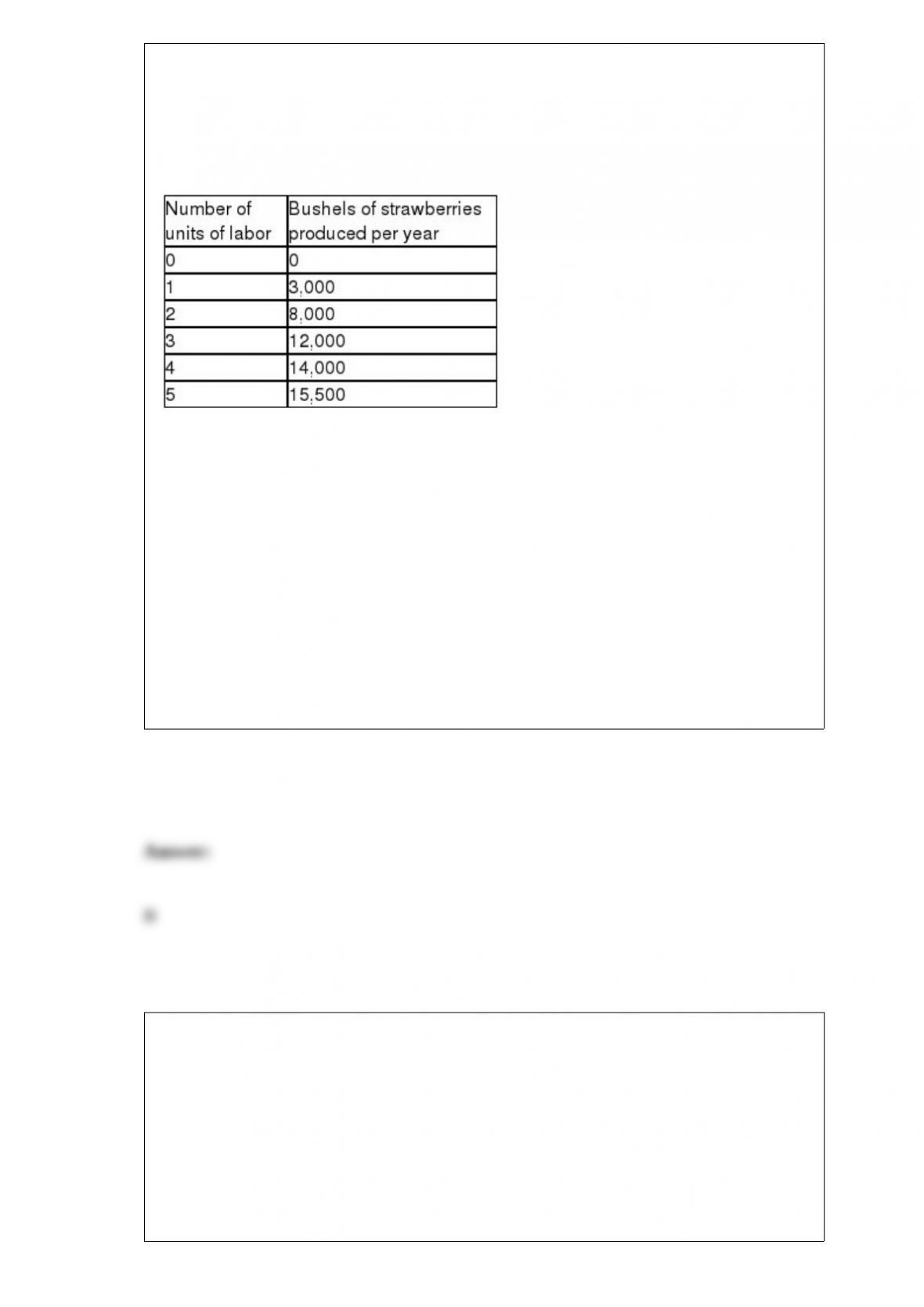
The following questions are based on the following information:
A firm uses inputs of labor, fertilizer, and land to produce strawberries (which are sold
to wholesalers and processors). The quantity of land used is fixed at eight acres per
season and the production function implies the relationships in the following table:
It can be said that this firm experiences diminishing returns beyond the employment of
the ________ unit of labor.
a. first
b. second
c. third
d. fourth
e. fifth
Germany’s decision after World War I to print more money rather than tax its citizens to
pay reparations resulted in
a. runaway inflation that totally destroyed Germany’s middle class.
b. severe creeping inflation that took several years to control.
c. decreased inflation.

d. a mild, temporary inflation that actually boosted economic production.
e. the value of the mark rising relative to the U.S. dollar.
The distinction between the short run and the long run is
a. strictly a calendar matter; the long run is over 10 years.
b. dependent solely on the time period necessary to vary all relevant inputs.
c. that in the short run neither input nor output can be changed.
d. that the law of diminishing marginal returns is operational in the long run but not in
the short run.
e. operationally meaningless since the firm is continually planning for the future in the
short run.
One problem associated with public regulation of industries has been the tendency for
a. regulators to set prices below average variable costs.
b. most regulatory agencies to be incapable of carrying out their duties.
c. regulatory commissions to accommodate the requests of the businesses they are
supposed to regulate at the expense of the public.

d. regulatory agencies and legislation to be ruled unconstitutional by the courts.
e. public regulation to be introduced in markets characterized as natural monopolies,
where such regulation is least appropriate.
If the estimated current dollar output is $3,535 billion and the relevant price index is
2.21, the constant dollar output is ________ billion.
a. $1,600
b. $2,921
c. $3,314
d. $3,756
e. $7,812
It is sometimes hard to separate the impact of technology from that of investment
because
a. you can directly measure investment, but there is no way to quantify new technology.
b. neither has been a major factor in economic growth for about 10 years now.
c. technology has grown at a such a variable rate that its impact cannot be effectively
measured.

d. new technology is useful only when it is embodied in the physical capital financed
through investment.
e. neither activity is reflected in the prices we pay for goods and services.
A group of individuals who wish to start a business that needs considerable funds to
initiate and who wish protection in the event that their business fails should
a. form a simple proprietorship.
b. incorporate.
c. establish a partnership.
d. form a complex proprietorship.
e. establish a firm.
In a union shop, workers
a. must be union members before they can be hired.
b. need not be union members to work.
c. must become union members within a certain period of time once they have been
hired.

d. are not able to strike under any circumstances.
e. sign yellow dog contracts before they begin work.
The total profit at the profit-maximizing output is
a. 0V.
b. PR.
c. QT.
d. UV.
e. RS.
The following questions are based on the following graphs for men’s shirts in South
Korea and the United States. The exchange rate is 1,200 won equals $1.00.
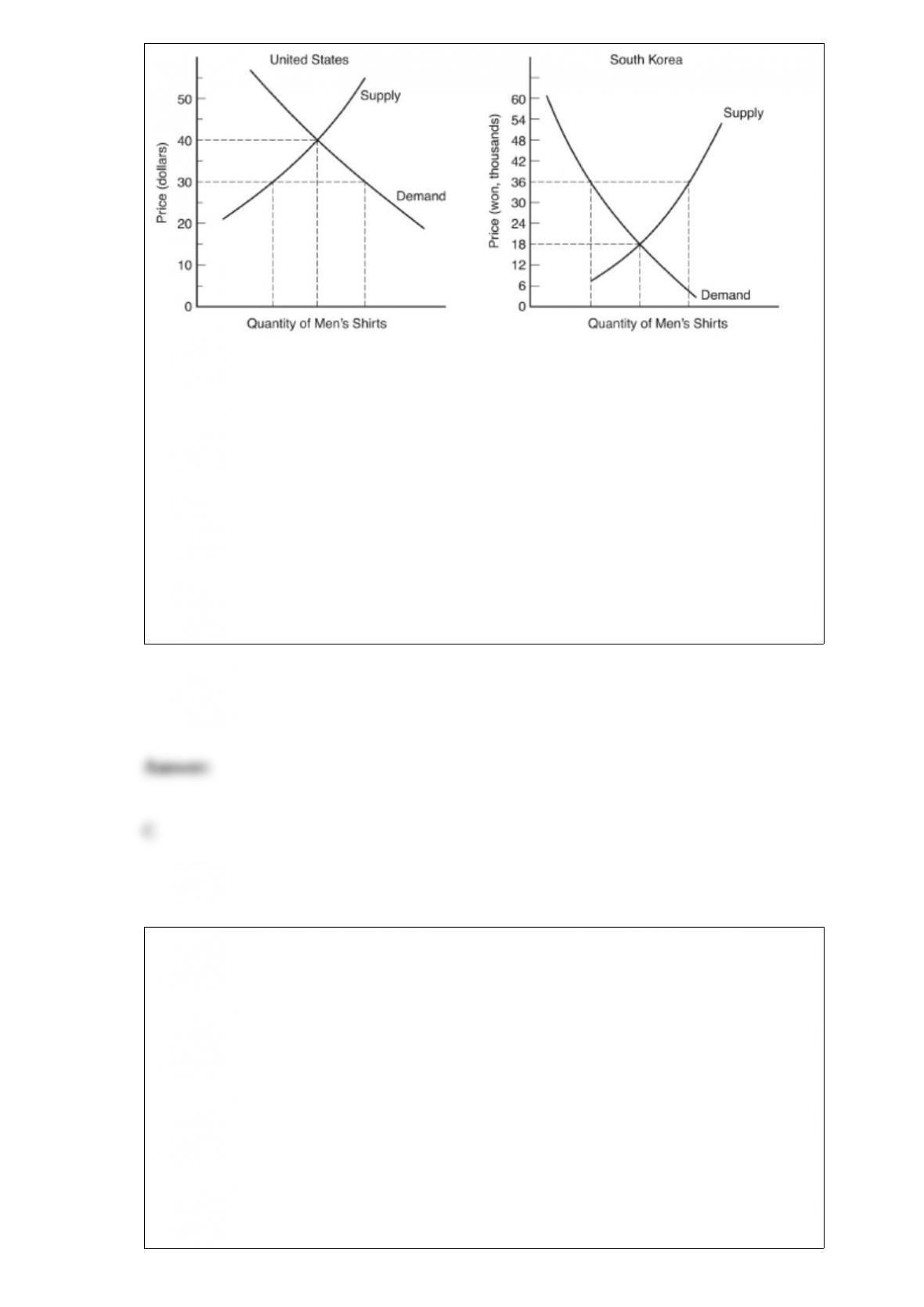
If the United States imposes a tariff on imported men’s shirts, the price of a man’s shirt
in the United States probably is
a. below $30.
b. $30.
c. between $30 and $40.
d. $40.
e. over $40.
The Fed can set the ratio of legally required reserves between the limits of 8 and 14
percent on checkable deposits. Hence, the maximum multiple by which the banking
system could theoretically expand a dollar of excess reserves would vary between
a. 2 and 3.
b. 5 and 6.
c. 8 and 14.
d. 12 and 7.
e. 14 and 6.