
1) in an open trading system, a country will import those commodities that it produces
at relatively low cost while exporting commodities that can be produced at relatively
high cost.
a.true
b.false
2) increased foreign competition tends to:
a.intensify inflationary pressures at home
b.induce falling output per worker-hour for domestic workers
c.place constraints on the wages of domestic workers
d.increase profits of domestic import-competing industries
3) important trading partners of the united states include canada, mexico, japan, and
china.
a.true
b.false
4) developing countries, such as mexico and india, often close their borders to foreign
companies unless they are willing to take on partner companies in developing countries.
a.true
b.false
5) economic sanctions are most effective in causing the target nation to modify its
behavior when the:
a.target nation had negligible economic relationships with the imposing nation prior to
the sanctions
b.people of the target nation have weak cultural ties to the people of the imposing
nation
c.sanctions are levied by a large number of nations
d.target government is supported by the majority of its people

6) as of 2002, members of the european monetary union agreed to replace their
currencies with the:
a.mark
b.dollar
c.franc
d.euro
7) international trade and investment are most frequently financed by the u.s. dollar and
the:
a.japanese yen
b.british pound
c.australian dollar
d.swiss franc
8) industrial policies
a.require formal explicit efforts by governments
b.may be implicit
c.have never been used by the u.s. government
d.both a and b
9) according to the “big mac” index, if a big mac costs $2.28 in the united states and
25.75 krone in denmark (equivalent to $4.25), the danish krone is an undervalued
currency.
a.true
b.false

10) today most industrial countries protect their industries via global import quotas
rather than selective import quotas.
a.true
b.false
11) although free trade provides benefits for consumers, it is often argued that import
protection should be provided to domestic producers of strategic goods and materials
vital to the nation’s security.
a.true
b.false
12) the terms of trade is given by:
a.(price of exports/price of imports) 100
b.(price of exports/price of imports) + 100
c.(price of exports/price of imports) 100
d.(price of exports/price of imports) 100
13) producing goods for export produces:
a.jobs
b.income
c.tariffs
d.a and b
14) figure 2.1. production possibilities schedule
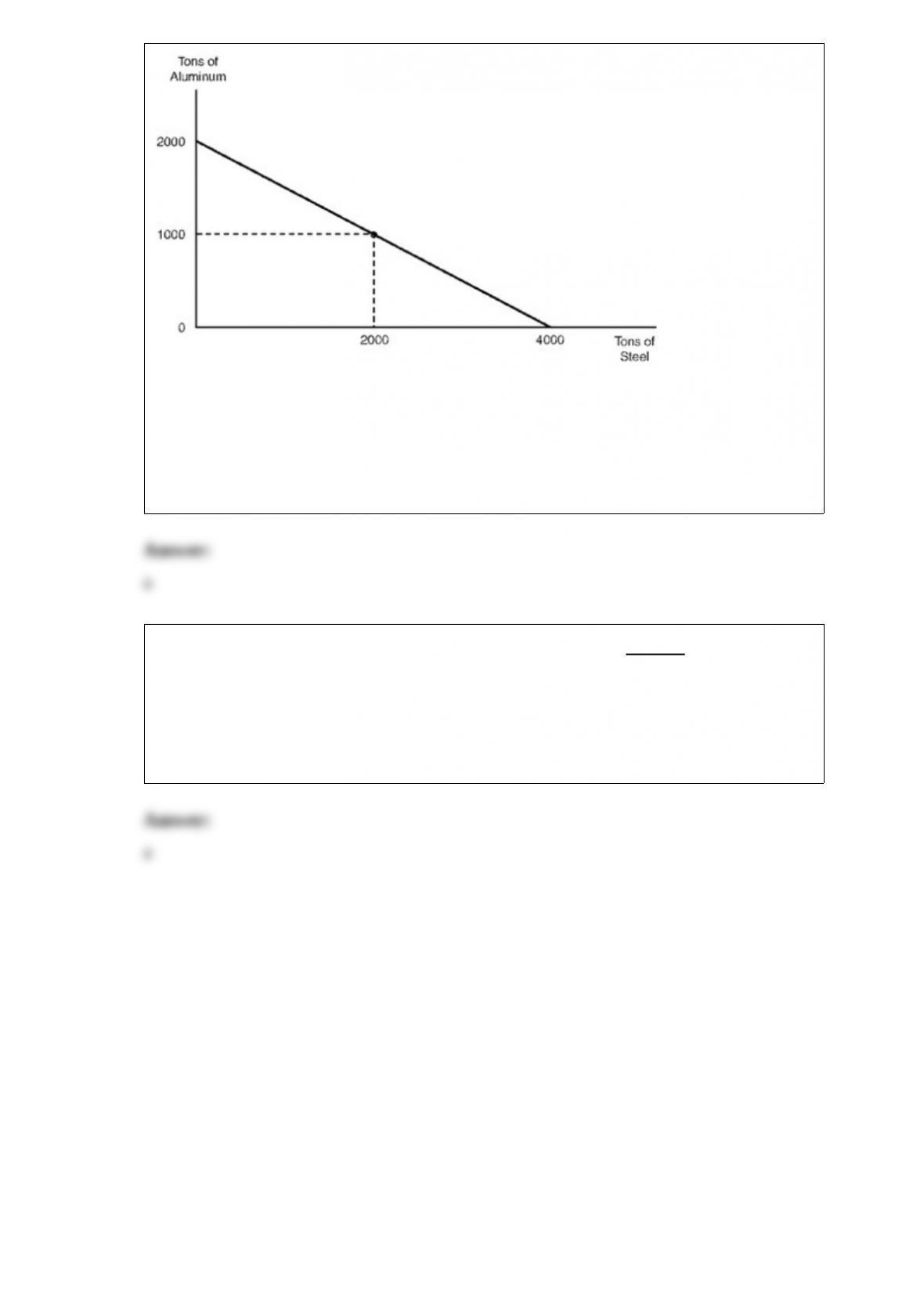
refer to figure 2.1. if the relative cost of steel were to rise, then the production
possibilities schedule would:
a.become steeper
b.become flatter
c.shift inward in a parallel manner
d.shift outward in a parallel manner
15) assume the cost of transporting autos from japan to canada exceeds the pretrade
price difference for autos between japan and canada. trade in autos is:
a.impossible
b.possible
c.highly profitable
d.moderately profitable