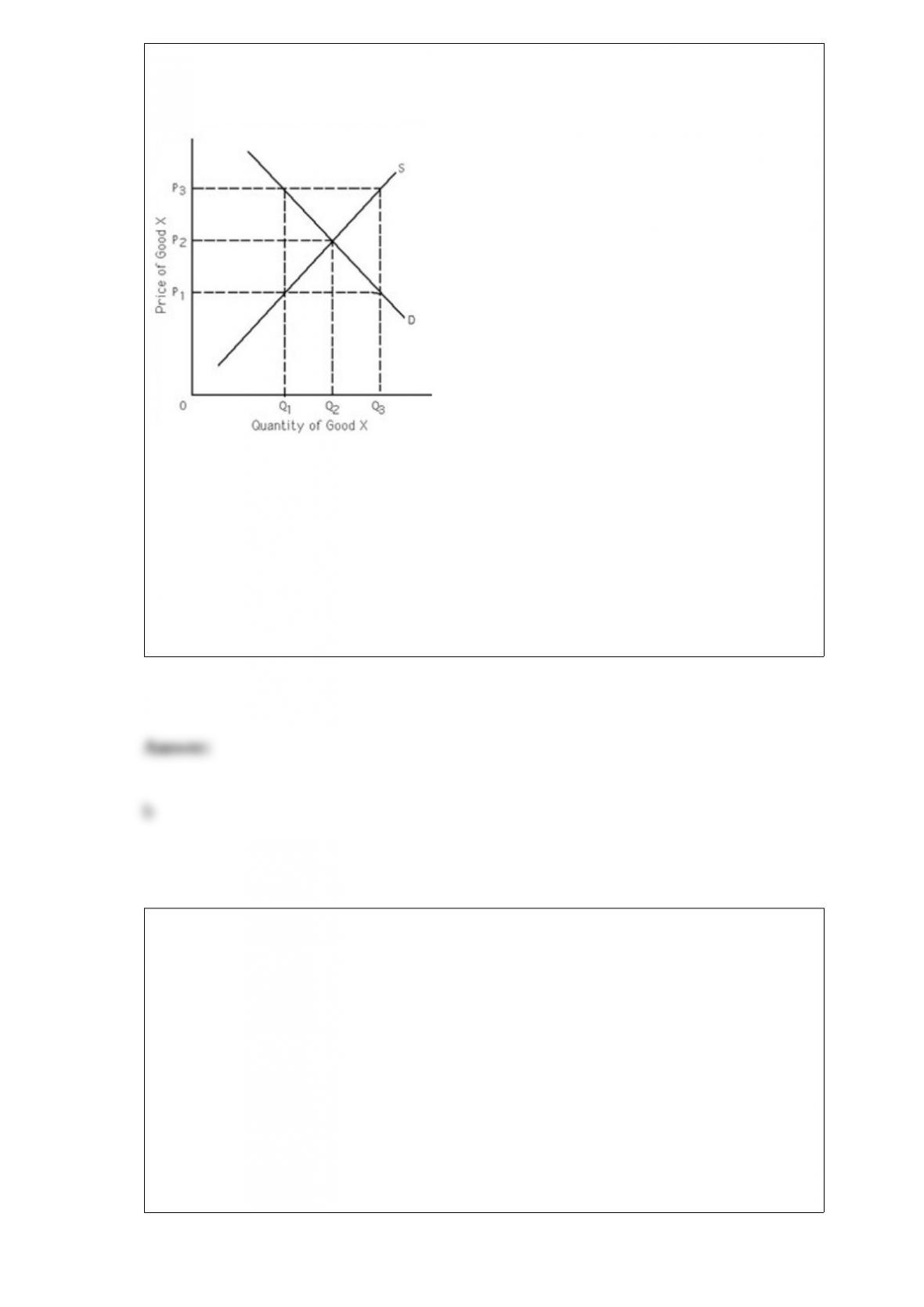
Refer to Exhibit 4-3. Which of the following is true?
Exhibit 4-3
a. If price P3 is set as a price ceiling it will have an effect on the market for good X.
b. If price P3 is set as a price floor it will have an effect on the market for good X.
c. Price P3 is the equilibrium price for good X.
d. Price P3 is the highest price that can legally be charged in the market for good X.
Given two goods, X and Y, their prices, PX and PY, a consumer is in equilibrium when
the last dollar spent on X yields
a. zero marginal utility for Y.
b. the same marginal utility as if all the money were spent on Y.
c. a smaller marginal utility than the last dollar spent on Y.
d. the same marginal utility as the last dollar spent on Y.
e. none of the above

If a perfectly competitive firm and a perfectly price-discriminating monopolist face the
same demand and cost curves, then
a. the competitive firm will attain resource-allocative efficiency, but the monopolist will
not.
b. the competitive firm will attain resource-allocative efficiency, but the monopolist
may or may not, depending upon the demand for its product.
c. the competitive firm will not attain resource-allocative efficiency, but the monopolist
will.
d. both the competitive firm and the monopolist will attain resource-allocative
efficiency.
e. neither the competitive firm nor the monopolist will attain resource-allocative
efficiency.
Refer to Exhibit 39-2. Given a target price of P1, what price does the consumer pay?
Exhibit 39-2
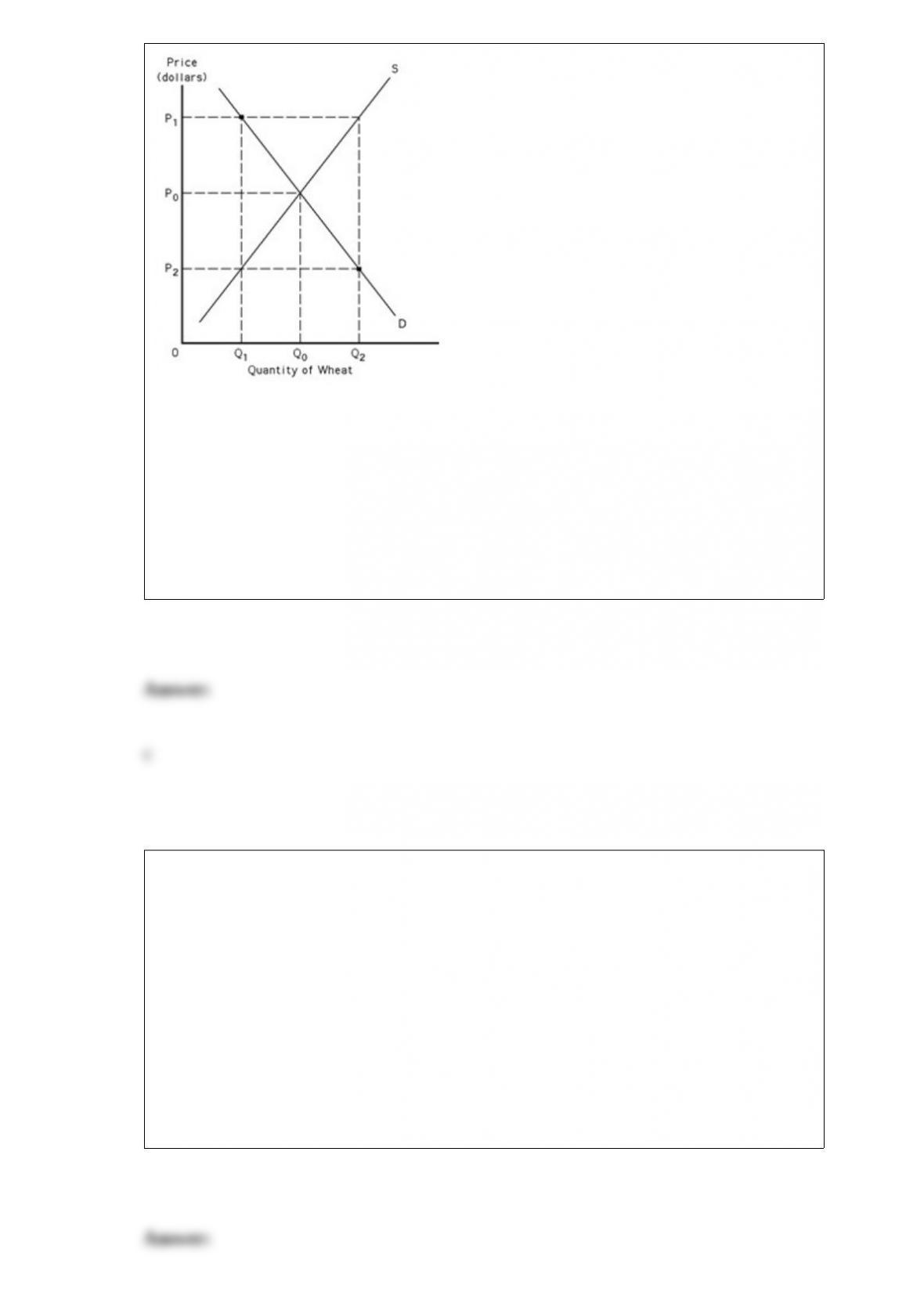
a. P1.
b. P0.
c. P2.
d. a price not shown on the diagram.
Which of the following combinations of factors comes closest to describing the
situation in agriculture?
a. elastic demand for agricultural products and large swings in supply
b. elastic demand for agricultural products and small swings in supply
c. inelastic demand for agricultural products and constant supply
d. inelastic demand for agricultural products and large swings in supply
e. none of the above

One can determine producers’ surplus if the minimum selling price and the
_____________ are known.
a. price received
b. price paid
c. tax paid
d. tax received
e. a and c
According to economists Alchian and Demsetz, firms are formed when
a. the sum of what individuals can produce as a team is greater than the sum of what
individuals can produce working alone.
b. the sum of what individuals can produce working alone is greater than the sum of
what individuals can produce as a team.
c. what each individual can produce as a member of a team is less than what each
individual can produce working alone.
d. the sum of what individuals can produce as a team is equal to the sum of what
individuals can produce working alone.
e. none of the above

Network goods such as telephones, computer operating systems and the like, will tend
to become monopolies because consumers will naturally tend to buy from the largest
supplier of the good. who will eventually become a monopoly. This monopoly position
a. automatically violates the Sherman Antitrust Act
b. violates the Sherman Antitrust Act only if the company illegally acts to maintain their
position
c. is automatically subject to FTC or state regulation and does not fall under the
Sherman Antitrust Act
d. is not covered by the Sherman Antitrust Act
The monopolistic competitive firm will most likely earn a normal profit in the long run
because of
a. product differentiation.
b. many buyers and sellers.
c. easy entry and exit.
d. b and c

You paid $25 for your ticket to the football game, only to see your favorite team losing
28-0 at the end of the first quarter. That $25 should now be regarded as a(n)
__________ cost that economists say should be __________ in your decision on
whether or not to stay at the game or leave.
a. explicit; included
b. explicit; disregarded
c. sunk; included
d. sunk; disregarded
A good is a nonexcludable if
a. its consumption by one person does not reduce its consumption by others.
b. it is impossible to prevent people from obtaining the benefits of the good once it has
been produced.
c. no negative externalities are associated with its production and consumption.
d. it is free in the first place; that is, it is so abundant that people can get all they want at
zero price.

The Taft-Hartley Act allowed the federal government laws regulating the formation of
unions to take precedence over (override) union laws enacted by the individual states.
a. True
b. False
When the government institutes a target price,
a. a surplus is created.
b. consumers must pay the target price.
c. the farmer receives a deficiency payment if the market price is below the target price.
d. the farmer receives a deficiency payment if the market price is above the target price.
e. all of the above
Refer to Exhibit 25-6. In the exhibit,
Exhibit 25-6
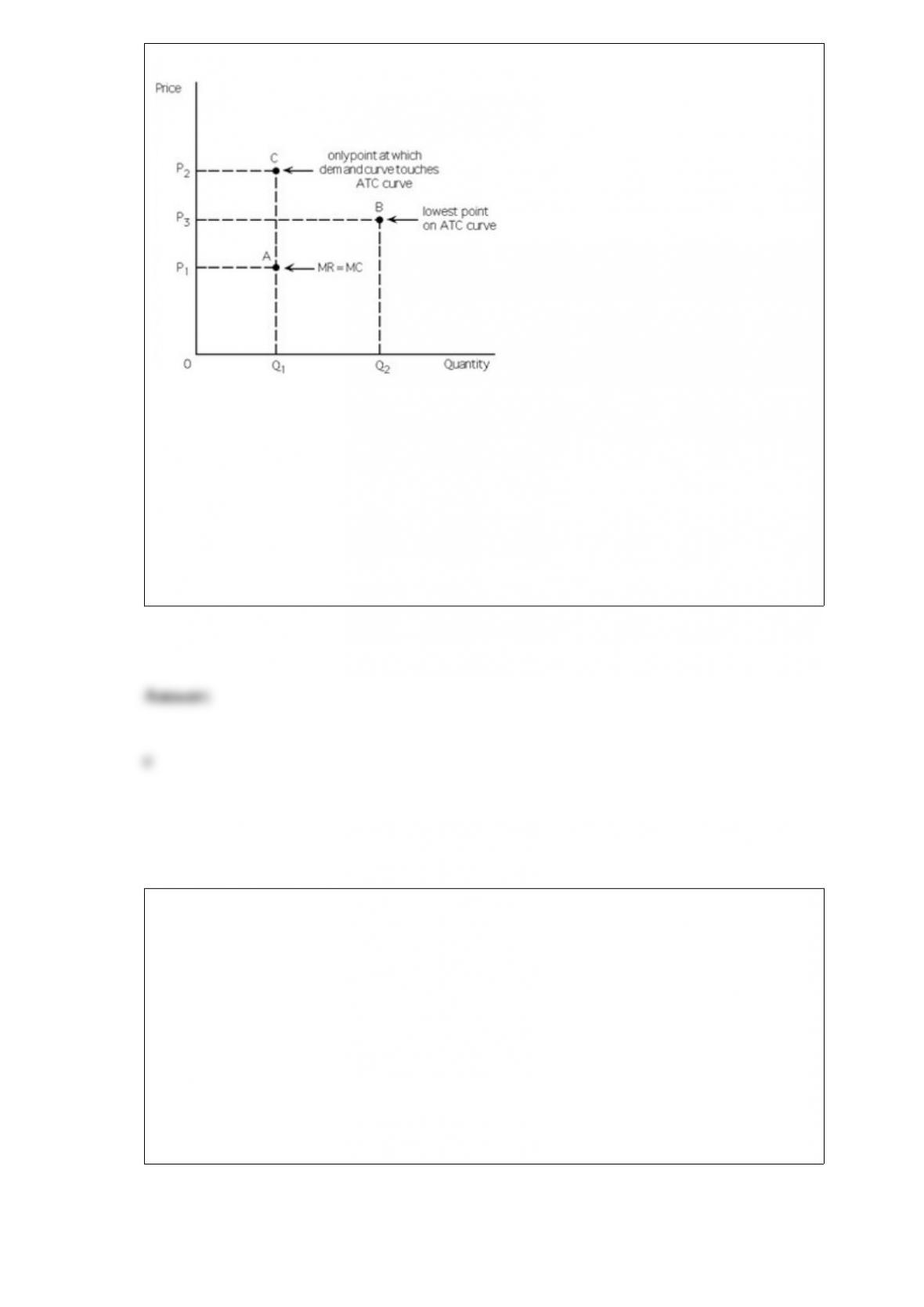
a. the demand curve and the marginal
revenue curve are the same.
b. the MC curve must have a downward-sloping portion and an upward-sloping portion.
c. the MC curve cuts the ATC curve at point B.
d. if the firm produced Q2, it would be taking a loss.
e. c and d
For the monopoly firm that does not engage in perfect price discrimination,
a. the marginal revenue curve lies below the demand curve.
b. the marginal revenue curve and demand curve are the same.
c. the marginal revenue curve lies above the demand curve.
d. marginal revenue equals price.
e. c and d
One of the reasons why economies of scale exist is that the opportunity for labor
specialization tends to increase as the size of the firm grows.
a. True
b. False
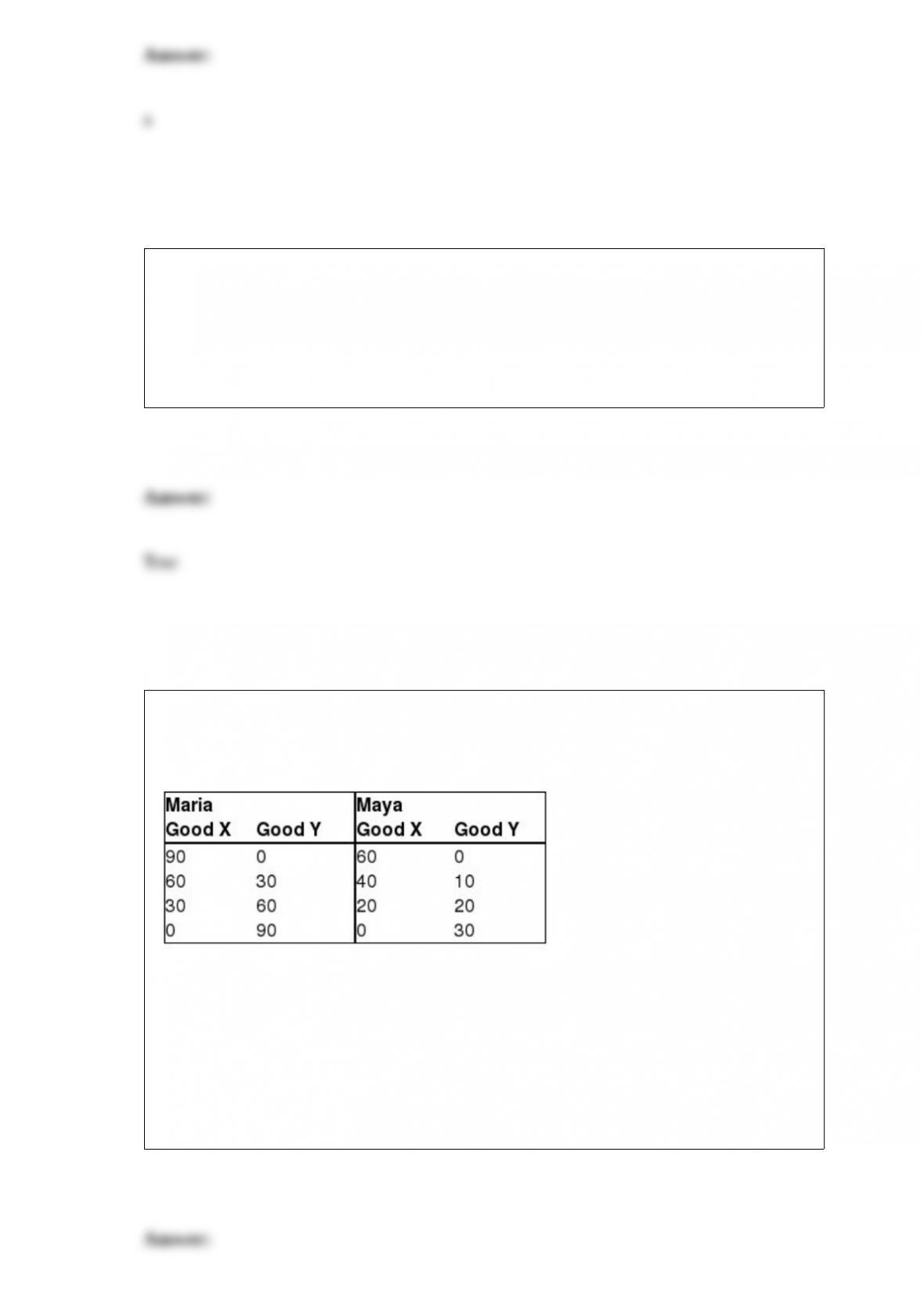
Refer to Exhibit 2-8. For Maria, the opportunity cost of producing one unit of good Y is
___________ unit(s) of good X.
Exhibit 2-8
a. 2.00
b. 1.00
c. 10.00
d. 0.50

Those who think that a popular investment is necessarily a good investment often find
themselves earning low returns.
a. True
b. False
In the prisoner’s dilemma setting for stealing and producing, both participants end up
__________, which turns out to be ________________________ stolen.The
government _________ make both participants better off by changing the payoff
matrix.
a. stealing; better for them than if they had both not; can
b. stealing; worse for them than if they had both not; can
c. not stealing; better for them than if they had both; cannot
d. not stealing; worse for them than if they had both; cannot
In year 1 the price of good X is $10 and 100 units are bought and sold. In year 2 the
price of good X is $13 and 230 units are bought and sold. What can explain this?
a. The supply of good X was higher in year 2 than in year 1 and the demand for good X

was the same in year 2 as in year 1.
b. The demand for good X was higher in year 2 than in year 1 and the supply of good X
was the same in year 2 as in year 1.
c. Both the demand for, and supply of, good X were higher in year 2 than in year 1.
d. b or c
e. a, b, or c
Suppose you are eating buffalo wings at a local happy hour. The total utils from doing
so after the fourth, fifth, sixth, and seventh wings are 30, 50, 65, 72, respectively. In this
situation we have __________ marginal utility, which is generally __________ in the
analysis of consumer choice.
a. increasing; assumed
b. increasing; not assumed
c. diminishing; assumed
d. diminishing; not assumed