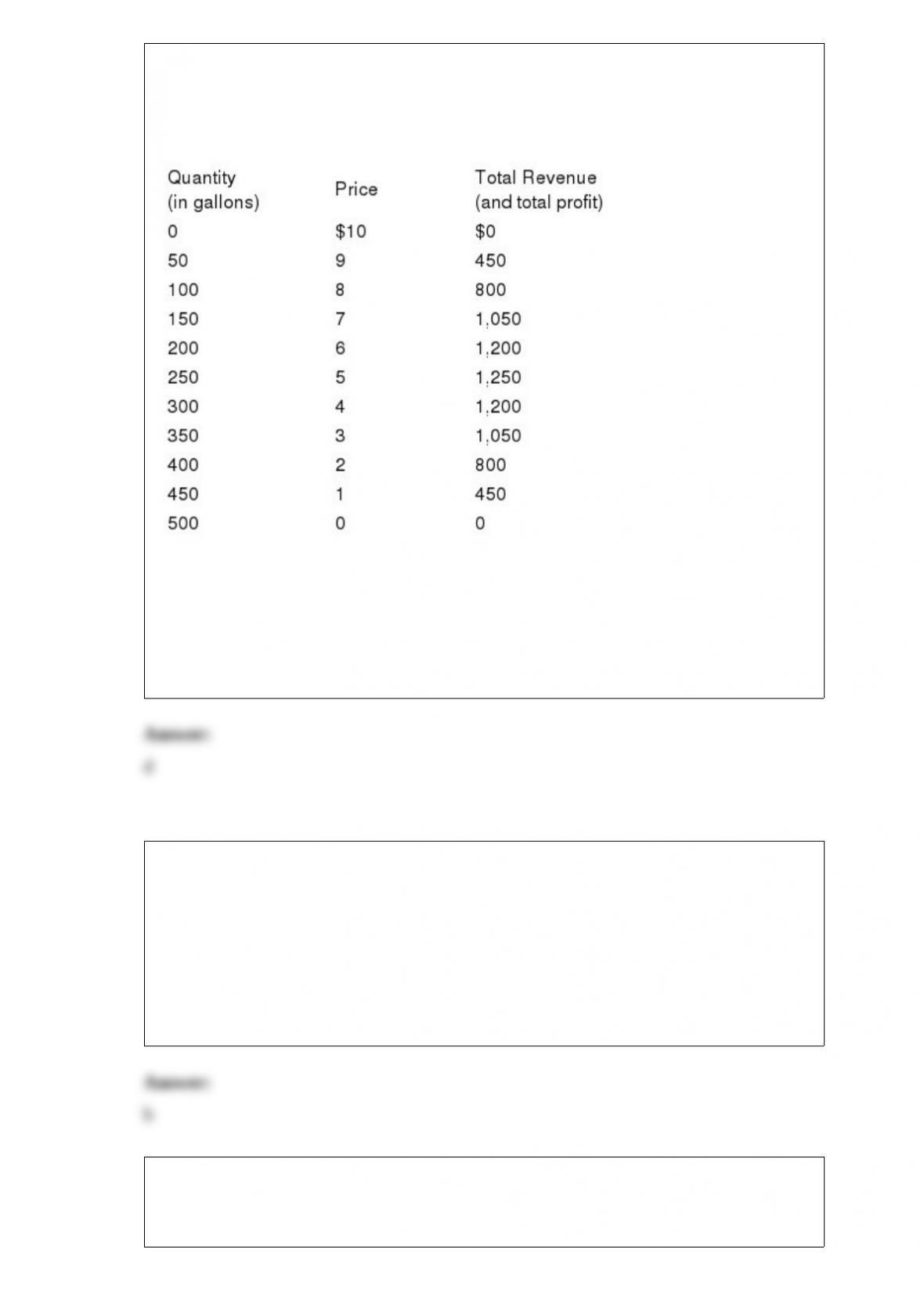
1) Table 17-4
The table shows the town of Mauston’s demand schedule for gasoline. For simplicity,
assume the town’s gasoline seller(s) incur no costs in selling gasoline.
Refer to Table 17-4. If the market for gasoline in Mauston is perfectly competitive,
then the equilibrium price of gasoline is
a.$7 and the equilibrium quantity is 150 gallons.
b.$5 and the equilibrium quantity is 250 gallons.
c.$3 and the equilibrium quantity is 350 gallons.
d.$0 and the equilibrium quantity is 500 gallons.
2) Milk has an inelastic demand, and beef has an elastic demand. Suppose that a
mysterious increase in bovine infertility decreases both the population of dairy cows
and the population of beef cattle by 50 percent.
The change in equilibrium quantity will be
a.greater in the milk market than in the beef market.
b.greater in the beef market than in the milk market.
c.the same in the milk and beef markets.
d.Any of the above could be correct.
3) Which of the following statements is not correct?
a.Part of the deadweight loss associated with monopoly is measured by the monopolist’s
economic profit.
b.Marginal cost is always less than average total cost in a natural monopoly.
c.Discount coupons available free to the public are a type of price discrimination.
d.Anti-trust laws make it harder for firms to create synergies.
4) Scenario 20-4
Suppose the government implemented a negative income tax and used the following
formula to compute a family’s tax liability:
Taxes owed = (1/5 of income) – $15,000
Refer to Scenario 20-4. A family earning $50,000 before taxes would have how much
after-tax income?
a.-$5,000
b.$40,000
c.$45,000
d.$55,000
5) For the purpose of protecting the environment, upon which of the following
approaches do we rely more and more as time goes by?
a.adherence to the notion of the invisible hand
b.command-and-control policies
c.the development and enforcement of regulations
d.the requirement that decision makers bear the full costs of their actions
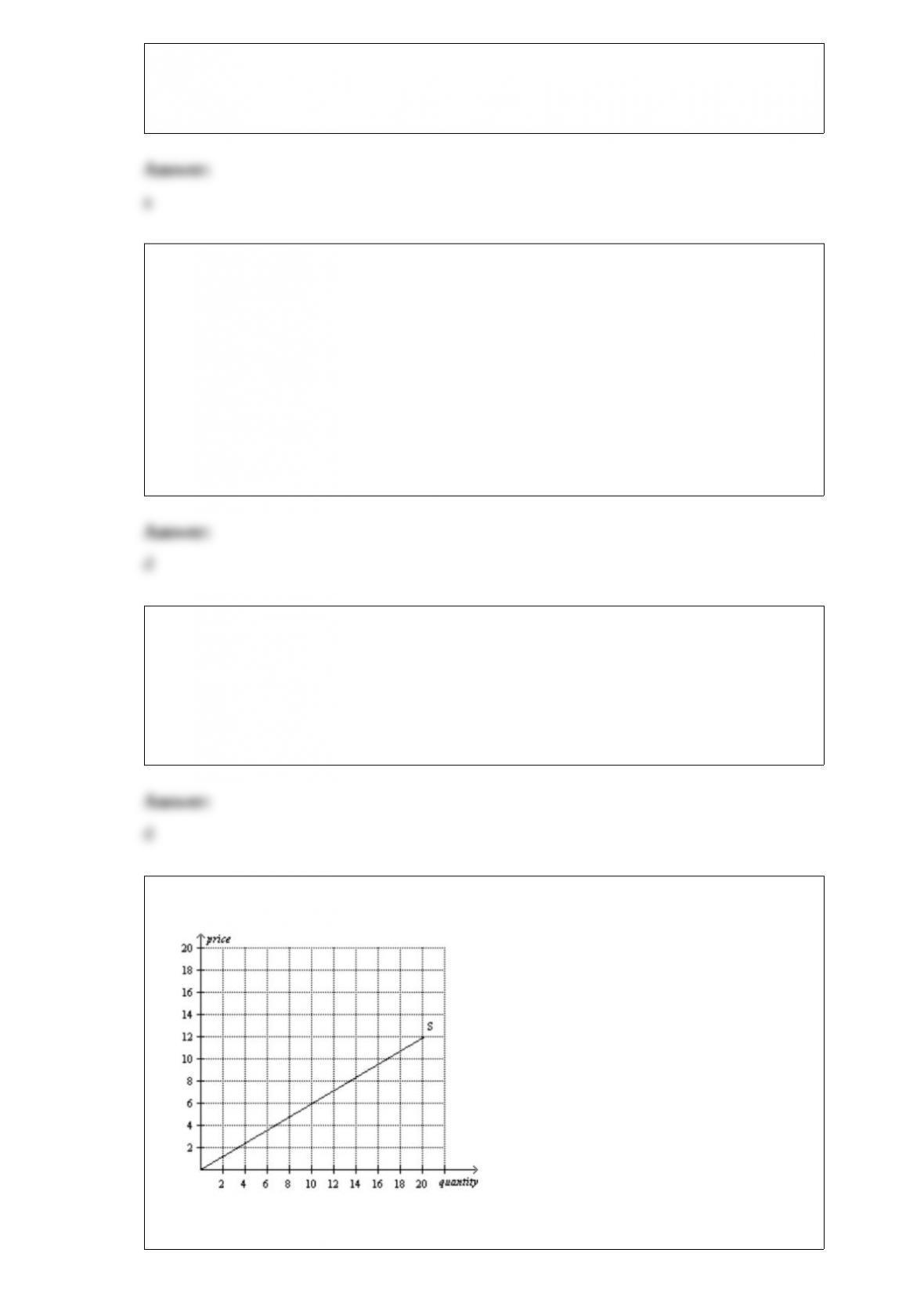
6) Firm A
Firm B
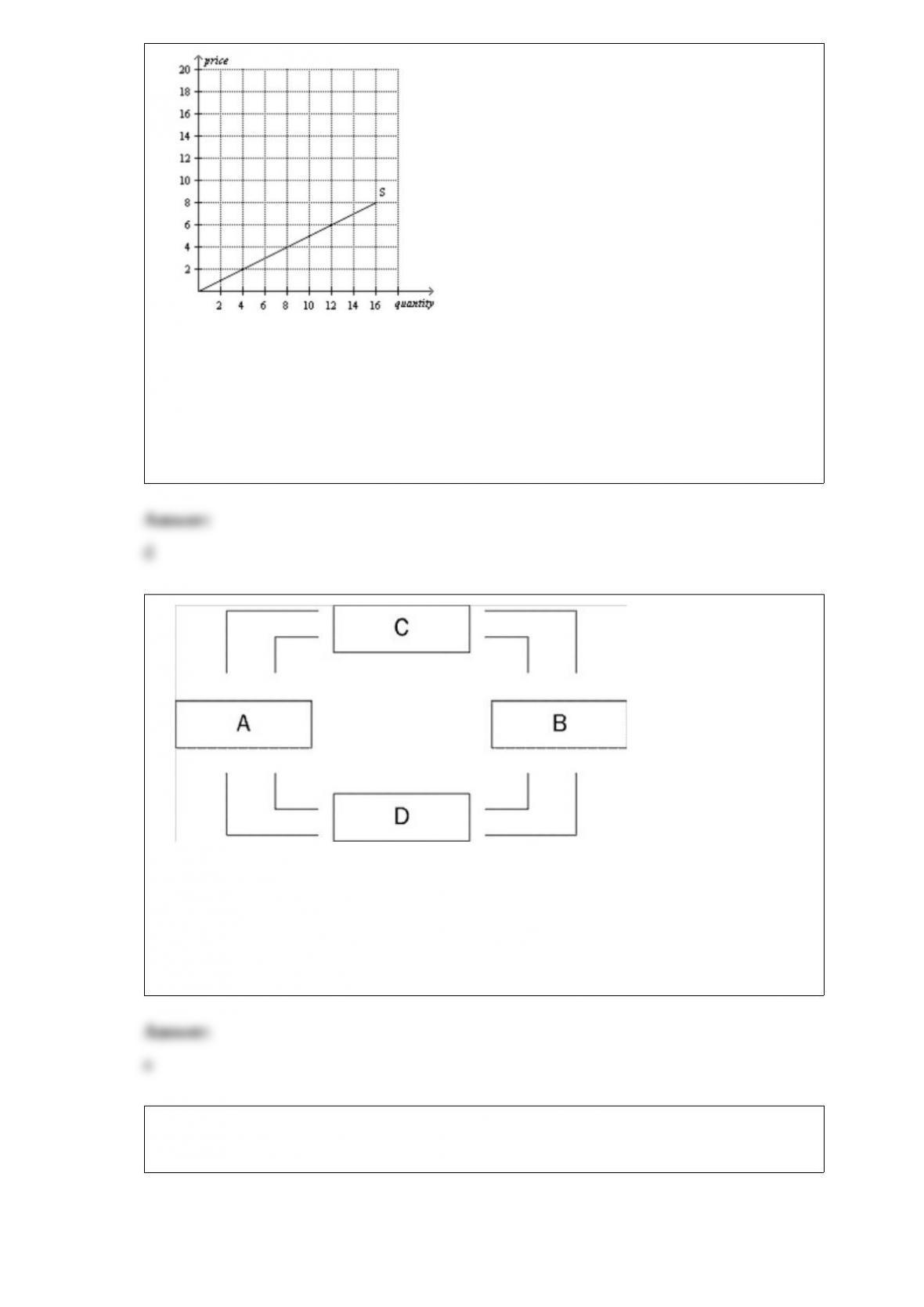
If these are the only two sellers in the market, then the market quantity supplied at a
price of $4 is
a.6 units.
b.7 units.
c.8 units.
d.14 units.
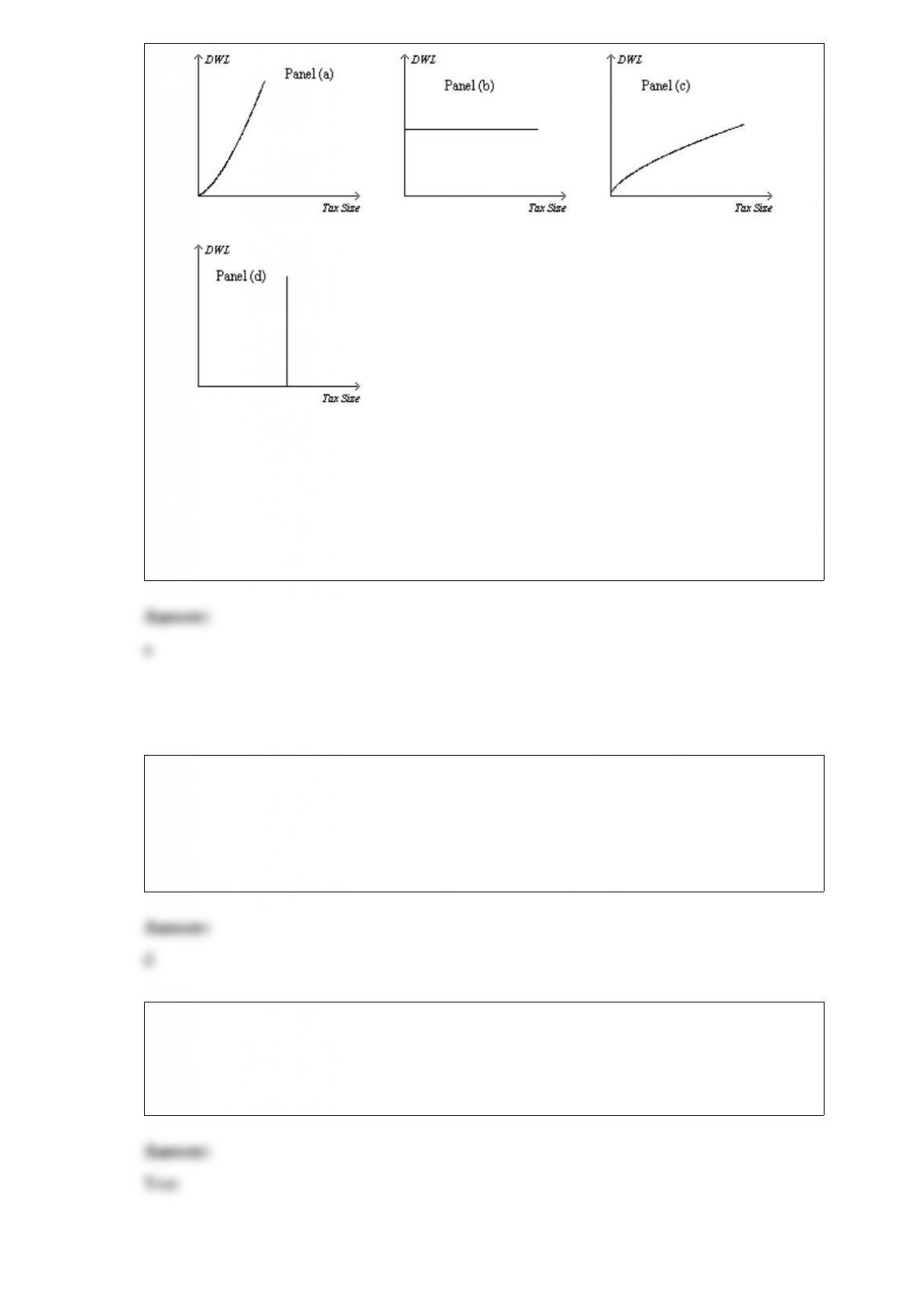
7)
If Box A of this circular-flow diagram represents firms, then which box represents
households?
a.Box B
b.Box C
c.Box D
d.Any one of the other boxes (B, C, or D) could represent households.
8) Figure 8-20
On the vertical axis of each graph, DWL is deadweight loss.
Which graph correctly illustrates the relationship between the size of a tax and the size
of the deadweight loss associated with the tax?
a.Panel (a)
b.Panel (b)
c.Panel (c)
d.Panel (d)
9) Which of the following is a decision that economists study?
a.how much people work
b.what people buy
c.how much money people save
d.All of the above are correct.
10) Policymakers have generally come to accept the view that advertising enhances the
efficiency of markets.
a.True
b.False
11) Suppose society consists of three individuals: Phil, Jay, and Mitchell. Phil has
$60,000 of income, Jay has $200,000 of income, and Mitchell has $100,000 of income.
A utilitarian would argue that
a.taking $1 from Mitchell and giving it to Phil would increase society’s total utility.
b.taking $1 from Mitchell and giving it to Jay would increase society’s total utility.
c.taking $1 from Phil and giving it to Jay would increase society’s total utility.
d.None of the above are correct because all three individuals have sufficient income.
12) A discovery that increases wheat yields per acre hurts farmers by increasing supply
and lowering their total revenues.
a.True
b.False
13) A concentration ratio
a.measures the percentage of total output supplied by the four largest firms in the
industry.
b.reflects the level of competition in an industry.
c.is related to the control that each firm has over price.
d.All of the above are correct.
14) In the long run a company that produces and sells dog beds incurs total costs of
$1,200 when output is 30 beds and $1,600 when output is 40 beds. Firm A exhibits
a.diseconomies of scale because total cost is rising as output rises.
b.constant returns to scale because average total cost is constant as output rises.
c.diseconomies of scale because average total cost is rising as output rises.
d.economies of scale because average total cost is falling as output rises.
15) Studies of human decision making have found that people are reluctant to change
their minds.
a.True
b.False