
1) Shirking refers to the behavior of workers who provide less-than-expected effort on
the job.
2) the business cycle is so named because upswings and downswings in business
activity are equal in terms of duration and intensity.
3) Demographers expect world population to decline in the next century.
4) health care is an inferior good.
5) Granting property rights to forest land tends to increase the rate at which the land is
deforested.
6) The crowding-out effect refers to the possibility that deficit spending may motivate
people to increase their saving in anticipation of higher future taxes.
7) Tariffs create larger gains to domestic producers than losses to domestic consumers.
8) The most important growth obstacle common to all DVCs is the lack of desire to
increase their standards of living.
9)
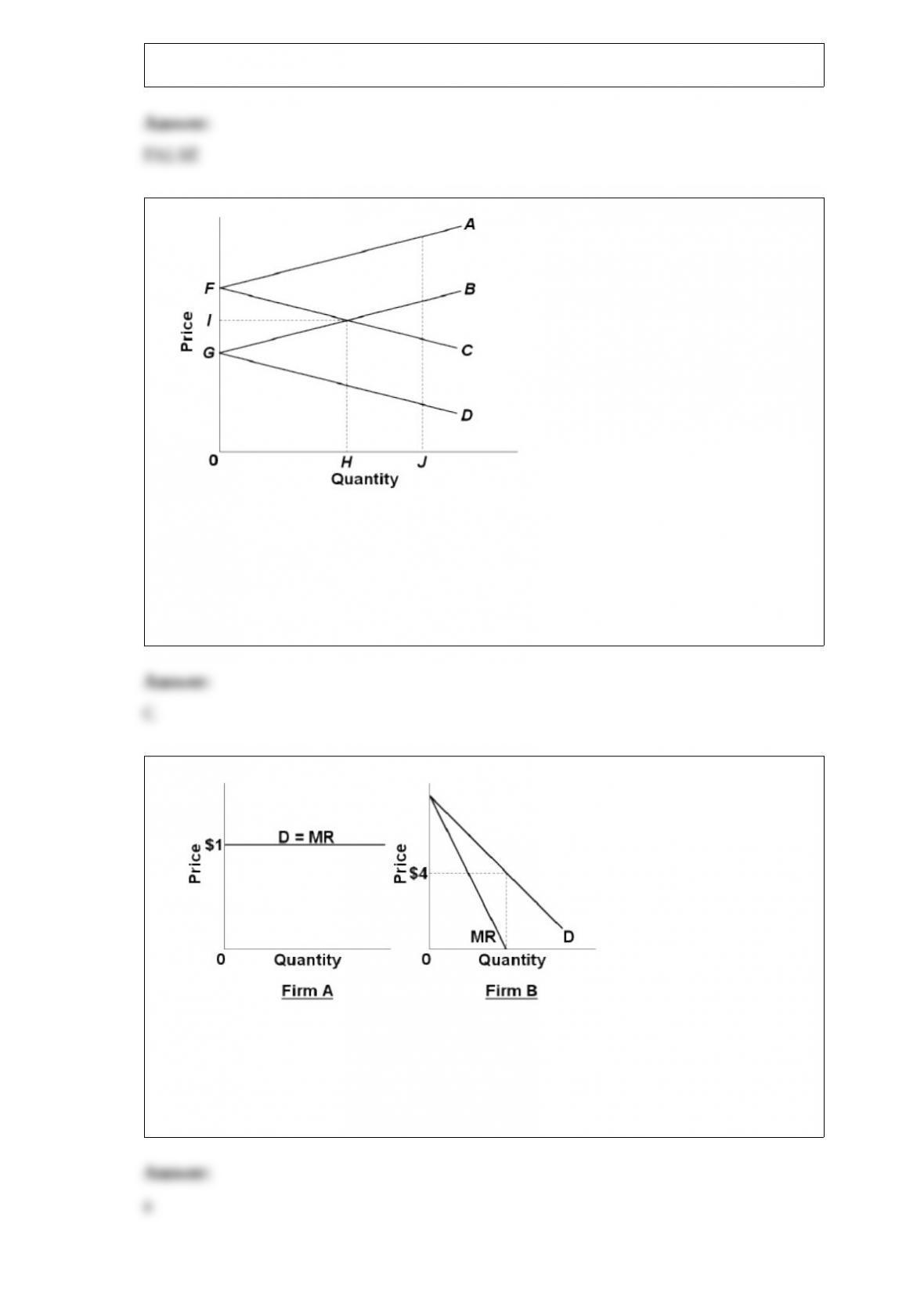
Refer to the above diagram pertaining to two nations and a specific product. Lines FC
and GD are:
A.domestic supply curves for two countries.
B.domestic demand curves for two countries.
C.import demand curves for two countries.
D.export supply curves for two countries.
10)
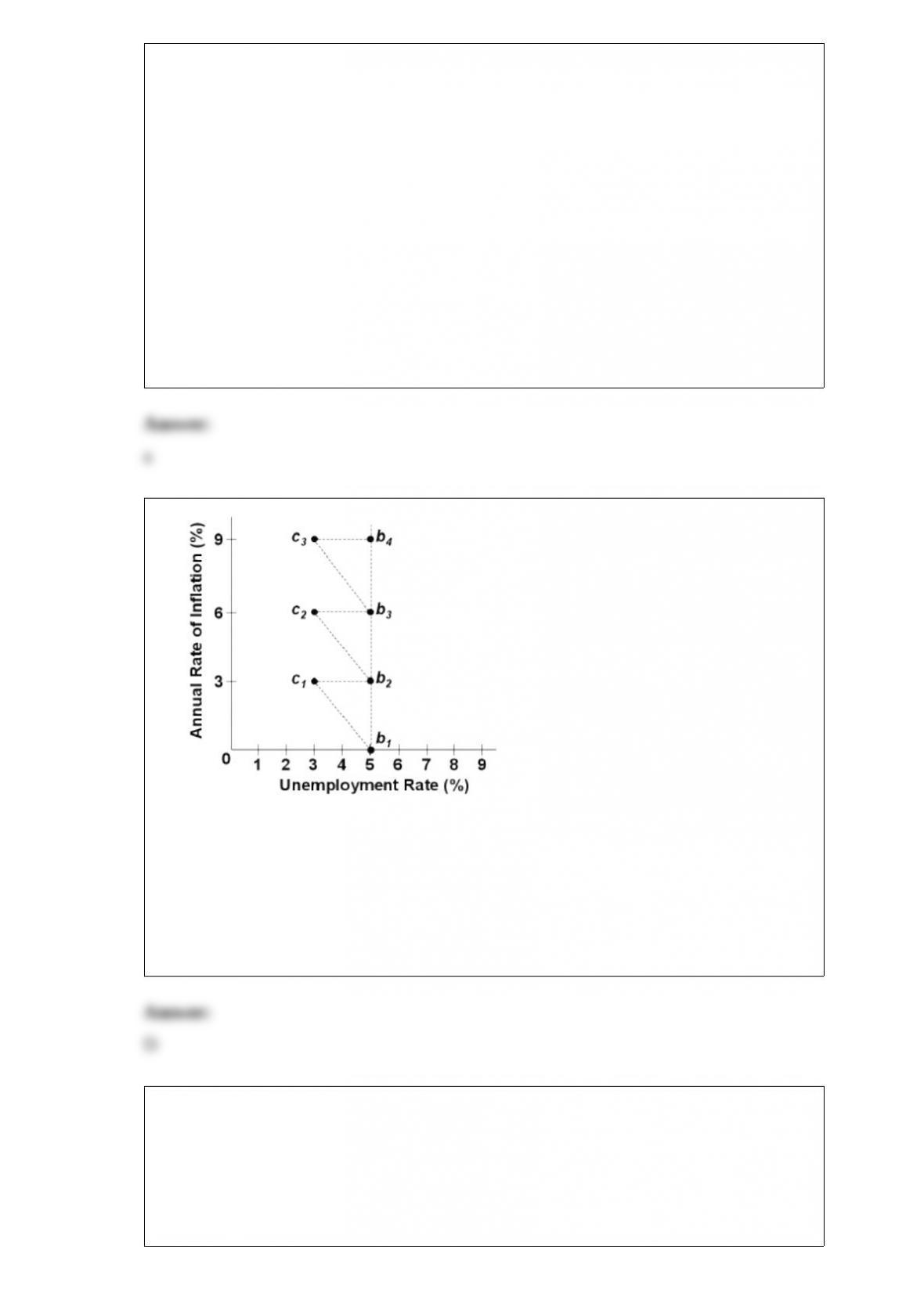
refer to the above diagrams. the demand for firm a’s product is:
a.perfectly elastic over all ranges of output.
b.perfectly inelastic over all ranges of output.
c.elastic for prices above $1 and inelastic for prices below $1.
d.inelastic for prices above $1 and inelastic for prices below $1.
11) the following is cost information for the creamy crisp donut company:
entrepreneur’s potential earnings as a salaried worker = $50,000
annual lease on building = $22,000
annual revenue from operations = $380,000
payments to workers = $120,000
utilities (electricity, water, disposal) costs = $8,000
value of entrepreneur’s talent in the next best entrepreneurial activity = $80,000
entrepreneur’s forgone interest on personal funds used to finance the business = $6,000
refer to the above data. creamy crisp’s total economic costs (explicit + implicit costs,
including a normal profit) are:
a.$286,000.
b.$150,000.
c.$94,000.
d.$156,000.
12)
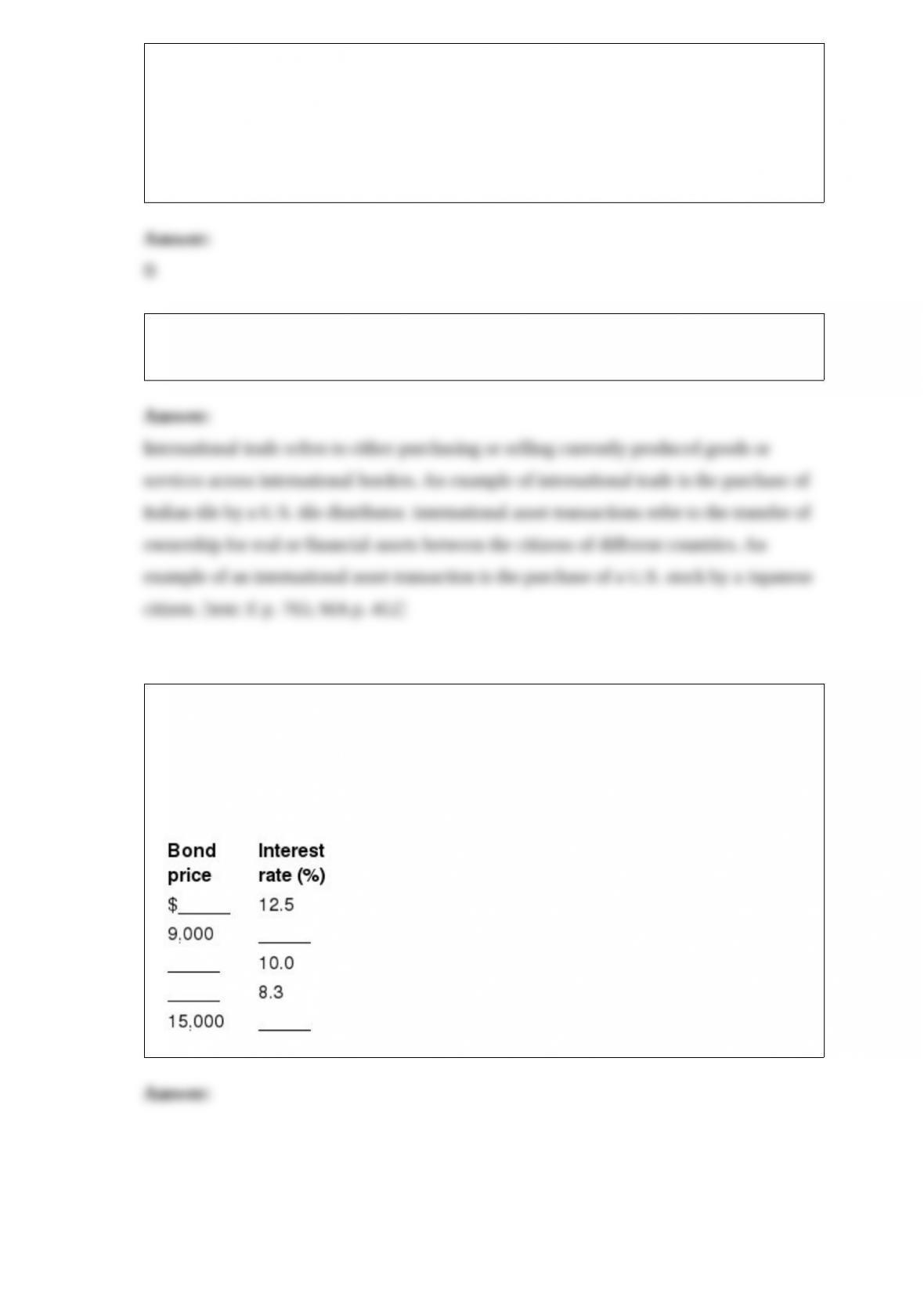
Refer to the above diagram and assume the economy is initially at point b1. Point c1
represents:
A.a stable position because reality and expectations are consistent.
B.a stable position because full employment and a constant annual inflation rate are
represented.
C.an unstable situation because government will undertake contractionary policies.
D.an unstable situation because nominal wage rates will increase.
13) what percentage of the u.s. adult population has at least a high school education (as
of 2007)?
a.41 percent
b.75 percent
c.86 percent
d.95 percent

14) which of the following statements is correct? unanticipated inflation:
a.arbitrarily “taxes” fixed-income groups.
b.increases the real value of savings.
c.increases the purchasing power of the dollar.
d.benefits creditors at the expense of debtors.
15) An important routine function of the Federal Reserve Bank is to:
A.supervise the liquidation of the assets of bankrupt state banks.
B.help large commercial banks develop correspondent relationships with smaller
commercial banks.
C.advise commercial banks as to the most profitable ways of reinvesting profits.
D.provide facilities by which commercial banks and thrift institutions may collect
checks.
16) a constant-cost industry is one in which:
a.a higher price per unit will not result in an increased output.
b.if 100 units can be produced for $100, then 150 can be produced for $150, 200 for
$200, and so forth.
c.the demand curve and therefore the unit price and quantity sold seldom change.
d.the total cost of producing 200 or 300 units is no greater than the cost of producing
100 units.
17) inflows of immigrant workers tend to reduce the wages of domestic-born workers.
under which of the following circumstances is this least likely to occur?
a.migration between countries is unimpeded.
b.immigrant workers make remittances to their home country.
c.immigrant workers and domestic-born workers are substitute resources.
d.immigrant workers and domestic-born workers are complementary resources.
18) If the top quintile (fifth) of all households receives 48 percent of total income and
the lowest quintile receives 4 percent of total income, we can conclude that:
A.the resulting Lorenz curve will be a 45-degree straight line.
B.the top quintile receives twelve times as much income as the lowest quintile.
C.the middle quintile must receive 60 percent of all income.
D.government must be subsidizing the top quintile.
19) Contrast and give examples of international trade and international asset
transactions.
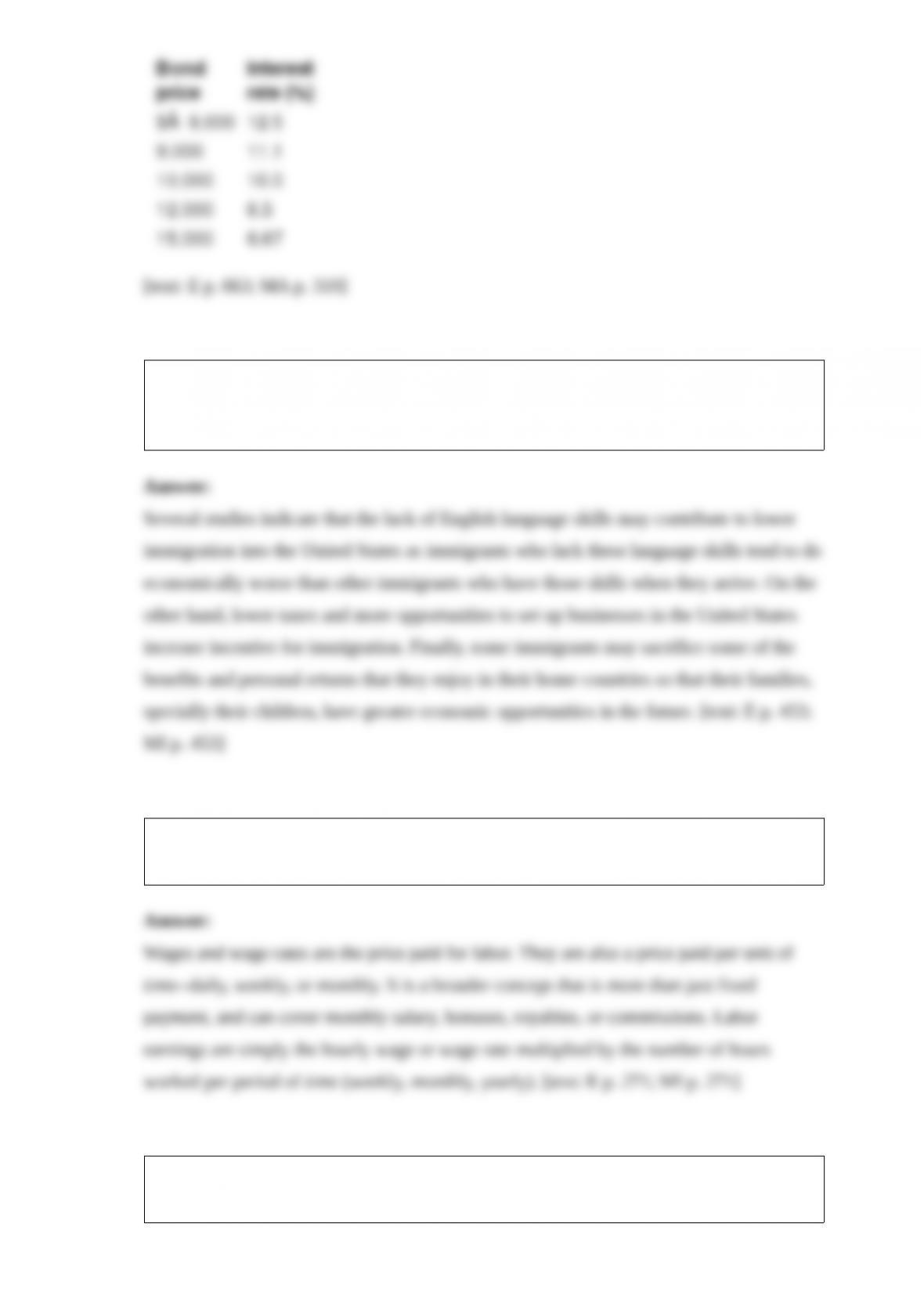
20) Suppose that a bond having no expiration date has a face value of $10,000 and pays
a fixed amount of interest of $1000 annually. Compute and enter in the spaces provided
either the effective interest rate which a bond buyer could receive at the new price or
the bond price (rounded to the nearest $1000) required to receive the interest rate
shown.
21) Identify at least two factors, other than distance and the age of prospective
migrants, that may affect the cost and benefit calculations of emigrants to the United
States.
22) What do wages and wage rates mean in economics? How do they differ from labor
earnings?
23) How does technological advance enhance economic efficiency? Distinguish
between its effects on productive efficiency and allocative efficiency.

24) Money is what money does. Explain.
25) What are some of the theories that economists have developed as to why business
cycles occur?
26) Job discrimination may actually result from rational decision making on the part of
firms and not because of prejudice. Explain this statement.