
1) Which of the following groups has the lowest poverty rate?
A.married-couple families
B.whites
C.foreign-born (not citizens)
D.African-Americans
2) In 1993 the Federal government boosted income tax rates. In the seven years that
followed:
A.tax revenues fell slightly.
B.productivity growth slowed.
C.the unemployment rate increased.
D.tax revenues expanded rapidly.
3) Which of the following problems will most likely occur with a system of flexible
exchange rates?
A.Macroeconomic instability as exports and imports fluctuate with the exchange rates.
B.Government favoritism toward selected importers of goods and services.
C.The emergence of black markets for foreign currency.
D.Distortions in trade patterns away from the pattern suggested by comparative
advantage.
4) north korea’s command economy:
a.is one of the few remaining command economies.
b.has grown much faster than south korea since the two countries were divided after
world war ii.
c.produces a per capita gdp of nearly $25,000.
d.has undergone significant market reforms and is now one of the fastest growing
economies.
5) Consider the following situations. Explain how prices and output will adjust
according to the classical view of self-correction and the rational expectation theory.
(a)Development of a new microchip improves computer efficiency and causes a boom
in investment in the technology.
(b)Congress approves a large tax rate increase for personal taxes. Consumers expect
prices to decline as a result.
(c)A recent political conflict causes a rise in anti-American sentiment and demand for
U.S. goods abroad declines.
6) A bank that has liabilities of $150 billion and a net worth of $20 billion must have:
A.excess reserves of $130 billion.
B.assets of $150 billion.
C.excess reserves of $150 billion.
D.assets of $170 billion.
7) Occupational licensing can best be understood in terms of:
A.the inclusive unionism model.
B.the exclusive unionism model.
C.the bilateral monopoly model.

D.the monopsony model.
8) Irving Tiller exclusively grew wheat in each of the past three years. Under the Food,
Conservation, and Energy Act of 2008, Tiller:
A.must grow wheat in the current year in order to receive direct payments from the
Federal government.
B.can grow whatever crop he wants to in the current year but will only receive direct
payments from the Federal government if the price of wheat falls below a targeted
price.
C.can grow whatever crop he wants in the current year and will still receive direct
payments from the Federal government based on his previously grown wheat crops.
D.must grow something other than wheat to qualify for direct payments from the
Federal government.
9) assume the price of product y (the quantity of which is plotted on the vertical axis) is
initially $15 and the price of x (the quantity of which is plotted on the horizontal axis) is
initially $3. assume money income is initially $60. if the prices of y and x now increase
to $30 and $6 respectively and money income increases to $120, then the budget line
will:
a.shift rightward and become steeper.
b.shift rightward and become flatter.
c.shift rightward, but its slope will not change.
d.be unchanged.
10) In terms of aggregate supply, a period in which nominal wages and other resource
prices are unresponsive to price-level changes is called the:
A.long run.
B.short run.
C.immediate market period.
D.very long run.

11) Unlike a private good, a public good:
A.has no opportunity costs.
B.has benefits available to all, including nonpayers.
C.produces no positive or negative externalities.
D.is characterized by rivalry and excludability.
12) Which is correct?
A.Wealth is less equally distributed than income and therefore increases income
inequality.
B.Wealth is more equally distributed than income and therefore increases income
inequality.
C.Wealth is less equally distributed than income and therefore decreases income
inequality.
D.Wealth is more equally distributed than income and therefore decreases income
inequality.
13) Using the balance sheet below and assuming a required reserve ratio of 33%,
answer the following: (a) What is the amount of excess reserves? (b) This bank can
safely expand its loans by what amount? (c) By expanding its loans by this amount in
part (b), its checkable deposits would expand to what amount (if all loans were made to
checking account customers)? (d) If checks clear against the bank equal to the amount
loaned in (b), how much would remain in reserves and in checkable deposits?
14) The initial values for expected returns, R&D and interest-rate cost for an energy
companys investment in developing alternative fuels are listed in the table below. Using
this information, answer the following questions.
(a)What is the equilibrium level of return and R&D?
(b)Suppose that the energy companys credit rating plummets after it is exposed for
using unethical accounting practices. How will this affect the expected-rate-of-return
curve and interest-rate cost of funds?
(c)Suppose the interest-rate cost of funds curve shifts upward by 10%. What will be the
new equilibrium rate of return and level of R & D investment?
(d)Suppose that the increased cost of oil has increased the demand for alternative fuels.
How will this affect the interest-rate cost of funds and expected return curves?
(e)Suppose the expected-rate-of-return curve shifts outward by 10%. What will be the
new equilibrium level of R&D and expected rate of return? (Assume the interest-rate
cost of funds is 15%.)
15) The impact of monetary policy on investment spending may be weakened:
A.because of the Treasury’s desire for high interest rates.
B.if the rate at which dollars are spent changes in the same direction as the money
supply.
C.if the investment-demand curve shifts to the right during inflation and to the left
during recession.
D.if the investment-demand curve is very flat.
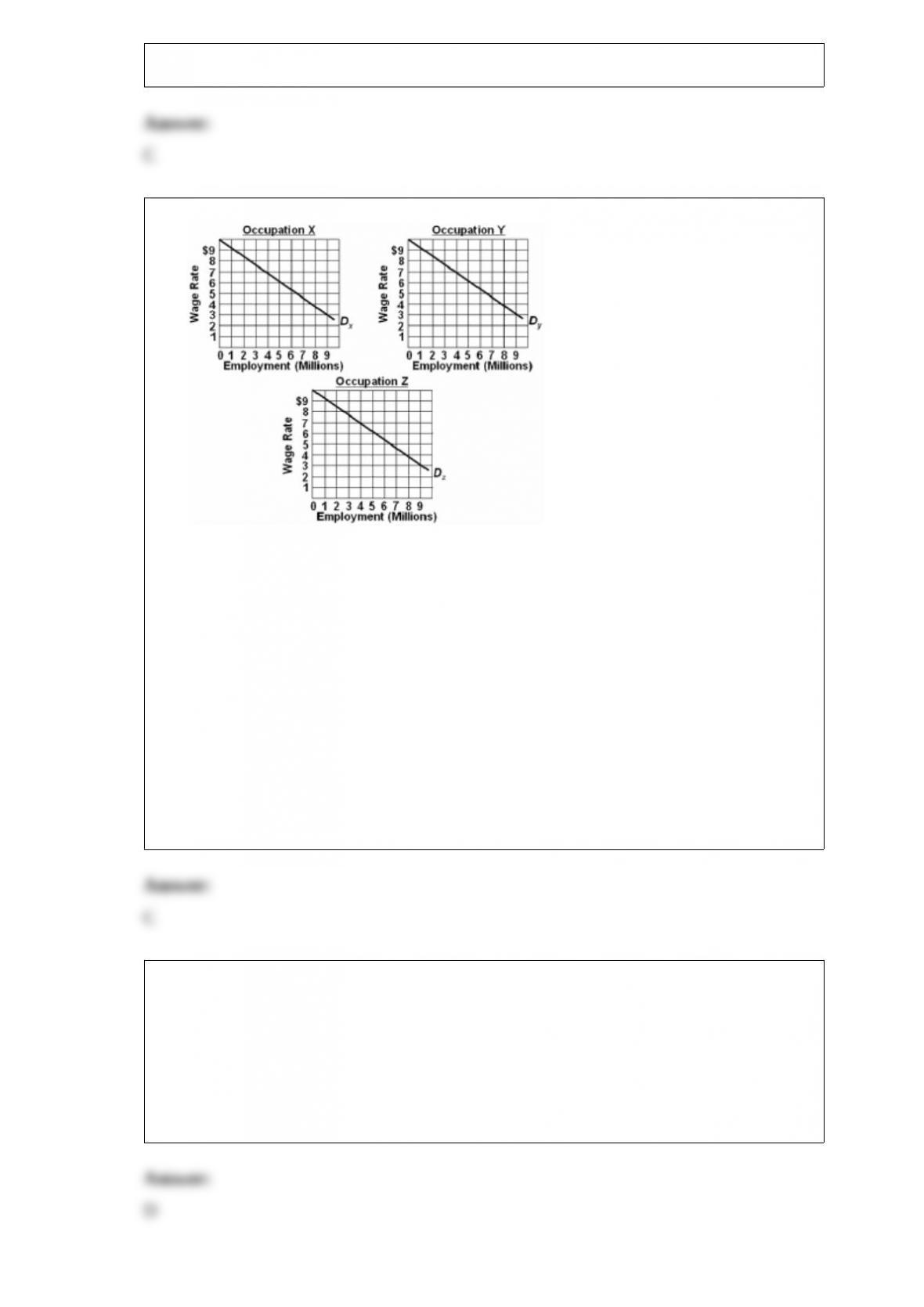
16)
Assumptions: (1) the labor force is comprised of 9 million men and 9 million women
workers; (2) the economy has 3 occupations, X, Y, and Z, each having identical demand
curves for labor; (3) men and women workers are homogeneous with respect to their
labor-market capabilities; (4) women are discriminated against by being excluded from
occupations X and Y and are confined to Z; and (5) aside from discrimination, the
economy is competitive.
Refer to the above diagram and list of assumptions. The allocation of employment
determined in the previous question will result in which of the following wage
structures?
A.Men and women will both be paid $5.
B.Men will be paid $5 and women $4.
C.Men will be paid $6.50 and women $3.
D.Women and men will both be paid $6.50.
17) A monopsonistic employer’s marginal resource (labor) cost curve:
A.is always more elastic than the labor supply curve.
B.coincides with the labor supply curve.
C.lies below the labor supply curve because the higher wage paid to an additional
worker must also be paid to all other employed workers.
D.lies above the labor supply curve because the higher wage paid to an additional
worker must also be paid to all other employed workers.
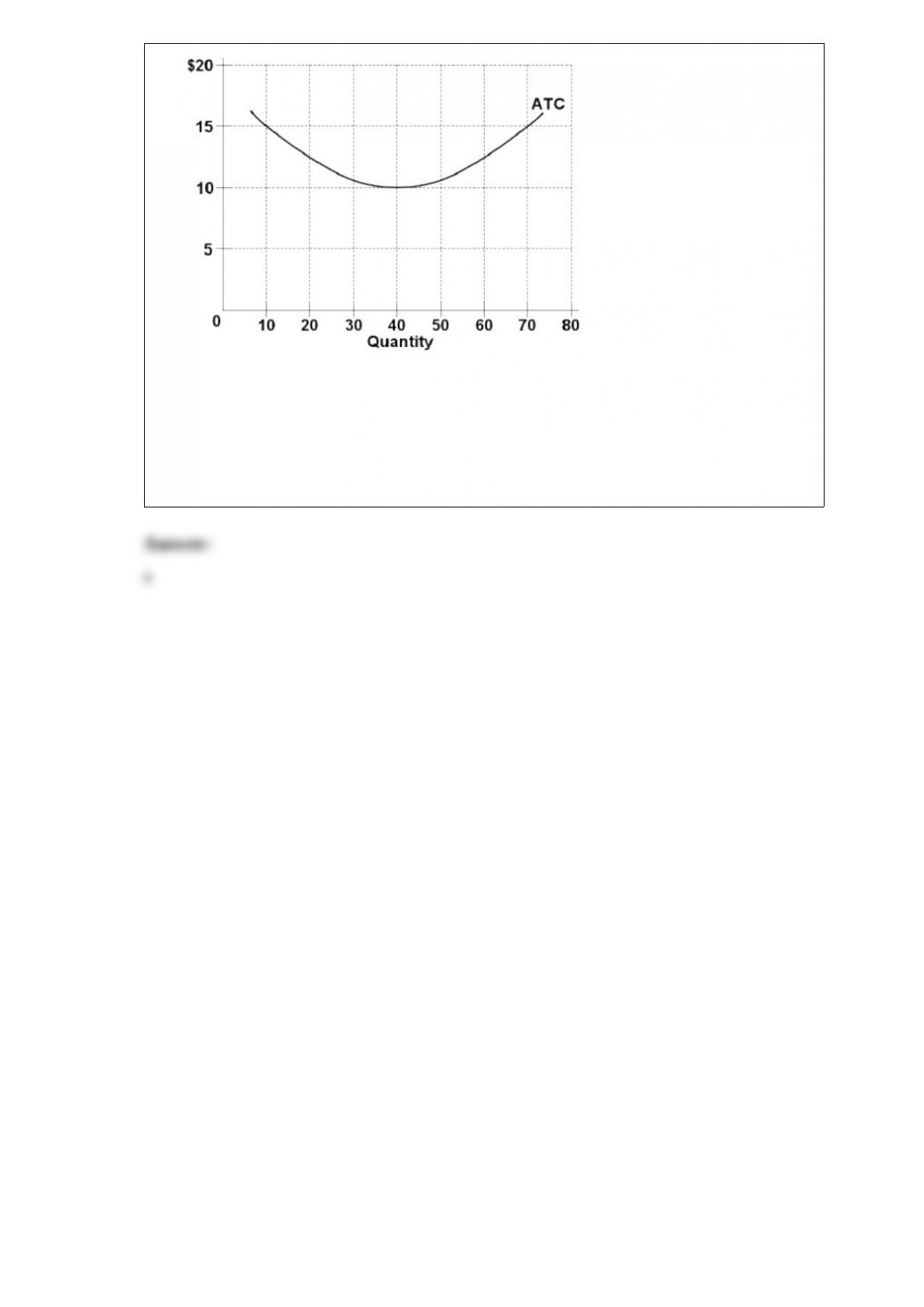
18)
refer to the above diagram showing the average total cost curve for a purely competitive
firm. at the long-run equilibrium level of output, this firm’s economic profit:
a.is zero.
b.is $400.
c.is $200.
d.cannot be determined from the information provided.