
Producer surplus is measured as the
A) area under the demand curve above market price.
B) entire area under the supply curve.
C) area under the demand curve above the supply curve.
D) area above the supply curve up to the market price.
The demand curve for tickets to the George Winston concert (with special guest star,
Kenny G) is given as follows:
Q = 200 – 0.1P
At a price of $30, what is the consumer surplus from concert tickets?
A) $0
B) $20
C) $2,000
D) $1,970
E) $194,045

Consider the information below:
For Group A the cost of attaining an educational level y is
CA(y) = $6,000y
and for Group B the cost of attaining that level is
CB (y) = $10,000y.
Employees will be offered $50,000 if they have y < y*, where y* is an education
threshold determined by the employer. They will be offered $130,000 if they have y >
y*.
The lowest level of y* that can be set and still have only the high-productivity people
meet it is
A) 16.
B) 13 1/3.
C) 13.
D) 8.
E) 0.
Which of the following is a normative statement?
A) The taxes paid by the poor should be reduced in order to improve the income
distribution in the U.S.
B) State governments should not subsidize corporations by training welfare recipients.
C) Presidential candidates should not be given funds from the federal government to
run campaigns.
D) The sea otter should not be allowed to spread into Southern California coastal
waters, because it will reduce the value of fisheries.
E) all of the above

A mathematical technique used to solve constrained optimization problems (finding the
consumer optimum, for example) is:
A) the method of Lagrange multipliers.
B) the Cobb-Douglas method.
C) the Slutsky method.
D) the Hicks substitution method.
Consider the information below:
For Group A the cost of attaining an educational level y is
CA(y) = $6,000y
and for Group B the cost of attaining that level is
CB (y) = $10,000y.
Employees will be offered $50,000 if they have y < y*, where y* is an education
threshold determined by the employer. They will be offered $130,000 if they have y >
y*.
If the threshold educational level y* is set at 14,
A) only individuals in Group A will attain it.

B) only individuals in Group B will attain it.
C) individuals in both groups will attain it.
D) no individuals will attain it.
E) some fraction of individuals in each group will attain it.
What is the key characteristic of profit maximizing price discrimination that
distinguishes intertemporal price discrimination from peak-load pricing?
A) Peak-load pricing does not require MC = MR.
B) Marginal revenue may be different across different groups of buyers under
intertemporal price discrimination.
C) Marginal costs are independent across time periods under peak-load pricing.
D) Marginal revenue must be constant under both pricing schemes.
What is the value of the Lerner index under perfect competition?
A) 1
B) 0
C) infinity

D) two times the price
What is the potential drawback if firms follow a price leadership model in an actual
market?
A) The price leader’s behavior may be interpretted as collusion and be subject to
antitrust sanctions.
B) Excessive price signalling may force all of the firms to adopt price-taking strategies,
which reduces overall profits among the firms.
C) Disputes about which firm should be the price leader may lead to price wars.
D) Signalling efforts increase the firms’ fixed costs of production.
The shutdown decision can be restated in terms of producer surplus by saying that a
firm should produce in the short run as long as
A) revenue exceeds producer surplus.
B) producer surplus is positive.
C) producer surplus exceeds fixed cost.
D) producer surplus exceeds variable cost.

E) profit and producer surplus are equal.
In some remote communities, there was only one employer in the local labor market
several years ago, but the number of firms that hired workers in the market increased
over time. What is the expected change in the local labor market as the number of
employers increased (ceteris paribus)?
A) Wages and employment increase
B) Wages remain the same but employment increases
C) Wages increase but employment remains the same
D) Wages and employment decline
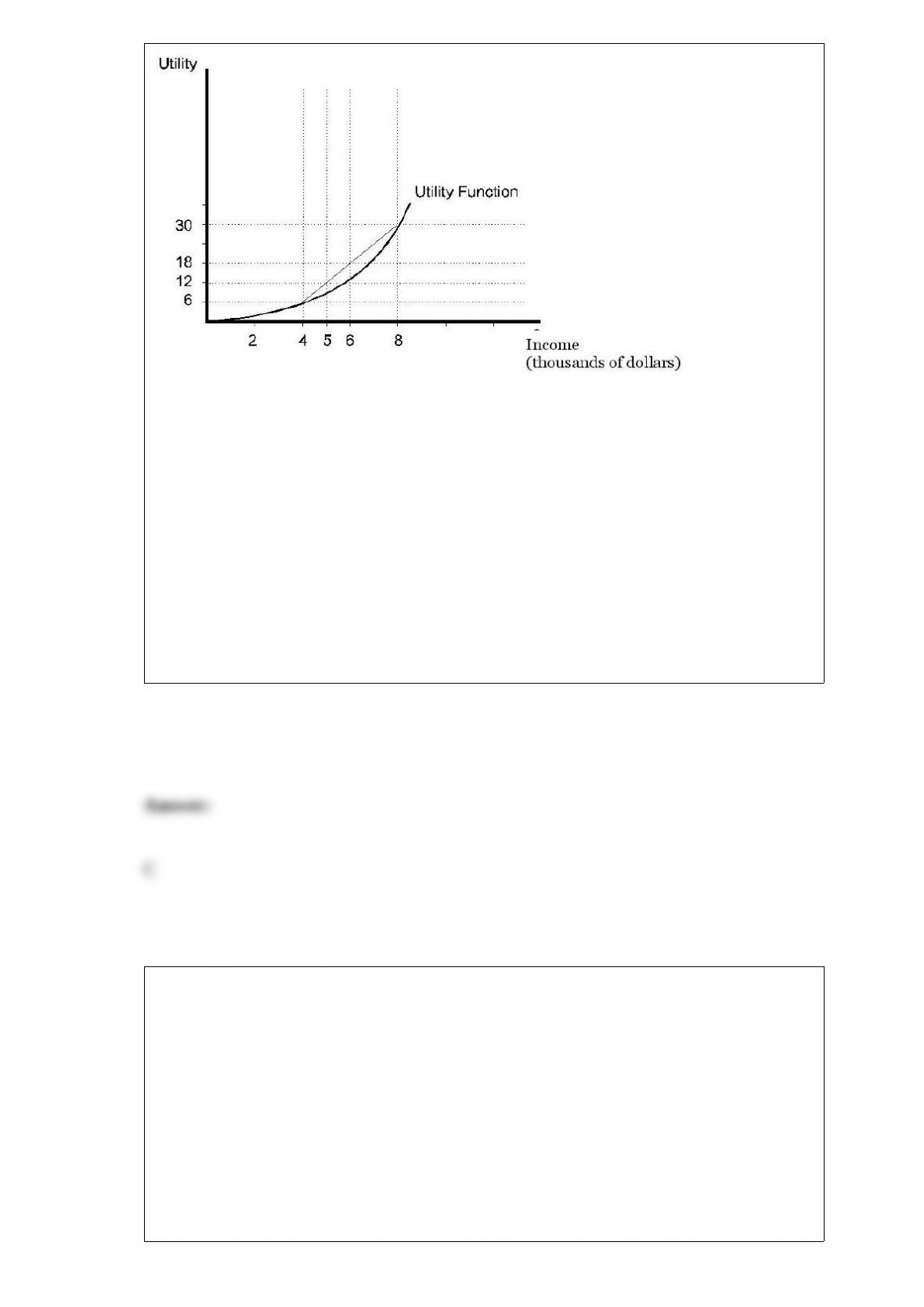
Figure 5.3
The individual pictured in Figure 5.3
A) must be risk-averse.
B) must be risk-neutral.
C) must be risk-loving.
D) could be risk-averse, risk-neutral, or risk-loving.
E) could be risk-averse or risk-loving, but not risk-neutral.
For consideration of such issues as labor’s productivity growth nationwide, the relevant
measure is the
A) marginal product of labor.
B) average product of labor.
C) total product of labor.
D) wage.

E) cost of capital.
In the competitive output market for good Q, the marginal revenue product for an input
X can be expressed as
A) MPX / TRQ.
B) MPQ MRX.
C) APX MRQ.
D) MPX* PQ
Use the following statements to answer this question.
I. To maximize profit, a firm will advertise more when the advertising elasticity is
larger.
II. To maximize profit, a firm will advertise more when the price elasticity of demand is
smaller.
A) Both I and II are true.
B) I is true, and II is false.
C) I is false, and II is true.

D) Both I and II are false.
To be certain that exchange between people is mutually beneficial, we generally assume
A) not all people are free to enter the market at will, but once in they are free to make
any offer to trade.
B) all people have complete information about each other’s preferences.
C) there are no transaction costs.
D) both B and C
E) both A and B
Suppose there are 10 apples and 10 oranges in the economy. Joe is currently consuming
4 apples and 5 oranges, and Jane is consuming 6 apples and 5 oranges. At this
allocation, Joe’s marginal utility of apples is 3, and his marginal utility of oranges is 5.
Jane’s marginal utility of apples is 6, and her marginal utility of oranges is 10. The
current price of apples is $4 and the current price of oranges is $5. To reach a
competitive equilibrium, the required price adjustment is:
A) a decrease in the apple price relative to the orange price.
B) a decrease in the orange price relative to the apple price.

C) no change in the relative prices.
D) an increase in both prices.
What is the shape of the total revenue curve derived from a linear downward sloping
demand curve?
A) Horizontal
B) Vertical
C) U-shaped
D) Inverted u-shaped
Assume that a profit maximizing monopolist is producing a quantity such that marginal
revenue exceeds marginal cost. We can conclude that the
A) firm is maximizing profit.
B) firm’s output is smaller than the profit maximizing quantity.
C) firm’s output is larger than the profit maximizing quantity.
D) firm’s output does not maximize profit, but we cannot conclude whether the output is
too large or too small.

A farmer lives on a flat plain next to a river. In addition to the farm, which is worth $F,
the farmer owns financial assets worth $A. The river bursts its banks and floods the
plain with probability P, destroying the farm. If the farmer is risk averse, then the
willingness to pay for flood insurance unambiguously falls when
A) F is higher, and A is lower.
B) P is lower, and F is higher.
C) F & A are higher.
D) P is lower, and A is lower.
E) A is higher, and F is lower.
An amusement park charges an entrance fee of $75 per person plus $2.50 per ride. This
is an example of
A) first-degree price discrimination.
B) a two-part tariff.
C) second-degree price discrimination.
D) bundling.
E) tying.

We may not be able to fully remove risk by diversification if:
A) a completely risk-free asset does not exist.
B) the asset returns in our portfolio are positively correlated.
C) buying stock on margin is not allowed by financial regulators.
D) none of the above
Because the presence of a warranty for a good is a signal that the good is of high
quality,
A) consumers are willing and able to pay more for a good that carries a warranty.
B) consumers are willing to buy goods if and only if the goods come with warranties.
C) producers do not need to charge extra for warranties.
D) producers can use warranties to sort out high-risk customers.
E) producers must make warranties available on all goods.
Which of the following is a positive statement?
A) The President of the United States ought to be elected by a direct vote of the
American people rather than the Electoral College.
B) A fundamental assumption of the economic theory of consumer behavior is that
consumers always prefer having more of any good to having less of it.
C) Because many adults cannot afford to go to college, tax credits for tuition should be
introduced.
D) all of the above
E) none of the above
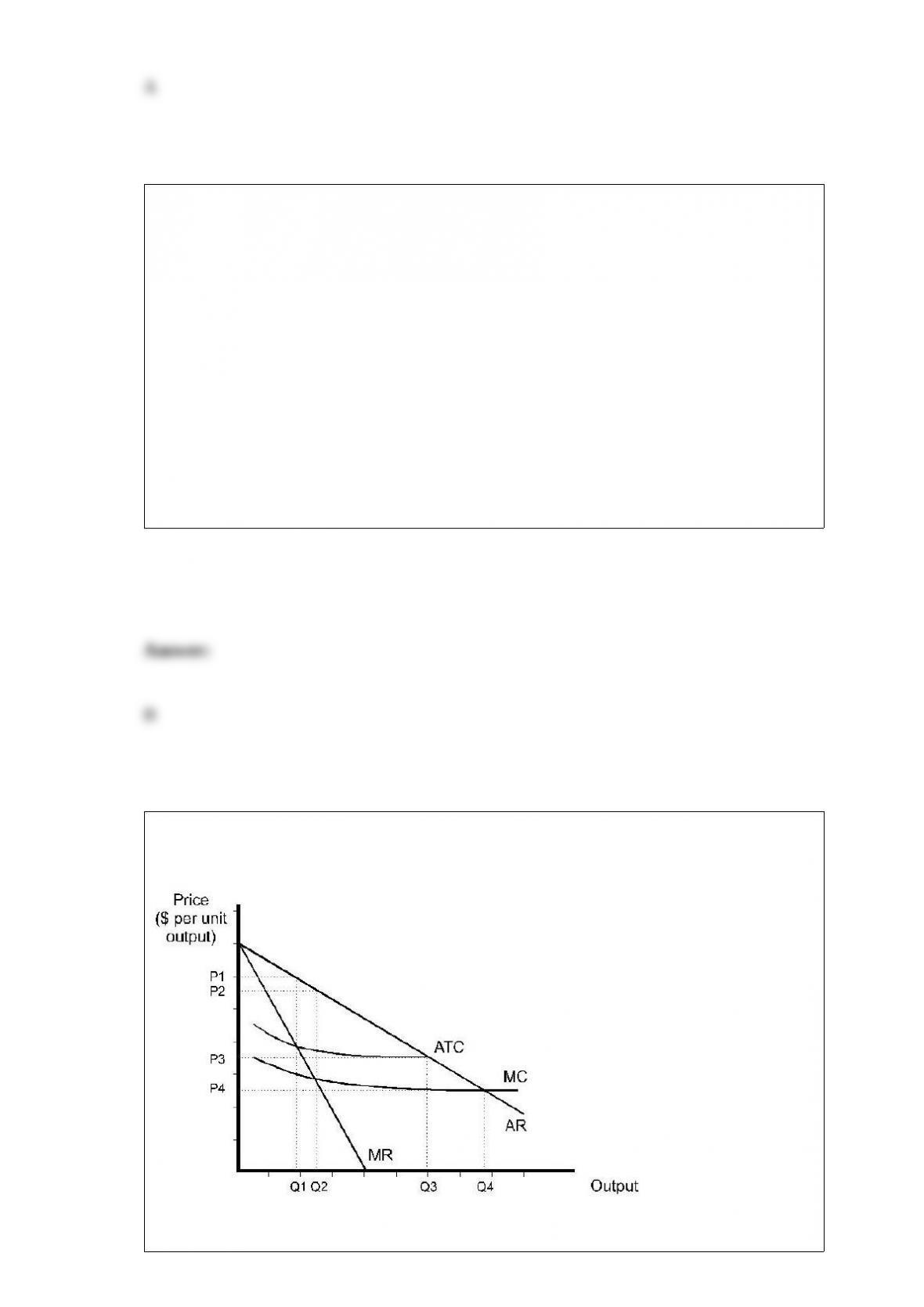
Figure 1

The revenue and cost curves in the diagram above are those of a natural monopoly
Refer to Figure 10.1. The minimum feasible price is ________.
A) P1
B) P2
C) P3
D) P4
E) none of the above
Three hundred firms supply the market for paint. For fifty of the firms, their short-run
average variable costs are minimized at $10 and short-run total costs are minimized at
$15. For the remaining firms, the short-run average variable costs and short-run average
total costs are minimized at $20 and $25, respectively. If each firm has a U-shaped
marginal cost curve then the short-run market supply curve is
A) U-shaped too
B) kinked at $10
C) kinked at $15
D) kinked at $20
E) kinked at $25

Which of the following could not possibly be included in the same market as Coke?
A) Pepsi
B) Gatorade
C) Milk
D) Bread
In some markets plumbers have a choice of joining unions or working as nonunion
plumbers. The total short-run supply of plumbers is perfectly inelastic at 500 workers
per day. The demands for nonunionized and unionized plumbers, respectively, are:
WNU = 30 – 0.04L WU = 30 – 0.10L.
The wage rate is W in $/hr. and the number of workers per day is L.
a. Determine the total demand for plumbers.
b. Calculate the total market wage rate of plumbers assuming that unionized and
nonunionized plumbers get the same wage rate.
c. If the unionized workers succeeded in getting their wage increased to $20.00 per
hour, how many unionized workers would lose their jobs?
d. If the unionized workers in (c) who lost their jobs take jobs as non-unionized
workers, how much and in what direction would non-unionized wages change?
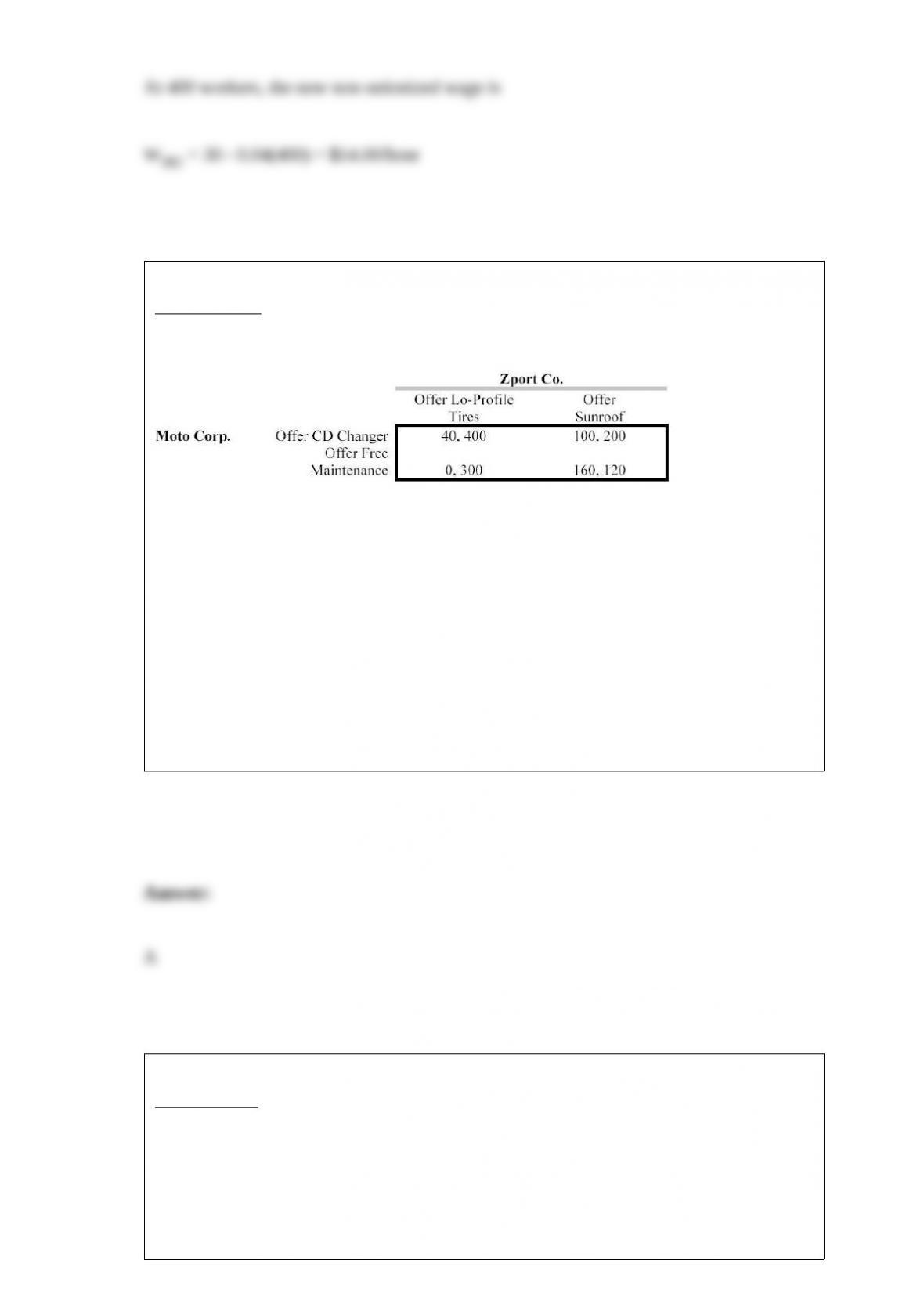
Scenario 13.3
Consider the following game:
In the game in Scenario 13.3, the equilibrium outcome:
A) is for Moto to offer a CD changer and Zport to offer low-profile tires.
B) is for Moto to offer a CD changer and Zport to offer a sun roof.
C) is for Moto to offer free maintenance and Zport to offer low-profile tires.
D) is for Moto to offer free maintenance and Zport to offer a sunroof.
E) does not exist in pure strategies.
Scenario 5.2:
Randy and Samantha are shopping for new cars (one each). Randy expects to pay
$15,000 with 1/5 probability and $20,000 with 4/5 probability. Samantha expects to pay
$12,000 with 1/4 probability and $20,000 with 3/4 probability.
Refer to Scenario 5.2. Randy’s expected expense for his car is
A) $20,000.
B) $19,000.
C) $18,000.
D) $17,500.
E) $15,000.
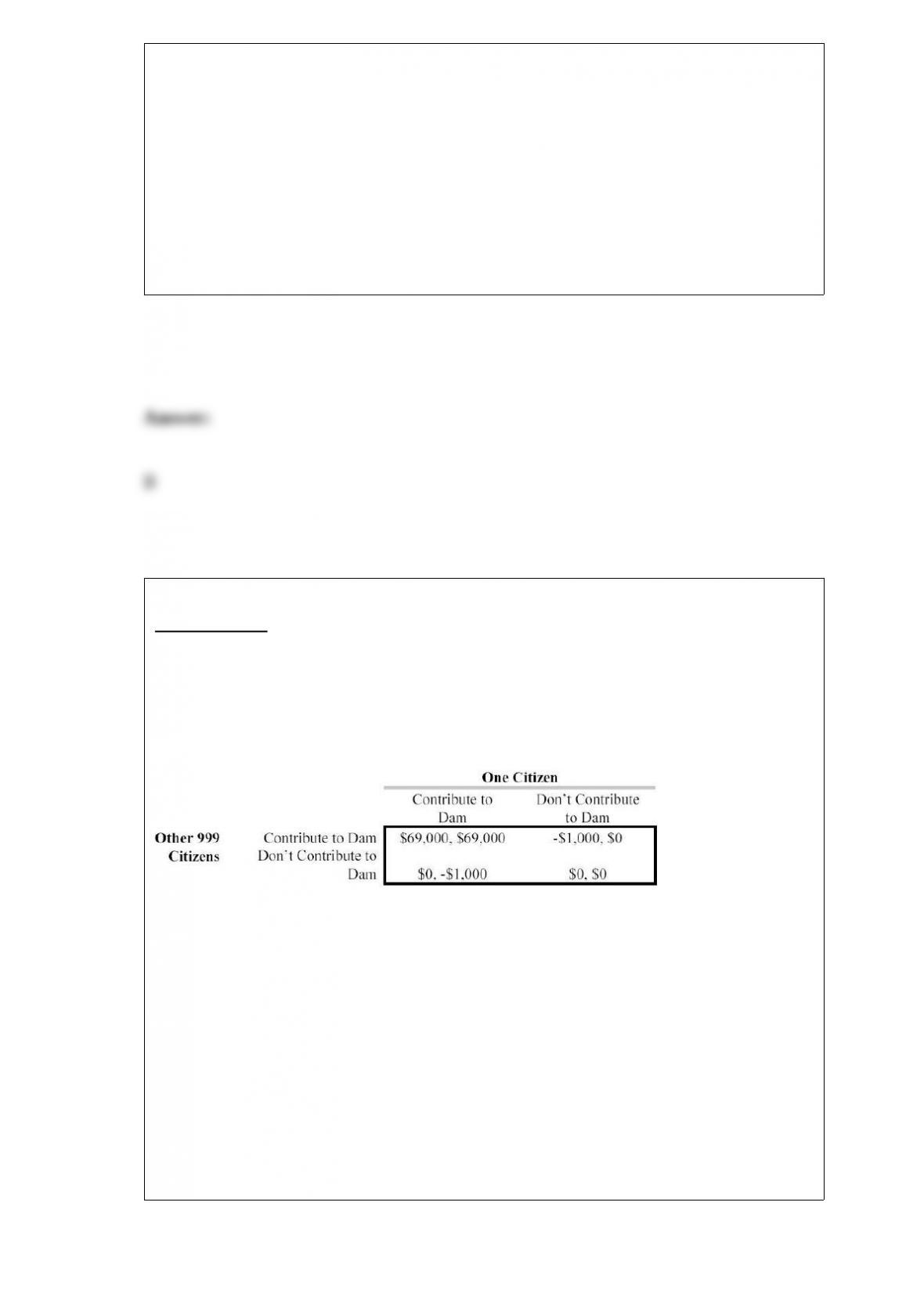
Scenario 13.7:
Consider the game below about funding and construction of a dam to protect a
1,000-person town. Contributions to the Dam Fund, once made, cannot be recovered,
and all citizens must contribute $1,000 to the dam in order for it to be built. The dam, if
built, is worth $70,000 to each citizen.
In the game in Scenario 13.7, the strategy pair that pays
A) $69,000 to each player is the only equilibrium.
B) ($0, -$1000) is the only equilibrium.
C) (-$1000, $0) is the only equilibrium.
D) $0 to each player is the only equilibrium.
E) $69,000 to each player and the strategy pair that pays $0 to each player are
equilibria.

If an Engel curve has a negative slope,
A) the good is inferior.
B) the good is normal.
C) the good has no substitutes.
D) the good has no complements.
Suppose there are seven firms in a market where the three largest firms supply 20% of
the market-clearing quantity and the other four firms supply 10% of the market-clearing
quantity. What is the five-firm concentration ratio (i.e., the share of total sales
controlled by the five largest firms in the market)?
A) 60%
B) 70%
C) 80%
D) 90%

Suppose we believe the income response for hamburger consumption is positive
(normal) at low income levels but becomes negative (inferior) at high income levels. Is
the log-linear demand function a good choice for this particular product?
A) Yes, the log-linear model has an income elasticity that can be positive or negative.
B) No, the log-linear model has a constant income elasticity that cannot change with the
income level.
C) No, the Engel curves for this case are vertical lines, and this behavior cannot be
represented with the log-linear demand function.
D) none of the above
Having seen the quantity of drugs supplied by pharmaceutical companies in a
competitive market, a government decides to force companies to sell exactly the same
quantity of drugs at prevailing market prices. The government then forbids additional
drug sales and allows doctors to prescribe the drugs at no cost to patients in need. This
government scheme is
A) efficient as the quantity of drugs traded is the same as under a free market.
B) efficient as the price of drugs paid by the government is the same as under a free
market.
C) efficient as consumer surplus is maximized.
D) likely to be inefficient as doctors are unlikely to prescribe drugs to the consumers
who are willing to pay the most for the drugs.
E) likely to be inefficient as drug producers have a captive buyer.