
The windfall profits tax on oil will curtail oil production if
a. oil executives decide to be spiteful.
b. the demand for oil is inelastic.
c. the supply curve for oil is upward sloping.
d. the supply curve for oil is vertical.
Everything else being equal, one can expect the euro to appreciate relative to the dollar
if
a. Americans decrease their travel to Germany.
b. the Germans add to their holdings of U.S. Treasury bills.
c. Americans purchase land in Germany and build factories.
d. American exports to Germany increase.
Monopolistically competitive firms can earn large profits in the long run.
a. True
b. False

The prices of telecommunications services have decreased due to productivity
increases.
a. True
b. False
After a particular loan has been paid off, neither the borrower nor the lender has lost
purchasing power. Therefore, it must be true that actual inflation was
a. greater than expected inflation.
b. equal to expected inflation.
c. less than expected inflation.
d. greater than the nominal rate of interest.

A recession is a period of time in which real GDP falls.
a. True
b. False
Every economic decision involves a trade-off because of
a. theory.
b. opportunism.
c. consumption.
d. scarcity.
e. efficiency.
One of the reasons why firms pollute air and water is that
a. air and water are often not priced.
b. managers desire to pollute.
c. air and water have no value to society.
d. managers are profit maximizers.

A tariff affects imports
a. by limiting quantity and raising price to a higher level.
b. by reducing quantity demanded so that supply falls.
c. by increasing supply, raising price, and reducing demand.
d. by raising price and reducing quantity demanded.
In 2013, corporate profits were about ____ percent of national income.
a. 7.2
b. 14.0
c. 25.3
d. 44.1

The federal government, in order to fund expanded health care, imposes a lump-sum tax
on all business property. Profit-maximizing firms that stay in business will respond by
a. raising prices to pay the tax.
b. cutting output to reduce costs.
c. lowering prices to stimulate demand.
d. doing nothing.
The money cost of a particular good will approximate its opportunity cost if
a. there are serious distortions in the market.
b. the market functions well.
c. there is much specialization in the market.
d. nations are exploiting the law of comparative advantage.
Foreign direct investment generally leads to technological advancements in poorer
countries.
a. True

b. False
In the short run, the dominant effect of deficit reduction causes an
a. outward shift of the aggregate supply curve.
b. inward shift of the aggregate supply curve.
c. outward shift of the aggregate demand curve.
d. inward shift of the aggregate demand curve.
The production possibilities frontier has a tendency to bow outward from the origin.
a. True
b. False

Barter transactions involve a double coincidence of wants.
a. True
b. False
The role of government in a market economy includes all of the following except
a. providing services such as national defense.
b. collecting taxes.
c. extensive ownership of productive resources.
d. making and enforcing laws.
Table 22-4
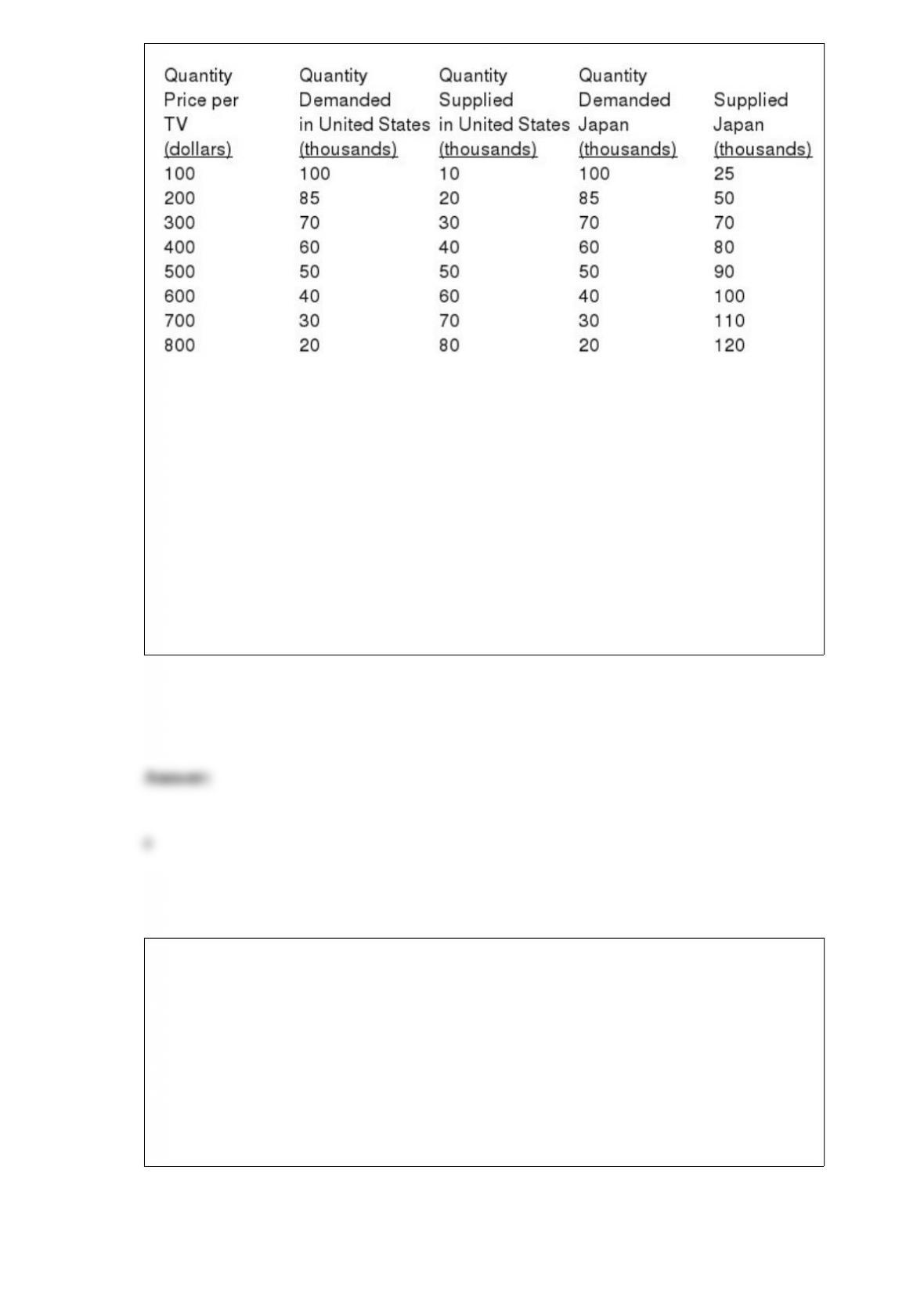
Table 22-4 presents the demand and supply schedules for television sets in Japan and
the United States. If Japan and the United States trade with each other, which country
will export television sets and how many?
a. Japan will export 20,000 television sets to the United States.
b. Japan will export 30,000 television sets to the United States.
c. The United States will export 20,000 television sets to Japan.
d. The United States will export 40,000 television sets to Japan.
A decrease in AS will trigger less inflation under which of the following conditions?
a. AD is relatively steep.
b. AD is relatively flat.
c. AS is relatively steep.
d. AS is relatively flat.

The marginal rate of substitution represents the maximum amount of one commodity a
consumer is willing to give up in exchange for one more unit of another commodity.
a. True
b. False
For those in the lowest tax bracket, each dollar tax cut increases disposable income by
about $1.33.
a. True
b. False
Personal consumption spending is the most sensitive component of aggregate demand
to monetary policy.
a. True
b. False
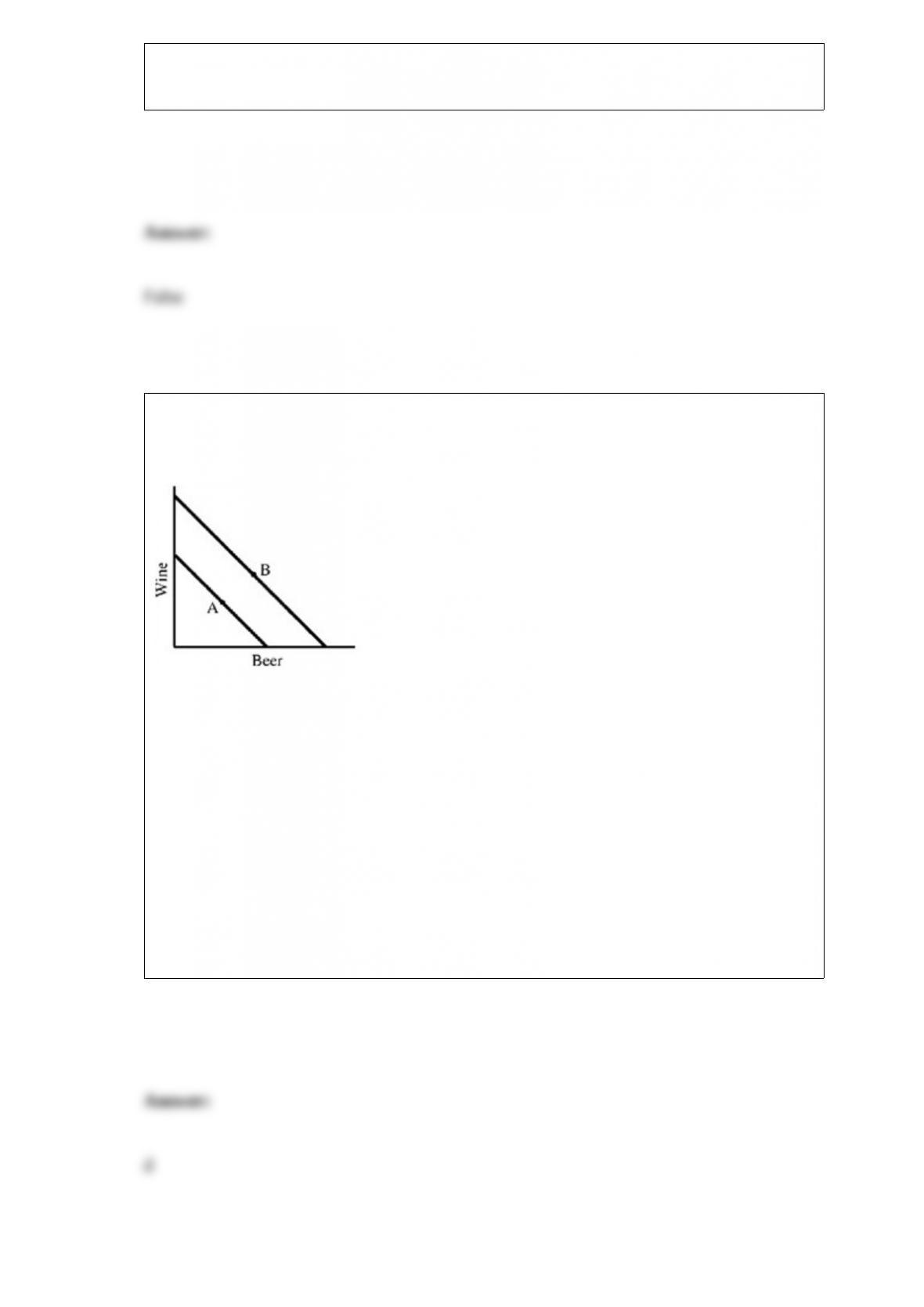
Figure 5-4
In Figure 5-4, the rightward shift in budget lines from the one containing point A to the
one containing point B
a. resulted from equal price reductions in beer and wine.
b. resulted from an increase in the consumer’s income.
c. could have been caused by income or price changes.
d. All of the answers above are correct possibilities.
e. None of the above is correct.

If the dollar appreciates, it can be said that
a. foreigners respect the United States more.
b. it increases in value within the United States.
c. other currencies depreciate.
d. it takes more dollars to buy foreign currencies.
The term “satisficing” for decision-making behavior by many firms was coined by
a. Milton Friedman.
b. Adam Smith.
c. Herbert Simon.
d. Alan Greenspan.
If expectations are rational,
a. a predictable change in inflation can make the expected inflation rate deviate from
the actual rate.
b. unemployment can exceed the full-employment rate even in the long run.

c. the difference between the actual inflation rate and the expected inflation rate must be
a purely random number.
d. the inflation rate cannot be reduced without a period of high unemployment because
the Phillips curve is downward sloping.
The type of human capital formation that occurs in the business sector is called
a. vocational education.
b. business education.
c. on-the-job training.
d. productivity enhancement.
What does the Herfindahl-Hirschman Index value near zero imply about the market?
a. Monopoly
b. Perfect competition
c. Monopolistic competition
d. Oligopoly

A factory produces 1,000 radios a year, AVC = $10 and TFC = $5,000. The factory’s TC
a. equals $15.
b. equals $5,005.
c. equals $15,000.
d. cannot be determined from the information given.
If you discover that the opportunity cost of raising your economics grade is zero, you
a. are studying too hard and receiving a higher grade than is optimal for you.
b. must be on the production possibilities frontier that describes your trade-offs between
producing high grades and producing other goods.
c. must be inside the production possibilities frontier that describes your trade-offs
between producing high grades and producing other goods.
d. must be producing more of other goods than is optimal for you.