
When quantity supplied increases at every possible price, we know that the supply
curve has
a. shifted to the left.
b. shifted to the right.
c. not shifted; rather, we have moved along the supply curve to a new point on the same
curve.
d. not shifted; rather, the supply curve has become flatter.
Which of the following statements does not help to explain why government drug
interdiction increases drug-related crime?
a. The demand for illegal drugs is inelastic.
b. Interdiction results in drug addicts having a greater need for quick cash.
c. Interdiction results in an increase in the amount of money needed to buy the same
amount of drugs.
d. Government drug programs are more lenient now with drug offenders than they were
in the 1980s.
Suppose a country has only a sales tax. Now suppose it replaces the sales tax with an
income tax that includes a tax on interest income. This would make equilibrium

a. interest rates and the equilibrium quantity of loanable funds rise.
b. interest rates rise and the equilibrium quantity of loanable funds fall.
c. interest rates fall and the equilibrium quantity of loanable funds rise.
d. interest rates and the equilibrium quantity of loanable funds fall.
The price index was 92 in 2000, and the inflation rate was 13 percent between 1999 and
2000. The price index in 1999 was
a. 79.
b. 81.4.
c. 103.96.
d. 105.
If the U.S. imposed an import quota on apples, then which of the following would rise?
a. the U.S. real exchange rate and U.S. net exports
b. the U.S. real exchange rate but not U.S. net exports
c. U.S. net exports but not the U.S. real exchange rate
d. neither the U.S. real exchange rate nor U.S. net exports
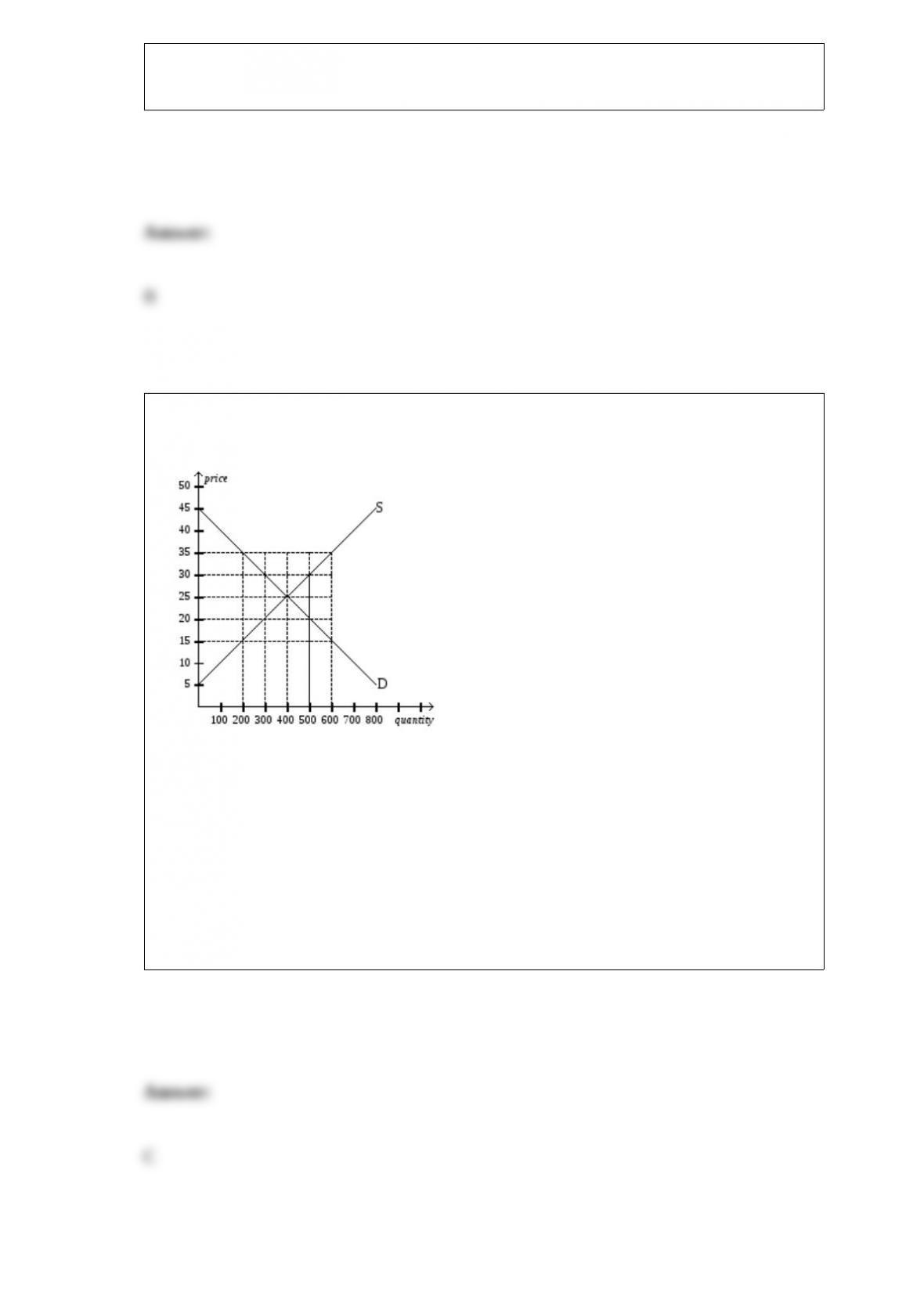
Figure 4-15
Refer to Figure 4-15. At a price of $15, there would be a
a. surplus of 400 units.
b. shortage of 200 units.
c. shortage of 400 units.
d. shortage of 600 units.

A key lesson from the payroll tax is that the
a. tax is a tax solely on workers.
b. tax is a tax solely on firms that hire workers.
c. tax eliminates any wedge that might exist between the wage that firms pay and the
wage that workers receive.
d. true burden of a tax cannot be legislated.
Abraham drinks Mountain Dew. He can buy as many cans of Mountain Dew as he
wishes at a price of $0.55 per can. On a particular day, he is willing to pay $0.95 for the
first can, $0.80 for the second can, $0.60 for the third can, and $0.40 for the fourth can.
Assume Abraham is rational in deciding how many cans to buy. His consumer surplus
is
a. $0.50.
b. $0.60.
c. $0.70.
d. $1.00.
Suppose a producer is able to separate customers into two groups, one having an
inelastic demand and the other having an elastic demand. If the producer’s objective is
to increase total revenue, she should
a. increase the price charged to customers with the elastic demand and decrease the
price charged to customers with the inelastic demand.
b. decrease the price charged to customers with the elastic demand and increase the
price charged to customers with the inelastic demand.
c. decrease the price to both groups of customers.
d. increase the price for both groups of customers.
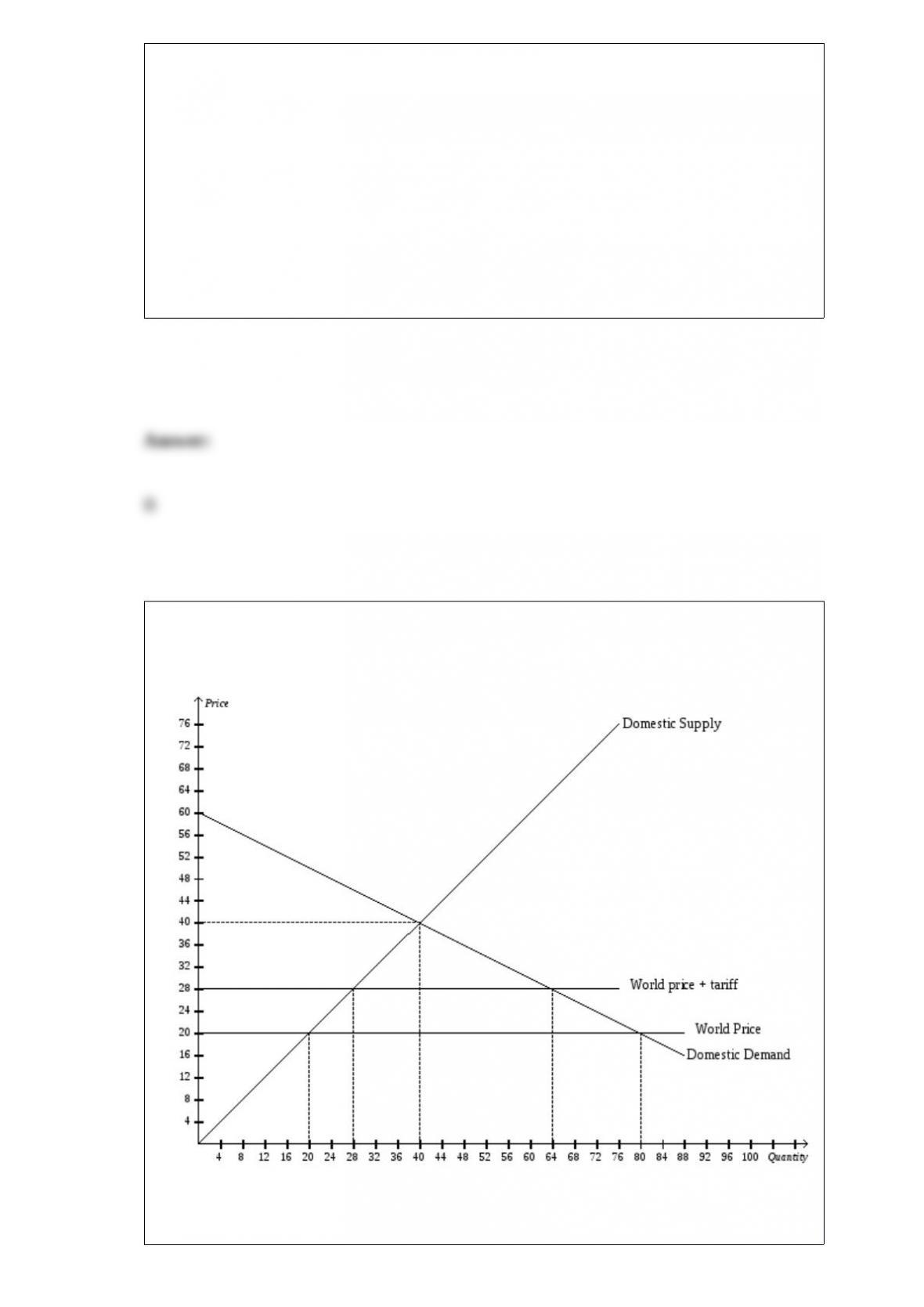
Figure 9-17
Refer to Figure 9-17. With free trade, the country imports

a. 16 units of the good.
b. 24 units of the good.
c. 60 units of the good.
d. 64 units of the good.
A marginal change is a
a. change that involves little, if anything, that is important.
b. large, significant adjustment.
c. change for the worse, and so it is usually a short-term change.
d. small, incremental adjustment.
If inflation expectations decline, then the short-run Phillips curve shifts
a. left, so that at any inflation rate unemployment is lower in the short run than before.
b. right, so that at any inflation rate unemployment is lower in the short run than before.
c. right, so that at any inflation rate unemployment is higher in the short run than
before.

d. left, so that at any inflation rate unemployment is higher in the short run than before.
Deflation
a. increases incomes and enhances the ability of debtors to pay off their debts.
b. increases incomes and reduces the ability of debtors to pay off their debts.
c. decreases incomes and enhances the ability of debtors to pay off their debts.
d. decreases incomes and reduces the ability of debtors to pay off their debts.
Table 3-1
Assume that Andia and Zardia can switch between producing wheat and producing beef
at a constant rate.
Minutes Needed to Make 1
Refer to Table 3-1. Assume that Andia and Zardia each has 360 minutes available. If
each person divides his time equally between the production of wheat and beef, then
total production is

a. 10.5 bushels of wheat and 16.5 pounds of beef.
b. 21 bushels of wheat and 33 pounds of beef.
c. 35 bushels of wheat and 22 pounds of beef.
d. 42 bushels of wheat and 66 pounds of beef.
A law that requires the money supply to grow by a fixed percentage each year would
eliminate
a. the time inconsistency problem, but not political business cycles.
b. the political business cycle, but not the time inconsistency problem.
c. both the time inconsistency problem and political business cycles.
d. neither the time inconsistency problem nor political business cycles.
Table 7-11

Refer to Table 7-11. Both the demand curve and the supply curve are straight lines. At
equilibrium, consumer surplus is
a. $24.
b. $36.
c. $42.
d. $48.
If Norway sold more goods and services abroad than it purchased from abroad, then it
had
a. positive net exports which is a trade surplus.
b. positive net exports which is a trade deficit.
c. negative net exports which is a trade surplus.
d. negative net exports which is a trade deficit.

Government-run employment agencies and public training programs are operated by
the government to try to facilitate job search and reduce unemployment.
a. Almost all economists agree that such programs are of no use.
b. Almost all economists agree that such programs work very well.
c. Some economists claim that the government can do these things no better than firms
and individuals could do them for themselves.
d. Some economists claim that these programs increase frictional unemployment.
Hector puts $150 into an account when the interest rate is 4 percent. Later he checks his
balance and finds he has about $168.73. How long did Hector wait to check his
balance?
a. 3 years
b. 3.5 years
c. 4 years
d. 4.5 years
Trade
a. allows specialization, which increases costs.
b. allows specialization, which reduces costs.
c. reduces specialization, which increases costs.
d. reduces specialization, which reduces costs.
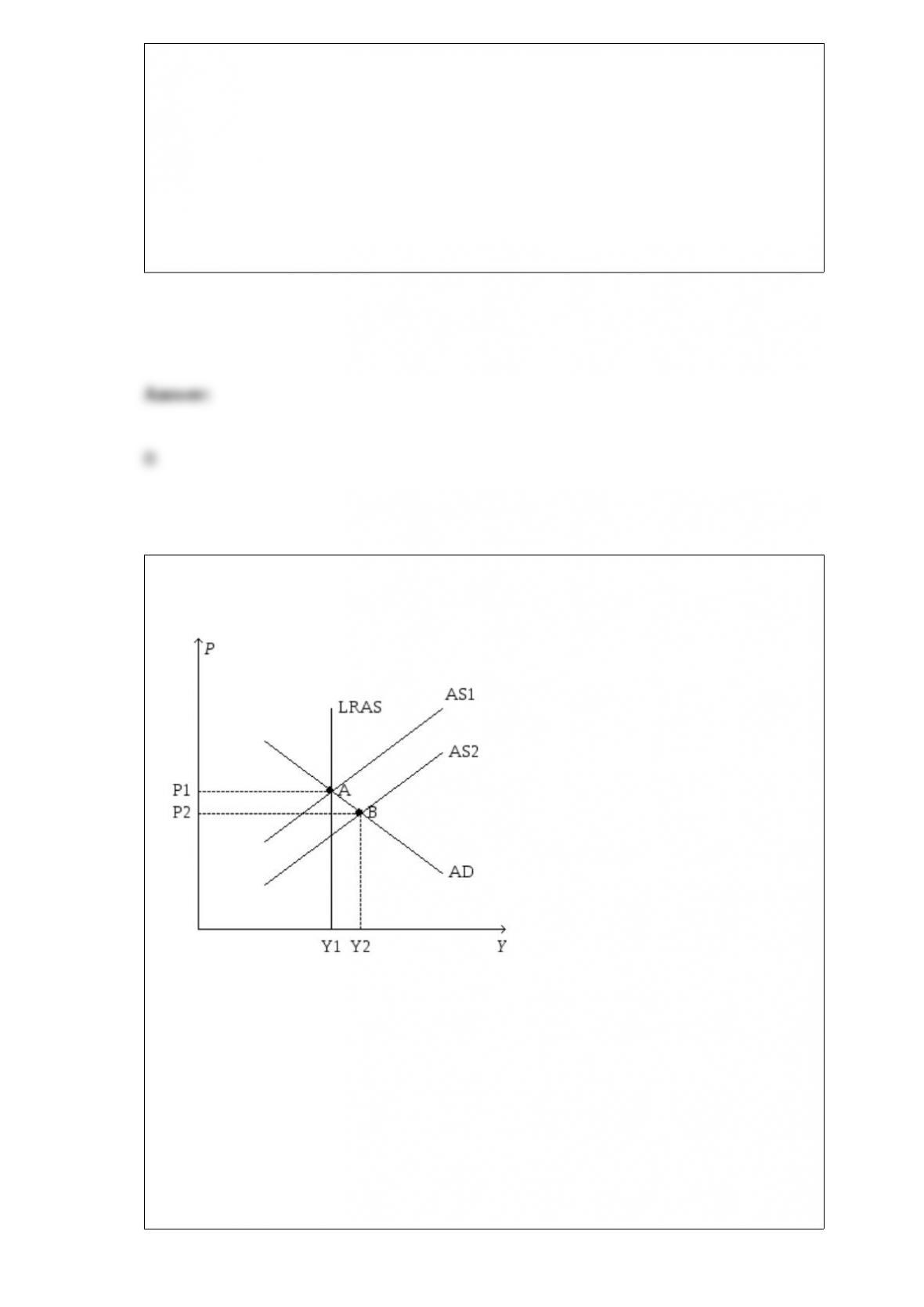
Figure 20-2.
Refer to Figure 20-2. The shift of the short-run aggregate-supply curve from AS1 to
AS2
a. could be caused by an outbreak of war in the Middle East.
b. could be caused by a decrease in the expected price level.
c. causes the economy to experience an increase in the unemployment rate.
d. causes the economy to experience stagflation.

A bank loans Kellie’s Print Shop $350,000 to remodel a building near campus to use as
a new store. On their respective balance sheets, this loan is
a. an asset for the bank and a liability for Kellie’s Print Shop. The loan increases the
money supply.
b. an asset for the bank and a liability for Kellie’s Print Shop. The loan does not increase
the money supply.
c. a liability for the bank and an asset for Kellie’s Print Shop. The loan increases the
money supply.
d. a liability for the bank and an asset for Kellie’s Print Shop. The loan does not increase
the money supply.
The slope of a line is equal to
a. the change in the value of x divided by the change in the value of y.
b. the change in the value of y divided by the change in the value of x.
c. the horizontal distance divided by the vertical distance.
d. the value of y divided by the value of x.

A U.S. mutual fund buys stocks issued by a Columbian company. This purchase is an
example of
a. U.S. foreign direct investment. It increases Columbia’s net capital outflow.
b. U.S. foreign direct investment. It decreases Columbia’s net capital outflow.
c. U.S. foreign portfolio investment. It decreases Columbia’s net capital outflow.
d. U.S. foreign portfolio investment. It increases Columbia’s net capital outflow.
Which of the following best illustrates the human capital of a survivor stranded on an
island?
a. the fishing poles she has produced
b. the invention of a better fishing lure
c. the fresh fruit and fish on and around the island
d. her previous training in a survival course
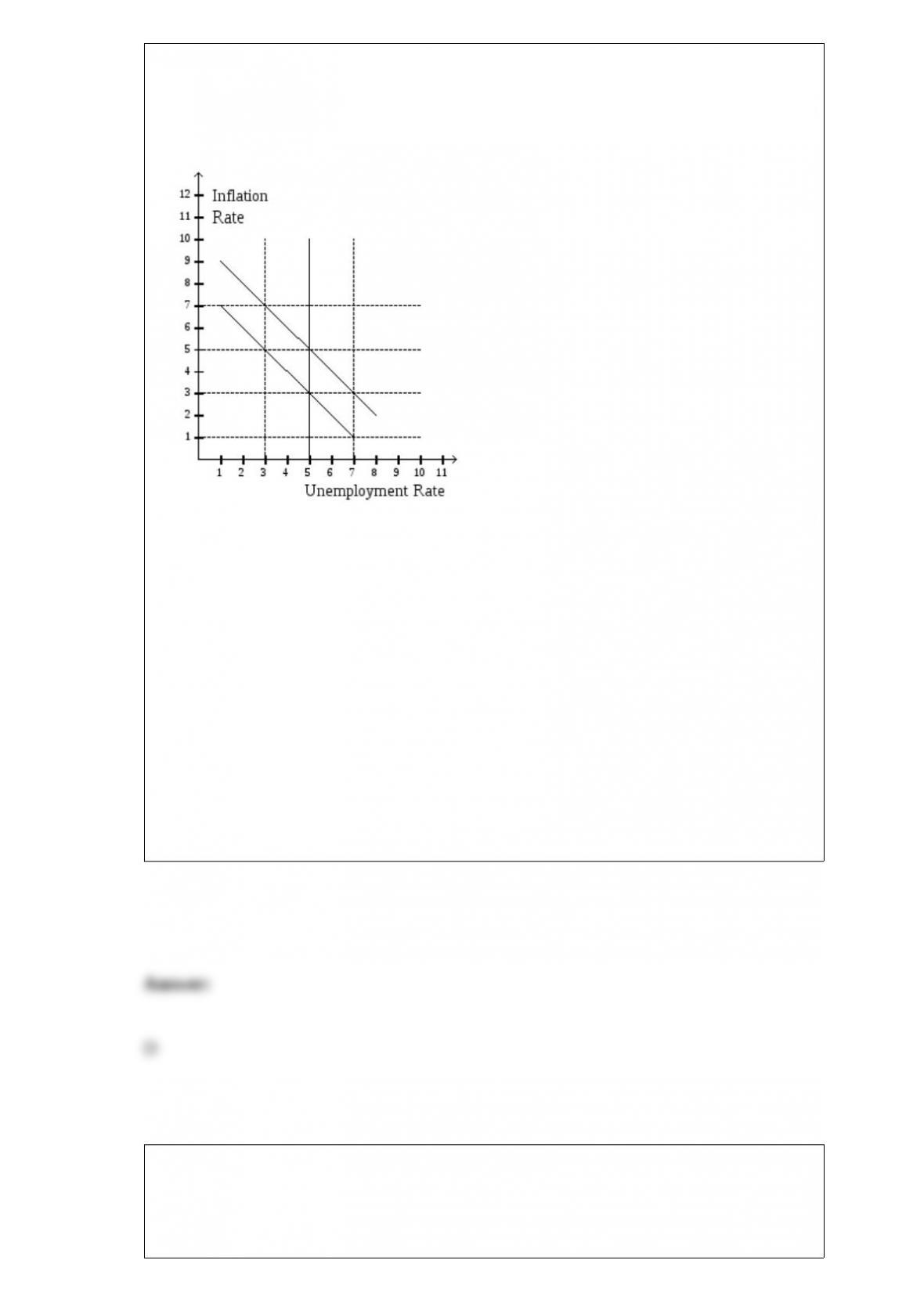
Figure 22-7
Use this graph to answer the questions below.
Refer to figure 22-7. If the economy starts at 5% unemployment and 5% inflation then
if the Federal Reserve pursues a contractionary monetary policy, in the short run the
economy moves to
a. 3% unemployment and 5% inflation. In the long run the economy moves to 5%
unemployment and 5% inflation.
b. 3% unemployment and 5% inflation. In the long run the economy moves to 5%
unemployment and 3% inflation.
c. 7% unemployment and 3% inflation. In the long run the economy moves to 5%
unemployment and 5% inflation.
d. 7% unemployment and 3% inflation. In the long run the economy moves to 5%
unemployment and 3% inflation.
Steve purchases some land for $30,000. He maintains it, but makes no improvements to
it. One year later he sells it for $32,000. Stephanie puts $30,000 in a savings account
that pays 6% interest. Steve has to pay the 50% capital gains tax, Stephanie is in the
35% tax bracket. The inflation rate was 2%. Who had the higher before-tax real gain
and who had the higher after-tax real gain?
a. Steve had both the higher before-tax real gain and the higher after-tax real gain.
b. Steve had the higher before-tax real gain but Stephanie had the higher after-tax real
gain.
c. Stephanie had the higher before-tax real gain but Steve had the higher after-tax real
gain.
d. Stephanie had both the higher before-tax real gain and the higher after-tax real gain.
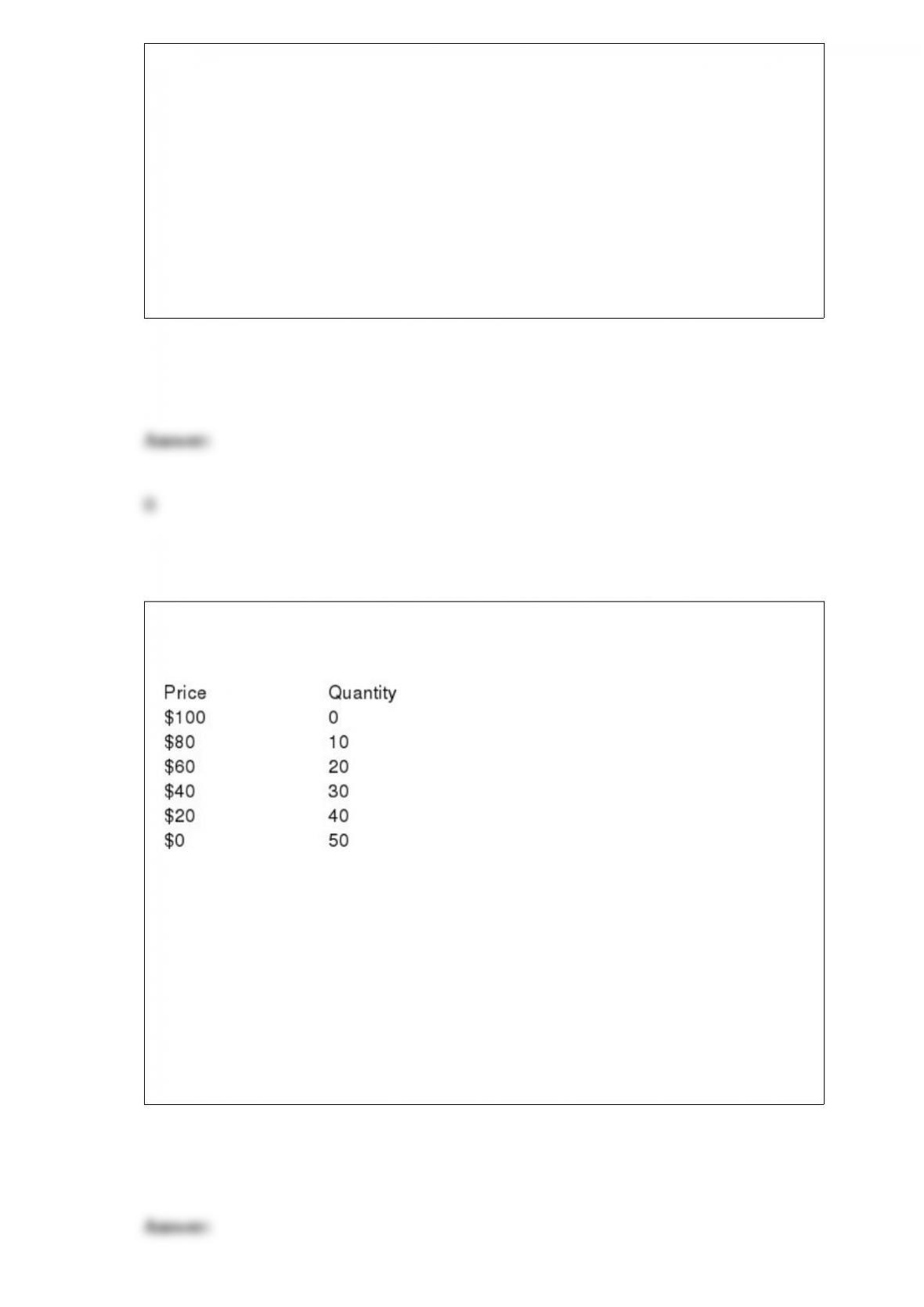
Table 5-2
Refer to Table 5-2. Using the midpoint method, if the price falls from $40 to $20, the
price elasticity of demand is
a. zero.
b. inelastic.
c. unit elastic.
d. elastic.

A improvement in production technology will shift the
a. supply curve to the right.
b. supply curve to the left.
c. demand curve to the right.
d. demand curve to the left.
The aggregate demand and aggregate supply graph has
a. quantity of output on the horizontal axis. Output can be measured by the GDP
deflator.
b. quantity of output on the horizontal axis. Output can be measured by real GDP.
c. quantity of output on the vertical axis. Output can be measured by the GDP deflator.
d. quantity of output on the vertical axis. Output can be measured by real GDP.
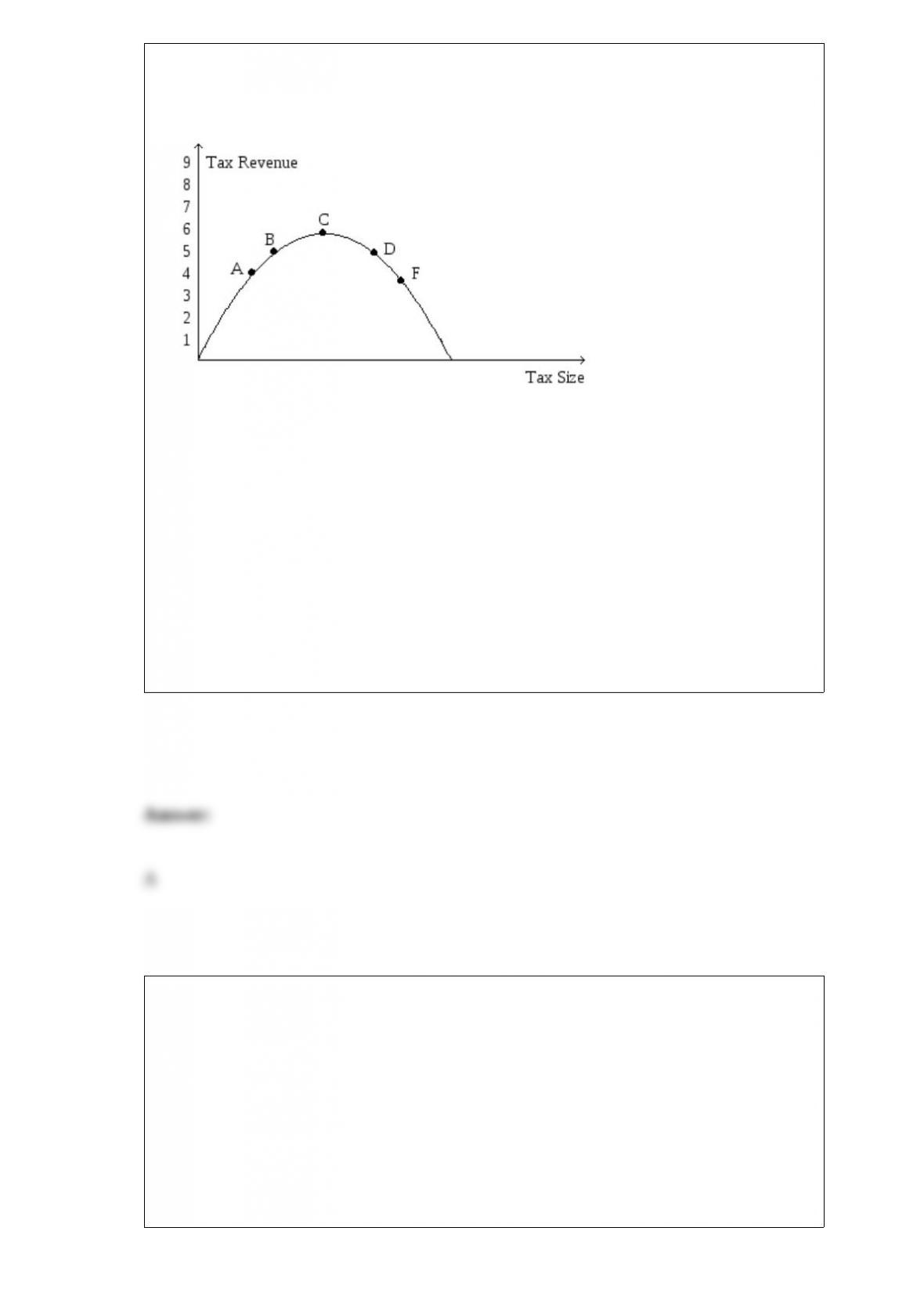
Figure 8-20. The figure represents the relationship between the size of a tax and the tax
revenue raised by that tax.
Refer to Figure 8-20. Suppose the figure pertains to the labor tax, and suppose also
that point B represents the position on the curve of the typical European country. Then,
according to a recent research paper published by the European Central Bank, the
position on the curve of the U.S. would most likely be point
a. A.
b. C.
c. D.
d. F.
A consumer’s willingness to pay directly measures
a. the extent to which advertising and other external forces have influenced the
consumer’s preferences.
b. the cost of a good to the buyer.
c. how much a buyer values a good.
d. consumer surplus.

Other things the same, an increase in aggregate demand reduces unemployment and
raises inflation in the short run.
When an American doctor opens a practice in Bermuda, his production there is part of
U.S. GDP.
The burden that results from a tax on yachts falls more heavily on the buyers of yachts
than on the sellers of yachts.

By itself, if a U.S. firm builds a new factroy overseas, U.S. net captial outflow rises.
Purchasing-power parity says that the nominal exchange rate must equal the real
exchange rate.
The sacrifice ratio of the Volcker disinflation was larger than previous estimates had
predicted.
Other things equal, the higher the price level, the higher is the real wealth of
households.

Causes of the decline in the U.S. men’s labor-force participation rate over the past
several decades include young men now staying in school longer than their fathers and
grandfathers did, older men now retiring earlier and living longer, and more fathers now
staying at home to raise their children.
The quantity equation is M x V = P x Y.
Perhaps the most dramatic change in the U.S. economy over the past four decades has
been the increasing relative importance of international trade and finance.
If the Fed were to unexpectedly increase the money supply, creditors would gain at the
expense of debtors.
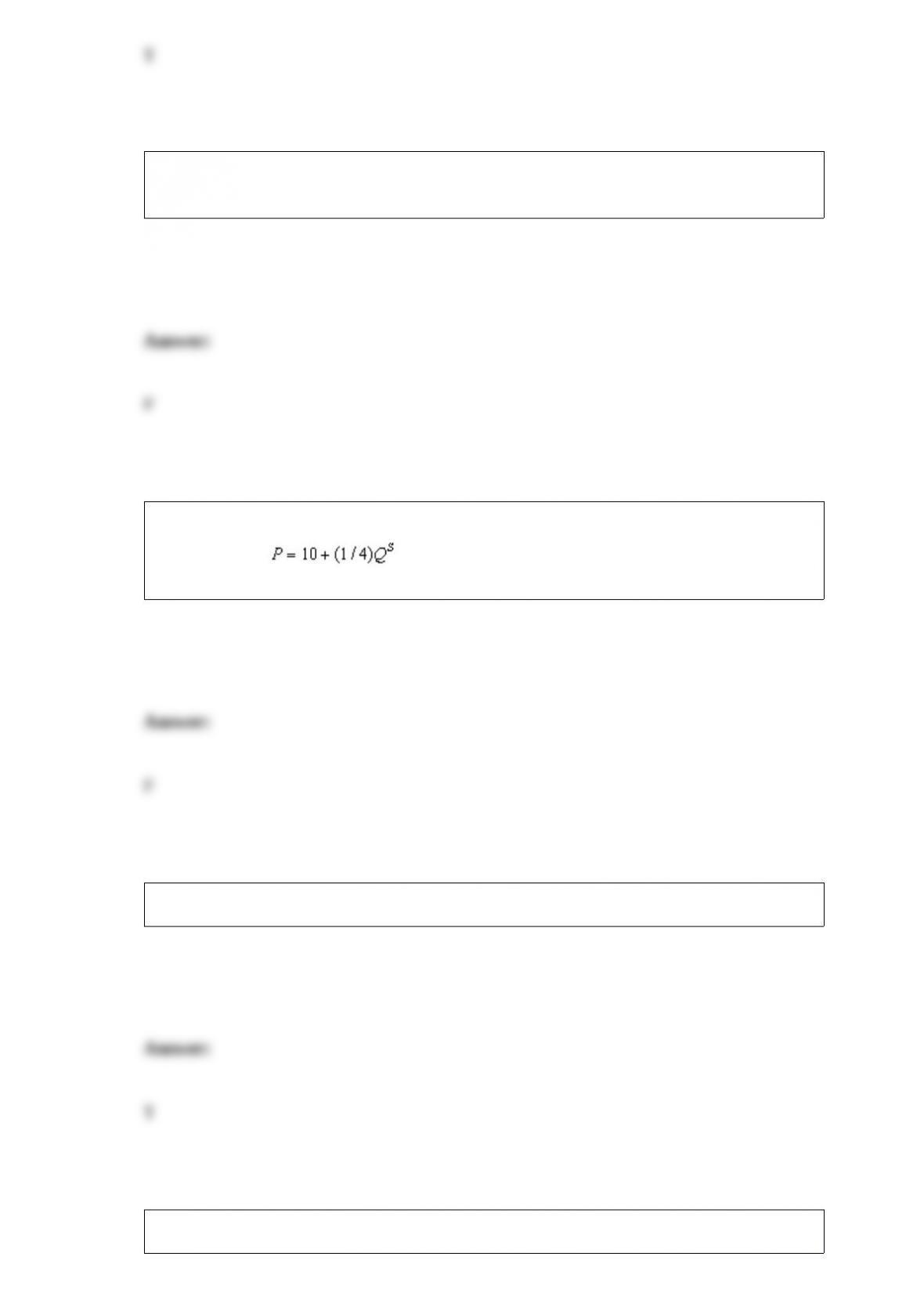
Let P represent price; let QS represent quantity supplied; and assume the equation of the
supply curve is . If 80 units of the good are produced and sold, then
producer surplus amounts to $1,200.
Not all unemployment ends with the job seeker finding a job.
What makes the New York Federal Reserve regional bank so important?

Risk-averse persons will take no risks.
The Bureau of Labor Statistics is part of the U.S. Department of Labor.
If C+I+G>Y, then net exports and net capital outflow are both less than zero.

The rationing mechanisms that develop under binding price ceilings are usually
inefficient.