
The value of a basis point for 90-day Eurodollar Time Deposit futures contract is:
a. $10.
b. $100.
c. $25.
d. $250.
e. $500.
Answer:
If the yield curve is inverted, a portfolio manager can take advantage of this by:
a. pricing more deposits on a fixed-rate basis.
b. buying more long-term securities
c. making variable-rate, callable loans.
d. increasing the number of rate-sensitive assets.
e. All of the above.
Answer:

What is a microhedge?
a. It is a hedge of the bank’s aggregate portfolio.
b. It is a hedge using just one type of futures contract.
c. It is the hedge of a specific asset or liability for which the bank is exposed to interest
rate risk.
d. It is a hedge using two or more types of futures contracts.
e. It is a has that has a duration of less than one month.
Answer:
A bank’s net balance sheet exposure to changes in the value of Euros is measured as:
a. the amount of assets denominated in U.S. dollars minus the amount of liabilities
denominated in Euros.
b. the amount of assets denominated in Euros minus the amount of liabilities
denominated in U.S. dollars.
c. the amount of liabilities denominated in Euros minus the amount of liabilities
denominated in U.S. dollars.
d. the amount of assets denominated in Euros minus the amount of assets denominated
in U.S. dollars.
e. the amount of assets denominated in Euros minus the amount of liabilities
denominated in Euros.
Answer:

How does bank capital reduce bank risk?
a. It provides a cushion for firms to absorb losses.
b. It creates unlimited growth opportunities.
c. It limits access to the financial markets.
d. All of the above.
e. a. and b.
Answer:
Which of the following is not a techniques that banks use to “manage earnings”?
a. Window dressing
b. Nonrecurring sales of assets
c. Adjusting the allowance for loan losses
d. Increasing loans classified as non-performing
e. All of the above are techniques that banks use to “manage earnings”
Answer:

Which of the following would be considered an interim loan?
a. Automobile loan
b. Residential mortgage loan
c. Construction loan
d. Home equity loan
e. Student loan
Answer:
Put the following steps for conducting a Static GAP analysis in the proper
chronological order.
I. Forecast changes in net interest income for a variety of interest rate scenarios.
II. Select the sequential time intervals for determining when assets and liabilities are
rate-sensitive.
III. Group assets and liabilities into time “buckets.”
IV. Develop interest rate forecasts.
a. I, II, III, IV
b. IV, I, III, II
c. IV, I, II, III
d. II, III, IV, I
e. IV, II, III, I

Answer:
Which of the following is not a member of the European Community (EC)?
a. France
b. Germany
c. Australia
d. Spain
e. United Kingdom
Answer:
A 90-day Treasury bill is quoted as having a 6% bond equivalent yield. What is the
effective annual yield?
a. 6.00%
b. 6.14%
c. 6.23%
d. 6.62%
e. 6.79%

Answer:
Which of the following would cause a firm’s ROE to be high, but its ROA to be low?
a. A low gross profit margin but a high net profit margin.
b. Financing a relatively large proportion of assets with equity.
c. Paying very low interest rates on the firm’s debts.
d. Leasing a large amount of equipment.
e. Financing a relatively large proportion of assets with debt.
Answer:
Which of the following is primarily used as collateral for borrowings from the Federal
Home Loan Bank Board?
a. Real estate loans
b. Treasury securities
c. Negotiable CDs
d. Credit card receivables
e. Repurchase agreement

Answer:
The _________ allows adequately capitalized bank holding companies to acquire banks
in any state.
a. Riegle-Neal Interstate Banking and Branching Efficiency Act
b. Competitive Equality Banking Act
c. Financial Institutions Reform, Recovery and Enforcement Act
d. Federal Deposit Insurance Corporation Improvement Act
e. Depository Institutions Deregulation and Monetary Control Act
Answer:
Which of the following would be an example of a Eurodollar account?
a. A U.S. dollar denominated deposit held at a Japanese bank.
b. A British pound denominated deposit held at a New York bank.
c. A French franc denominated deposit held at a Toronto bank.
d. A U.S. dollar denominated deposit held at a Chicago bank.
e. A EMU euro denominated deposit held at a London bank.

Answer:
Federal Reserve Reg. ____ makes it illegal for any lender to discriminate on the basis
of national origin.
a. AA
b. BB
c. Z
d. C
e. B
Answer:
Use the following information.
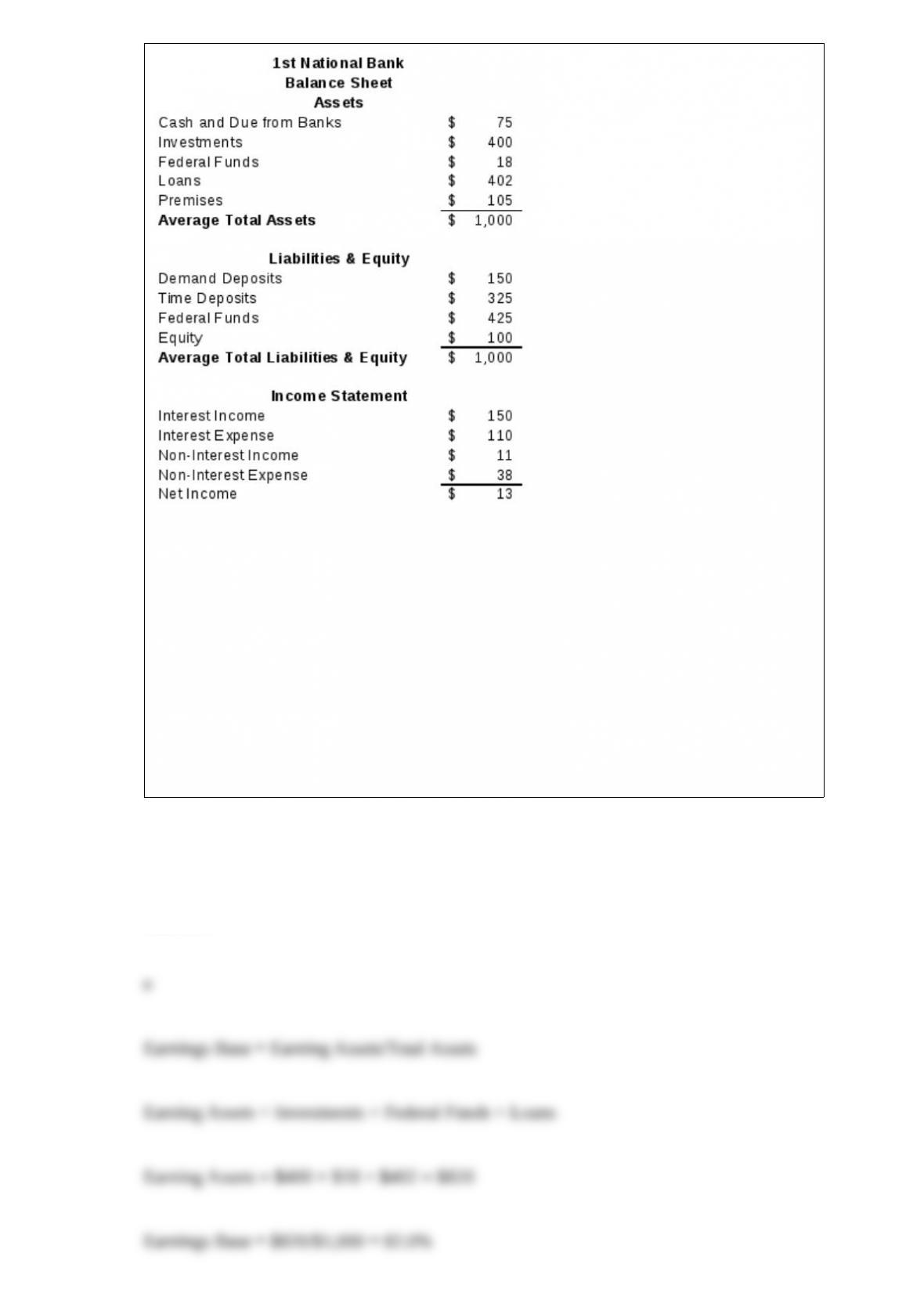
What is the earnings base at 1st State?
a. 12.5%
b. 17.0%
c. 58.5%
d. 75.5%
e. 82.0%
Answer:

For a bank that has a positive duration gap, a decrease in interest rates will cause a(n)
_______ in the economic value of assets that is ______ than the _______ in the
economic value of liabilities, and a(n) _______ in the economic value of equity.
a. increase, greater, decrease, increase
b. increase, less, increase, decrease
c. increase, greater, increase, increase
d. decrease, greater, decrease, increase
e. decrease, less, decrease, decrease
Answer:
To decrease liability sensitivity, a bank can:
a. buy longer-term securities.
b. attract more non-core deposits.
c. increase the number of floating rate loans.
d. pay premiums on longer-term deposits.
e. All of the above.
Answer:

Originally, the FDIC insured deposits up to:
a. $100,000
b. $50,000
c. $25,000
d. $10,000
e. $5,000
Answer:
Which of the following investment banking services would be classified as an advisory
services?
a. Managing investments for governments.
b. Designing an initial public offering
c. Acting as a broker that facilitates security trading
d. Running a hedge fund
e. Proprietary trading
Answer:

Eurodollar deposits:
a. are very different from domestic CDs from the depositor’s perspective.
b. have no maturity.
c. pay interest rates slightly above CDs issued by U.S. banks.
d. are subject to reserve requirements established by the Fed.
e. are generally small in nature, with a maximum denomination of $10,000.
Answer:
Sweep accounts:
a. allow banks to shift funds from transaction accounts to MMDA accounts.
b. changes customer account balances.
c. reduces a bank’s statutory required reserves.
d. All of the above.
e. a. and c. only.
Answer:

Banks with greater capital can do all of the following except:
a. borrow at lower rates.
b. make larger loans.
c. expand faster through acquisitions.
d. expand faster through internal growth
e. Banks with greater capital can do all of the above.
Answer:
All of the following are components of a bank’s non-interest expense except:.
a. deposit service fees.
b. occupancy expense.
c. goodwill impairment.
d. personnel expense.
e. other intangible amortization.
Answer:

The Consumer Financial Protection Bureau was created as part of the:
a. Hope for Homeowners Act
b. Dodd-Frank Act
c. Fair and Accurate Credit Transactions Act
d. Gramm-Leach-Bliley Act
e. Sarbanes-Oxley Act
Answer:
Financial futures are:
a. a commitment between two parties to trade a financial instrument at a certain rate at a
specified time in the future.
b. A call option on a standardized asset at a certain price at a specified time in the
future.
c. A put option on a standardized asset at a certain price at a specified time in the future.
d. a commitment between two parties on the price of a standardized financial asset with
the final settlement specified time in the future.
e. b. and c.
Answer:

A primary difference between “intelligent” smart cards and “memory” smart cards is
that:
a. intelligent smart cards can store information, while memory smart cards cannot.
b. intelligent smart cards are larger than memory smart cards.
c. memory cards can only store information.
d. intelligent smart cards are “digital”, while memory smart cards are not.
e. intelligent smart cards are used in ACH transactions, while memory smart cards are
not.
Answer:
Core deposits are affected by all of the following except:
a. location.
b. availability.
c. volatile liabilities.
d. service charges.
e. Core deposits are affected by all of the above.
Answer:

A firm has the following financial statement data: Sales = $1,000, COGS = $400,
Operating Expenses = $200, and Taxes = $200. What is the firm’s profit margin?
a. 10%
b. 20%
c. 30%
d. 40%
e. 60%
Answer:
The largest financial company in the United States (as of September 2013) is:
a. J.P. Morgan Chase & Co.
b. Citigroup Inc.
c. Bank of America
d. Wells Fargo
e. The Bank of New York Mellon.
Answer:

Interest costs do not equal the effective cost of bank liabilities because:
a. reserve requirements increase the effective cost.
b. there may be substantial processing costs.
c. service charges may offset a portion of non-interest expense.
d. all of the above.
e. a. and c.
Answer:
Total operating expense is comparable to _________ for a non-financial firm.
a. sales
b. cost of goods sold + other operating expenses
c. interest expense
d. earnings before taxes
e. net income
Answer:
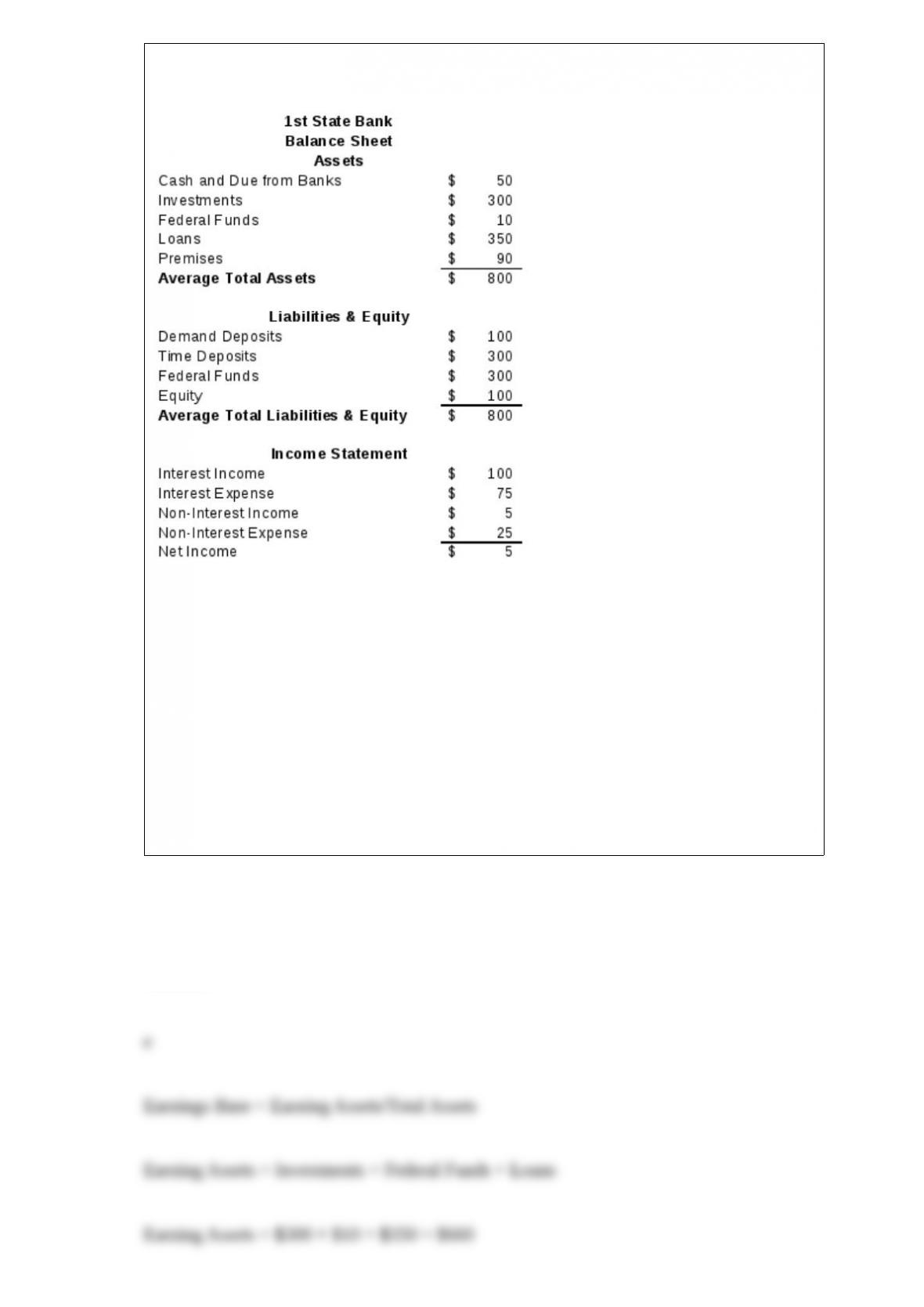
Use the following information.
What is the earnings base at 1st State?
a. 12.5%
b. 17.5%
c. 58.5%
d. 75.5%
e. 82.5%
Answer: