1) When economist John Maynard Keynes said “In the long run we’re all dead!” he
meant that there was no point in the government engaging in stabilization policy.
2) the consumer demand curve for a product is downsloping because marginal utility is
constant when price declines.
3)
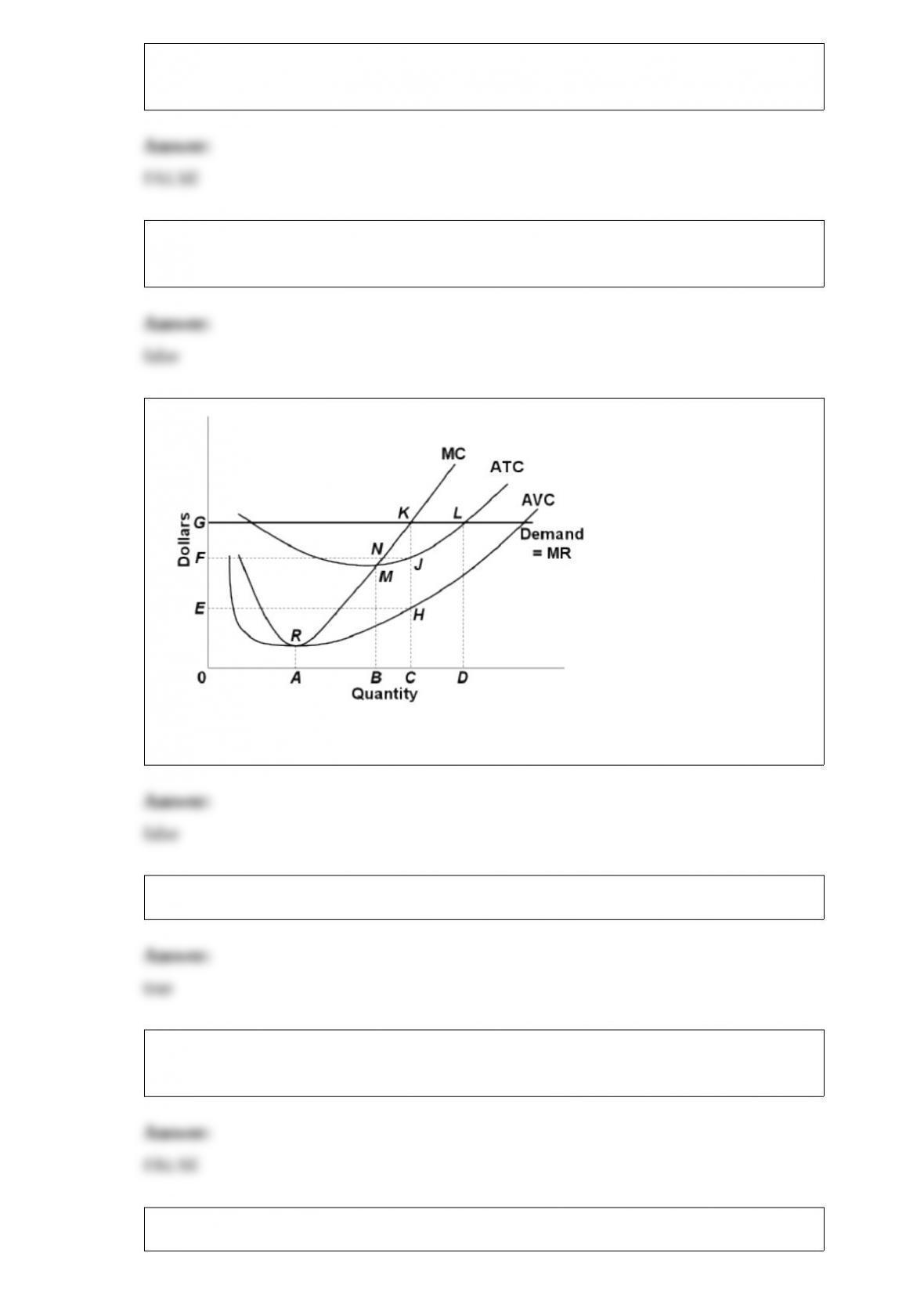
refer to the above diagram. if demand fell to the level of fnj, there would be no output at
which the firm could realize an economic profit.
4) the total revenue curve of a competitive seller graphs as a straight, upsloping line.
5) Economic profits are the salaries received by the hired managers of business
corporations.
6) The following information. Assume that by devoting all its resources to the
production of X, nation Alpha can produce 40 units of X. By devoting all its resources
to Y, Alpha can produce 60Y. Comparable figures for nation Beta are 60X and 40Y.
Refer to the above information. If Alpha had produced 20X and 30Y and Beta had
produced 30X and 20Y before specialization and trade, then we can say that the gains
from specialization and trade are 10X and 10Y.
7) a ceiling price in a competitive market will result in persistent surpluses of a product.
8) economic growth can be shown as a movement from a point on one production
possibility curve to a point on a curve located farther from the origin.
9) illegal immigration has little effect on the average level of wages in the united states.
10)
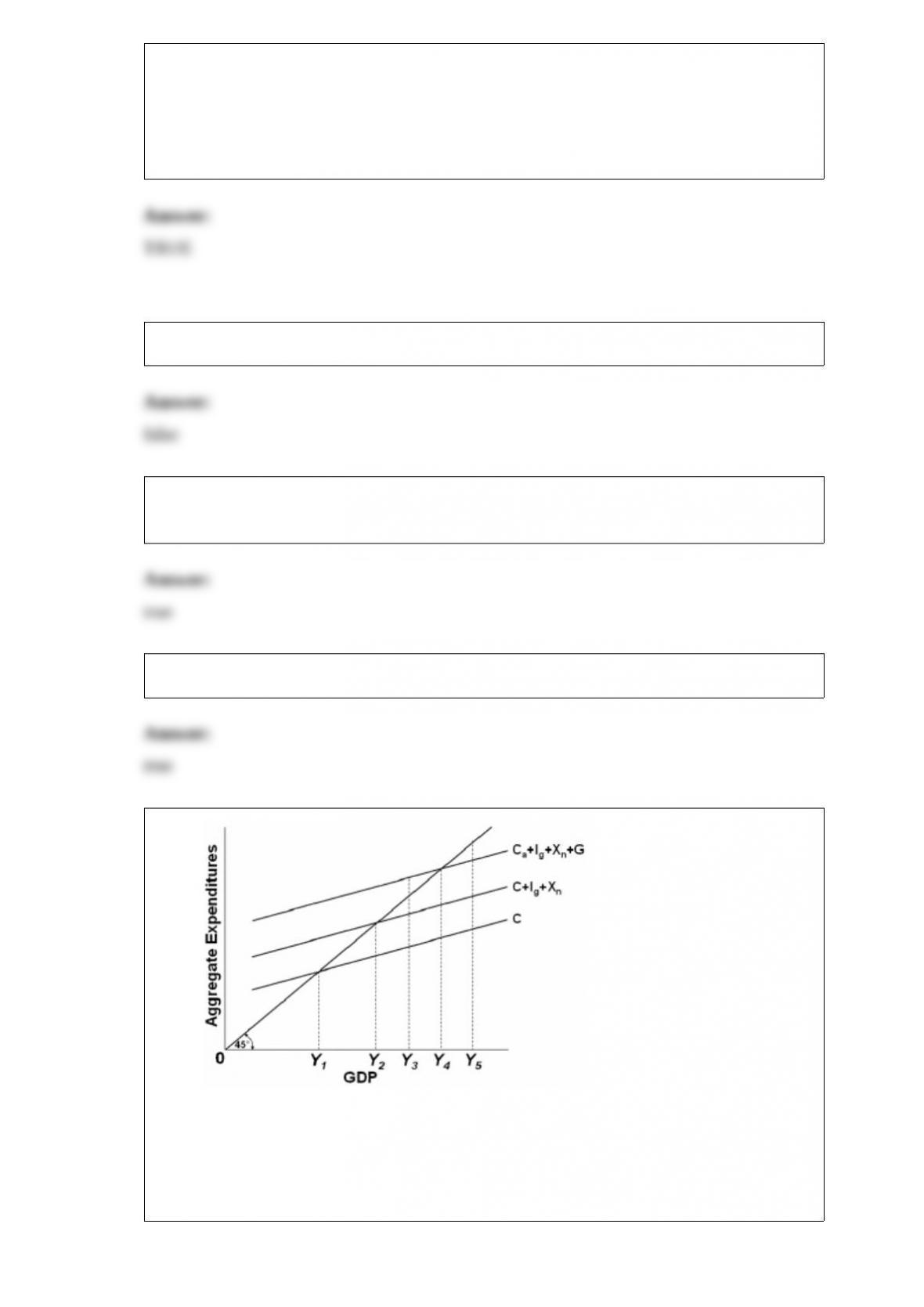
Refer to the above diagram. If the full-employment GDP is Y3, government should:
A.incur neither a deficit nor a surplus.
B.increase taxes and government spending by equal amounts.
C.reduce taxes and increase government spending.
D.increase taxes and reduce government spending.

11) if a firm finds that it can sell $13,000 worth of a product when its price is $5 per
unit and $11,000 worth of it when its price is $6, then:
a.the demand for the product is elastic in the $6-$5 price range.
b.the demand for the product must have increased.
c.elasticity of demand is 0.74.
d.the demand for the product is inelastic in the $6-$5 price range.
12) an efficiency loss (or deadweight loss):
a.is measured as the combined loss of consumer surplus and producer surplus.
b.results from producing a unit of output for which the maximum willingness to pay
exceeds the minimum acceptable price.
c.can result from underproduction, but not from overproduction.
d.can result from overproduction, but not from underproduction.
13) Other things equal, if the supply of money is reduced:
A.the demand for money will increase.
B.the interest rates will fall.
C.bond prices will fall.
D.investment spending will increase.
14)

refer to the budget line shown in the diagram above. the absolute value of the slope of
the budget line is:
a.muc/mud.
b.one-half.
c.pd/pc.
d.pc/pd.
15) the largest component of national income is:
a.compensation of employees.
b.rents.
c.interest.
d.corporate profits.
16) The short-run aggregate supply curve is upsloping because:
A.of the interest rate effect.
B.higher price levels create incentives to expand output when resource prices are
unresponsive to price-level changes.
C.of the net export effect.
D.higher price levels create an expectation among producers of still higher price levels.
17) Which of the following is correct?
A.The Federal tax system is regressive, while the state and local tax system is
progressive.
B.Both the Federal tax system and the state and local tax system are regressive.
C.The Federal tax system is progressive, while the state and local tax system is
regressive.
D.Both the Federal tax system and the state and local tax systems are progressive.
18)
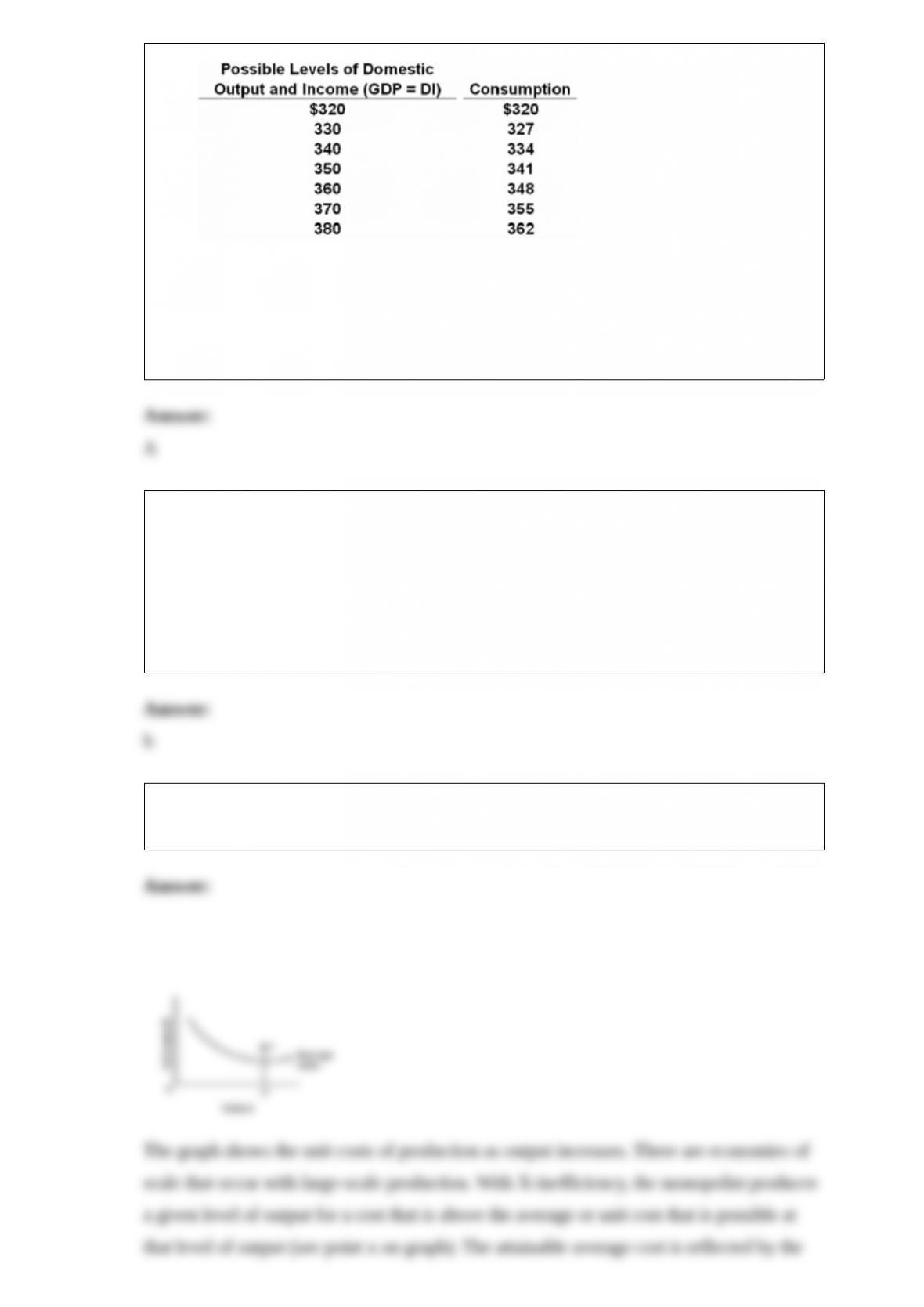
Refer to the above data. At the $370 billion level of DI the APS is approximately:
A.4 percent.
B.7 percent.
C.1 percent.
D.16 percent.
19) which of the following statements is most accurate about modern economic
growth?
a.economic historians mark modern economic growth as beginning around a.d. 1500.
b.modern economic growth is characterized by sustained and ongoing increases in
living standards.
c.modern economic growth has virtually eliminated business cycle fluctuations.
d.modern economic growth has been distributed more or less equally across nations.
20) Draw a graph that illustrates X-inefficiency. Explain the concept of X-inefficiency
using the graph.

21) What are the likely trends for the demand for and the supply of resources in the
future?
22) What has been the recent focus of monetary policy?
23) Why cant food be used as a form of money?
24) What are the two key factors that determine the strength of demand? How do they
determine whether a good is in high demand or low demand?
25) Assume that in a purely competitive industry: (1) the entry and exodus of firms are
the only long-run adjustments; (2) firms in the industry have identical cost curves; and
(3) the industry is a constant-cost industry. Explain how long-run equilibrium is
eventually achieved in the industry when there are initially economic profits and losses.
26) Explain why even small changes in the rate of economic growth are significant. Use
the rule of 70 to demonstrate the point.