The United States generally has a comparative advantage in the development of
technology because of:
A. larger amounts of natural resources.
B. a high concentration of the best research universities.
C. tax incentives.
D. the existence of patent law, which no other country provides.
All of the following would be included in planned aggregate expenditure EXCEPT:
A. purchases of services provided by government employees.
B. planned changes in inventories.
C. sales of domestically produced goods to foreigners.
D. social security payments.
If potential output equals 8,000 and short-run equilibrium output equals 8,500, there is

a(n) ______ gap and the Federal Reserve must ______ real interest rates in order to
close the gap.
A. recessionary; raise
B. recessionary reduce
C. recessionary; not change
D. expansionary; raise
The aggregate supply curve shows the relationship between the amount of output firms
want to produce and the ______.
A. nominal interest rate
B. real interest rate
C. unemployment rate
D. inflation rate
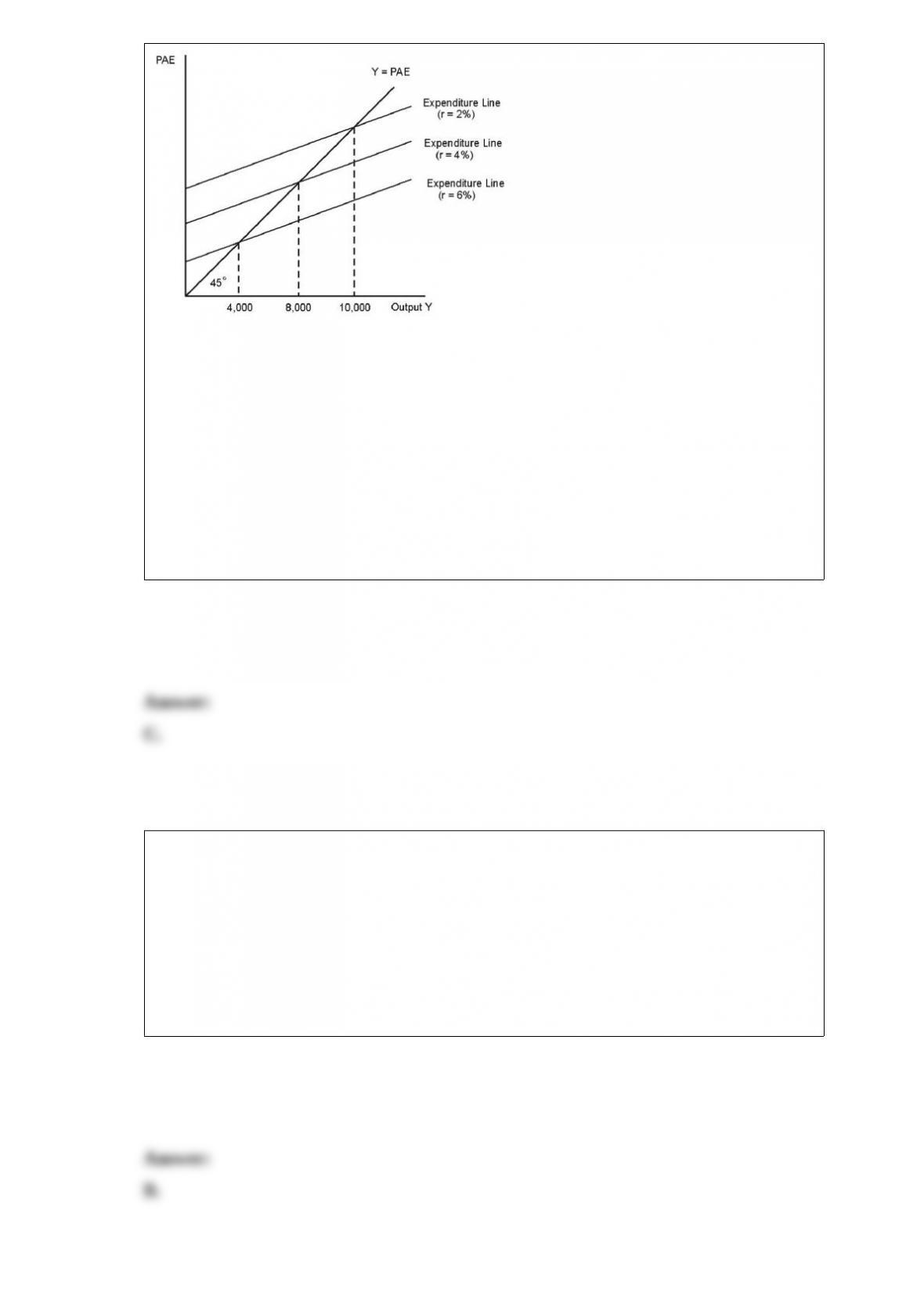
Refer to the figure above. Based on the diagram, if potential output equals 8,000 and
the real interest rate is 4%, then there is ______ gap and the Fed must ______ the real
interest rate so that output will equal potential output.
A. a recessionary; raise
B. a recessionary; lower
C. no output; not change
D. an expansionary; raise
In the United States since 1929 the duration of recessions on average has been:
A. longer than the duration of expansions.
B. shorter than the duration of expansions.
C. about the same duration as expansions.
D. shorter than the duration of expansions before World War II, but longer afterwards.
The four categories of final users of GDP are:
A. businesses, firms, governments, and the foreign sector.
B. households, the Federal Reserve, governments, and the foreign sector.
C. businesses, corporations, firms, and farms.
D. households, firms, governments, and the foreign sector.
The numbers in each cell are each firm’s profits.
Refer to the figure above. If Column Cafe offers coupons, and Row Restaurants does
not publish coupons:
A. Row Restaurant will earn 10 in profits, and Column Cafe will earn 200 in profits.
B. both Row Restaurant and Column Cafe will earn 25 in profits.
C. Row Restaurant will earn profits of 200 and Column Cafe will earn profits of 10.
D. both Row Restaurant and Column Cafe will earn profits of 120.

Suppose that there are two employers in Tinytown. CareCo offers a generous health
insurance package to all employees while ApathyInc pays slightly higher wages, just
sufficient to pay for health coverage for a person in average health.
Suppose that the cost of insurance increases if greater-than-average claims are made,
whether the insurance is purchased by an individual or by a company for its employees.
Therefore, over time,
A. CareCo’s insurance costs will fall.
B. ApathyInc will have to increase its wages to cover increased insurance premiums.
C. less healthy employees at ApathyInc will move to CareCo.
D. less healthy employees at CareCo will move to ApathyInc.
An economy with an expansionary gap will, in the absence of stabilization policy,
eventually experience a(n) ______ in the inflation rate, leading to a(n) ______ in
output.
A. increase; increase
B. increase; decrease
C. decrease; increase
D. decrease; decrease

Suppose the price of gold is initially 300 U.S. dollars per ounce in New York and 450
Canadian dollars per ounce in Toronto, Canada. If the law of one price holds for gold,
the nominal exchange rate is ______ Canadian dollars per U.S. dollar. If Canada
experiences inflation, such that the price of gold rises to 510 Canadian dollars per
ounce, but the U.S. does not experience any inflation, the nominal exchange rate would
be ______ Canadian dollars per U.S. dollar.
A. 0.59; 0.67
B. 0.67; 0.59
C. 1.70; 1.50
D. 1.50; 1.70
The current U.S. income tax system requires taxpayers to pay a higher marginal tax rate
on higher levels of taxable income. Suppose that the tax rate is 10% on the first $15,000
of taxable income, 15% on the next $45,000 of taxable income, 30% on the next
$60,000 of taxable income, and 35% on taxable income above $120,000.
Suppose that the tax code also includes provisions that allow taxpayers to reduce the
income on which they are taxed, and that those provisions most often apply only to the
wealthiest taxpayers. These provisions tend to make the tax code
A. more regressive.
B. more efficient.
C. less progressive.
D. less regressive.
If an industry experiences an increase in the number of firms, then:
A. the new firms will produce more than the original firms.
B. the industry supply curve will shift left.
C. the new firms will produce the same amount as the original firms.
D. the industry supply curve will shift right.
Total revenue minus total explicit and implicit costs defines:
A. gross earnings.
B. profit.
C. marginal earnings.
D. net worth.
In general, if the price of a variable factor of production increases:
A. total costs fall.
B. the profit maximizing level of output rises.
C. price rises.
D. marginal costs rise.
The Principle of Increasing Opportunity Costs implies that:
A. productive people do the hardest tasks first, while they are fresh.
B. to increase production, you should use the resources with the lowest opportunity cost
first.
C. the cost-benefit principle does not apply to increasing productivity.
D. specialization increases productivity.

A large decrease in oil prices is an example of:
A. a positive inflation shock.
B. a negative inflation shock.
C. inflation inertia.
D. excessive aggregate spending.
Labor unions contribute to structural unemployment by:
A. keeping wages above the market-clearing level.
B. keeping wages below the market-clearing level.
C. allowing unemployed workers to search longer or less intensively for jobs.
D. forcing unemployed workers to take the first job offered to them.
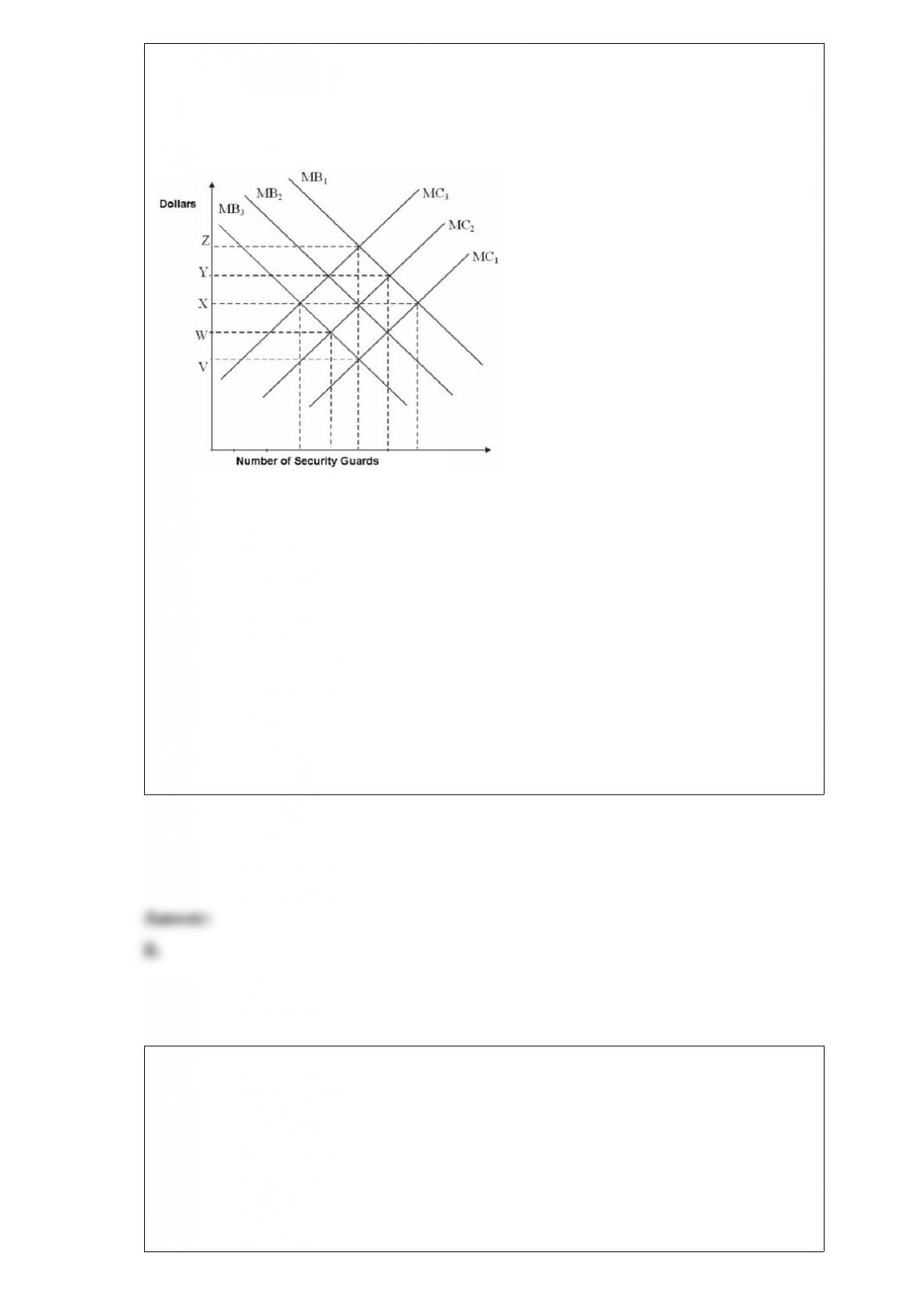
Suppose that the marginal benefit of having a security guard at the airport is MB1, at the
bank is MB2, and at the mall is MB3. The marginal cost of assigning security guard is
the same for all three places, and it is represented by MC2.
Starting with MB1 (marginal benefit curve for the airport) and MC2, suppose the federal
government decided to increase security at the airport. As a result training costs for
security guards increases. This would shift ______ and ______ the optimal number of
security guard at the airport.
A. MC2 to MC3; increase
B. MC2 to MC3; decrease
C. MC1 to MC2; increase
D. MC2 to MC1; increase
Each of the following would decrease the demand for U.S. dollars, shifting the demand
curve for dollars to the left, EXCEPT:
A. a decreased preference for U.S.-made goods.
B. a decrease in real GDP abroad.
C. a decrease in the real interest rate on U.S. assets.

D. a depreciation of foreign currencies relative to the U.S. dollar.
If you knew that two countries had the same level of real GDP per person, what
additional piece of information would help you determine in which country people had
a better standard of living?
A. The total physical volume of output for each country
B. The population of each country
C. The average number of hours worked per week in each country
D. The average level of prices in each country
Which of the following would not be analyzed in microeconomics?
A. How to make the largest profit?
B. Whether to study or watch TV tonight.
C. How an early freeze in California will affect the price of fruit?
D. Whether the federal budget should always be balanced.
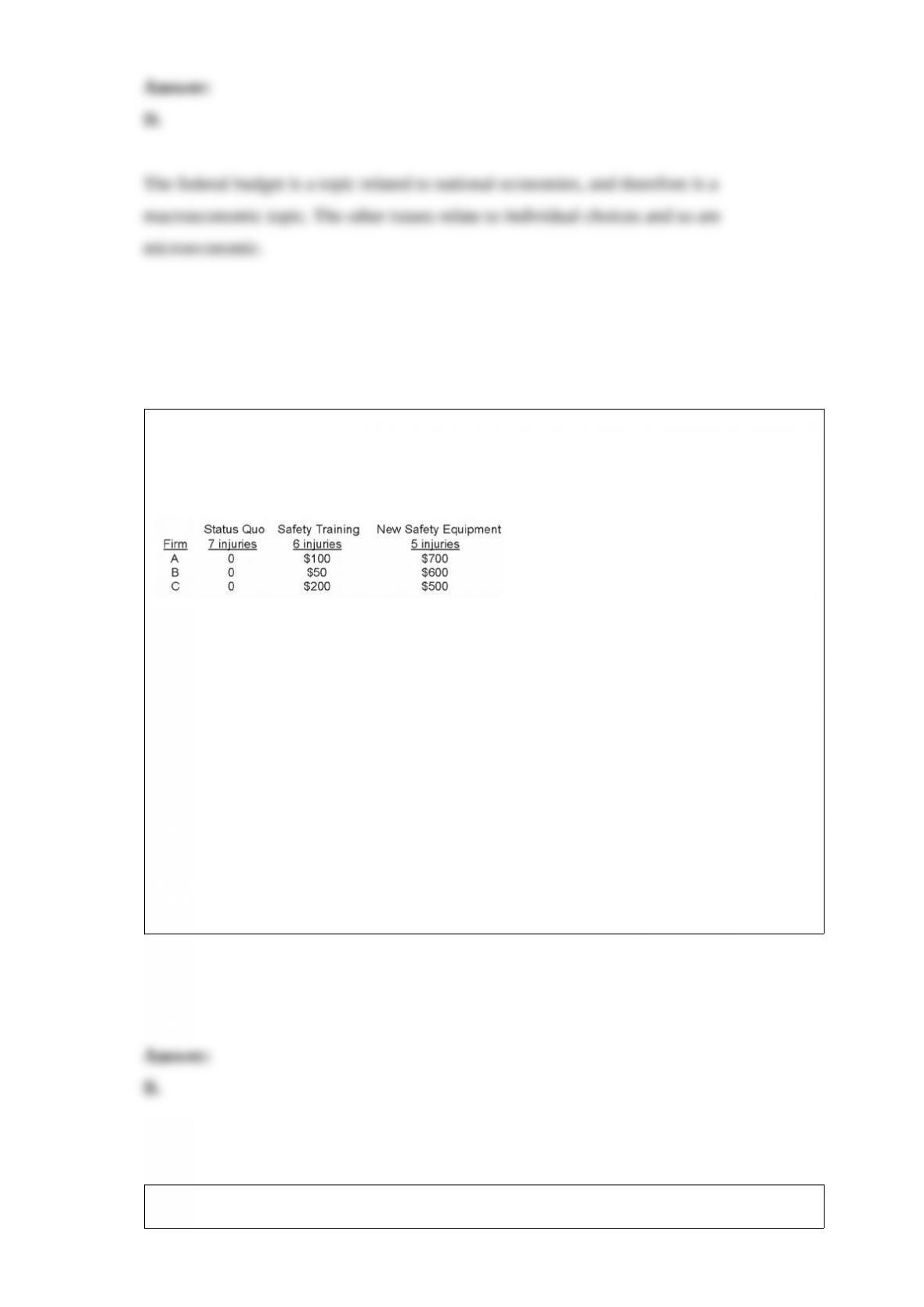
The three firms shown below can choose among three workplace safety alternatives:
continue with the status quo, provide safety training or purchase new safety equipment.
The injury rates for the firms under the three alternatives as well as the costs of the
alternatives are shown in the table. The cost of treating an injury is $200.
If a 2% reduction in workplace injuries is valued at $1000 and can be achieved by
having workers wear large, heavy goggles, then
A. it would be efficient to buy and require them if the firm can purchase goggles for
$1000 or less.
B. it would be efficient to buy and require them if the purchase price of the goggles plus
the value each worker placed on the discomfort from wearing the goggles totaled $1000
or less.
C. injuries will be unchanged because workers will refuse to wear them.
D. it would be efficient to buy and require them if the value each worker placed on the
discomfort from wearing the goggles is $1000 or less.
Daily Supply and Demand: Oranges in Hurricane Alley
Refer to the figure above. At the price of $4.00, sellers offer _____ pounds of oranges
per day, and buyers want to purchase ____ pounds of oranges a day.
A. 10; 30
B. 10; 20
C. 20; 20
D. 30; 10
A country’s trade balance equals:
A. the value of tariffs less the number of quotas.
B. the number of quotas less the value of tariffs.
C. the value of exports minus the value of imports.
D. the value of imports minus the value of exports.
A firm employs Pam to assemble personal computers. Pam can assemble 1 computer if
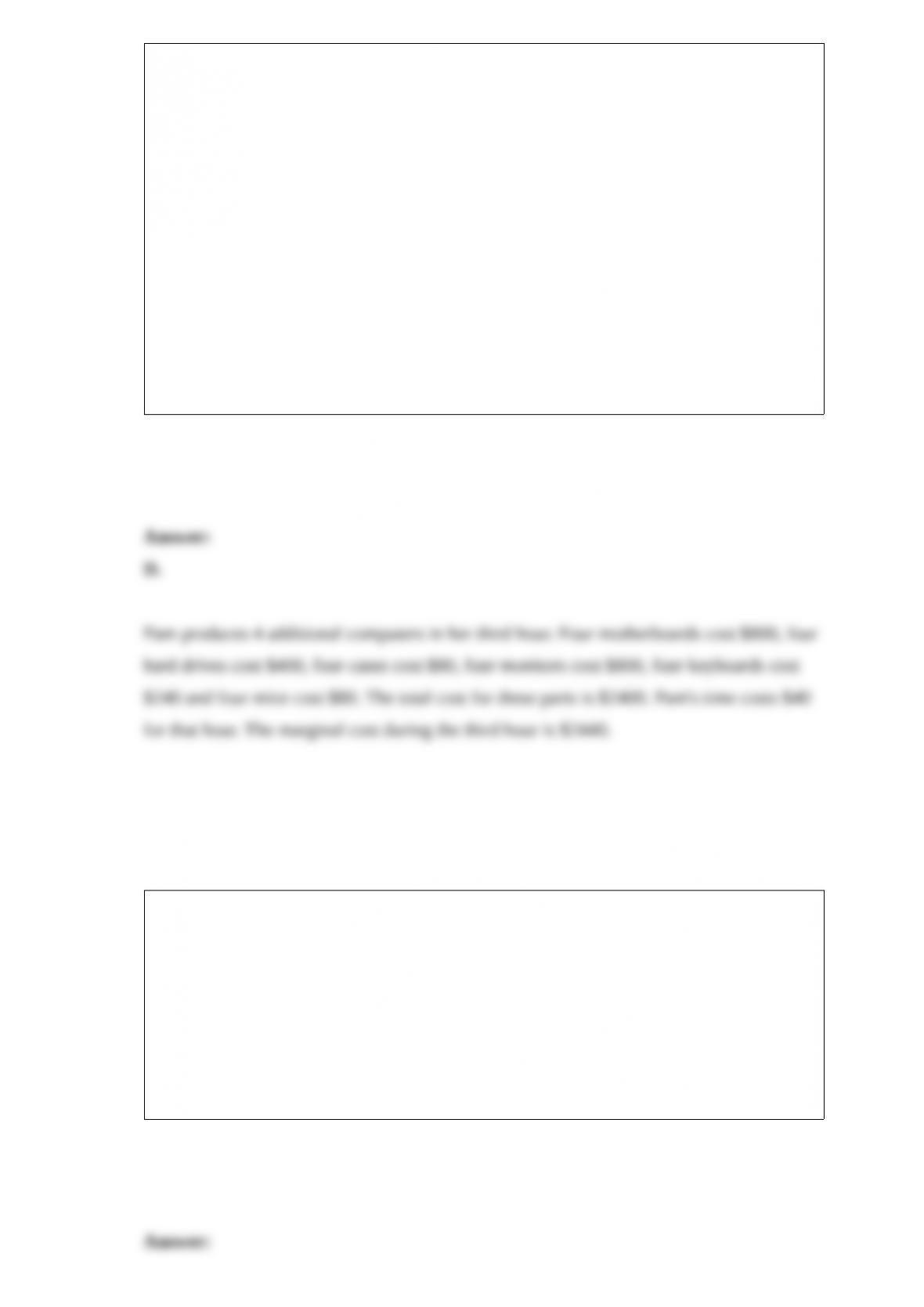
she works 1 hour, 4 computers in 2 hours, 8 computers in 3 hours, 10 computers in 4
hours, and 11 computers in 5 hours. Each computer consists of a motherboard that costs
$200, a hard drive that costs $100, a case that costs $20, a monitor that costs $200, a
keyboard that costs $60 and a mouse that costs $20. The cost of employing Pam is $40
per hour.
What is the marginal cost of producing the computers Pam assembles during her 3rd
hour of work?
A. $1,200
B. $1,240
C. $2,400
D. $2,440
All of the following describe trends in labor markets EXCEPT:
A. growing wage inequality in the United States in recent decades.
B. a slowdown in real wage growth since the 1970s.
C. substantial growth in the level of employment in the United States.
D. over-sixteen population growth rates that exceed the growth rate of new jobs in the
United States.
Which of the following is most likely to be used efficiently?
A. A resource that has private property rights
B. A resource that benefits everyone
C. Government owned resources
D. Endangered species
Two firms can choose from five different technologies to reduce their pollution: A, B,
C, D and E. The amount of pollution emitted by each technology and the cost of the
technologies are shown in the table. Both firms have adopted technology A and
currently emit 4 tons apiece. The government is considering two plans to reduce
pollution: a 50% reduction by both firms or selling pollution permits. One permit
entitles the owner to emit one ton of pollution. Without a permit, no pollution can be
emitted.
The ultimate equilibrium price of six permits is __________ with Industrio buying
__________ and Capitalista buying __________.
A. $100; 3; 3
B. $110; 2; 4
C. $50; 4; 2
D. $300; 3; 3

The aggregate demand curve shifts when there are changes in:
A. the inflation rate.
B. planned spending that are not caused by changes in output or the inflation rate.
C. planned spending that are caused only by changes in output or the inflation rate.
D. real GDP.
Because many European nations have adopted the euro as their common currency, they
are ______ able to conduct independent ______ policy.
A. no longer; monetary
B. no longer; fiscal
C. increasingly; monetary
D. increasingly; fiscal
The existence of a negative externality will result in:
A. a less than optimal level of production.
B. a greater than optimal level of production.
C. prices that are artificially high.
D. elimination of deadweight loss.