When plasma television sets were first introduced prices were high and few firms were
in the market. Later, economic profits attracted new firms and the price of plasma
televisions fell. This example illustrates
A) a decreasing-cost industry.
B) that consumers receive this new technology “free of charge” in the sense that they
only have to pay a price for plasma televisions equal to the lowest production cost.
C) an industry with a low minimum efficient scale.
D) how fickle consumer demands are.
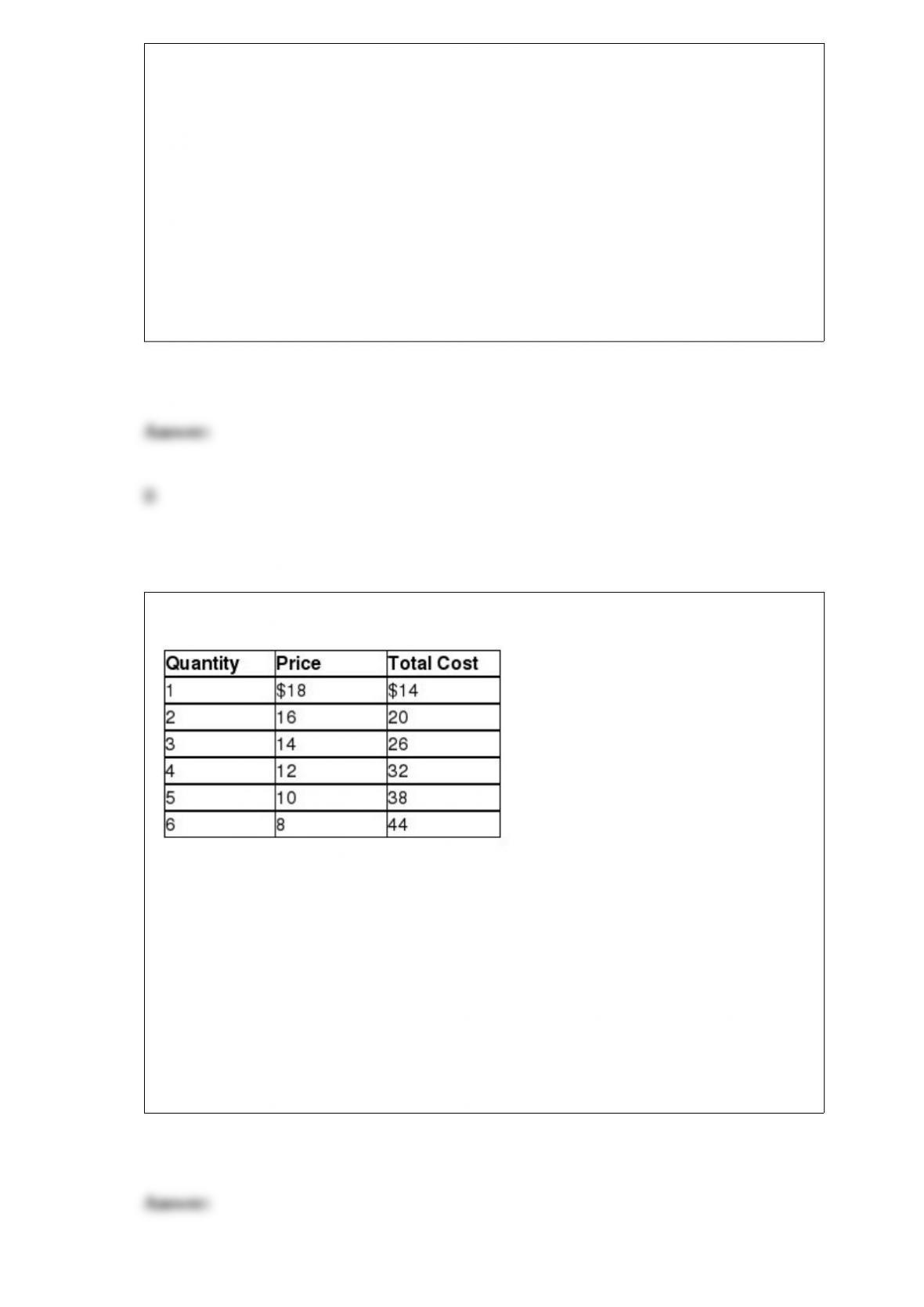
Table 13-5
Table 13-5 shows the demand and cost data facing a monopolistically competitive
producer of canvas bags. What are the firm’s profit-maximizing or loss-minimizing
price and quantity?
A) price = $10; quantity = 5.
B) price = $12; quantity = 4.
C) The firm should shut down temporarily.
D) This cannot be determined from the information given.

Southwest Airlines wants to raise $20 million to finance the renovation of their
corporate offices, and the company wishes to raise the funds through direct finance.
Which of the following methods could it use?
A) It could issue $20 million in stocks.
B) It could sell $20 million in bonds.
C) It could borrow $20 million from a bank.
D) It could choose either A or B.
The United States has developed a comparative advantage in film production due to the
film industry being long-established in southern California, and lower costs result from
the size of the industry in the area. This source of comparative advantage is referred to
as
A) the abundance of natural resources.
B) superior process technology.
C) external economies.
D) best practices of unskilled labor.

Assume that Honduras has a comparative advantage in producing bananas and exports
bananas to Brazil. We can conclude that
A) Honduras also has an absolute advantage in producing bananas relative to Brazil.
B) Honduras has a lower opportunity cost of producing bananas relative to Brazil.
C) Brazil has an absolute disadvantage in producing bananas relative to Honduras.
D) Labor costs are higher for banana producers in Brazil than in Honduras.
Suppose there are two cities that have rent controlled apartments. In one city (Albany)
all apartments are subject to rent control; in the other city (Halftrack) one-half of the
apartments are rent controlled. Which of the following is most likely to be true?
A) It will be difficult to find a rent-controlled apartment in Albany or Halftrack; rents
for the Halftrack apartments not subject to controls will be higher than they would be
without rent control.
B) It will be easier to find an affordable apartment in Albany since rents will be low
across the board.
C) It will be easier to find an affordable apartment in Halftrack, either a rent-controlled
apartment or another apartment, at a reasonable price.
D) It will be impossible to rent an apartment in either city at any price.
Which of the following is the largest source of revenue for the U.S. federal
government?
A) the individual income tax
B) social insurance taxes
C) sales taxes
D) property taxes
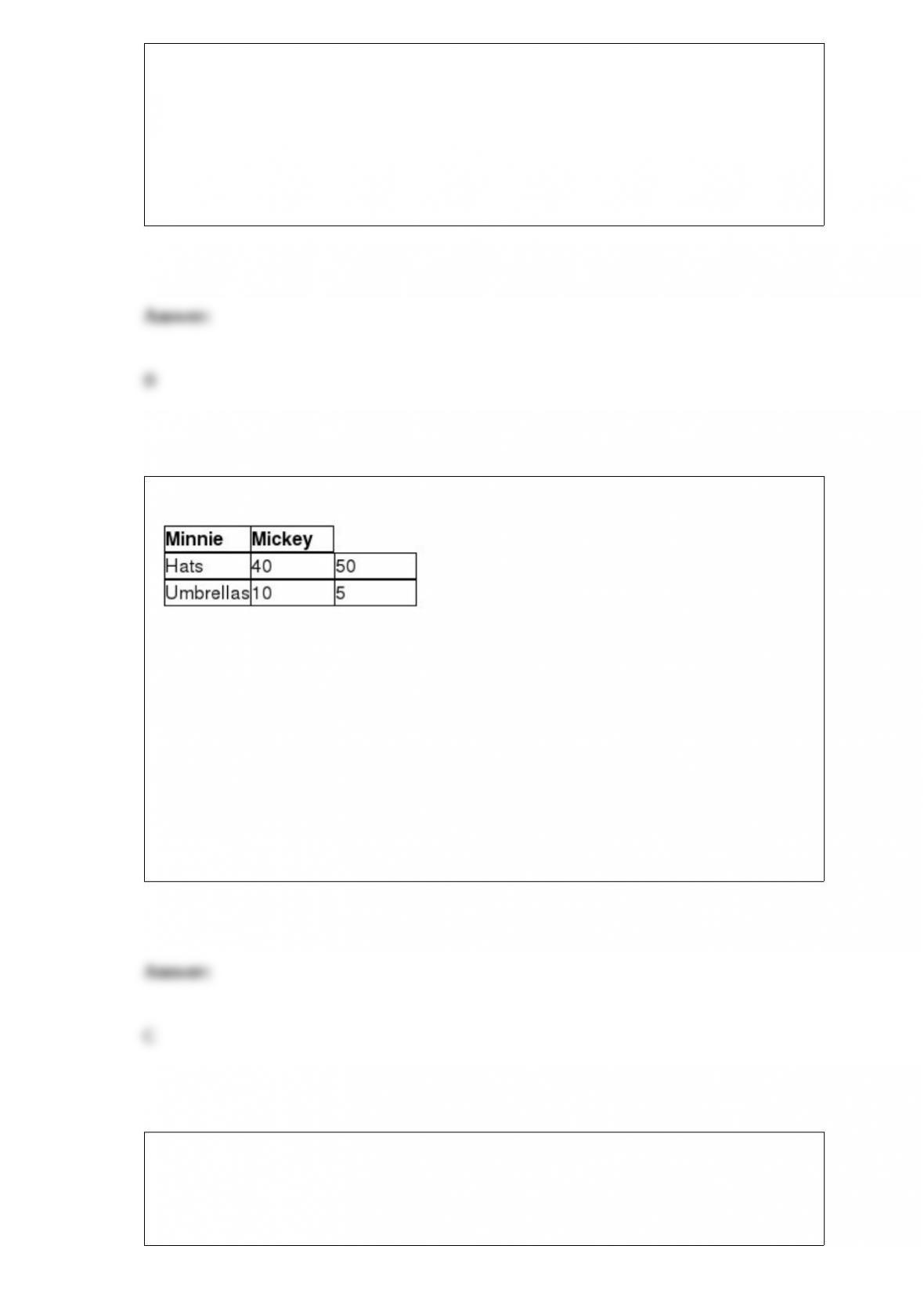
Table 2-7
Table 2-7 shows the output per week of two people, Minnie and Mickey. They can
either devote their time to making hats or making umbrellas. What is Mickey’s
opportunity cost of making an umbrella?
A) 1/5 of a hat
B) 5 hats
C) 10 hats
D) 50 hats
The decision about what goods and services will be produced made in a
centrally-planned economy is made by
A) lawmakers in the government deciding on what will be produced.

B) workers deciding to produce only what the boss says must be produced.
C) producers deciding what society wants most.
D) consumers and firms choosing which goods and services to buy or produce.
E) consumers dictating to firms what they need most.
Which of the following are examples of a firm experiencing a positive technological
change? a. A firm is able to reduce its inputs by 15 percent and still produce the same
level of output.
b. A seminar attended by the firm’s workers makes them more productive.
c. A firm adds 5 percent to its workforce and is able to maintain its initial level of
output.
d. A firm restructures its distribution system and is able to save on its shipping times.
e. A firm rearranges its warehouse and finds that it can use fewer workers to maintain
its productivity level.

If a state requires all drivers to purchase auto insurance, insurance companies still face
the problem of
A) correctly pricing their insurance.
B) sunk costs.
C) adverse selection.
D) excess demand for their insurance.
Assume that a 50 percent gasoline tax led to a large increase in its price and only a
small decrease in the quantity of gasoline demanded. Economic analysis would lead one
to conclude that
A) gasoline should be taxed because the benefits of the tax would exceed the costs.
B) gasoline should not be taxed because the benefits are uncertain.
C) gasoline should not be taxed on ethical grounds since ethical benefits and costs can’t
be measured.
D) the benefits of taxing gasoline is a normative issue. Economic analysis can be used
to contribute to discussion of this issue but cannot decide it.
Suppose the price of gasoline is $3.50 per gallon, the quantity of gasoline demanded is
150 billion gallons per year, the price elasticity of demand for gasoline is -0.06, and the
federal government decides to increase the excise tax on gasoline by $1.00 per gallon,
which increases the price of gasoline by $0.75 per gallon. What is the new equilibrium
quantity of gasoline demanded after the tax is imposed?

A) 109.72 billion gallons per year
B) 127.25 billion gallons per year
C) 148.27 billion gallons per year
D) 161.61 billion gallons per year