
An airline is considering adding a flight from Chicago to Sioux Falls. Total cost of the
flight is $5,500. Variable cost is $2,000. Revenue from the flight is expected to be
$3,000. Should the flight be added?
a. No, the revenue ($3,000) is below the cost ($5,500.)
b. No, the addition to profit is very small and not worth the effort.
c. Yes, profit increases by $1,000 ($3,000 − $2,000.)
d. Yes, profit increases by $3,000.
Total utility always decreases when additional amounts of a commodity are consumed.
a. True
b. False
When Scuba, Inc., lowered the price of a tank of compressed air by 20 percent, it sold
10 percent more tankfuls. The price elasticity for compressed air is
a. 2.
b. 1/2.
c. 1.

d. 20.
A macroeconomist would concentrate on which of the following issues?
a. the price of pizzas
b. the profits of the IBM Corporation
c. the unemployment rate in Germany
d. the market for hot dogs
If two persons trade, one must gain at the expense of the other.
a. True
b. False
A horizontal line has a slope of
a. one.
b. zero.
c. infinity.
d. undefined.
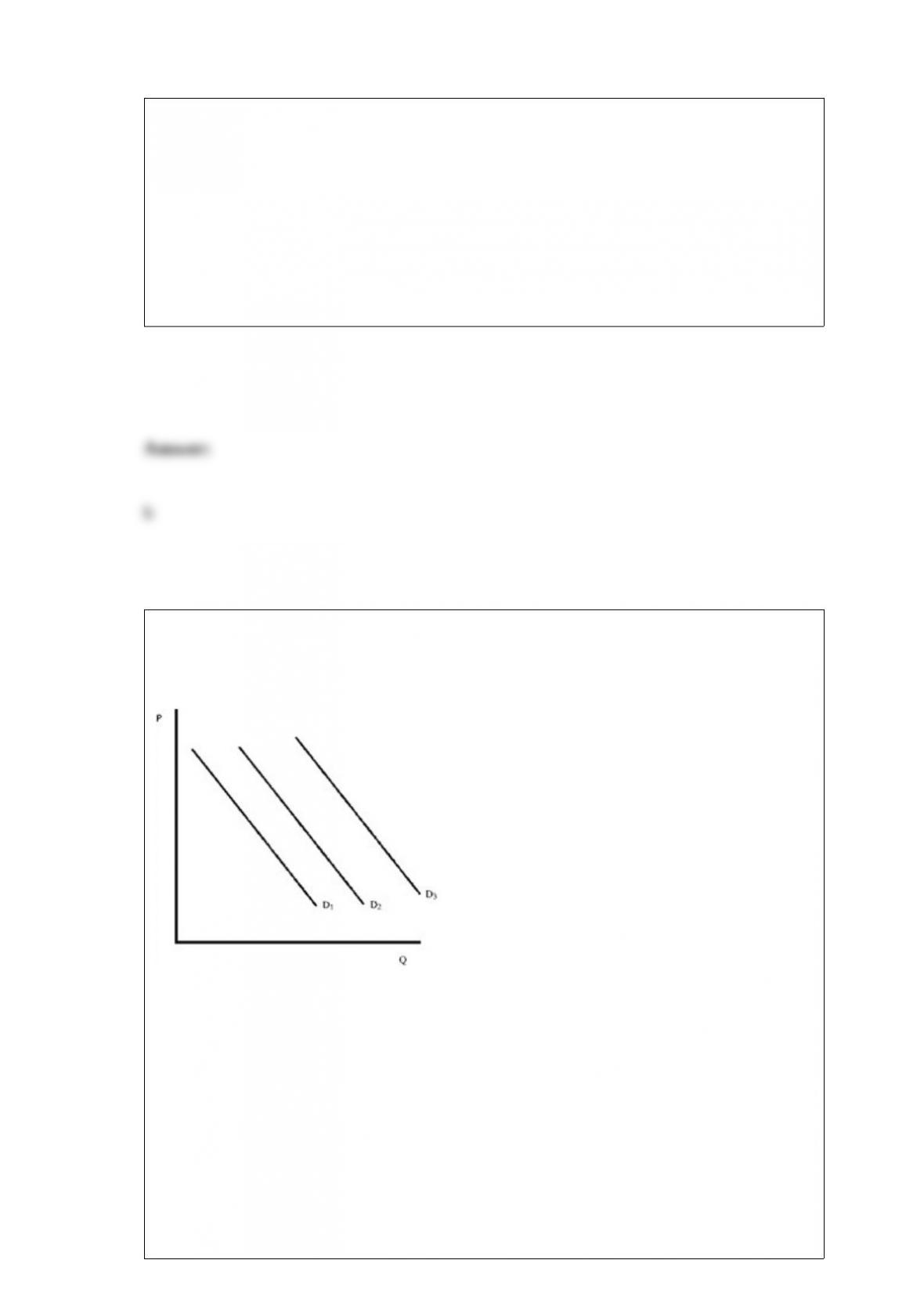
Figure 4-4
Assume that Figure 4-4 shows demand for MP3 players. An increase in the price of
music downloads changes demand from
a. D1 to D2.
b. D2 to D1.
c. D2 to D3.
d. D1 to D3.
Accounting profit is usually larger than economic profit.
a. True
b. False
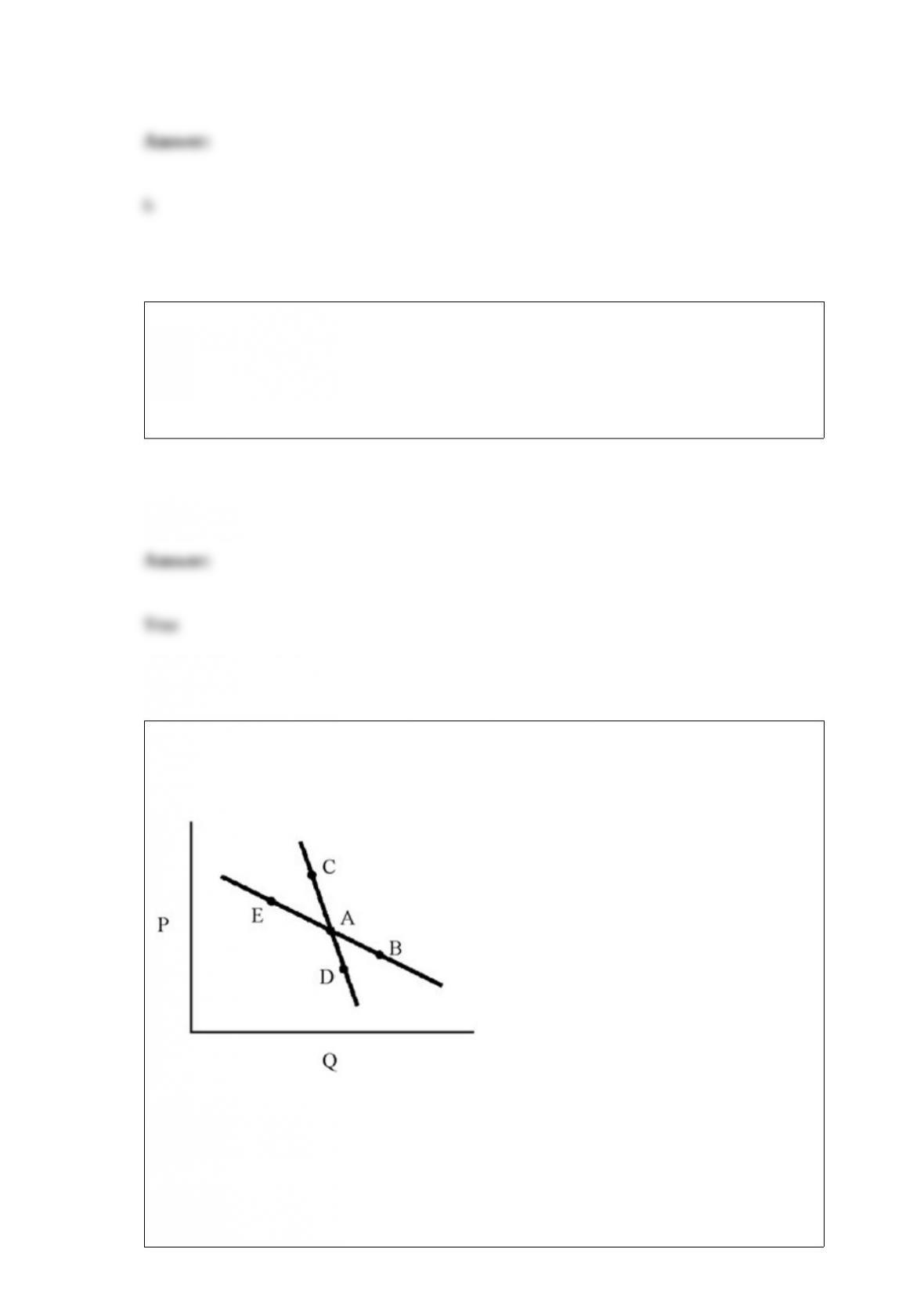
Figure 12-3
In Figure 12-3, according to economic theory, the kink in the demand curve will occur
at point
a. E.
b. A.

c. C.
d. D.
Adam Smith’s diamond-water puzzle
a. can be resolved by distinguishing between marginal and total utility.
b. occurs because diamonds have no utility.
c. occurs because scarcity increases total utility.
d. will likely never be resolved with existing economic tools.
Theoretically, the price of a field hand on the New Orleans slave market would have
a. varied directly with the price of cotton.
b. risen as interest rates fell.
c. risen when the importation of slaves became illegal.
d. All of the above are true.

Inputs in production processes are called resources.
a. True
b. False
If every country uses tariffs, everyone is likely to lose.
a. True
b. False
If the price elasticity of demand for radios is 2.5 (dropping the minus sign), then a 50
percent reduction in the price of radios will lead to
a. the sale of 200 additional radios.
b. the sale of 125 percent more radios than before.

c. the sale of 150 percent more radios than before.
d. the sale of 25 percent more radios than before.
The primary purpose of bank regulation is to
a. assure that banks do not get into financial trouble.
b. assure that banks lend to needy persons and businesses.
c. assure that banks maintain a minimum level of profits.
d. guarantee bank profitability and prevent stockholder losses.
It is often asserted that the United States no longer manufactures anything, and that
instead it imports manufactured goods from countries like China. Critically evaluate
this claim.
For the average American, innovation has led to:
a. an average income that is below many countries because of monies spent on R&D
b. an average income that is not paralleled anywhere in the world
c. an average income that exceeds that of all but the richest countries
d. None of the above is correct.
A tax is progressive if the ratio of taxes to income rises as income rises.
a. True
b. False
During one winter quarter at Frozen U., snow falls every Friday night. Students assume
that, on their campus, Fridays cause snow. This hypothesis

a. should more properly be considered a theory.
b. assumes that correlation implies causation.
c. assumes that causation implies correlation.
d. reflects the fallacy of composition.
If the Fed lends to member banks, what happens to reserves and the money supply?
a. Reserves increase and the money supply decreases.
b. Both increase.
c. Reserves decrease and the money supply increases.
d. Both decrease.
At levels of output close to full employment, the aggregate supply curve is probably
a. very flat.
b. very steep.
c. sloped downward.

d. perfectly elastic.
Professor Gordon posits that the best years of U.S. growth are behind us because of four
“headwinds,” which are:
a. lackluster growth and poverty
b. demographids and education
c. debt and inequality
d. a and b only
e. b and c only
Aggregate demand is the sum of total domestic spending by the private sector.
a. True
b. False

In reality, firms may seek to maximize
a. sales.
b. profits.
c. market share.
d. All of the above can be correct, depending upon management, owners, and other
factors.
Which of the following leads to a fundamental difficulty for stabilization policy?
a. Time lags in policy decisions
b. Presence of shock absorbers in the economy
c. Absence of data on the effectiveness of policy measures
d. Existence of self-correcting mechanism
Any increase in efficiency increases output available for distribution.
a. True
b. False
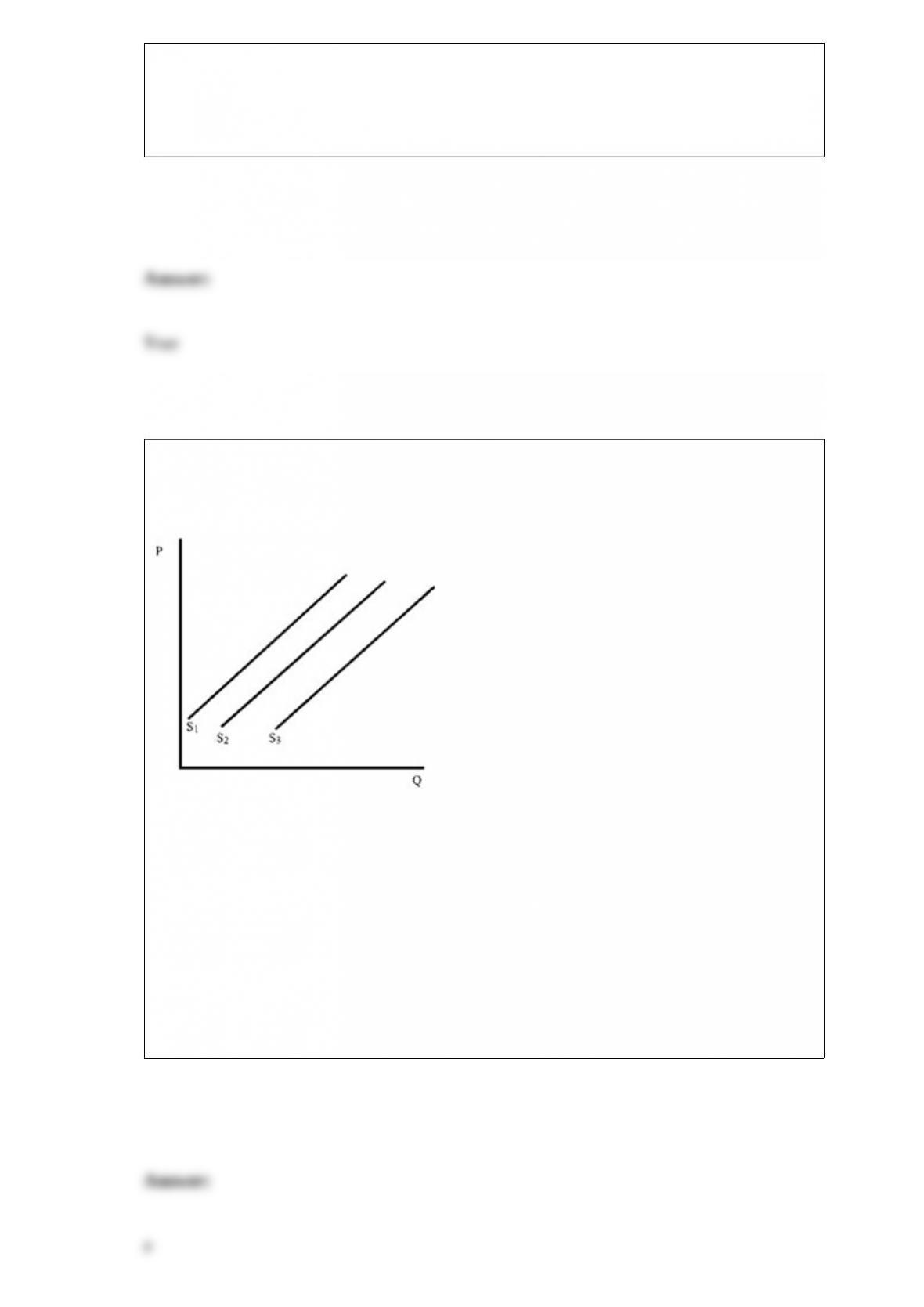
Figure 4-16
In Figure 4-16, an increase in the number of producers will shift supply from
a. S1 to S2.
b. S2 to S1.
c. S3 to S2.
d. S3 to S1.

On which of the following assets are you most likely to earn interest income?
a. cash and currency
b. checkable deposits
c. money market deposit accounts
d. gold and other precious metals
e. All of the above are correct.
State governments’ main source of revenue is
a. property taxes.
b. income taxes.
c. excise taxes.
d. sales taxes.
Real GDP
a. is nominal GDP adjusted for changes in the price level.

b. is also called nominal GDP.
c. measures GDP minus depreciation of capital.
d. will always change when prices change.
Conscious manipulation of the interest rate causes it to become a less effective tool in
allocating resources among time periods.
a. True
b. False
To avoid an increase in the local property tax, Sullivan County, New York, proposed a 2
percent hotel tax, which presumably would be passed on to tourists. The hotel industry
argued that the tax would hurt hotel business. They are really arguing that
a. tourist and convention demand is inelastic, so hotel bookings will decline.
b. tourist and convention demand is very elastic, so hotel bookings will decline.
c. they would prefer a property tax increase instead.
d. it is unfair to tax people who do not live in the area.

Marginal cost is defined by the slope of the total revenue curve.
a. True
b. False