
Which of the following transactions would be included in the GDP of the United
States?
A. Coca Cola produces soft drinks in England.
B. Honda produces cars in Ohio.
C. McDonalds sells hamburgers in Russia.
D. Ford Motor Company produces cars in Mexico.
If workers’ compensation premiums reflected the full social cost of the injuries
sustained by each employer’s workers, then:
A. most firms would be forced out of business.
B. the premium would function like an optimal tax on injuries.
C. injury rates would rise.
D. firms would become less capital intensive.
If supply decreases while demand increases simultaneously, the new equilibrium price
is ___________ and the new equilibrium quantity is _________________.
A. lower; lower
B. lower; indeterminate
C. indeterminate; higher
D. higher; indeterminate
The lemons model predicts that the market price of high-quality used cars will be
______ the true value of high-quality used cars, so that only relatively ______ cars will
be put up for sale in market.
A. greater than; high-quality
B. less than; high-quality
C. greater than; low-quality
D. less than; low-quality
Developing new products and services as well as introducing new production methods
are among the ways that ______ increases average labor productivity.
A. human capital

B. physical capital
C. an entrepreneur
D. a manager
Assume that all firms in this industry have identical cost curves, and that the market is
perfectly competitive.
In the short run, firms in this market will shut down if the market price is:
A. greater than $10.
B. less than $15.
C. less than $10.
D. less than $5.
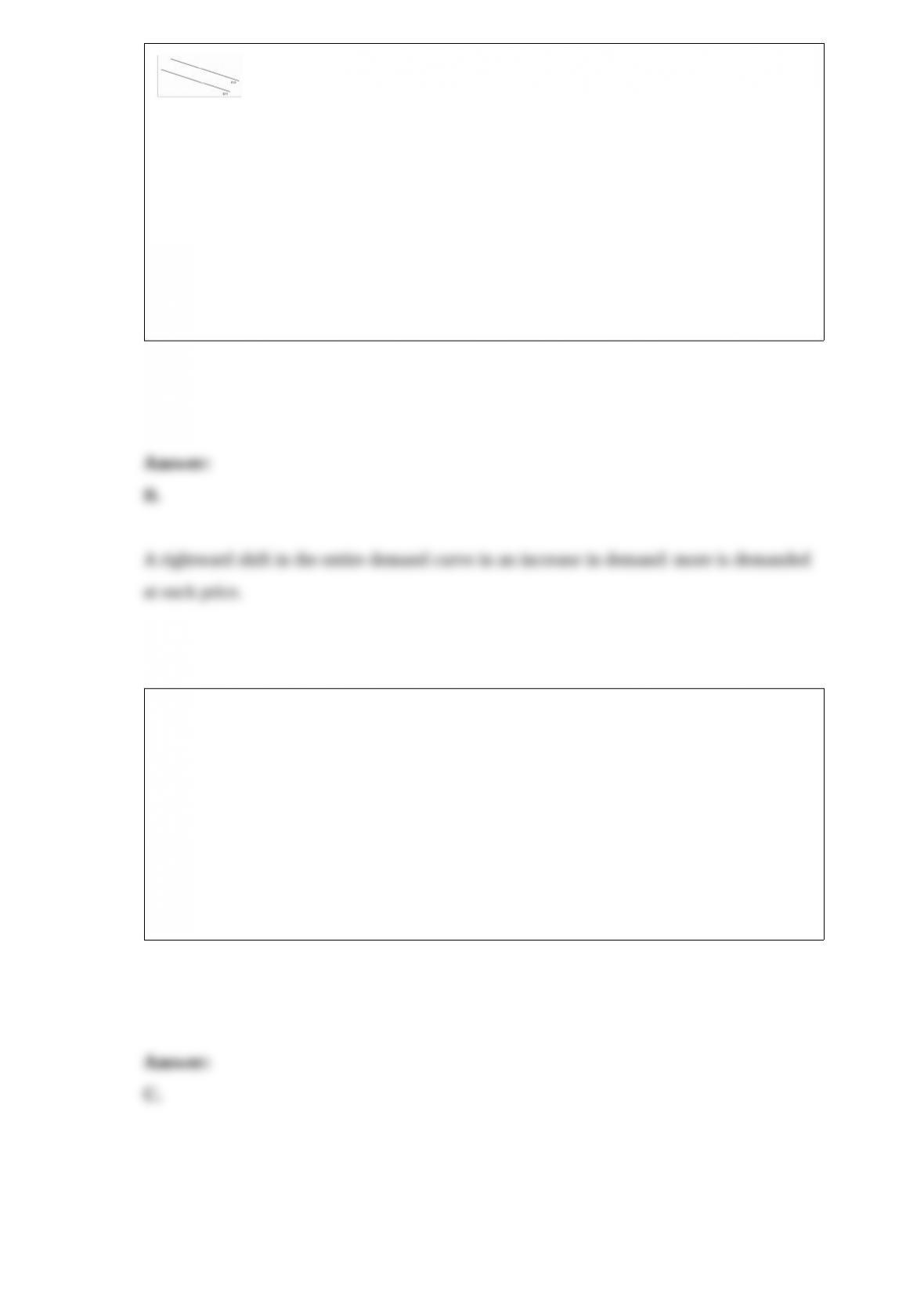
Refer to the figure above. Moving from demand curve D1 to demand curve D2
illustrates a(n):
A. increase in quantity demanded.
B. increase in demand.
C. decrease in demand.
D. decrease in quantity demanded.
A policy maker has argued for higher taxes on gasoline to reduce the negative
externalities associated with driving. This policy will lead to a relatively ______
reduction in driving if demand is ______.
A. small; perfectly elastic
B. large; perfectly inelastic
C. small; relatively inelastic
D. large; relatively inelastic
Suppose Cathy and Lewis work in a bakery making pies and cakes. Suppose it takes
Cathy 1.5 hours to make a pie and 1 hour to make a cake, and suppose it takes Lewis 2
hours to make a pie and 1.5 hours to make a cake. What is the opportunity cost to Cathy
of making a cake?
A. 2/3 of a pie.
B. 1 pie.
C. 1.5 pies.
D. 1.33 pies.
The table below shows the marginal benefit and marginal cost of purchasing an
additional unit of 3 different public goods.
Total economic surplus could be increased by reallocating total spending away from
A. public good 2 toward public good 3.
B. public good 3 toward public good 1.
C. public good 2 toward public good 1.
D. public good 1 toward public good 3.

As disposable income decreases, consumption:
A. increases.
B. decreases.
C. may either increase or decrease depending on the mpc.
D. may either increase or decrease depending on the wealth effect.
Real GDP per person in Richland is $20,000, while real GDP per person in Poorland is
$10,000. However, Richland’s real GDP per person is growing at 1 percent per year, and
Poorland’s real GDP per person is growing at 2 percent per year. After 50 years, real
GDP per person in Richland minus real GDP in Poorland is:
A. positive and greater than $10,000.
B. positive but less than $10,000.
C. zero.
D. negative.
Government regulations that increase the cost to the employer of hiring workers will:
A. increase the demand for labor.

B. decrease the demand for labor.
C. increase the supply of labor.
D. decrease the supply of labor.
All else equal, if U.S. stocks are perceived to have become riskier compared to financial
investments in other countries, then the market equilibrium value of the exchange rate
for the U.S. dollar will:
A. rise.
B. fall.
C. become fixed.
D. be equal to the value chosen by the Federal Reserve.
Suppose Erie Textiles can dispose of its waste “for free” by dumping it into a nearby
river. While the firm benefits from dumping waste into the river, the waste reduces fish
and bird reproduction. This causes damage to local fishermen and bird watchers. At a
cost, Erie Textiles can filter out the toxins, in which case local fishermen and bird
watchers will not suffer any damage. The relevant gains and losses (in thousands of
dollars) for the three parties are listed below.
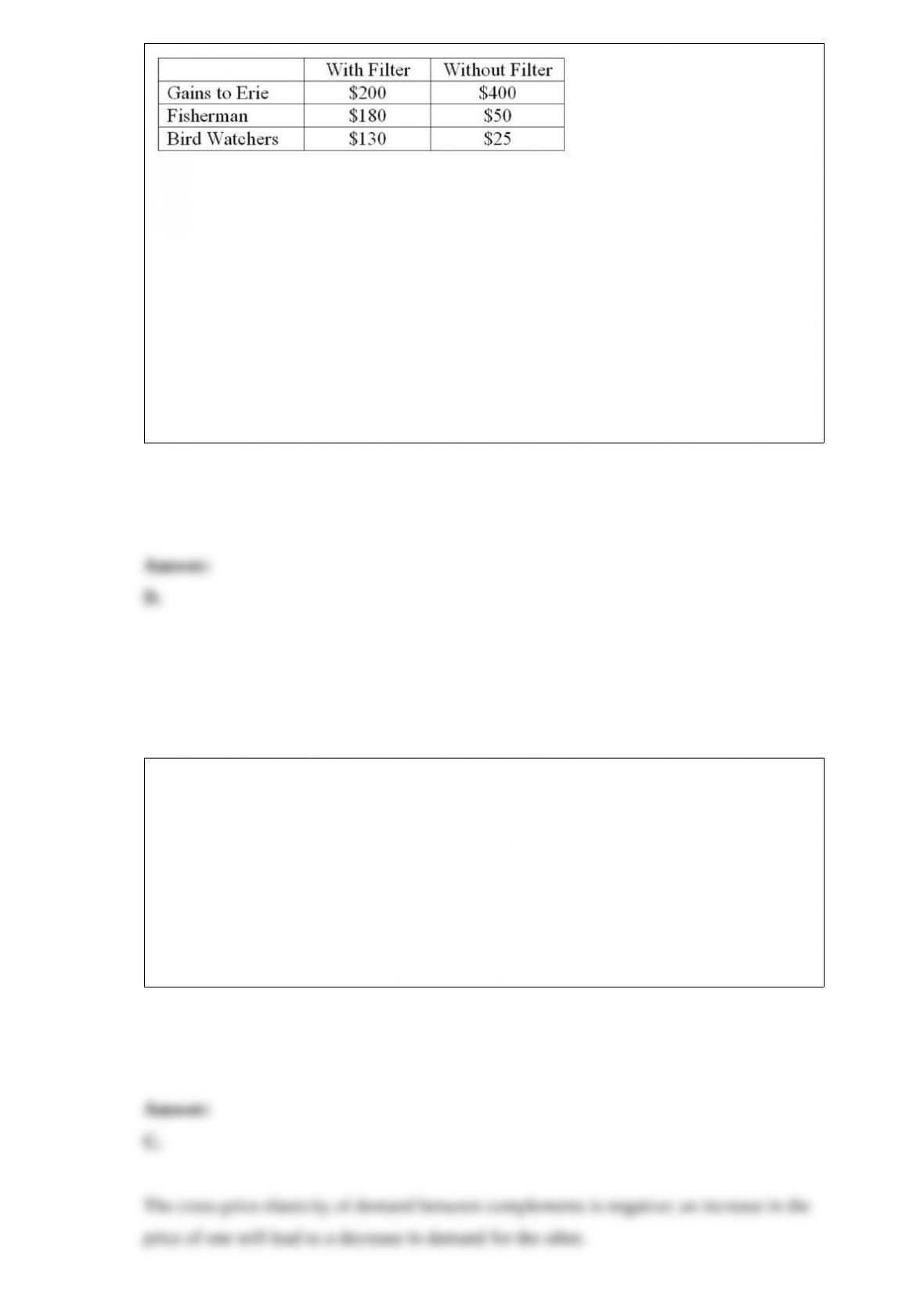
If all three parties can communicate and negotiate with each other at no cost, will Erie
Textiles use a filter?
A. No, because it makes $200 less in profit with the filter.
B. Yes, because the benefit it would receive from being able to advertise that it acts in
an environmentally responsible way exceeds the cost of using a filter.
C. No, because use of a filter would result in smaller total economic surplus.
D. Yes, because fishermen and bird watchers are willing to pay enough to Erie Textiles
to offset the cost of using a filter.
If the cross-price elasticity of demand between blueberries and yogurt is negative, then
the two goods are:
A. substitutes.
B. normal goods.
C. complements.
D. inferior goods.

The speed at which money circulates is called:
A. the multiplier
B. acceleration.
C. velocity.
D. the pace of money.
The sum of national saving and capital inflows from abroad must equal:
A. domestic investment in new capital goods.
B. capital outflows.
C. aggregate demand.
D. the trade deficit.
To obtain a given real rate of return, lenders must charge a ______ nominal interest rate
in the face of increasing inflation.
A. deflated

B. higher
C. lower
D. constant
If banks’ desired reserve ratio increases from 0.10 to 0.15, the public still desires to hold
the same amount of currency, and the Fed takes no actions, the money supply will:
A. increase.
B. decrease.
C. not change.
D. either increase or decrease.
Refer to the figure below. If this firm is a price taker, then when the price of each unit of
output is $30, this firm’s total revenue at its profit-maximizing level of output is
______.
A. $3,000
B. $2,400
C. $1,800
D. $900
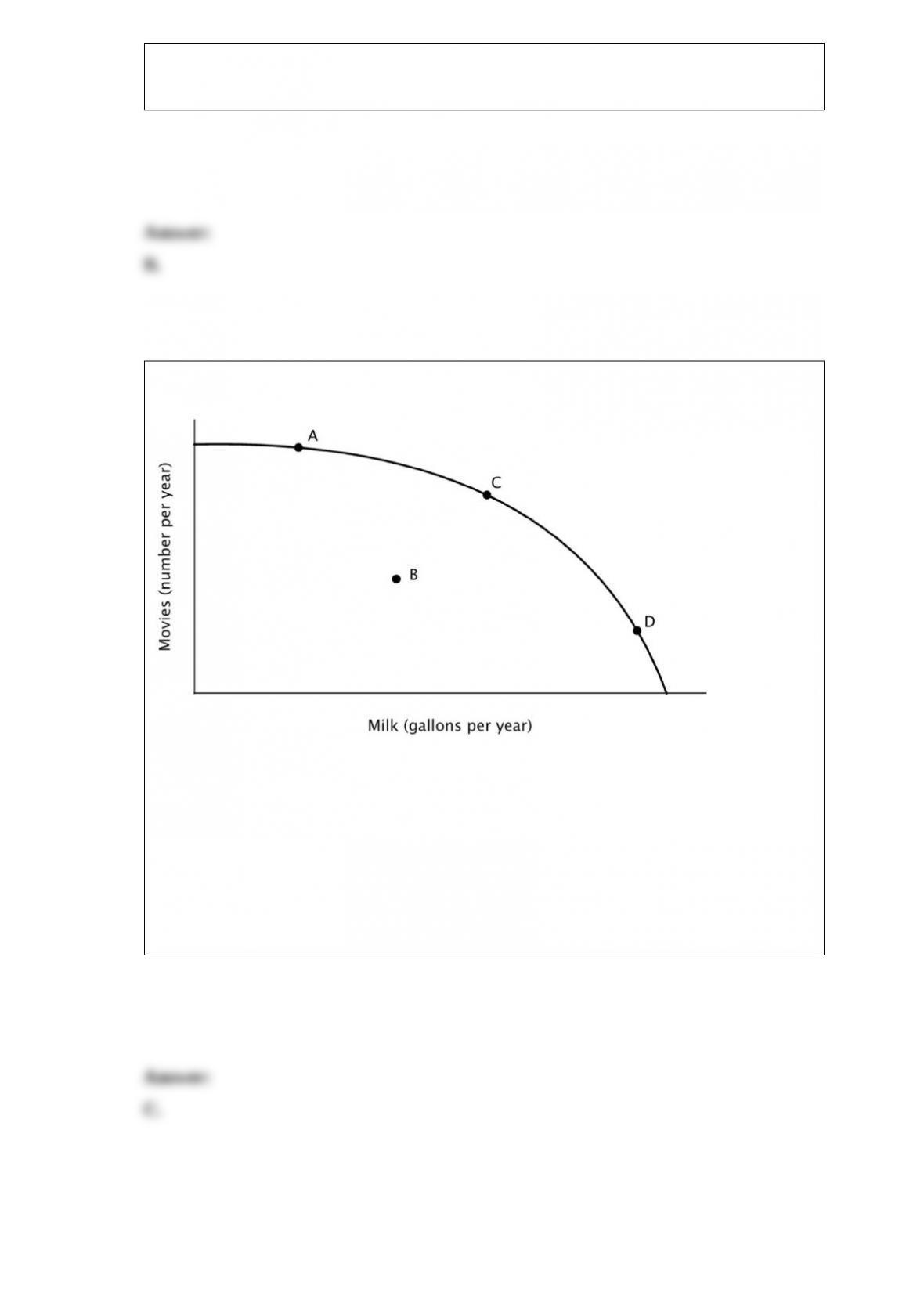
Refer to the figure below. At point D, the opportunity cost of making milk is:
A. low because the economy is specializing in making milk.
B. high because productive resources that are better-suited to making movies are not
being used to make milk.
C. high because productive resources that are better-suited to making movies are being
used to make milk.
D. high because the economy is not operating efficiently.

Refer to the figure below. If the Federal Reserve wants to lower the interest rate to 3%,
it must ______ the money supply to _____.
A. increase; 300
B. decrease; 300
C. increase; 900
D. increase; 700
If cross-price elasticity of demand between two goods is positive, the two goods are:
A. substitutes.
B. inferior.
C. complements.
D. normal.
Under cost-plus regulation, a regulated firm is permitted to charges prices that cover the
explicit cost of production plus a markup to cover the:
A. opportunity cost of the resources supplied by the firm’s owners.
B. extra cost associated with the state ownership of natural monopolies.
C. cost of winning a government contract.
D. owner’s economic rent.
When the price of an item increases, buyers tend to purchase less of that item:
A. solely because of the substitution effect.
B. solely because of the income effect.
C. because of both the substitution and the income effects.
D. only if the substitution effect and the income effect do not cancel out each other.

The value of the marginal product of labor equals the marginal product of labor times
the:
A. real wage.
B. nominal wage.
C. price of output.
D. quantity of labor.
Refer to the figure below. In this market, equilibrium price is ______ and equilibrium
quantity is ______.
A. $10; 25
B. $25; 10
C. $50; 20
D. $20; 50
The two main responsibilities of the Federal Reserve System are to ______ and to

______.
A. apprehend counterfeiters; regulate the stock market
B. enable banks to make affordable mortgages; control the exchange rate of the U.S.
dollar
C. insure bank deposits; print currency
D. conduct monetary policy; oversee financial markets
Your classmates from the University of Chicago are planning to go to Miami for spring
break, and you are undecided about whether you should go with them. The round-trip
airfares are $600, but you have a frequent-flyer coupon worth $500 that you could use
to pay part of the airfare. All other costs for the vacation are exactly $900. The most
you would be willing to pay for the trip is $1400. Your only alternative use for your
frequent-flyer coupon is for your trip to Atlanta two weeks after the break to attend your
sister’s graduation, which your parents are forcing you to attend. The Chicago-Atlanta
round-trip airfares are $450. If you do not use the frequent-flyer coupon to fly to
Miami, should you go to Miami?
A. Yes, your benefit is more than your cost.
B. No, your benefit is less than your cost.
C. Yes, your benefit is equal to your cost.
D. No, because there are no benefits in the trip.

A large increase in oil prices is an example of:
A. a positive inflation shock.
B. a negative inflation shock.
C. inflation inertia.
D. excessive aggregate spending.
Angelina Jolie’s economic rent from starring in a movie is equal to the difference
between:
A. her initial salary offer and her final salary, including royalties.
B. her final salary and what she could earn by starring in a different movie.
C. her final salary and the average salary for leading actresses.
D. her final salary and the least she would be willing to accept to star in the movie.
According to the textbook, the most important and enduring source of market power is:
A. government franchises.
B. patents.
C. copyrights.
D. economies of scale.
In general, when the supply curve shifts to the left and demand is constant then:
A. the market cannot reestablish an equilibrium.
B. the equilibrium price will fall.
C. the equilibrium quantity will rise.
D. the equilibrium price will rise.
If you were to start your own business, your implicit costs would include the:
A. rent that you have paid in advance for the use of a building.
B. opportunity cost of the time you spend working at the business.
C. profit you earn over and above your normal profit.
D. interest that you pay on your business loans.