
Economists would predict that, other things the same, the more generous
unemployment compensation a country has, the
a. shorter the duration of each spell of unemployment and the higher the unemployment
rate.
b. shorter the duration of each spell of unemployment and the lower the unemployment
rate.
c. longer the duration of each spell of unemployment and the higher the unemployment
rate.
d. longer the duration of each spell of unemployment and the lower the unemployment
rate.
Which of the following lists contains, in this order, natural resources, physical capital,
and human capital?
a. For a shoe factory: leather, hand tools, the managers’ knowledge of shoe making.
b. For a steel mill: the blast furnaces, iron ore, the workers.
c. For an airline: oil used to make jet fuel, the pilots’ knowledge of flying, jets.
d. None of the above is correct.
If unions were formed in more industries, the supply of labor in other industries would

a. increase, causing employment in other industries to rise.
b. increase, causing employment in other industries to fall.
c. decrease, causing employment in other industries to rise.
d. decrease, causing employment in other industries to fall.
In which case, if any, will inflation remain higher after a temporary adverse supply
shock?
a. both when the central bank maintains a higher money supply growth rate and when
the central bank does nothing
b. only if the central bank does nothing
c. only if the central bank maintains a higher money supply growth rate
d. None of the above is correct. Whether the central bank maintains a higher money
supply growth rate or not, the inflation rate will return to its original level.
If velocity = 5, the price level = 2, and the real value of output is 2,500, then the
quantity of money is
a. $250.

b. $25,000.
c. $1,000.
d. $6,250.
Changes in the price of oil
a. can only lead to recessions.
b. have not contributed much to output fluctuations in the United States.
c. change the economy principally by changing aggregate demand.
d. created both inflation and recession in the United States in the 1970s.
Which of the following would shift the supply of Green Bay Packers football jerseys to
the left?
a. The Green Bay Packers make it to the Super Bowl.
b. The price of the jerseys increases by $15.
c. The technology of sewing machines use to make the jerseys improves.
d. The cost of the fabric used to make the jerseys increases.
If the CPI was 125 this year and 120 last year, then
a. the cost of the CPI basket of goods and services increased by 4.2 percent this year.
b. the price level increased by 4.2 percent this year.
c. the inflation rate for this year was 4.2 percent.
d. All of the above are correct.
Table24-12.Will’s expenditures on food for three consecutive years, along with other
values, are presented in the table below.
RefertoTable24-12.Suppose Will’s 2009 food expenditures in 2011 dollars amounted to
$5,670. Suppose also that the real interest rate in 2011 was 3 percent. Then, in 2011,
a. the inflation rate was 8 percent and the nominal interest rate was 5 percent.
b. the inflation rate was 9 percent and the nominal interest rate was 6 percent.

c. the inflation rate was 8 percent and the nominal interest rate was 11 percent.
d. the inflation rate was 9 percent and the nominal interest rate was 12 percent.
After an oil price shock, which of the following would move unemployment back
towards its natural rate?
a. the Fed sells bonds
b. the government raises taxes
c. the government increases expenditures
d. All of the above are correct.
Which of the following statements about markets is most accurate?
a. Markets are usually a good way to organize economic activity.
b. Markets are usually inferior to central planning as a way to organize economic
activity.
c. Markets fail and are therefore not an acceptable way to organize economic activity.
d. Markets are a good way to organize economic activity in developed nations, but not
in less developed nations.

Over the period 1870-2010, the United States experienced an average annual growth
rate of real GDP per person of about 4 percent per year.
a. True
b. False
Which of the following is notcorrect?
a. A union is a worker association that bargains with employers over wages, benefits,
and working conditions.
b. Unions play a much larger role in the U.S. labor market now than they did in the past.
c. Unions play a large role in many European countries.
d. A union is a type of cartel.

Soup is an inferior good if the demand
a. for soup falls when the price of a substitute for soup rises.
b. for soup rises when the price of soup falls.
c. curve for soup slopes upward.
d. for soup falls when income rises.
In a closed economy, what remains after paying for consumption and government
purchases is
a. national disposable income.
b. national saving.
c. public saving.
d. private saving.
Katie is planning to sell her house, and she is considering making two upgrades to the
house before listing it for sale. Replacing the carpeting will cost her $2,500 and
replacing the roof will cost her $9,000. Katie expects the new carpeting to increase the
value of her house by $3,000 and the new roof to increase the value of her house by
$7,000.

a. She should make both improvements to her house.
b. She should replace the carpeting but not replace the roof.
c. She should replace the roof but not replace the carpeting.
d. She should not make either improvement to her house.
The long-run Phillips curve would shift to the left if
a. the money supply growth rate increased or if effective job-training programs were
implemented.
b. the money supply growth rate increased, but not if effective job-training programs
were implemented.
c. effective job-training programs were implemented, but not if the money supply
growth rate increased.
d. None of the above is correct.
The unemployment that results from the process of matching workers and jobs is called
structural unemployment.
a. True
b. False

Albert Einstein once referred to compoundingas
a. “an obsession among economists that defies explanation.”
b. “the greatest mathematical discovery of all time.”
c. his own discovery.
d. John Maynard Keynes’s greatest contribution.
A U.S. citizen buys bonds issued by an automobile manufacturer in Japan. Her
expenditures are U.S.
a. foreign direct investment that increase U.S. net capital outflow.
b. foreign direct investment that decrease U.S. net capital outflow.
c. foreign portfolio investment that increase U.S. net capital outflow.
d. foreign portfolio investment that decrease U.S. net capital outflow.

Suppose a country experiences capital flight. Of the demand for loanable funds and the
supply of currency in the market for foreign-currency exchange, which shifts right?
a. only the demand for loanable funds
b. only the supply of its currency in the market for foreign-currency exchange
c. both curves shift right
d. neither curve shifts right
A country has output of $600 billion, consumption of $350 billion, government
expenditures of $90 billion and investment of $60 billion. What is its supply of loanable
funds?
a. $160 billion
b. $150 billion
c. $60 billion
d. $30 billion
The producer price index measures the cost of a basket of goods and services bought by
firms rather than consumers.

a. True
b. False
As the Consumer Price Index increases, the value of money
a. falls, so people hold more money to buy the goods and services they want.
b. falls, so people hold less money to buy the goods and services they want.
c. rises, so people hold more money to buy the goods and services they want.
d. rises, so people hold less money to buy the goods and services they want.
Reserves increase if the Federal Reserve
a. raises the discount rate or auctions more credit.
b. raises the discount rate but not if it auctions more credit.
c. lowers the discount rate or auctions more credit.
d. lowers the discount rate but not if it auctions more credit.

Which of the following statements about real and nominal interest rates is correct?
a. Real interest rates can be either positive or negative, but nominal interest rates must
be positive.
b. Real interest rates and nominal interest rates must be positive.
c. Real interest rates must be positive, but nominal interest rates can be either positive
or negative.
d. Real interest rates and nominal interest rates can be either positive or negative.
The short-run effects of an increase in the expected price level include
a. a lower level of output and a lower price level.
b. a lower level of output and a higher price level.
c. a higher level of output and a lower price level.
d. a higher level of output and a higher price level.

A certain state legislature is considering an increase in the state gasoline tax.
Representative Campbell argues that an increase in the gasoline tax would harm
low-income drivers disproportionately. Representative Richards responds by saying that
low-income drivers own smaller cars that use less gasoline, and that low-income drivers
therefore would not be harmed disproportionately.
a. Representative Campbell’s argument is based primarily on efficiency, while
Representative Richards’ argument is based primarily on equality.
b. Representative Campbell’s argument is based primarily on equality, while
Representative Richards’ argument is based primarily on efficiency.
c. Both representatives’ arguments are based primarily on efficiency.
d. Both representatives’ arguments are based primarily on equality.
A tax on gasoline encourages people to drive smaller, more fuel-efficient cars. Which
principle of economics does this illustrate?
a. People face tradeoffs.
b. The cost of something is what you give up to get it.
c. Rational people think at the margin.
d. People respond to incentives.

Classical economist David Hume observed that as the money supply expanded after
gold discoveries it took some time for prices to rise and in the meantime the economy
enjoyed higher employment and production. This is inconsistent with monetary
neutrality because
a. monetary neutrality would mean that neither prices nor production should have risen.
b. monetary neutrality would mean that production should have risen, but prices should
not have.
c. monetary neutrality would mean the prices should have risen, but production should
not have changed.
d. monetary neutrality would mean that prices and production should both have fallen.
Other things the same, as the real interest rate falls
a. domestic investment and net capital outflow both rise.
b. domestic investment and net capital outflow both fall.
c. domestic investment rises and net capital outflow falls.
d. domestic investment falls and net capital outflow rises.
If Norway sold more goods and services abroad than it purchased from abroad, then it
had

a. positive net exports which is a trade surplus.
b. positive net exports which is a trade deficit.
c. negative net exports which is a trade surplus.
d. negative net exports which is a trade deficit.
A certain production possibilities frontier shows production possibilities for two goods,
jewelry and clothing. Which of the following concepts cannot be illustrated by this
model?
a. the flow of dollars between sellers of jewelry and clothing and buyers of jewelry and
clothing
b. the tradeoff between production of jewelry and production of clothing
c. the opportunity cost of clothing in terms of jewelry
d. the effect of economic growth on production possibilities involving jewelry and
clothing
If stock prices follow a random walk, then stock investors can make large profits by
a. buying stocks whose prices have been falling for several days.

b. buying stocks whose prices have been rising for several days.
c. performing fundamental analysis of stocks using data contained in annual reports.
d. using inside information.
Economists at the U.S. Department of the Treasury help design U.S. coins and paper
money.
a. True
b. False
Suppose the expected price level increases. Which curves in the aggregate demand and
aggregate supply model would be affected, and which way would they shift?
Suppose the Tooth Fairy paid 50 cents for a tooth in 1970. The CPI in 1970 was 38.8,
while the CPI in 2010 was 218.1. What is the value of the Tooth Fairy’s payment in
2010 dollars?
Suppose a presidential candidate promises to increase the government budget surplus
and claims that doing so will stop U.S. citizens from investing in foreign companies and
increase the value of the dollar. Evaluate this candidate’s promise.
Figure 3-26
Refer to Figure3-26. If Mary and Kate trade foods with each other, who will trade
away muffins in exchange for cookies?
The model of the market for loanable funds shows that an investment tax credit will
cause interest rates to rise and investment to rise. Yet we also suppose that higher
interest rates lead to lower investment. How can these two conclusions be reconciled?
Consider the production function Y = 4F(L,K,H,N). Suppose F(10,8,6,5)= 100 and
F(30,24,18,15)=300. Does the production function have the property of constant returns
to scale? Why or why not?
A central bank pledges to reduce the inflation rate from 10% to 3%. People reduce their
inflation expectations to 5%, but the central bank reduces inflation to 3%. What
happens to the unemployment rate?
Make a list of things that would shift the aggregate demand curve to the right.
Figure 3-26
RefertoFigure3-26.Who has a comparative advantage in making muffins?

Scenario 1-6
It costs a company $30,000 to produce 600 heart rate monitors. The company’s cost will
be $30,070 if it produces an additional heart rate monitor. The company is currently
producing 600 heart rate monitors.
Refer to Scenario1-6. A customer is willing to pay $60 for the 601stheart rate monitor.
Should the company produce and sell it? Explain.
Give an example of a trade-off faced by society.
What are transfer payments, and how do they affect the calculation of GDP?
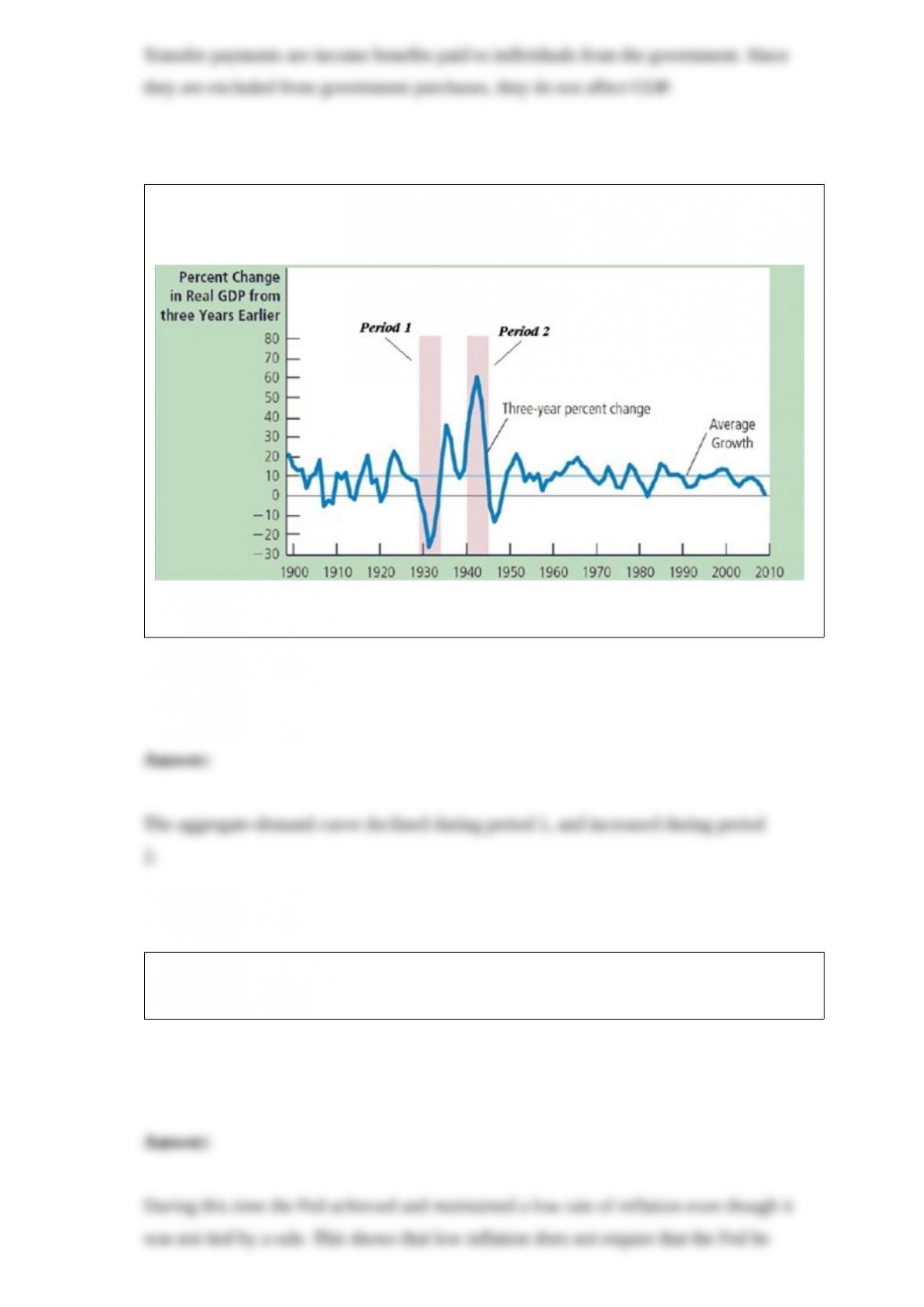
Figure 33-12.
RefertoFigure33-12. Explain how the aggregate demand and aggregate supply model
changed during periods 1 and 2.
What did the actions of the Federal Reserve during the 1990’s demonstrate about
monetary policy and rules?
The objective of diversification is to reduce risk. How does a person diversify a stock
portfolio? How is risk measured?
Suppose that businesses become less optimistic about the future. Assuming no change
in inflation expectations, how would the effects of this shock be shown on the Phillips
curve diagram and what would happen to inflation and unemployment?