For a monopsony buyer of an input, the marginal expenditure curve
A) lies above the average expenditure curve.
B) lies below the average expenditure curve.
C) is identical to the average expenditure curve.
D) lies below the input demand curve.
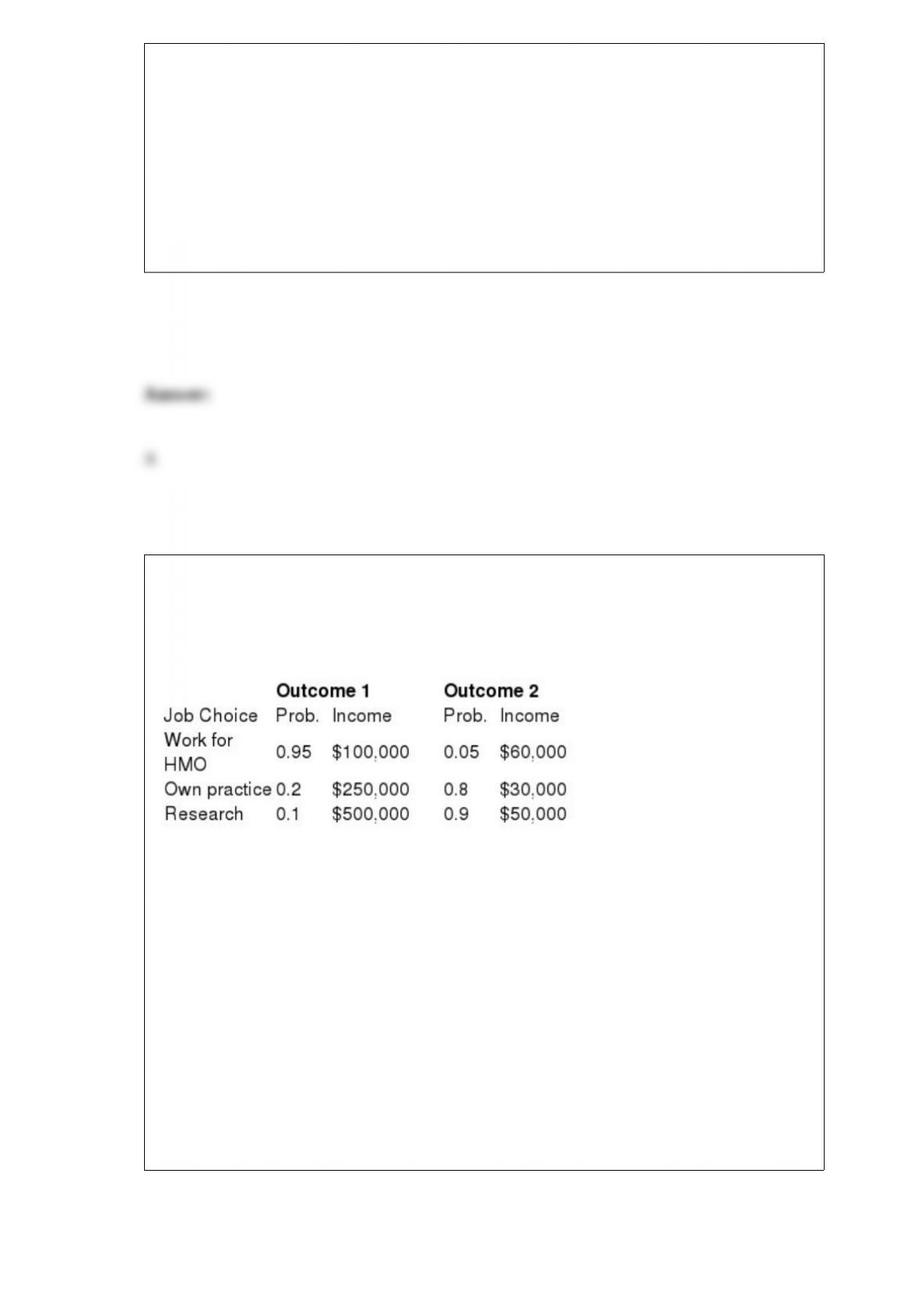
The information in the table below describes choices for a new doctor. The outcomes
represent different macroeconomic environments, which the individual cannot predict.
Table 5.3
Refer to Table 5.3. In order to weigh which of the job choices is riskiest, an individual
should look at
A) the deviation, which is the difference between the probabilities of the two outcomes.
B) the deviation, which is the difference between the dollar amounts of the two
outcomes.
C) the average deviation, which is found by averaging the dollar amounts of the two
outcomes.
D) the standard deviation, which is the square root of the average squared deviation.
E) the standard deviation, which is the squared average square root of the deviation.
To evaluate the potential impact of changes to its SUV business, Ford Motor Company
would use:
A) normative economic analysis.
B) positive economic analysis.
C) negative economic analysis.
D) arbitrage analysis.
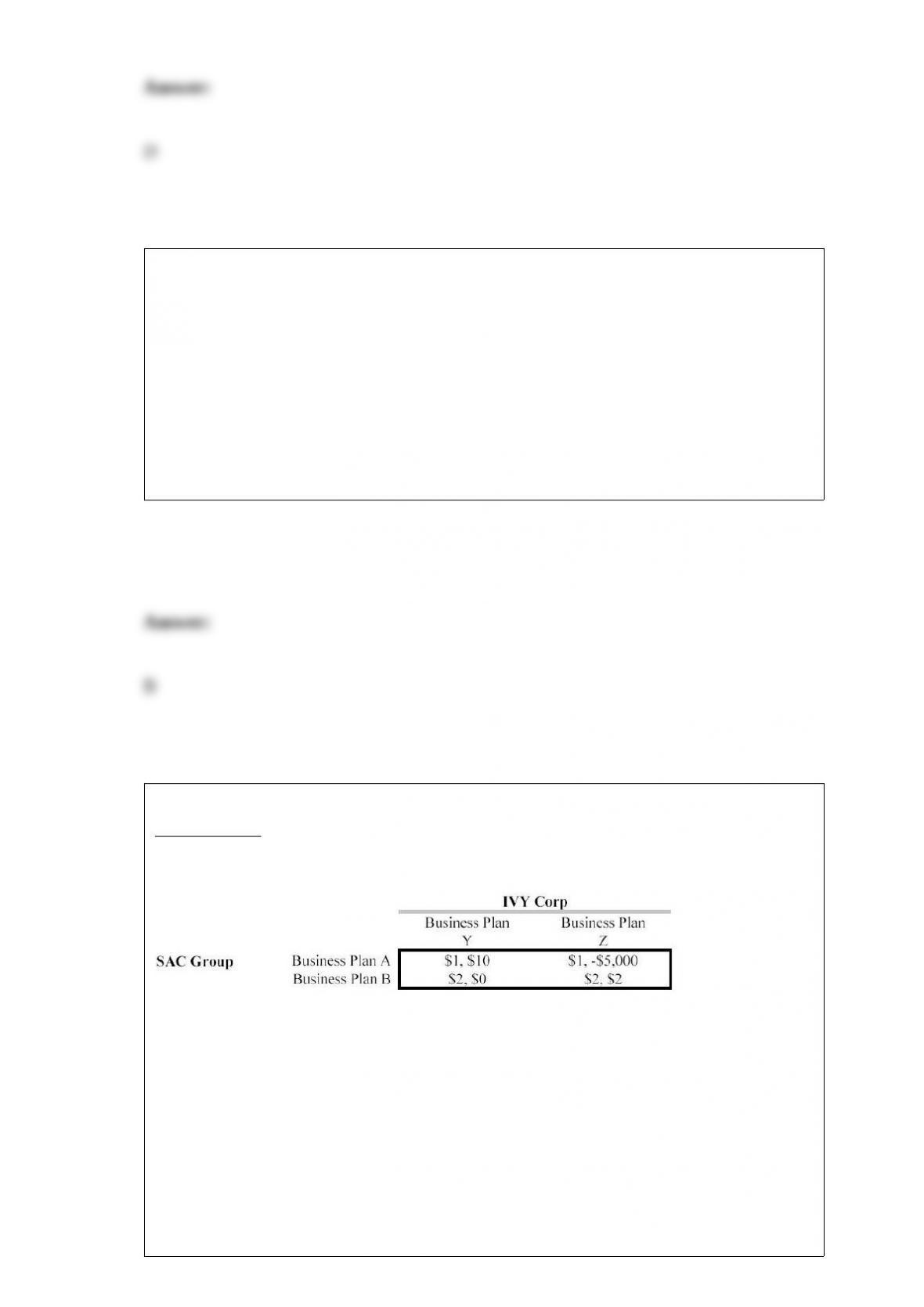
Scenario 13.8
Consider the following game:
In game in Scenario 13.8,
A) Y is a dominant strategy for IVY Corp.
B) Z is a dominant strategy for IVY Corp.
C) A is a dominant strategy for SAC Group.
D) B is a dominant strategy for SAC Group.

E) No firm has a dominant strategy.
For computers and other business equipment, small changes in business earnings tend
to generate relatively large short-run changes in the demand for this equipment, and the
long-run income response tends to be smaller. Industries that face demand behavior of
this type are known as:
A) natural monopolies.
B) cartels.
C) cyclical industries.
D) constant-cost industries.
The strategy that worked best in Axelrod’s experiments using the Prisoners’ Dilemma
game was to
A) play the “cooperate” (“don’t confess”) strategy.
B) play the “defect” (“confess”) strategy.
C) alternate between “cooperate” and “defect” strategies.
D) play the “cooperate” strategy at first, and from then on do whatever the other player
did in the previous round, cooperating if the other player did, and defecting if the other
player did.

E) play the “cooperate” strategy in the first round, and from then on cooperate so long
as the other player does, but if the other player defects, then play the “defect” strategy
from that time forward.
Consider the following information:
The probability of a fire in a factory without a fire prevention program is 0.01. The
probability of a fire in a factory with a fire protection program is 0.001. If a fire
occurred, the value of the loss would be $300,000. A fire prevention program would
cost $80 to run.
If the fire protection program were not in place, the insurer would not be willing to
ensure the warehouse for any amount less than
A) $80.
B) $300.
C) $3,000.
D) $6,000.
E) $300,000.
For many firms, capital is the production input that is typically fixed in the short run.
Which of the following firms would face the longest time required to adjust its capital

inputs?
A) Firm that makes DVD players.
B) Computer chip fabricator
C) Flat-screen TV manufacturer
D) Nuclear power plant
Scenario 1:
It is the factory’s choice whether to install a filter. It is the choice of the nearby
fishermen whether to install a treatment plant. Dollar figures show profit. The factory
and the fishermen can negotiate costlessly, and no one else is affected by the result.
Factory Fishermen
A: No filter or treatment plant $10,000 $2,000
B: Filter; no treatment plant $6,000 $10,000
C: No filter; treatment plant $10,000 $4,000
D: Filter; treatment plant $6,000 $6,000
If the fishermen are given the right to clean water,
A) the outcome will be more efficient than if the factory is given the right to use the
water as it sees fit.
B) the outcome will be less efficient than if the factory is given the right to use the
water as it sees fit.
C) the efficient outcome will occur no matter who is given which property right, and the
individual gains will be the same in each case.
D) the factory will be forced to shut down.

E) the efficient outcome will occur no matter who is given which property right, but
how that maximum gain is split will be determined during bargaining.
The income-consumption curve for Dana between Qa and Qb is given as: Qa = Qb. His
budget constraint is given as:
120 = Qa + 4Qb
How much Qa will Dana consume to maximize utility?
A) 0
B) 24
C) 30
D) 60
E) More information is needed to answer this question.
From Example 1.2 in the textbook, Pindyck and Rubinfeld distinguish between the
mass market and dealer market for bicycles. Although there are many dealers in the
U.S. and only a few mass merchandisers, we should expect the dealer market to be
somewhat less competitive than the mass market. Why?
A) Due to their differences in quality and performance, dealer bicycles are not close

substitutes.
B) The geographic extent of the market for dealer bicycles is typically small, so the
individual sellers do not have many local competitors.
C) Dealers are small sellers and have little control over bicycle prices.
D) A and B are correct.
E) B and C are correct.
The theory of consumer behavior is based on certain assumptions. The set of four basic
assumptions includes:
A) completeness.
B) transitivity.
C) intransitivity.
D) Both A and B are correct.
E) Both A and C are correct.
Suppose you solve a utility maximization problem, and the solution value of the
Lagrange multiplier equals zero. What does this outcome imply about the problem
solution?

A) You must have made an error while solving the problem.
B) The budget constraint is not binding, and the constrained solution is equal to the
solution to the unconstrained utility maximization problem.
C) The optimal utility level for the consumer equals zero.
D) The consumer’s demand curve is upward sloping.
The presence of pollution in the dry cleaning industry leads in the long run to dynamic
inefficiencies because
A) people will buy fewer clothes that need dry cleaning than they otherwise would
have.
B) people will develop substitutes for dry cleaning that are wasteful.
C) firms will be induced to leave the industry because of artificially high costs.
D) firms whose average private cost is less than price will stay in (or enter) the dry
cleaning industry even though their average social cost exceeds price.
E) firms whose average private cost exceeds the price will exit (or fail to enter) the dry
cleaning industry even though their average social cost is less than price.
Assume that the owners of a firm know that the firm’s profits will depend upon two

parameters: (1) how hard the managers work, and (2) the state of the economy. For
simplicity, assume that the managers can exert either maximum or minimum effort and
that the economy can be either favorable or unfavorable. The profits under various
situations are represented by the matrix below.
Favorable Unfavorable
Economy Economy
Maximum Effort 700,000 400,000
Minimum Effort 400,000 200,000
The firm considers there to be an equal probability of either state of the economy. The
manager considers the cost of effort to be C = 55,000x, where x = 1 for maximum
effort, 0 for minimum effort. The firm is considering the pay scheme described below.
Evaluate each alternative in terms of their incentive effects for the manager and their
effect on the firm’s profitability.
a. a flat salary of $30,000 that is not tied to the firm’s performance
b. a bonus of 0 if profit equals 200,000 or 400,000 and a bonus of 120,000 if profit
equals 700,000
c. a bonus determined by the formula: B = 0.20(PROFIT – 300,000)
d. a bonus determined by the formula: B = 0.24(PROFIT – 300,000)
Use the following statements to answer this question.
I. The numerical labels attached to indifference curves are meaningful only in an
ordinal way.
II. The numerical labels attached to isoquants are meaningful only in an ordinal way.
A) both I and II are true.
B) I is true, and II is false.
C) I is false, and II is true.
D) both I and II are false.

A firm is charging a different price for each unit purchased by a consumer. This is
called
A) first-degree price discrimination.
B) second-degree price discrimination.
C) third-degree price discrimination.
D) fourth-degree price discrimination.
E) fifth-degree price discrimination.
Which of the following is NOT an example of moral hazard in business?
A) A bank buys risky mortgage securities because they believe the government will
provide a bail-out if the investment performs badly.
B) A firm uses venture capital to speculate in the commodity futures market.
C) A firm does not hire adequate security protection for its warehouse after it pays for
insurance on the property.
D) Firms with the large debt problems are more likely to apply for bank loans than
financially stable firms.
There is always some economic rent whenever the:

A) demand for a factor is downward sloping.
B) supply of a factor is upward sloping.
C) supply and demand intersect.
D) supply of a factor is horizontal.
A price floor policy establishes a minimum price for a market. Which of the following
results from a binding price floor?
A) Equilibrium
B) Excess demand
C) Excess supply
D) Shortage
Which of the following is NOT an example of consumer behavior consistent with the
standard assumptions of microeconomic theory?
A) People are less likely to leave tips at restaurants that they are unlikely to visit again.
B) Waiters and waitresses have an incentive to provide good service in order to earn
tips.

C) Due to the convention of tipping, restaurants pay a lower wage to waiters and
waitresses than they would in the absence of any tipping rule.
D) Although tipping reduces the amount of income available for purchasing goods,
people usually leave tips at restaurants.
E) none of the above
Your firm is evaluating a potential investment in new machinery, but the manager in
charge of the project uses an opportunity cost of capital that is too large. How does this
error affect the projected net present value of the firm’s investment?
A) NPV is overstated
B) NPV is understated
C) NPV is unaffected
D) NPV changes from positive to negative
Scenario 4.2:
Suppose that the demand for artichokes (Qa) is given as:
Qa = 200 – 4PUse the information in Scenario 4.2. What is the price elasticity of
demand if the price of artichokes is $10?
A) 0
B) -0.25
C) -1
D) -4
E) negative infinity
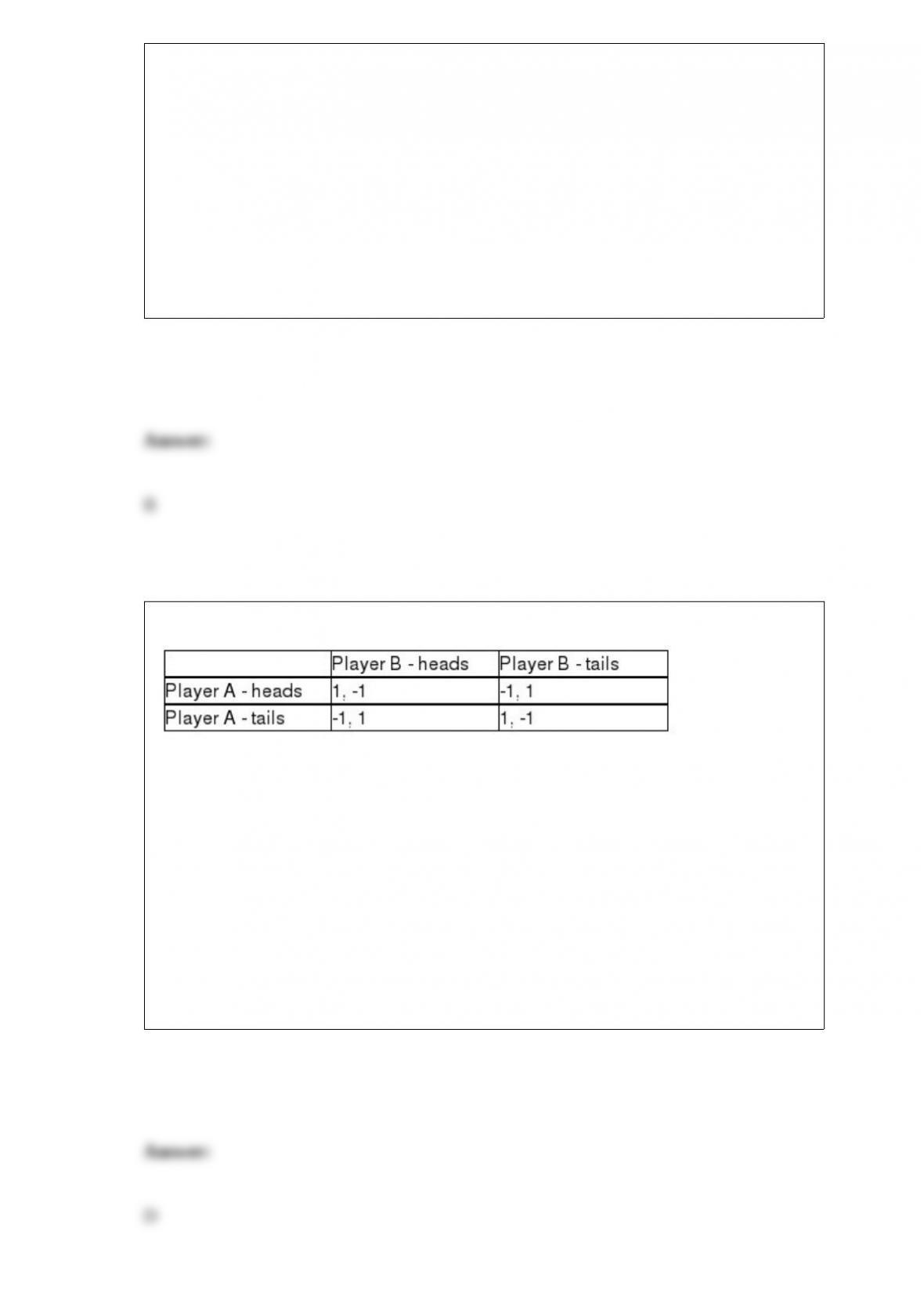
Consider the Matching Pennies game:
Suppose Player B always uses a mixed strategy with probability of 3/4 for head and 1/4
for tails. Which of the following strategies for Player A provides the highest expected
payoff?
A) Mixed strategy with probability 1/4 on heads and 3/4 on tails
B) Mixed strategy with probability 1/2 on heads and 1/2 on tails
C) Mixed strategy with probability 3/4 on heads and 1/4 on tails
D) Pure strategy in which Player A always selects heads

Which of the following is a public good?
A) Telephone service
B) Broadcast TV
C) A daily newspaper
D) The Red Cross
E) all of the above
The Acme Company is a perfect competitor in its input markets and a monopolist in its
output market. Its average product of labor is 30, the marginal product of labor is 20,
the price of labor is $20, and the price of the output is $5. For Acme Company, the
marginal revenue product of labor
A) is $100.
B) is $150.
C) is $400.
D) is $600.
E) cannot be determined with the information provided.
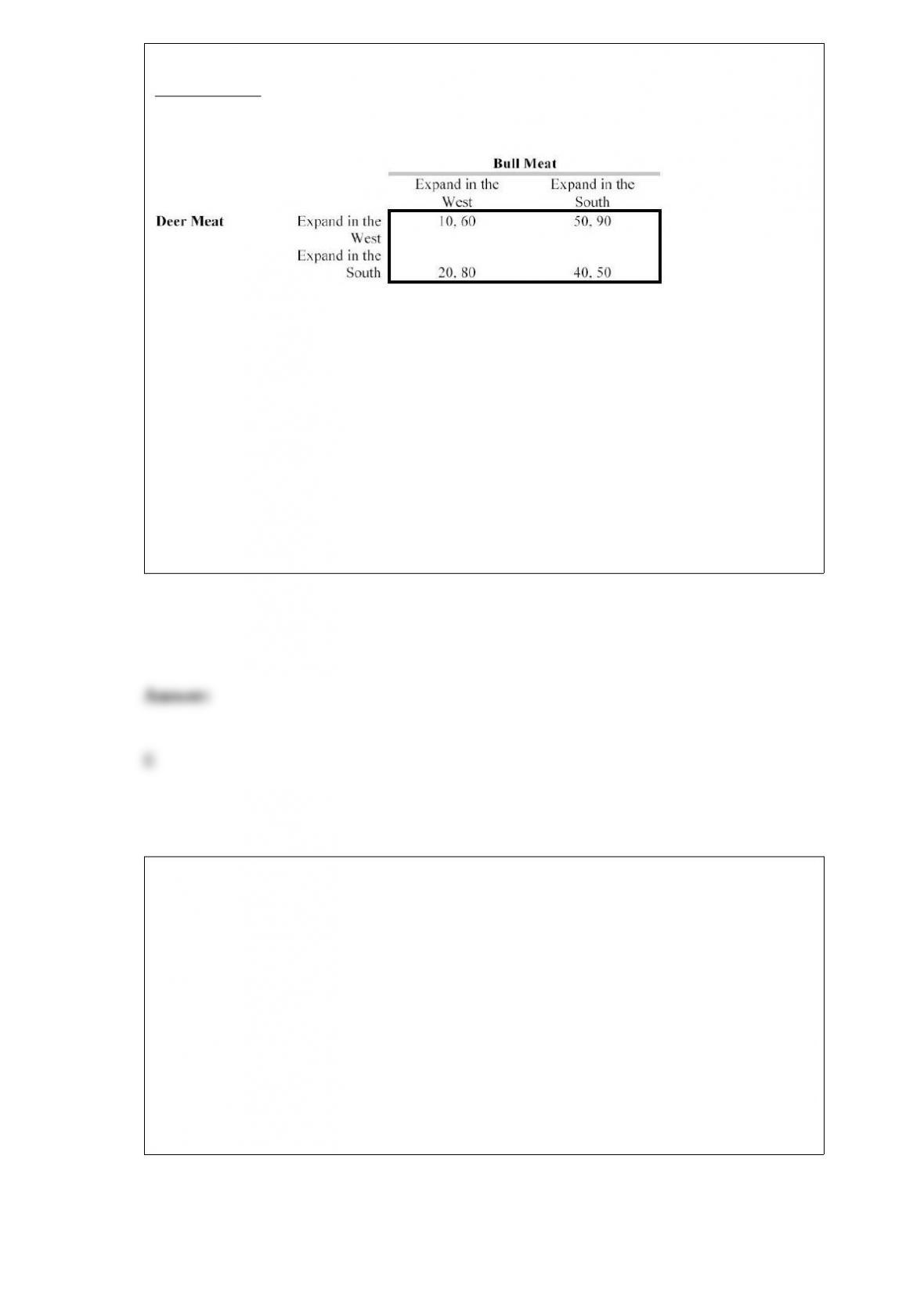
Scenario 13.5
Consider the following game:
Which of the following is true regarding the game in Scenario 13.5?
A) Only Bull Meat has a dominant strategy.
B) Only Deer Meat has a dominant strategy.
C) Both companies have a dominant strategy: expand West.
D) Both companies have a dominant strategy: expand South.
E) Neither company has a dominant strategy.
Bundling is effective when the demands for the bundled products are ________ and
________ correlated.
A) different; negatively
B) different; positively
C) similar; negatively
D) similar; positively
E) identical; perfectly

Consider the following three market baskets:
Table 3.1
Refer to Table 3.1. Which of the following cannot be true?
A) The consumer could be indifferent between A and B.
B) A and C could be on the same indifference curves.
C) The consumer could be indifferent between B and C.
D) A and C could be on different indifference curves.
The Acme Oil Company is a vertically integrated firm. It explores for and extracts
crude oil. It also refines the crude oil into gasoline and other products, and sells these
products to consumers. The internal price that Acme Oil uses when the crude oil that it
extracts is ‘sold” to one of its refineries is called:
A) the shadow price.
B) the transfer price.
C) the market price.
D) the non-market price.

E) none of the above
Scenario 4.3:
The demand for erasers (Q) is given as follows:
Q = 240 – 4Pe + 2I + Pb + A
where Pe is the price of erasers
I is the level of income
Pb is the price of another good
A is the level of advertising
Suppose that Q = 240, Pe = 10, Pb = 10, and A = 2.Given the information in Scenario
4.3, suppose that the price of erasers increases slightly from $10. How will this affect
the total revenue collected by the firm?
A) Total revenue will increase.
B) Total revenue will not change.
C) Total revenue will decrease.
D) There will be an indeterminate change in total revenue.