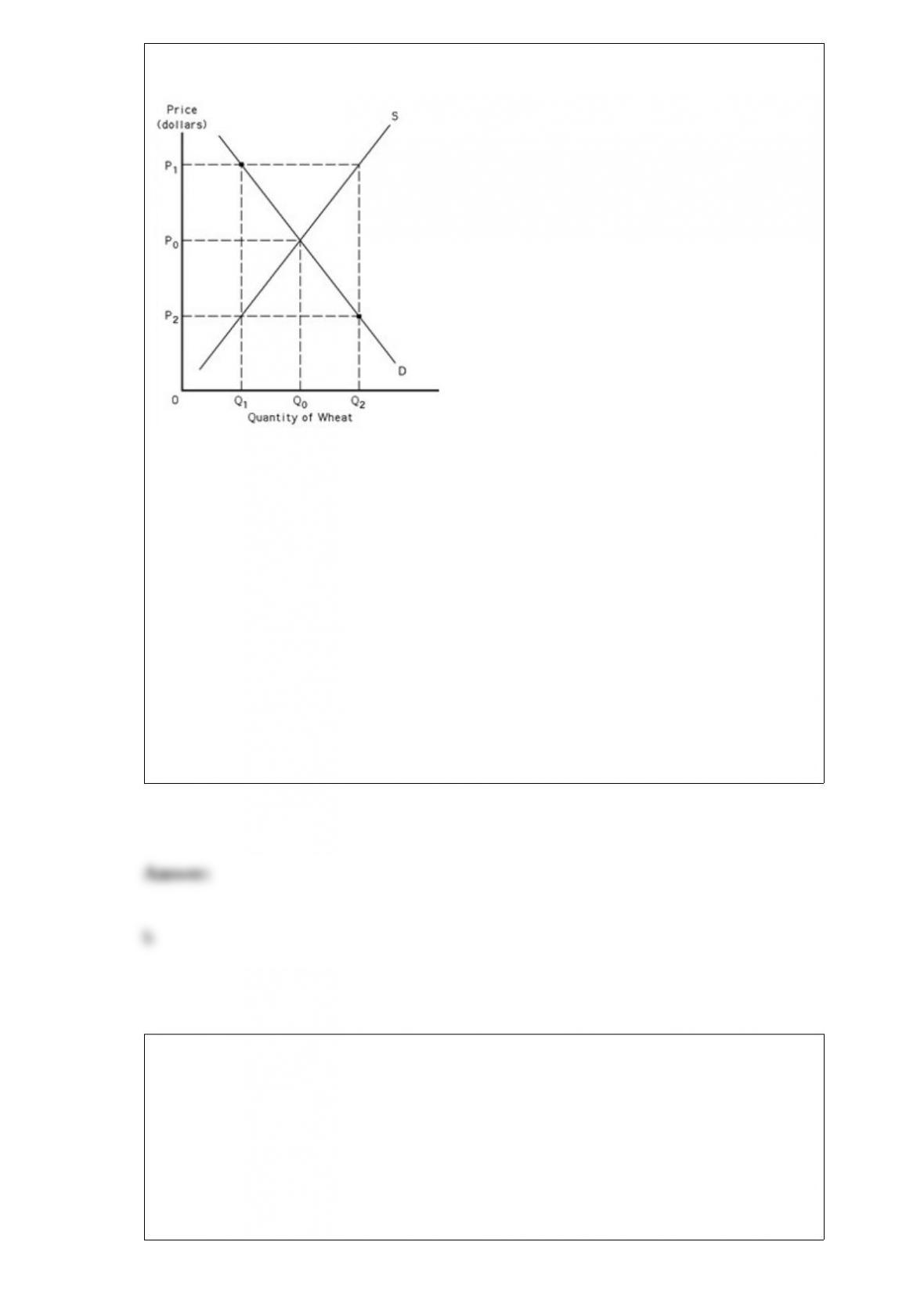
Exhibit 39-2
If P1 is a price support, the quantity of wheat purchased by the government would be
equal to
a. Q0 – Q1.
b. Q2 – Q1.
c. Q2 – Q0.
d. Q2.
e. Q1.
The author of the textbook defines economics as the
a. science of efficiency.
b. science of scarcity.
c. study of markets.

d. study of human activity.
Situation 22-2
Alejandro is one of the leading widget producers in the country. At his current level of
production, his total costs amount to $5,000, total fixed costs are $2,000, and average
total costs are $250.
How many widgets is Alejandro producing?
a. 10
b. 15
c. 20
d. 25
e. There is not enough information to answer the question.
Suppose that prices in Japan increase by 8 percent while prices in the United States
remain stable. We would expect that the result would be that in the foreign exchange
market ___________________________,€ceteris paribus€.
a. the dollar will appreciate and the yen will depreciate
b. the dollar will depreciate and the yen will appreciate
c. both the dollar and the yen will appreciate
d. both the dollar and the yen will depreciate
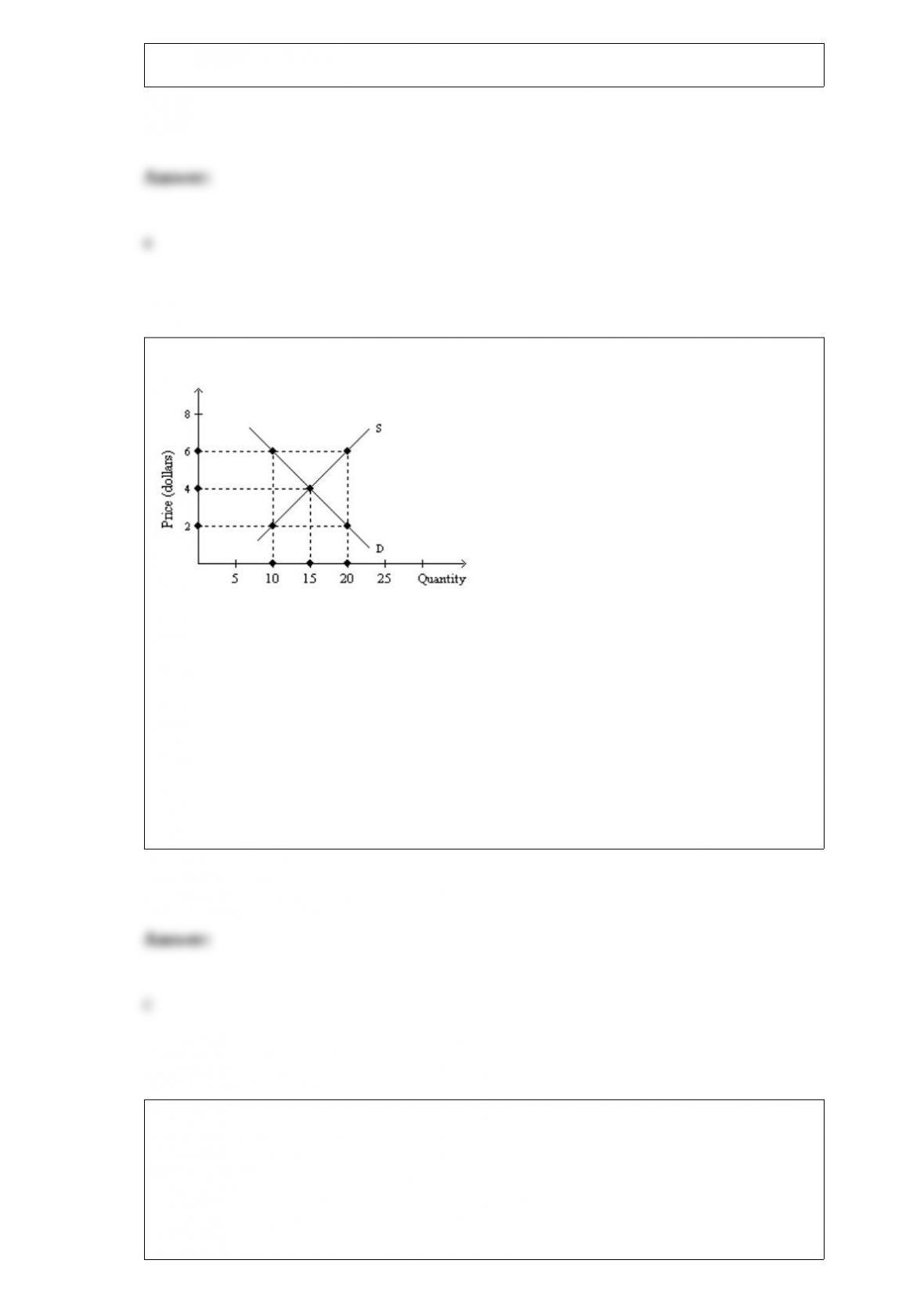
Exhibit 3-4
If this is a competitive market, price and quantity will gravitate toward
a. $6 and 10 units, respectively.
b. $6 and 20 units, respectively.
c. $4 and 15 units, respectively.
d. $2 and 15 units, respectively.
The branch of economics that studies the decisions of individuals and firms is called
a. macroeconomics.
b. microeconomics.
c. microeconomics and macroeconomics.
d. positive economics.
e. normative economics.
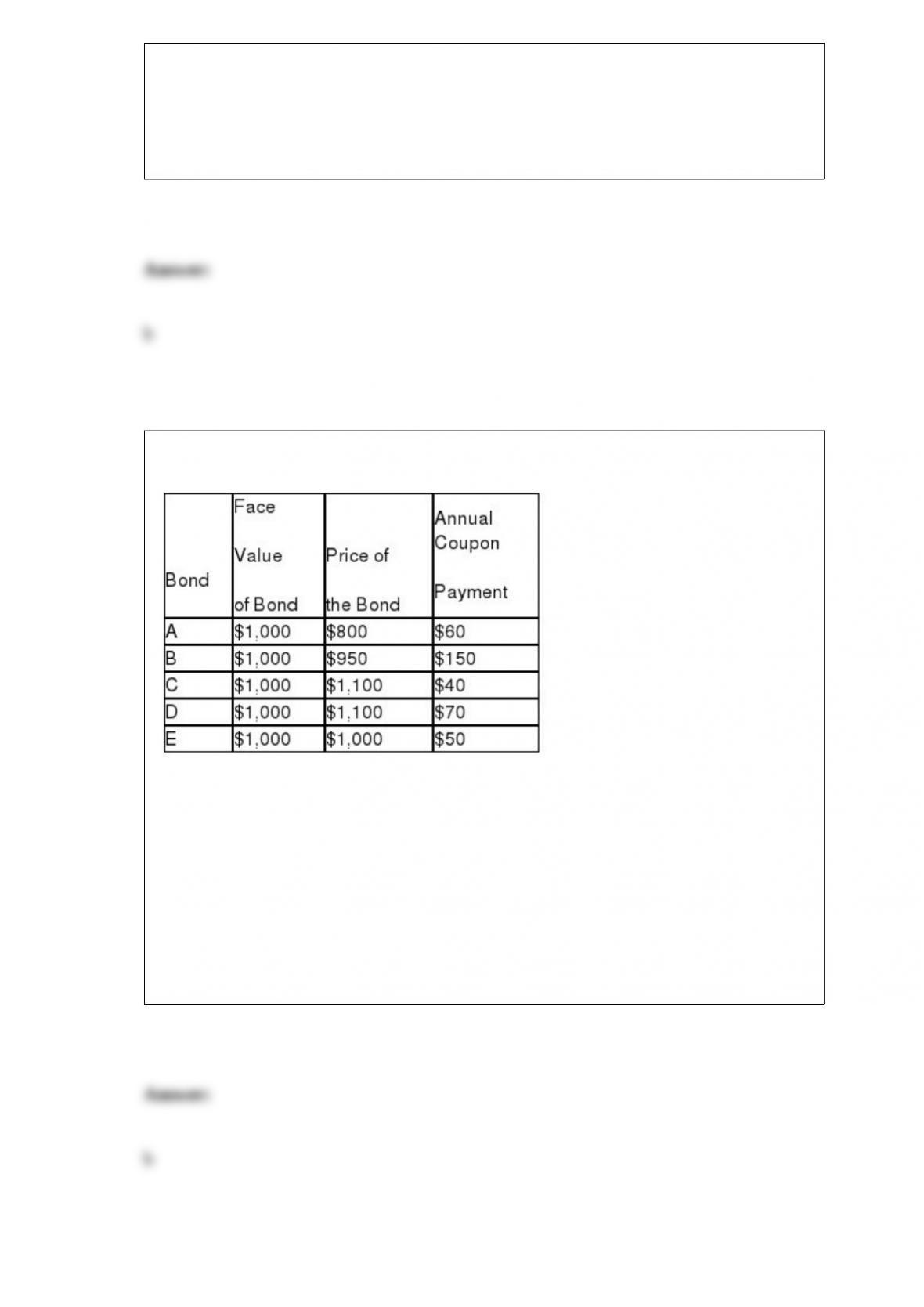
Exhibit 38-1
The yield on bond B is approximately
a. 9.5 percent.
b. 15.8 percent.
c. 0.15 percent.
d. 17 percent.

Another term for a stockbroker is an account representative.
a. True
b. False
Resource allocative efficiency occurs when a firm
a. minimizes costs of production yet charges the highest possible price.
b. produces the quantity of output at which price exceeds average total cost by the
greatest amount.
c. produces the quantity of output at which price equals marginal cost.
d. produces the quantity of output at which price equals average total cost.
e. produces the quantity of output at which price equals average variable cost.
Situation 22-1
Diane’s Donuts will begin selling donuts next week. Diane figures that the average
variable cost to make each donut will be constant at $0.30. She has already paid
$20,000 for the donut-making machinery and one year’s rent.
What will Diane’s approximate average fixed costs be if she sells 36,500 donuts in one
year?
a. $0.30

b. $0.088
c. $0.138
d. $0.55
Which of the following statements is false?
a. Microeconomics is the branch of economics that deals with human behavior and
choices as they relate to relatively small units-an individual, a firm, an industry, and a
single market.
b. Macroeconomics is the branch of economics that deals with human behavior and
choices as they relate to highly aggregate markets.
c. Positive economics attempts to determine what is.
d. Normative economics addresses what should be.
e. Positive and normative economics both address what should be.
Price rises from $10 to $12, and the quantity demanded falls from 200 units to 180
units. What is the price elasticity of demand between these two prices?
a. 0.58
b. 3.67
c. 1.73
d. 0.27
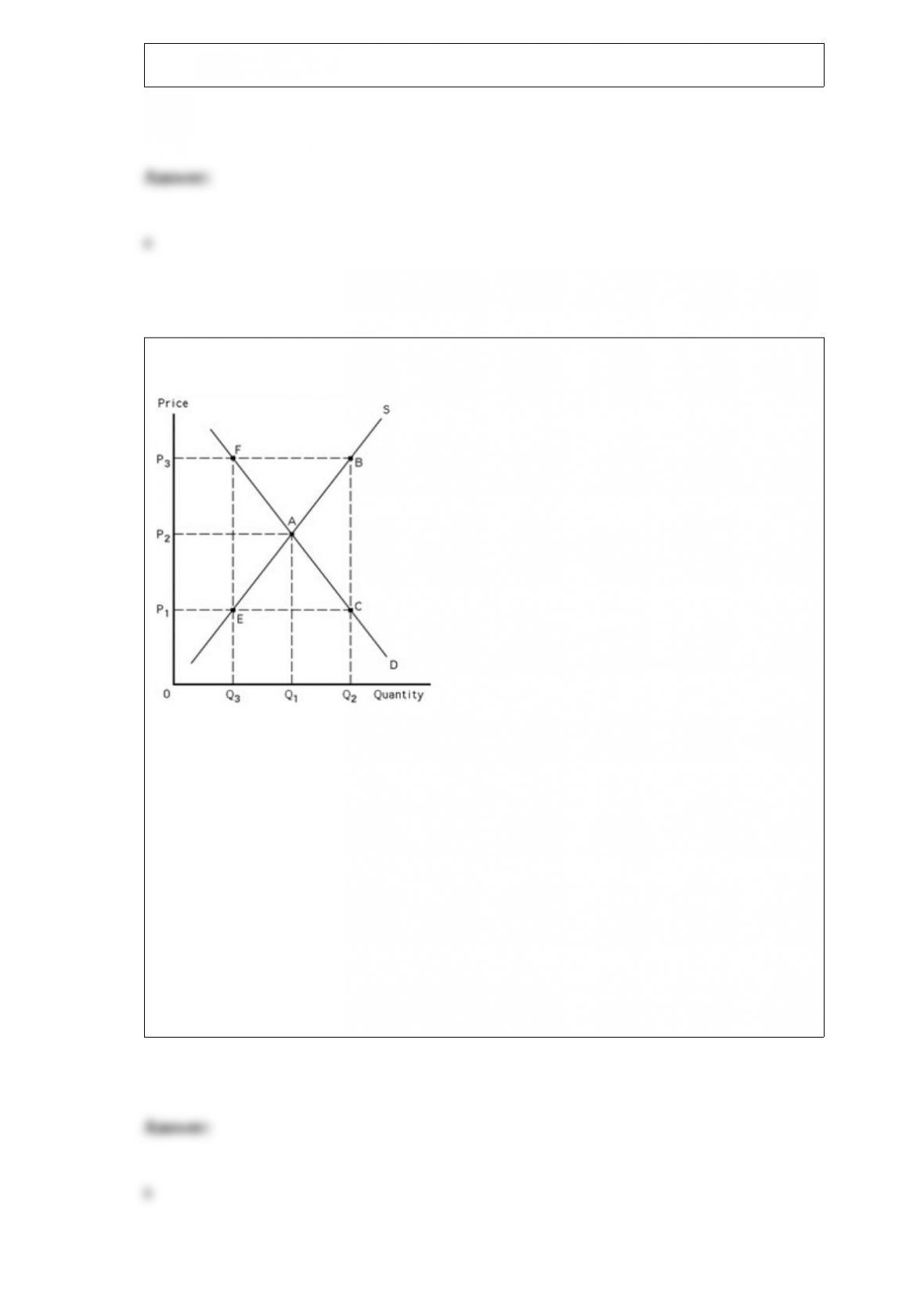
Exhibit 39-3
If P3 is a target price, the price at which output will be purchased is
a. P1.
b. P2.
c. P3.
d. P3 – P2.
e. P1 – P2.

A shortage of kidneys (for transplants) results from
a. the legal price being set below the equilibrium price.
b. the legal price being set above the equilibrium price.
c. a price floor being set in the kidney market at P = $0, assuming the equilibrium price
is greater than $0.
d. a price ceiling being set in the kidney market at P = $0, assuming the equilibrium
price is greater than $0.
e. a and d
One reason that helps to explain the law of supply is the law of
a. diminishing marginal utility.
b. diminishing marginal returns.
c. decreasing opportunity costs.
d. demand.
Suppose the socially optimal output is 134 units of a good and the market output is 95
units of the good. A possible reason the market produces “too little” is that
a. marginal private benefits are less than marginal social benefits.
b. marginal private benefits are greater than marginal private costs.

c. marginal private benefits are greater than marginal social benefits.
d. marginal private costs are greater than marginal private benefits.
e. b and c