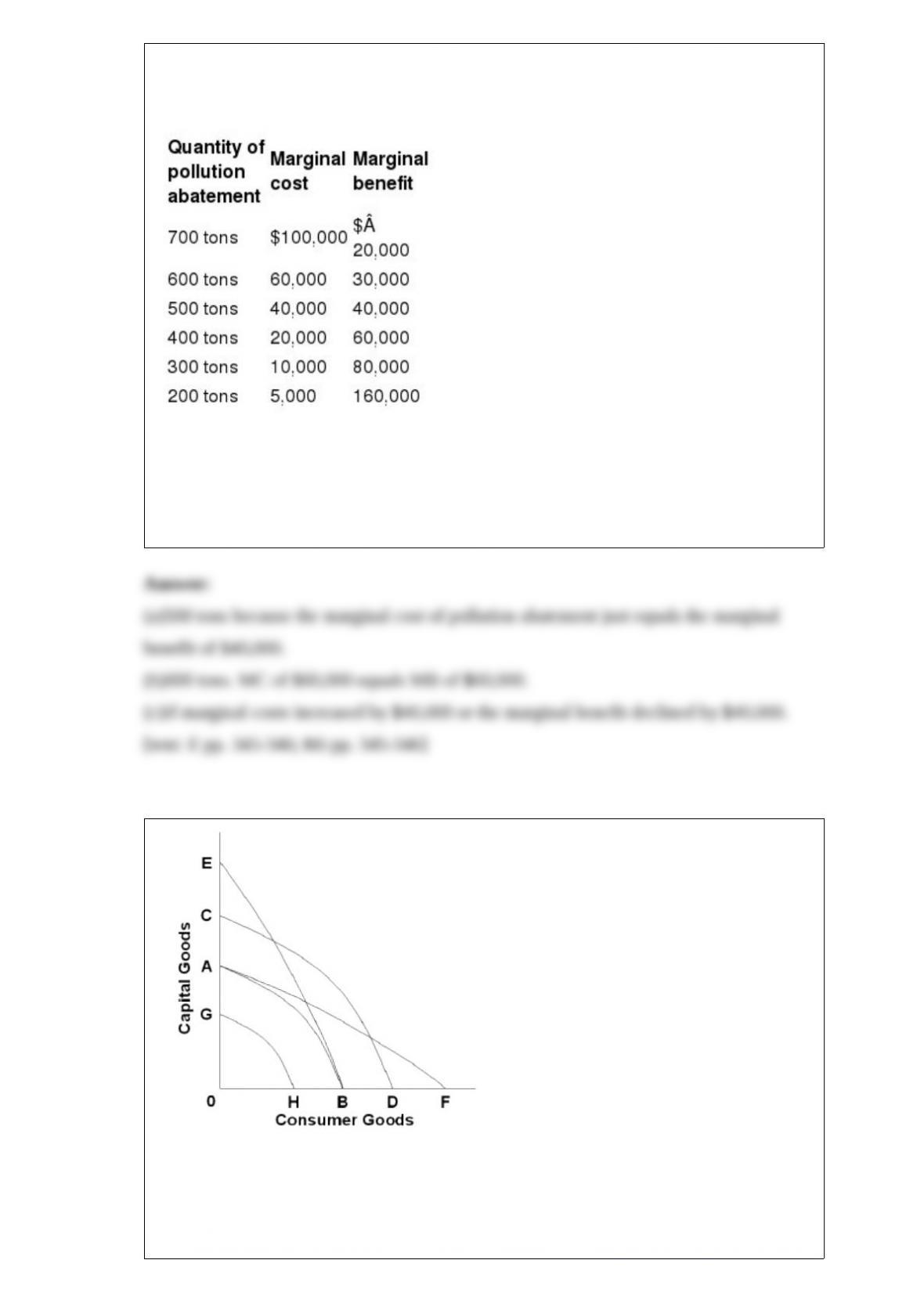
1) The following table shows marginal costs and benefits of the optimal quantity of
pollution abatement that will occur at a local factory.
(a)What is the optimal level of pollution abatement? Why?
(b)If the marginal benefit of pollution abatement were to increase by $30,000 at each
level because of the factorys desire to improve its image and environment, what would
the optimal level be? Why?
(c)What might cause the optimal level of pollution abatement to be 400 tons?
2)
refer to the above diagram. the concept of opportunity cost is best represented by the:
a.shift of the production possibilities curve from pp1 to pp2.
b.move from b on pp1 to e on pp2.
c.move from b on pp1 to c on pp1.
d.move from d inside pp1 to b on pp1.

3) If the reserve ratio is 15 percent and commercial bankers decide to hold additional
excess reserves equal to 5 percent of any newly acquired checkable deposits, then the
relevant monetary multiplier for the banking system will be:
A.31/2.
B.4.
C.5.
D.10.
4) Assume the MPC is .8. If government were to impose $50 billion of new taxes on
household income, consumption spending would initially decrease by:
A.$100 billion.
B.$90 billion.
C.$40 billion.
D.$50 billion.
5) Empirical studies suggest that the efficiency loss associated with the misallocation of
labor caused by the union wage advantage is:
A.$6 billion per year.
B.about 2 percent of domestic output.
C.less than one-half of one percent of domestic output.
D.about 4 percent of domestic output.
6) Describe the change in aggregate supply that should result from each of the
following changes in determinants. Assume that nothing else is changing besides the
identified change. (Use Decrease or Increase.) (a) A rise in the average price of inputs;
(b) An increase in worker productivity; (c) Government antipollution regulations
become stricter; (d) A new subsidy program is enacted for new business investment in
productive equipment; (e) Energy prices decline.
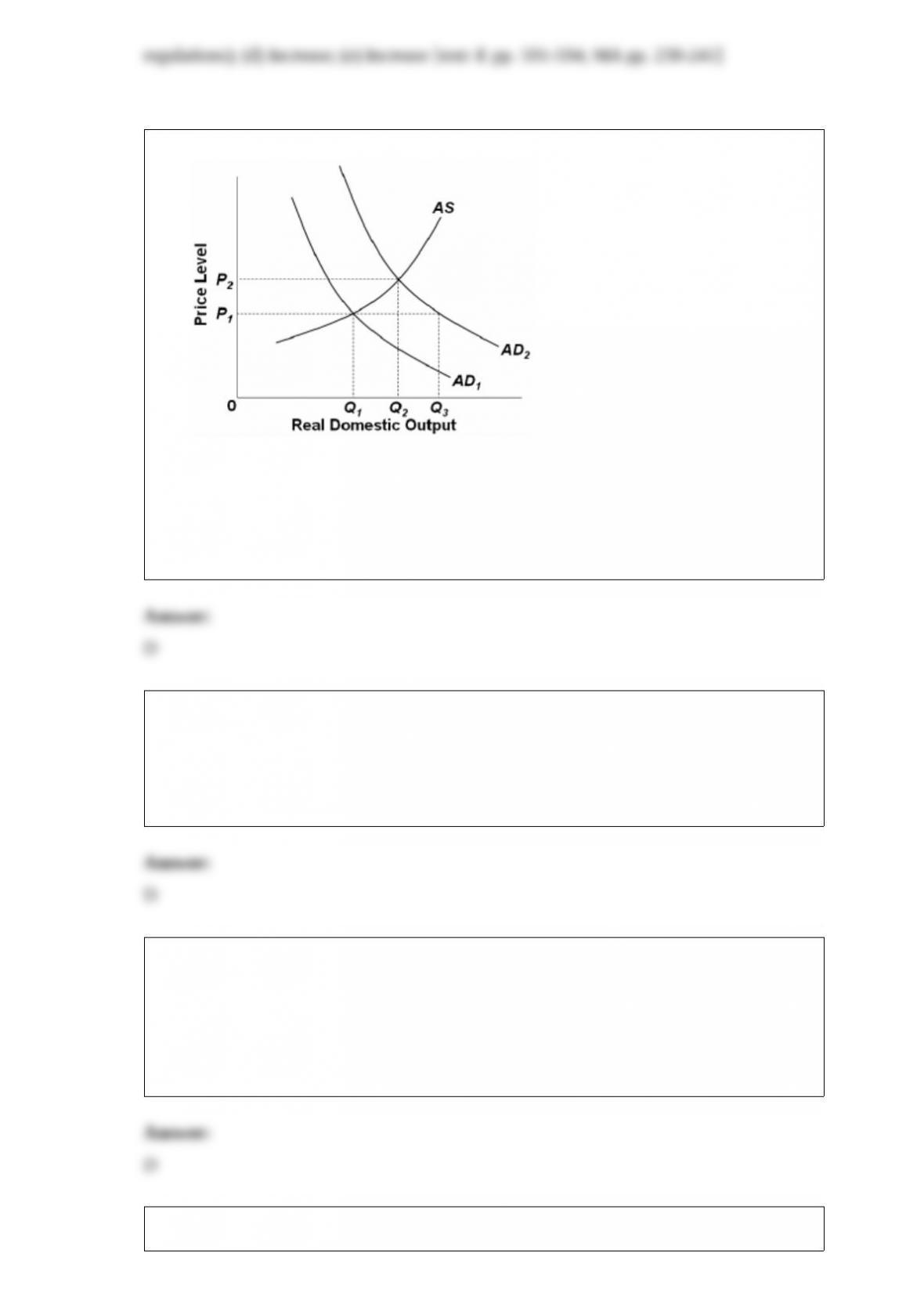
7)
Refer to the above diagram. If the equilibrium price level is P1, then:
A.aggregate demand is AD2.
B.the equilibrium output level is Q3.
C.the equilibrium output level is Q2.
D.producers will supply output level Q1.
8) Which of the following statements is correct?
A.Federal deficits were larger in the late 1990s than in the early 1990s.
B.Deep tax cuts always expand tax revenues and reduce the public debt.
C.The public debt has usually declined during wartime.
D.There is a tendency for the public debt to grow during recessions.
9) The United States has about ___ percent of the world’s population and produces
about ___ percent of the world output.
A.20, 30
B.3, 41
C.10, 32
D.5, 27
10) increases in the value of a product to each user, including existing users, as the total
number of users rises are called:
a.information cascades.
b.learning effects.
c.network effects.
d.scale economies.
11) the pure monopolist’s demand curve is relatively elastic:
a.in the price range where total revenue is declining.
b.at all points where the demand curve lies above the horizontal axis.
c.in the price range where marginal revenue is negative.
d.in the price range where marginal revenue is positive.
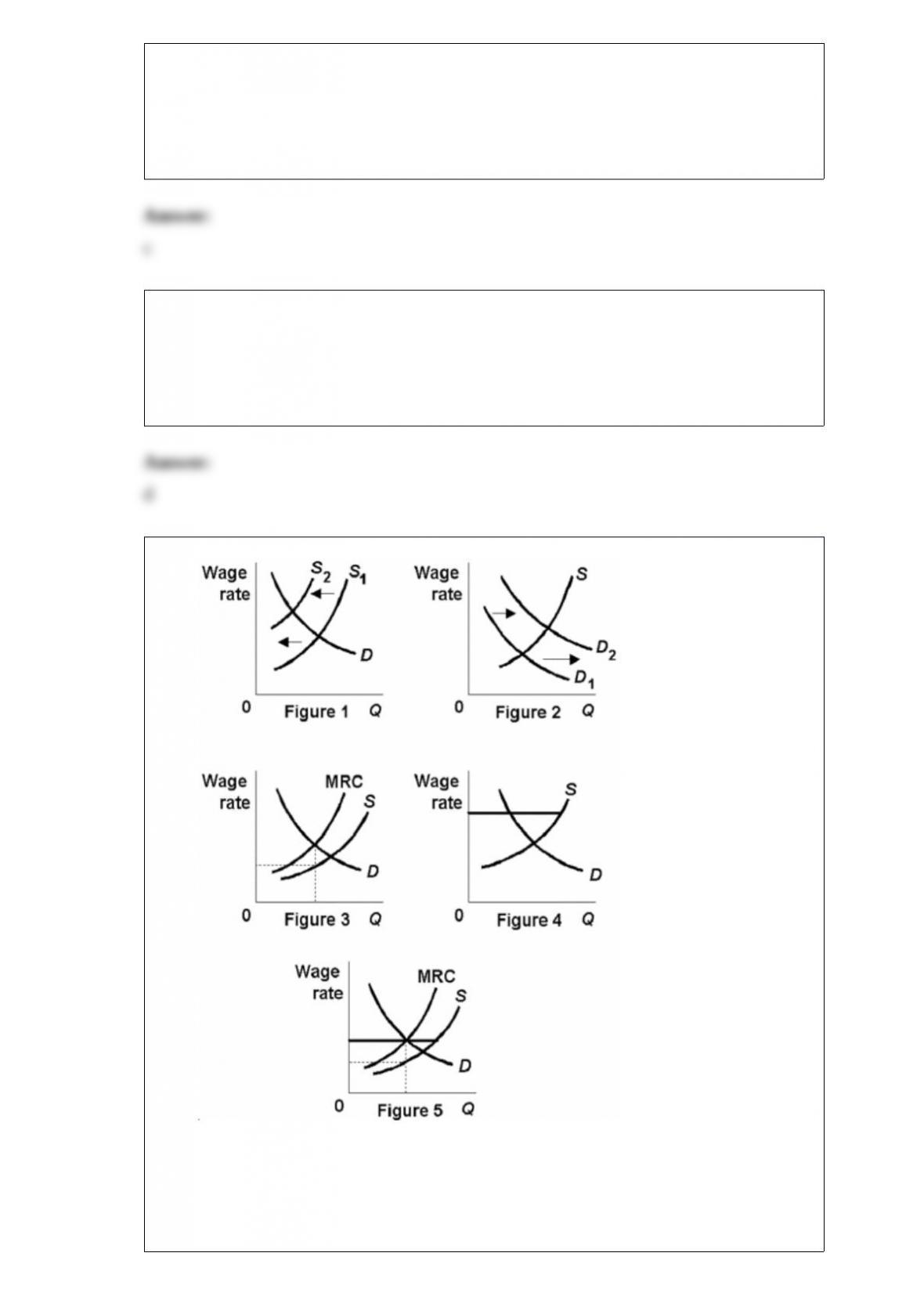
12)
Refer to the above labor market diagrams. The case of bilateral monopoly is represented
by Figure:
A.5
B.4
C.2
D.1
13) In the taste-for-discrimination model:
A.discriminatory employers behave as if employing non-preferred-race workers adds to
costs.
B.individual workers are judged by the characteristics of the groups to which they
belong.
C.prejudiced white employers will never hire African-American workers.
D.women and minorities are confined to a limited number of occupations.
14) the marginal utility of the last unit of apples consumed is 12 and the marginal utility
of the last unit of bananas consumed is 8. what set of prices for apples and bananas,
respectively, would be consistent with consumer equilibrium?
a.$4 and $6
b.$6 and $4
c.$8 and $12
d.$16 and $9
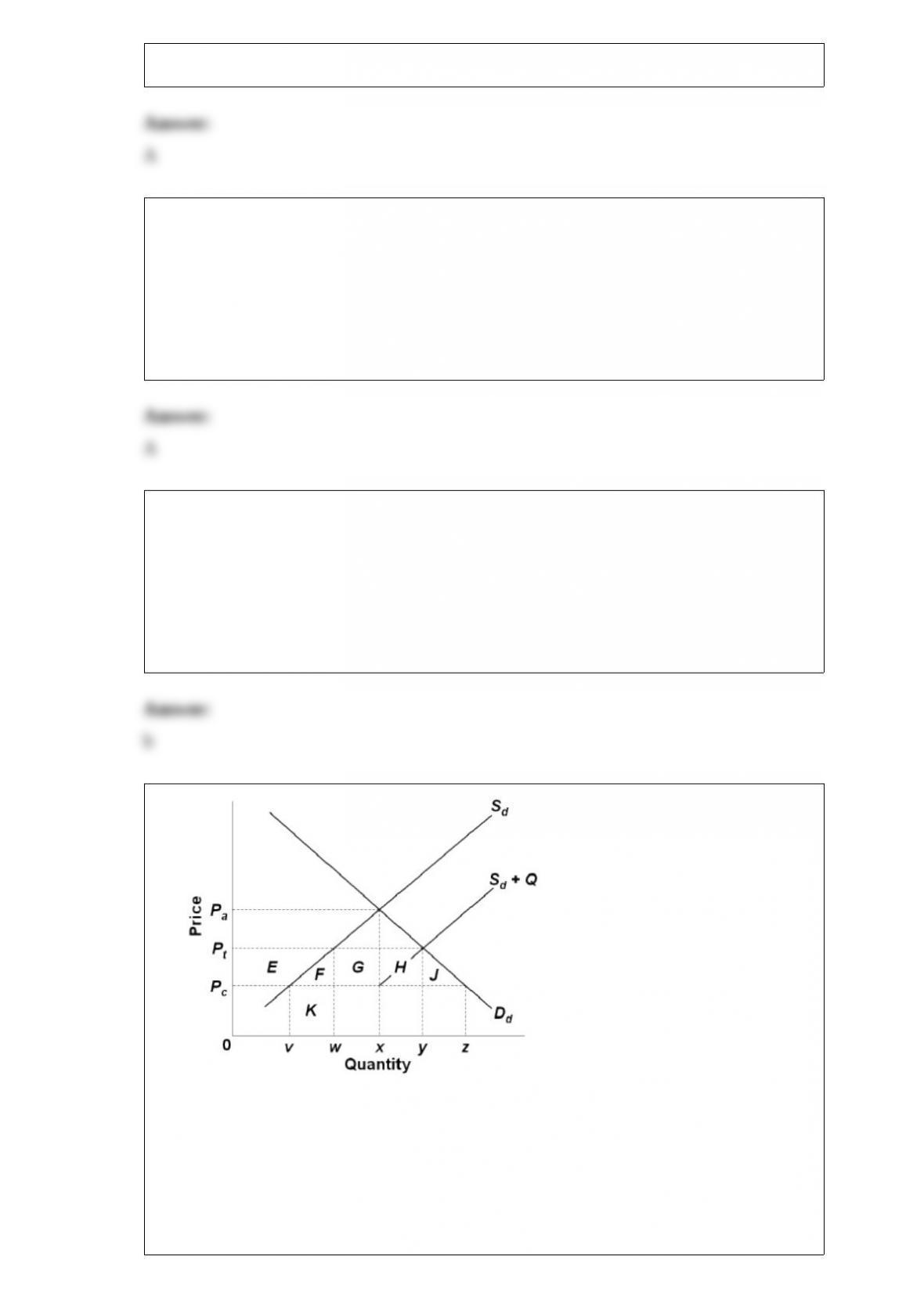
15)
Refer to the above diagram, where Sd and Dd are the domestic supply and demand for a
product and Pc is the world price of that product. Sd + Q is the product supply curve
after an import quota is imposed. A quota of wy will:
A.lower domestic price and increase domestic consumption.
B.increase the revenues of domestic producers by areas E + F + K
C.increase the revenues of domestic producers by areas G + H
D.increase the revenues of domestic producers by areas E + F + G + H + J

16) suppose total output (real gdp) is $4000 and labor productivity is $8. we can
conclude that:
a.real gdp per capita must be $500.
b.the price-level index must be greater than 100.
c.nominal gdp must be $500.
d.the number of worker-hours must be 500.
17) In the tables below are the demands for labor and the levels of domestic output that
can be produced at each level of employment in two countries.
(a)What would the wage rates be if employment was 200 in country X and 140 in
country Y?
(b)What would total wages paid and business incomes be in each country given
employment conditions in (a)?
(c)If 20 workers migrate from country Y to country X, what will happen to wage rates,
output, business incomes, and total wages?
18) The financing of a government deficit increases interest rates and, as a result,
reduces investment spending. This statement describes:
A.the supply-side effects of fiscal policy.
B.built-in stability.
C.the crowding-out effect.
D.the net export effect.

19) if variables x and y are positively correlated, this means that:
a.x is the cause of y.
b.y is the cause of x.
c.causation necessarily exists, but we don’t know whether x or y is the cause.
d.causation may or may not exist between x and y.
20) Farm groups spend considerable amounts of money to maintain and enlarge
political support for farm subsidies. This illustrates:
A.coalitions.
B.rent-seeking activity.
C.the special-interest effect.
D.the voting paradox.
21) Offer a defense of economic growth.
22) Suppose a bridge for automobiles was constructed across a river and all the costs
associated with its construction have been paid. The amount of traffic is such that there
are no foreseeable problems of overcrowding in the use of the bridge. Assume, also,
that the extra cost associated with traffic crossing the bridge is for all practical purposes
equal to zero. What toll should be charged to achieve the most efficient use of the
bridge?
23) What has been the general approach to the enforcement of antitrust laws based on
the type of mergers and price fixing among firms?
24) A firms labor input, total output of labor, and product price schedules are given
below. If labor is the only variable input, how much labor should the firm employ if the
wage rate is $8 per day?
25) What is likely to happen to resource demand in the next few decades?

26) Calculate the multiplier when the MPS is .5, .25, .10. What is the relationship
between MPS and the multiplier?