
Quick Buck and Pushy Sales produce and sell identical products and face zero marginal
and average cost. Below is the market demand curve for their product.
Suppose Quick Buck and Pushy Sales decide to collude and work together as a
monopolist with each firm producing half the quantity demanded by the market at the
monopoly price. If Quick Buck cheats by reducing its price to $1 and Pushy Sales
matches the price cut, then if consumers are evenly split between the two firms, what
will be Quick Buck’s economic profit?
A. $1,000
B. $1,500
C. $2,000
D. $3,000
U.S. firms wishing to purchase European goods and services are ______ the foreign
exchange market.
A. suppliers of U.S. dollars in
B. suppliers of Euros in
C. supplied Euros by the Fed for use in
D. demanders of U.S. dollars in

Suppose that average labor productivity in Country C is $5,000, and that Countries C
and E have the same real GDP per capita. Based on the information in the table, what
must be the average labor productivity in Country E?
A. $1,000
B. $1,500
C. $4,500
D. $6,250
Casey earns $150 a week and consumes only fish and shrimp. The price of fish is $3 a
pound and the price of shrimp is $5 a pound. If Casey’s income rises to $210, he could
buy a maximum of ______ pounds of fish or a maximum of ______ pounds of shrimp.
A. 30; 24
B. 24; 30
C. 70; 42
D. 42; 70
If most consumer goods and services are ______, then most income elasticities are
______.
A. normal; negative
B. inferior; positive
C. normal; greater than one
D. normal; positive
Changes in government purchases affect planned spending _____, and changes in taxes
and/or transfers affect planned spending _______.
A. directly; directly
B. directly; indirectly
C. directly; not at all
D. indirectly; indirectly

In the case of either a positive or negative externality, a good’s market price will:
A. be too low.
B. be too high.
C. not fully reflect a good’s social marginal cost or social marginal benefit.
D. not equate the quantity supplied by sellers with the quantity demanded by buyers.
Velocity is determined by:
A. the Federal Reserve.
B. the size of the government budget deficit.
C. average labor productivity times the population growth rate.
D. payments methods and technology.

Which of the following is a stock?
A. Saving
B. Income
C. Consumption
D. Wealth
Starting from potential output, if firms become more optimistic about the future and
decide to increase their investment in new capital, then this will generate a(n) _____
gap and inflation will _____.
A. recessionary; increase
B. recessionary; decrease
C. expansionary; decrease
D. expansionary; increase
In a competitive labor market, the equilibrium wage rate is determined by:
A. government regulation.
B. employers.

C. labor demand and labor supply.
D. employees.
When actual investment is greater than planned investment:
A. firms sold less output than expected.
B. firms sold more output than expected.
C. the quantity of output sold is the amount the firm expected to sell.
D. the economy produces the short-run equilibrium output.
The PPP theory is most useful in predicting:
A. short-run changes in the exchange rate for a country that mainly produces
heavily-traded standardized goods.
B. long-run changes in the exchange rate for a country that mainly produces
heavily-traded standardized goods.
C. short-run changes in the exchange rate for a country that mainly produces
lightly-traded standardized goods.

D. long-run changes in the exchange rate for a country that mainly produces
lightly-traded non-standardized goods.
A flow is a measure defined:
A. per unit of time.
B. at a point in time.
C. in real terms.
D. in nominal terms.
A rational seller will sell another unit of output:
A. whenever the seller is earning a profit.
B. if the cost of making another unit is less than the revenue gained from selling another
unit.
C. as long as the quantity demanded is greater than zero.
D. if the seller can charge more than the equilibrium price.

If the Federal Reserve sets a target nominal interest rate, it can:
A. independently set a target money supply.
B. only set a money supply target that is consistent with the nominal interest rate target.
C. achieve this target with any arbitrary supply of money.
D. shift the money demand curve to the right.
The principal demanders of U.S. dollars in the foreign exchange market are:
A. foreigners wishing to purchase U.S. goods or assets.
B. the Federal Reserve.
C. U.S. households or firms wishing to purchase U.S. goods or assets.
D. U.S. households or firms wishing to purchase foreign goods or assets.

When one’s performance is judged relative to others’ performance and not by an
absolute standard:
A. players will over invest in performance enhancements.
B. players will under invest in performance enhancements.
C. the incentive to sabotage the other players is lessened.
D. a positional externality is not possible.
Which of the following would increase the net export component of U.S. GDP?
A. A bottle of California wine is purchased in London.
B. A car produced in Japan is purchased in California.
C. A bottle of French wine is purchased in New York.
D. A car produced in Michigan is purchased in Louisiana.
If the Fed wishes to reduce nominal interest rates, it must engage in an open market

______ of bonds that ______ the money supply.
A. sale; increases
B. sale; decreases
C. purchase; decreases
D. purchase; increases
Mike and Tom debone chicken breasts for Ted’s Chicken Co. Mike is new and can only
debone 60 chicken breasts per hour by hand, while Tom’s experience allows him to
debone 120 chicken breasts per hour by hand. Ted buys one new machine that can
debone 100 chicken breasts per hour. Both Mike and Tom work the same 40 hours per
week, but one of them is assigned to operate the machine instead of deboning the
chicken breasts by hand. To obtain maximum average hourly productivity, ______ is
assigned to use the machine and their combined average hourly productivity as a team
is ______ chicken breasts.
A. Mike; 80
B. Mike; 110
C. Tom; 80
D. Tom; 110
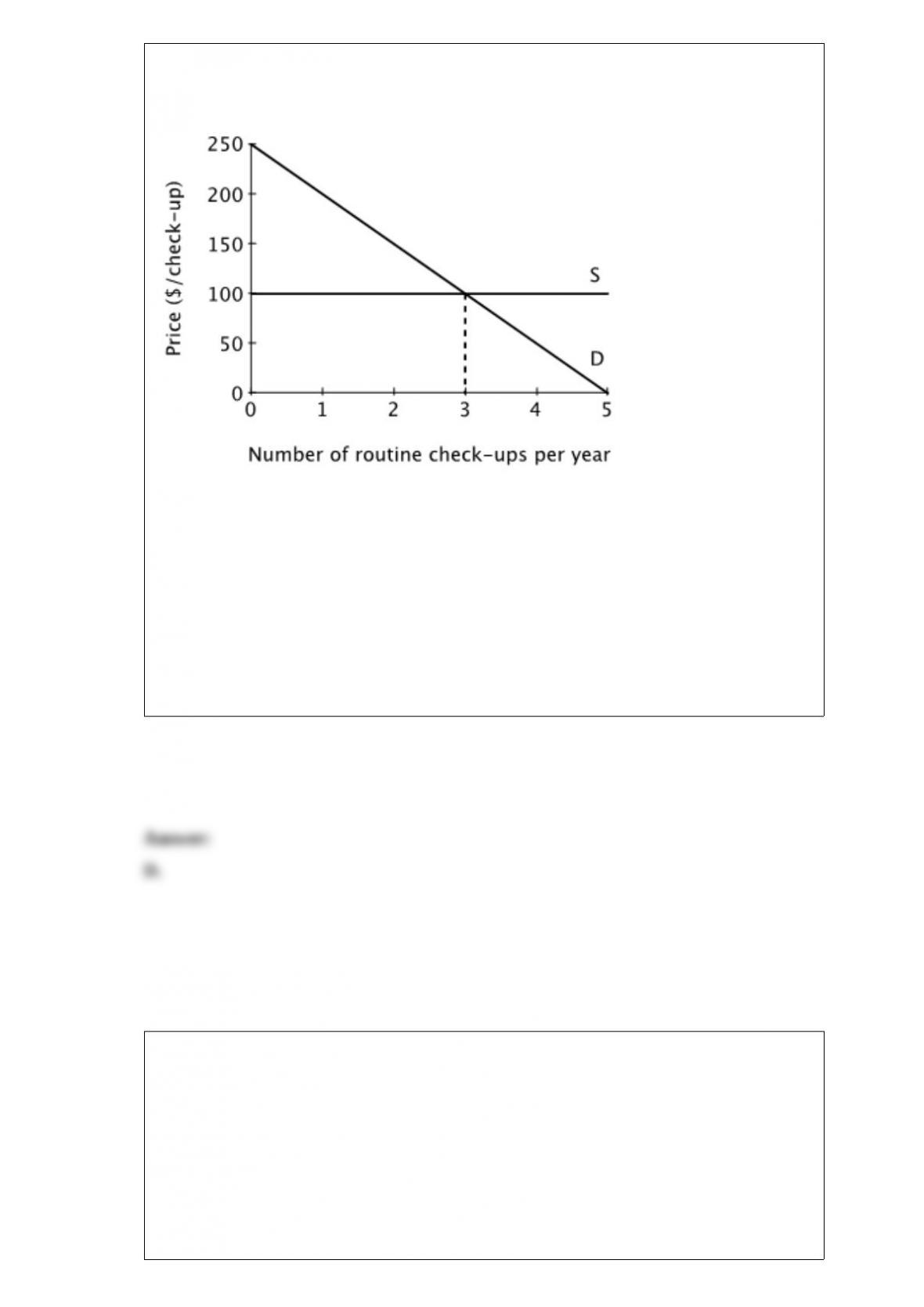
Suppose the figure below shows Luke’s demand curve for check-ups along with the
supply curve for check-ups.
If Luke had to pay the entire marginal cost of each check-up, then he would choose to
have ______ check-ups a year.
A. 5
B. 1
C. 2
D. 3
An increase in the real exchange rate will tend to ______ exports and to ______
imports.
A. increase; decrease
B. increase; increase
C. decrease; decrease
D. decrease; increase

A lower real interest rate ______ saving and ______ consumption spending.
A. increases; increases
B. increases; decreases
C. does not change; does not change
D. decreases; increases
The inside lag is relatively shorter for _____ policy; the outside lag is relatively shorter
for _____ policy.
A. monetary; fiscal
B. monetary; monetary
C. fiscal; monetary
D. fiscal; fiscal
If firms sell more output than expected, planned investment:
A. is greater than actual investment.
B. is less than actual investment.
C. equals actual investment.
D. equals zero.
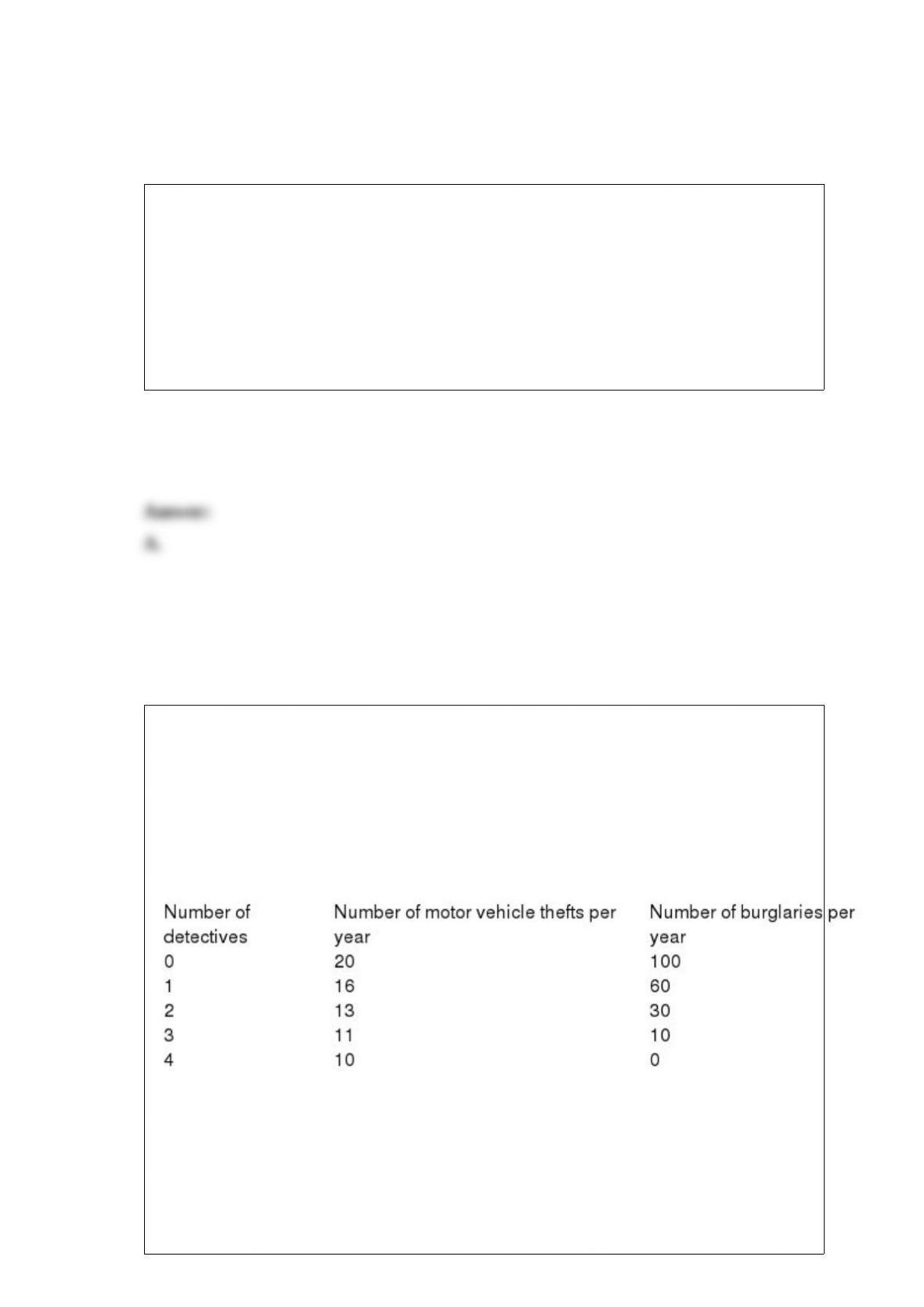
Consider a police department trying to decide how to allocate its crime prevention
resources between motor vehicle thefts and burglaries. The marginal benefit of one less
motor vehicle theft is $20,000, and the marginal benefit of one less burglary is $1,000.
Suppose the annual number of motor vehicle thefts and the annual number of burglaries
depends on the number of detectives assigned to each type of crime, as shown in the
table below. Each detective costs $35,000 each per year, regardless of whether the
detective is assigned to motor vehicle thefts or burglaries.
What is the socially optimal number of detectives to be assigned to each type of crime?
A. 4 detectives to motor vehicle theft and 0 to burglary.
B. 3 detectives to motor vehicle theft and 1 to burglary.
C. 4 detectives to motor vehicle theft and 2 to burglary.

D. 0 detectives to motor vehicle theft and 4 to burglary.
A technological innovation that reduces a firm’s cost of producing additional units of
output will lead to:
A. an increase in the quantity supplied by the firm, but no change in the firm’s supply.
B. an increase in the firm’s supply.
C. a decrease in the quantity supplied by the firm, but no change in the firm’s supply.
D. a decrease in the firm’s supply.
The supply curve illustrates that firms:
A. increase the supply of a good when its price rises.
B. increase the quantity supplied of a good when its price rises.
C. decrease the quantity supplied of a good when input prices fall.
D. decrease the quantity supplied to earn higher profits.

The short run is best defined as:
A. one year or less.
B. a period of time sufficiently short that all factors of production are variable.
C. the period of time between quarterly accounting reports.
D. a period of time sufficiently short that at least one factor of production is fixed.
During Thanksgiving you participated in a pumpkin-pie eating contest. You really
enjoyed the first two pies, the third one was okay, but as soon as you ate the fourth one
you became ill and lost the contest. Your total utility ______ with the first three pies
you ate.
A. increased
B. decreased
C. stayed the same

D. first increased than decreased
Donald has vast riches and consumes thousands of dollars’ worth of consumer goods
each week, yet he is never satisfied. Why not?
A. People’s wants are unlimited.
B. Donald fails to choose rationally.
C. The law of diminishing marginal utility shows that consuming too many material
goods lowers total utility.
D. Utility is unrelated to the level of consumption.