
Which of the following statements about the economic decisions consumers, firms, and
the government have to make is false?
A) Governments face the problem of scarcity in making economic decisions.
B) Only individuals face scarcity; firms and the government do not.
C) Both firms and individuals face scarcity.
D) Each faces the problem of scarcity which necessitates trade-offs in making economic
decisions.
In periods when prices are falling, on average,
A) real GDP will grow slower than nominal GDP.
B) real GDP will grow faster than nominal GDP.
C) real GDP will grow as fast as nominal GDP.
D) one cannot calculate real GDP.
All Gini coefficients must lie between 0 and 1. The lower the value,
A) the more unequal the income distribution.
B) the closer the income distribution is to being equal.
C) the greater the degree of poverty.
D) the lower the degree of poverty according to the federal government’s definition of
poverty.
“A competitive market achieves economic efficiency by maximizing the sum of
consumer surplus and producer surplus.” This statement
A) is true only if there are positive externalities in production in the market.
B) is true only if there are no negative externalities in the market.
C) is true only if there are no positive or negative externalities in the market.
D) is true in theory, but economic efficiency cannot be achieved in a real market.
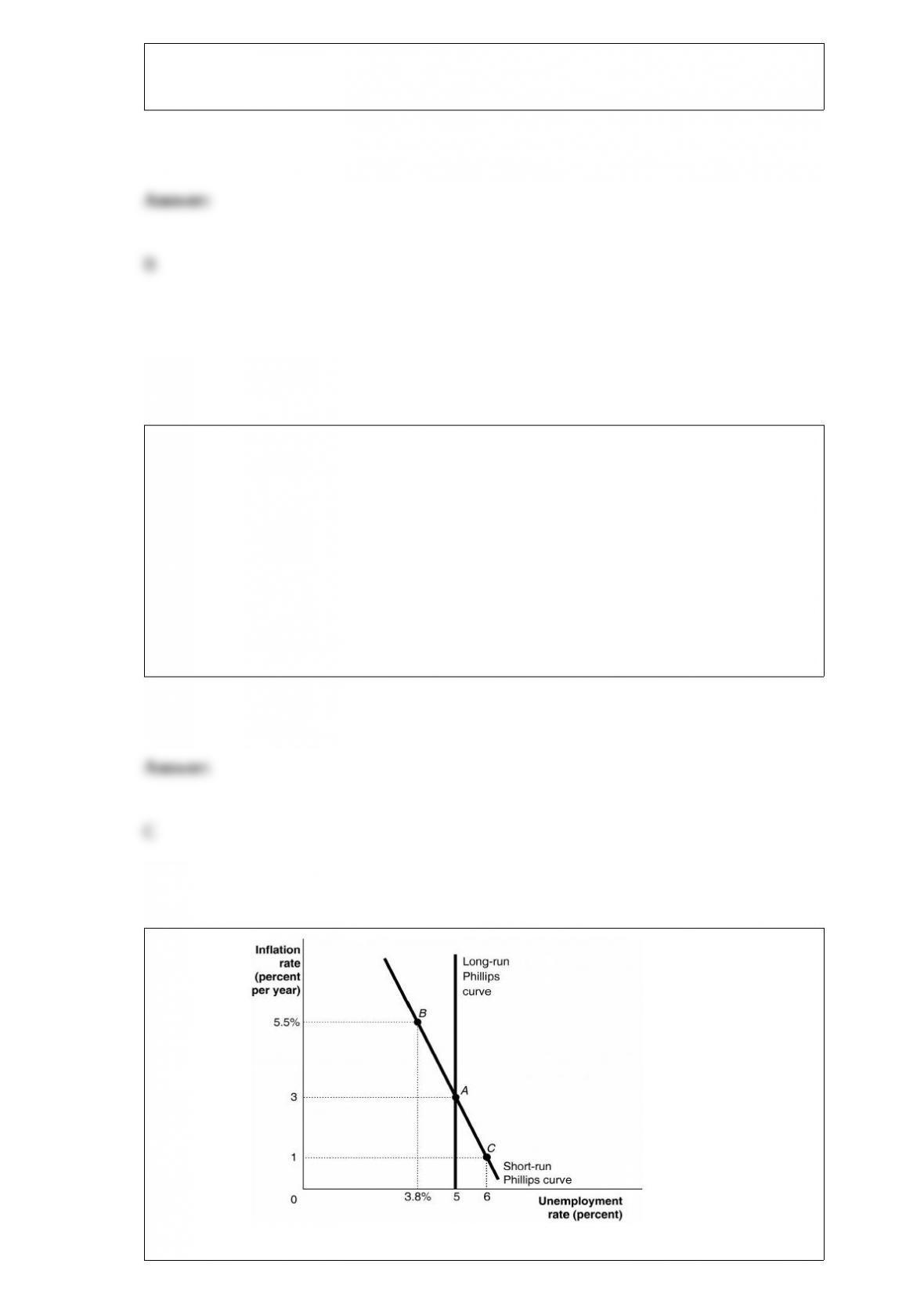
Figure 28-2

Suppose the economy is at point A in the figure above. Which of the following is true?
A) The short-run Phillips curve will shift to the right.
B) The short-run Phillips curve will shift to the left.
C) The long-run Phillips curve will shift to the left.
D) Actual inflation and expected inflation are the same.
E) The long-run Phillips curve will shift to the right.
What is the difference between a public franchise and a public enterprise?
A) A public franchise grants a firm the right to be the sole legal provider of a good or
service. A public enterprise refers to a service that is provided directly to consumers
through the government.
B) A public enterprise grants a firm the right to be the sole legal provider of a good or
service. A public franchise refers to a service that is provided directly to consumers
through the government.
C) A public enterprise is owned by the public through its holdings of shares of stock in
the enterprise. A public franchise is a firm owned by the government.
D) Both refer to a service provided directly to consumers through the government, but
“public franchise” is a term more commonly used in the United States while “public
enterprise” is more commonly used in European countries.
Which of the following would result in a higher absolute value of the price elasticity of

demand for a product?
A) A wide variety of substitutes are available for the good.
B) The time period under consideration is short.
C) The good is a necessity.
D) The expenditure on the good is small relative to one’s budget.
If in the market for peaches, the supply curve has shifted to the left,
A) the supply of peaches has increased.
B) the supply of peaches has decreased.
C) the quantity of peaches supplied has increased.
D) the quantity of peaches supplied has decreased.
A successful market economy requires well defined property rights and
A) balanced supplies of all factors of production.
B) an independent court system to adjudicate disputes based on the law.
C) detailed government regulations.
D) a safety net to ensure that those who cannot participate in the market economy can
earn an income.
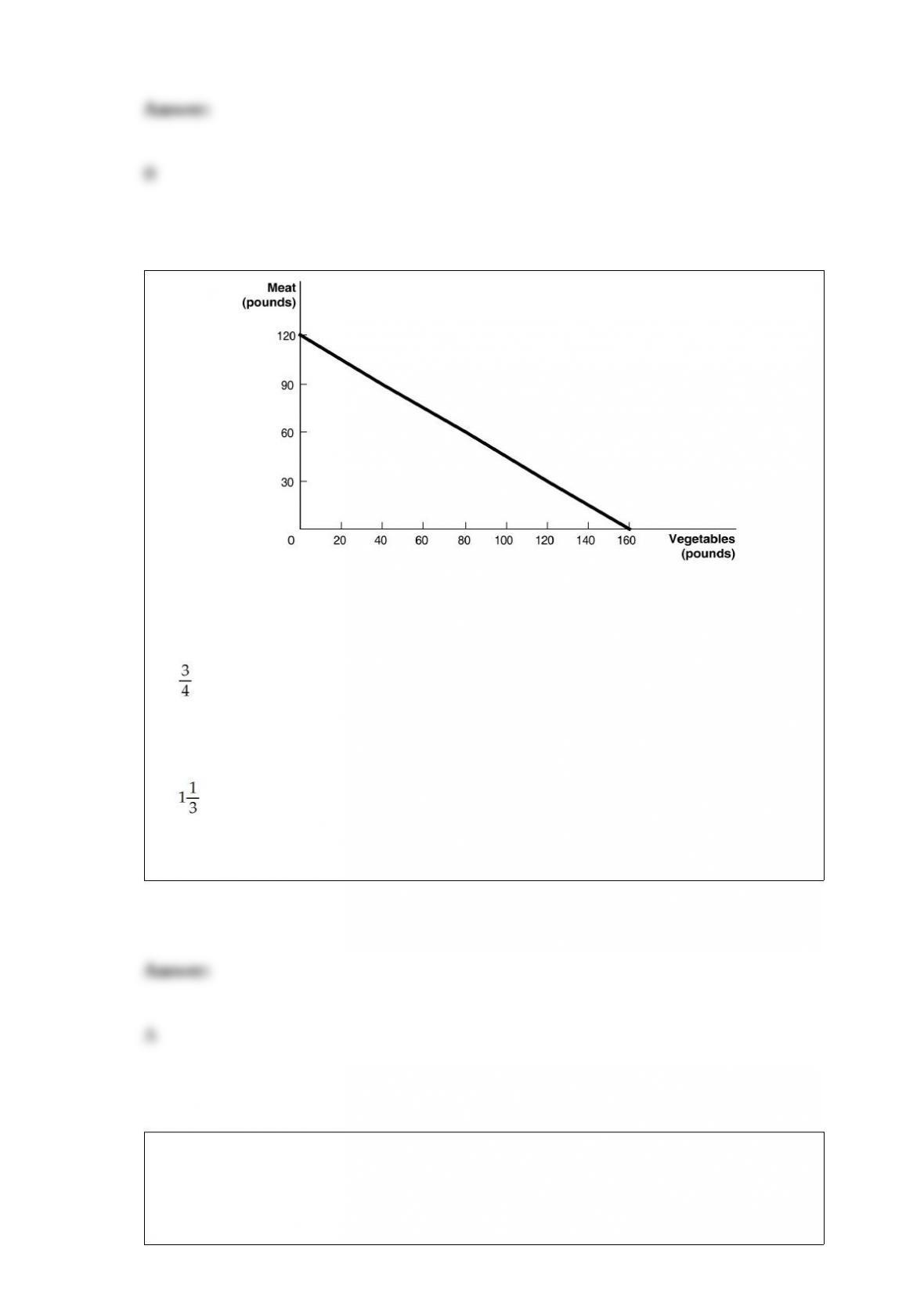
Figure 2-2 Figure
2-2 above shows the production possibilities frontier for Mendonca, an agrarian nation
that produces two goods, meat and vegetables. What is the opportunity cost of one
pound of vegetables?
A) pound of meat
B) 1.2 pounds of meat
C) pounds of meat
D) 12 pounds of meat
Every society faces economic trade-offs. This means
A) some people live better than others do.

B) not everyone can have enough goods to survive.
C) producing more of one good means less of another good can be produced.
D) society’s output cannot be made available to all.
Net exports usually ________ when the U.S. economy is in a recession and ________
when the U.S. economy is expanding.
A) increase; increase
B) decrease; increase
C) increase; decrease
D) decrease; decrease