1) output-per worker in the united states declined between 1995 and 2007.
2) Successful new products enable consumers to increase the total utility they obtain
from a specific amount of their total spending.
3) toothpaste and toothbrushes are substitute goods.
4) health care is an inferior good.
5) In the immediate short run, both input and output prices are fixed.
6) (consider this) the assertion by economists that “there is no free lunch” is:
a.contradicted by the presence of free goods offered by firms.
b.applies to goods that have prices, not to goods given away free by firms.
c.remains true even for goods given away free by firms.
d.applies to agricultural goods, but not to manufactured goods.
7) The value of the monetary multiplier is:
A.1/MPS.
B.1/Excess Reserves.
C.1/MPC.
D.1/Required Reserve Ratio.
8) The amount by which government expenditures exceed revenues during a particular
year is the:
A.public debt.
B.budget deficit.
C.full-employment.
D.GDP gap.
9) all of the following could immediately or eventually lead to an inward shift of a
nation’s production possibilities curve, except:
a.emigration of skilled workers from the nation.
b.a decline in the birth rate.
c.an increase in the average skill level of all occupational groups.
d.depletion and reduced availability of major energy resources.
10)
Refer to the above data. If a 10 percent proportional tax on income is imposed, the
consumption schedule will now be:
A.
B.
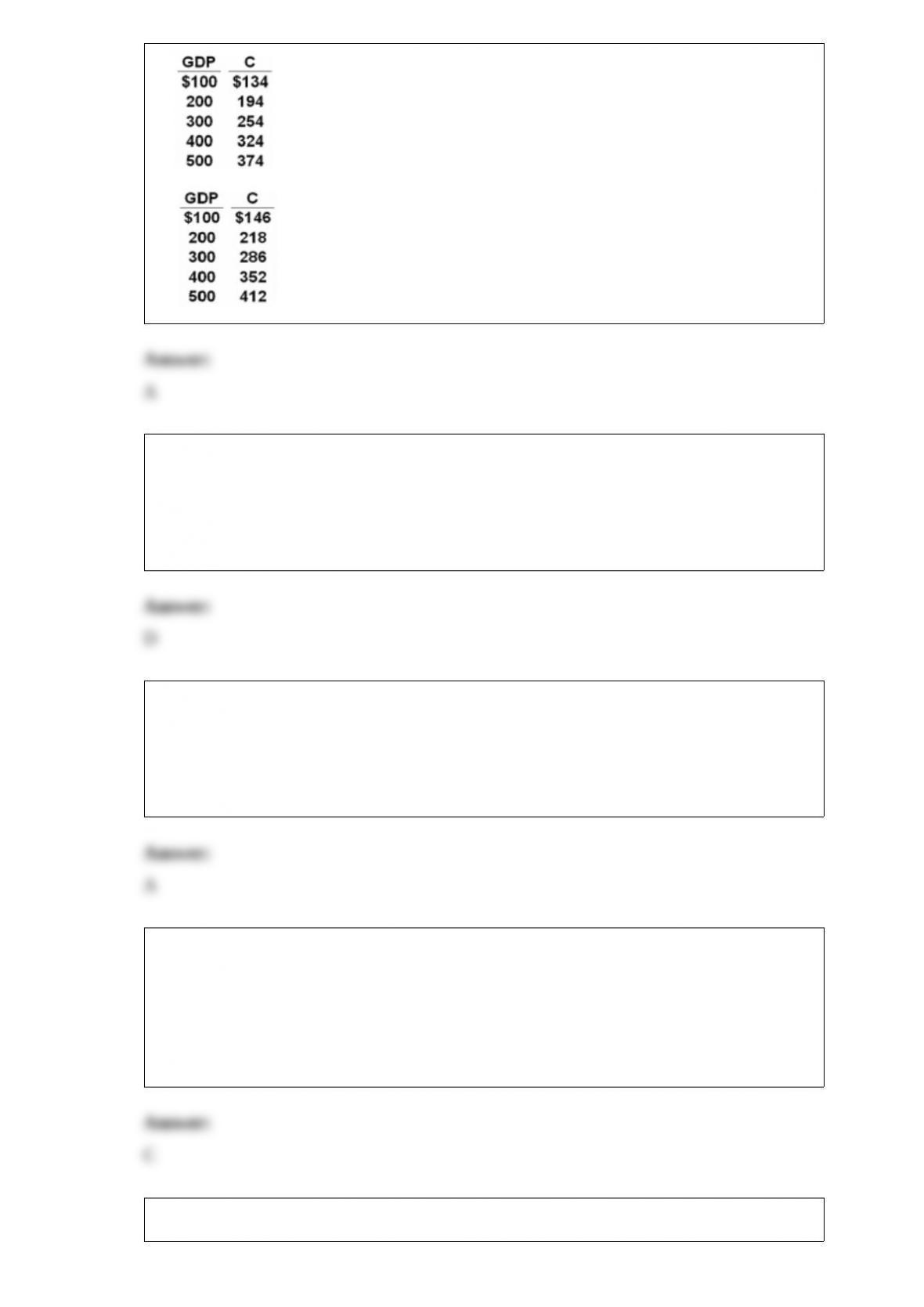
C.
D.
11) Which one of the following is not one of the so-called G8 nations?
A.Japan
B.Canada
C.United States
D.China
12) In 2006, the average income for households in the United States was about:
A.$66,570.
B.$22,820.
C.$9,610.
D.$82,700.
13) Suppose the United States eliminates high tariffs on German bicycles. As a result,
we would expect:
A.the price of German bicycles to increase in the United States.
B.employment to decrease in the German bicycle industry.
C.employment to decrease in the U.S. bicycle industry.
D.profits to rise in the U.S. bicycle industry.
14) The foreign purchases effect suggests that an increase in the U.S. price level relative
to other countries will:
A.increase the amount of U.S. real output purchased.
B.increase U.S. imports and decrease U.S. exports.
C.increase both U.S. imports and U.S. exports.
D.decrease both U.S. imports and U.S. exports.
15) a subsidy:
a.should be provided when there are external costs.
b.should be provided when there are external benefits.
c.should be provided only when a public good is being produced.
d.is appropriate when firms are guilty of pollution.
16) which of the following statements is correct?
a.both cash and noncash gift-giving cause value losses.
b.neither cash nor noncash gift-giving cause value losses.
c.noncash gift-giving create a value loss, but cash gifts do not.
d.cash gifts creates a value loss, but noncash gifts do not.
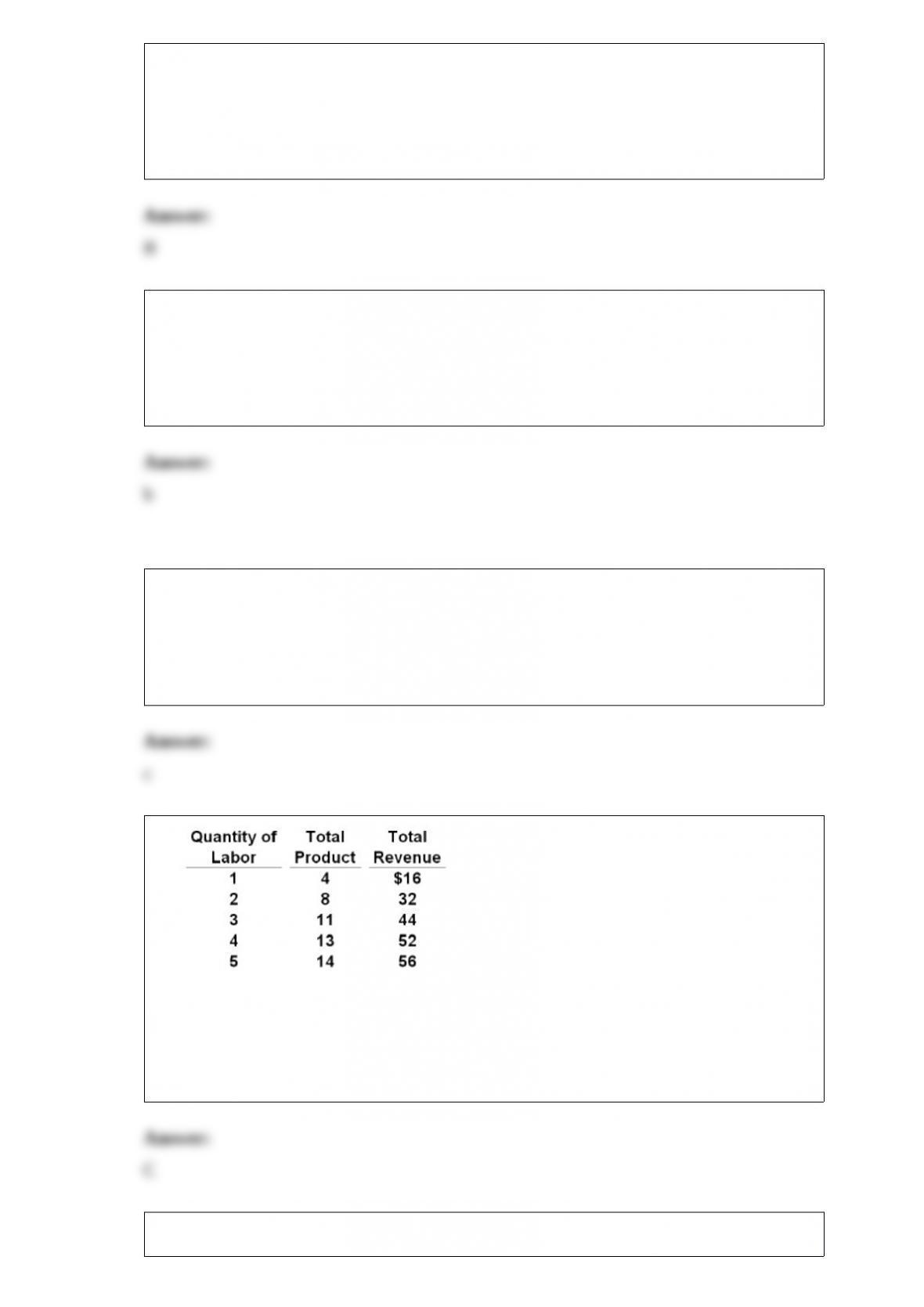
17)
Refer to the above data. This firm’s product price is:
A.$2.
B.$3.
C.$4.
D.$16.
18) The Federal budget deficit is found by:
A.subtracting government tax revenues plus government borrowing from government
spending in a particular year.
B.subtracting government tax revenues from government spending in a particular year.
C.cumulating the differences between government spending and tax revenues over all
years since the nation’s founding.
D.subtracting government revenues from the noninvestment-type government spending
in a particular year.
19) The purchase of government securities from the public by the Fed will cause:
A.commercial bank reserves to decrease.
B.the money supply to increase.
C.demand deposits to decrease.
D.the interest rate to increase.
20) if a pure monopolist is operating in a range of output where demand is elastic:
a.it cannot possibly be maximizing profits.
b.marginal revenue will be positive but declining.
c.marginal revenue will be positive and rising.
d.total revenue will be declining.
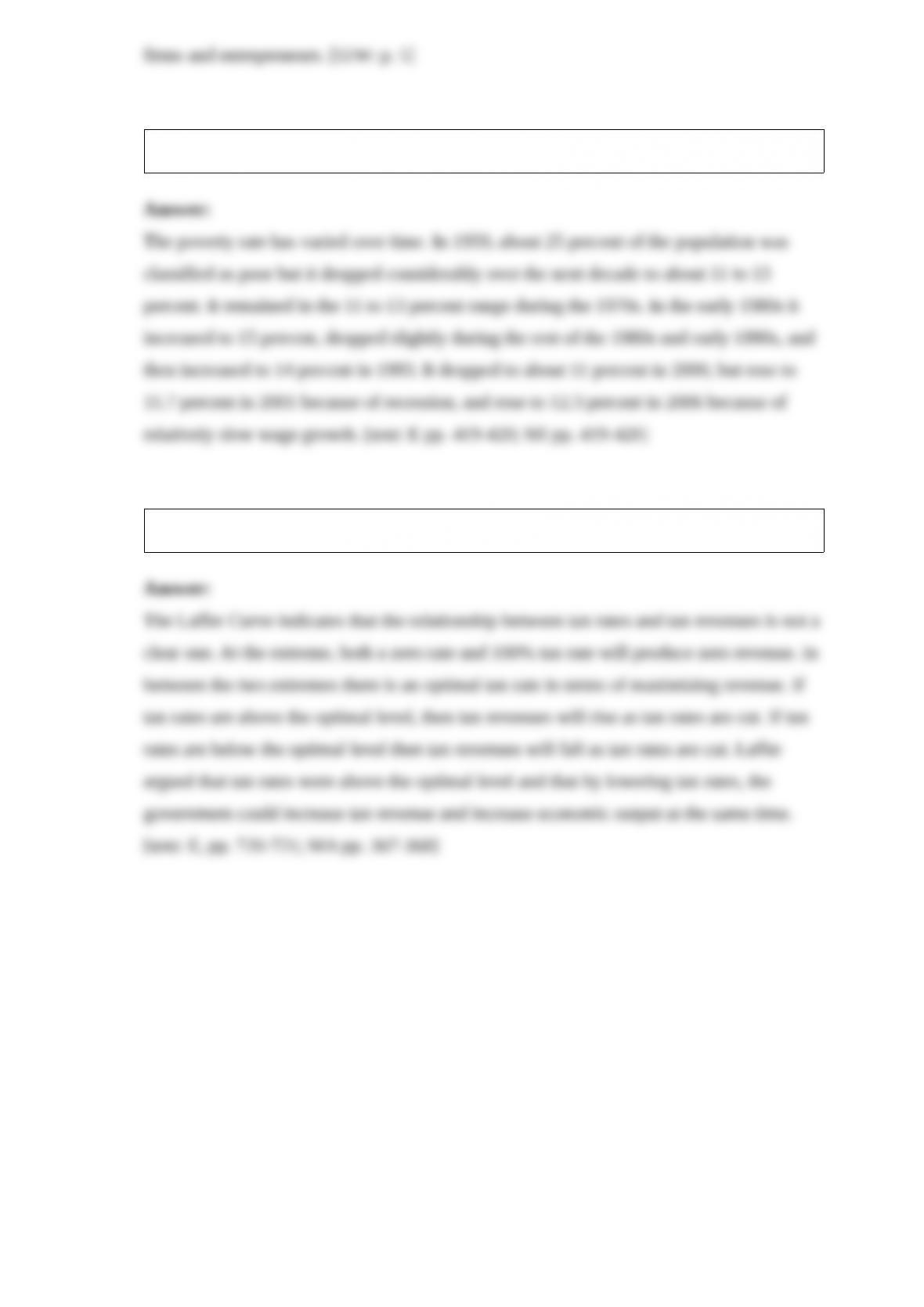
21) The following data are for a series of increasingly extensive flood control projects:
Refer to the above data. Plan C entails:
A.marginal benefits in excess of marginal costs.
B.fewer spillovers than either Plan A or Plan B.
C.an overallocation of resources to flood control.
D.an underallocation of resources to flood control.

22) rapidly rising u.s. health care costs have:
a.slowed the growth of real wages.
b.diminished labor mobility.
c.caused some employers to use more part-time and temporary workers.
d.done all of these.
23) For the firm, the major goal of profit sharing plans is to:
A.force workers to incur some of the business risk.
B.overcome the monopsony problem of having to pay higher wages to attract additional
workers.
C.overcome the principal-agent problem by better aligning the workers’ interests with
those of the firm.
D.reduce total compensation payments.
24) every month harry decorates his front lawn with some type of seasonal or holiday
display. harry’s neighbors enjoy his displays and people come for miles each month to
drive by the house and view the decorations. based on this we could conclude that:
a.harry has created a public good.
b.harry’s decorations create substantial spillover benefits.
c.substantial negative externalities are created if those driving to see the decorations are
generating large amounts of pollution and/or congested traffic in the neighborhood.
d.all of the above are possible outcomes of harry’s decorations.
25) which of the following is not a source of economies of scale?
a.learning-by-doing.
b.labor specialization.
c.use of larger machines.
d.inelastic resource supply curves.
26) What are the two significant characteristics of the fractional reserve banking
system?
27) How are changes in one currency mirrored in changes in some other foreign
currency?
28) Whenever there is change in spending, there will be a change in real GDP. Explain
why this is so.
29) What are four significant reasons for studying resource pricing?
30) In what ways do entrepreneurs differ from other innovators? In what types of
businesses do entrepreneurs and innovators tend to work? How do past successes affect
these types of individuals?
31) Banks pursue two conflicting goals. Explain what they are and why the conflict.
32) Why do entrepreneurs and other innovators actively study the scientific output of
universities and government laboratories?
33) What have been the poverty trends in the past forty-five years?
34) What is the Laffer Curve? Explain the relationship that is shown in the curve.