1) Home is a country that produces two goods, pears and cellular phones. Last year,
Home produced 450 bushels of pears and 1050 cellular phones. This year it produced
450 bushels of pears and 2000 cellular phones. Given no other information, which of
the following events could explain this change?
a.Home experienced increased unemployment.
b.Home experienced a decline in pear-producing technology.
c.Home experienced an improvement in cellular phone-making technology.
d.Home experienced a reduction in resources.
2) A government program that reduces land under cultivation hurts farmers but helps
consumers.
a.True
b.False
3) Irregular fluctuations in economic activity are known as the
a.business cycle.
b.broken window fallacy.
c.tradeoff between inflation and unemployment.
d.ten principles of economics.
4) Opponents of free trade often want the United States to prohibit the import of goods
made in overseas factories that pay wages below the U.S. minimum wage. Prohibiting
such goods is likely to
a.cause these factories to pay the U.S. minimum wage.
b.increase the rate of technological advance in poor countries so that they can afford to
pay higher wages.
c.increase poverty in poor countries and benefit U.S. firms which compete with these
imports.
d.harm U.S. firms which compete with these imports.
5) Because resources are scarce, a society cannot give all individuals the standard of
living to which each aspires.
a.True
b.False
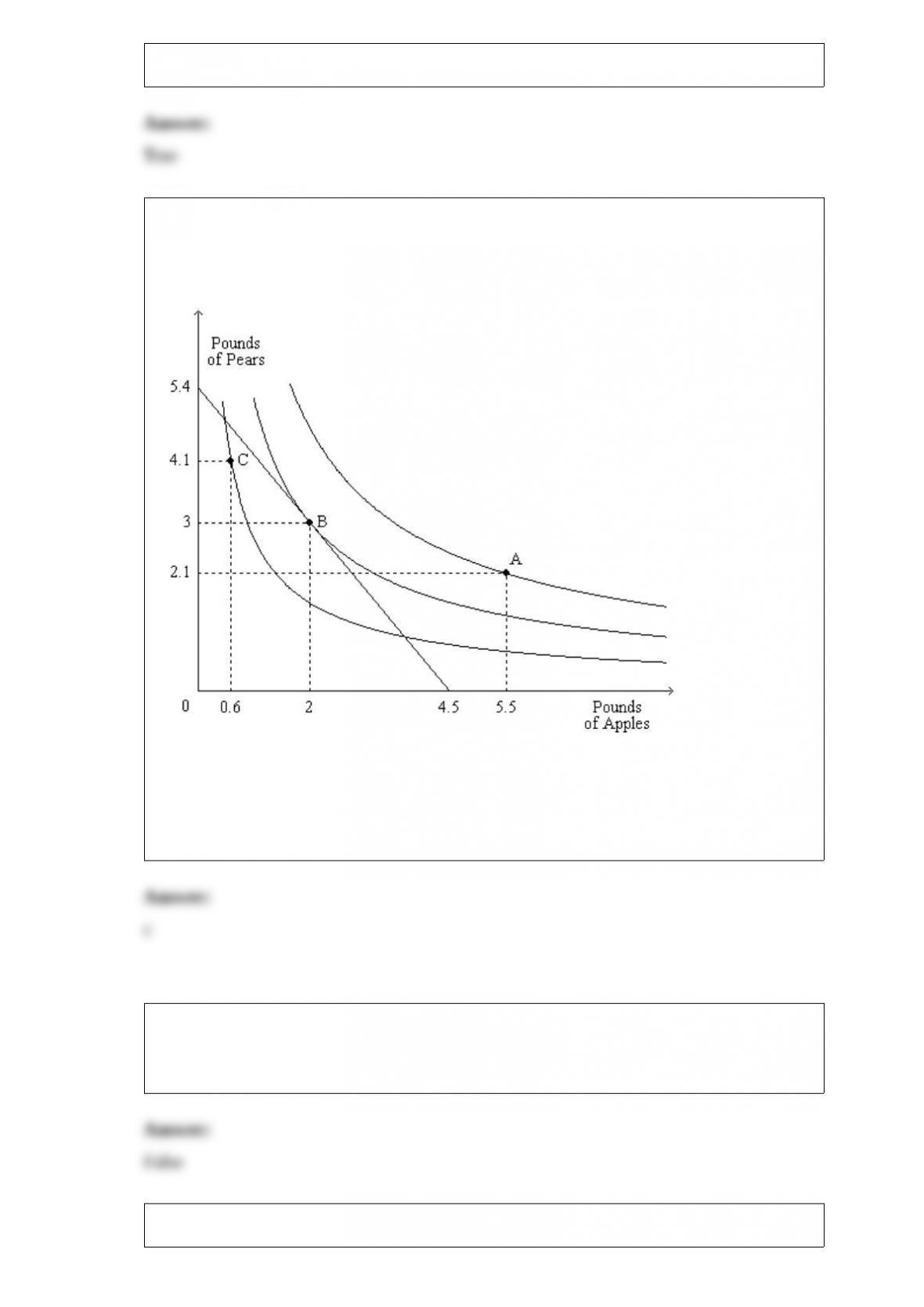
6) Figure 21-24
The figure shows three indifference curves and a budget constraint for a certain
consumer named Steve.
Refer to Figure 21-24. If the price of a pound of pears is $3, then Steve’s income is
a. $12.00.
b. $13.50.
c. $16.20.
d. $18.80.
7) Sellers respond to a shortage by cutting their prices.
a.True
b.False
8) Cost-benefit analysis is important to determine the role of government in our
economy because
a.the government should provide all goods for which the benefits exceed the costs.
b.cost-benefit analysis identifies the possible gains to society from government
provision of a particular good.
c.markets for private goods cannot effectively assign costs and benefits.
d.cost-benefit analysis is the best tool to identify market failures.
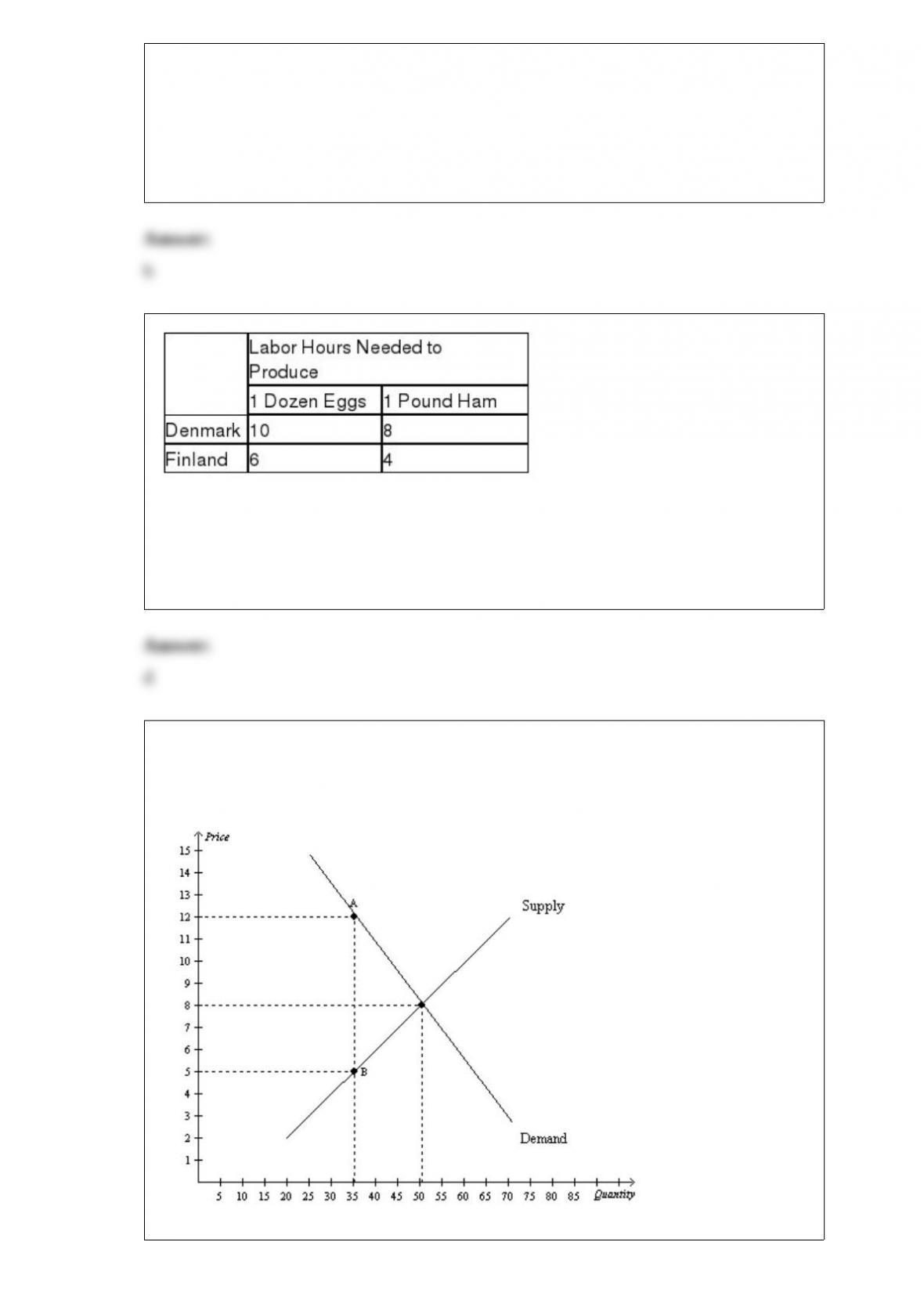
9) Finland’s opportunity cost of producing 1 unit of ham is
a.3/2 dozen eggs. This is higher than Denmark’s opportunity cost.
b.3/2 dozen eggs. This is lower than Denmark’s opportunity cost.
c.2/3 dozen eggs. This is higher than Denmark’s opportunity cost.
d.2/3 dozen eggs. This is lower than Denmark’s opportunity cost.
10)
Figure 8-4
The vertical distance between points A and B represents a tax in the market.
The per-unit burden of
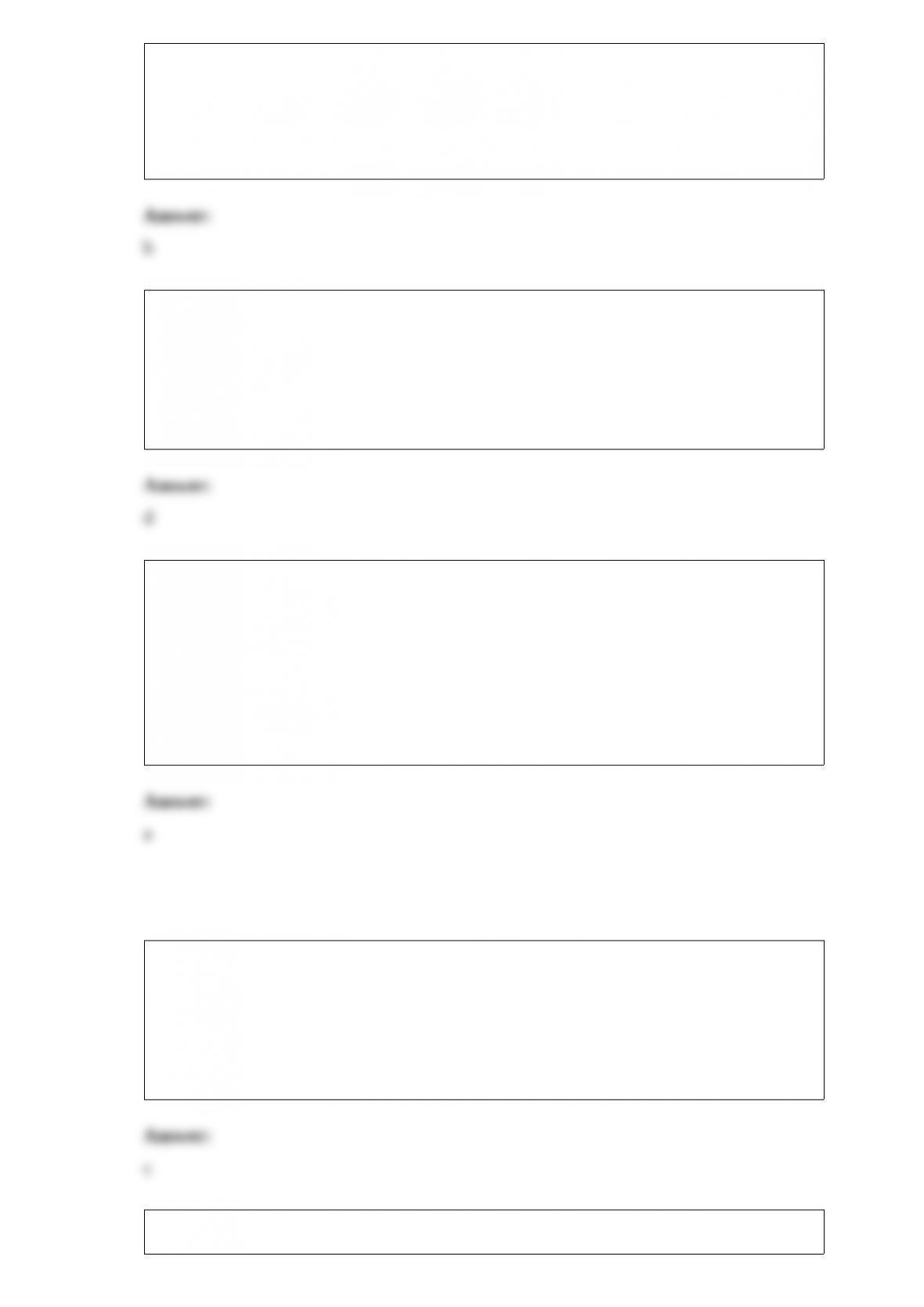
the tax on buyers is
a. $3.
b.$4.
c.$5.
d.$8.
11) Following the implementation of laws requiring automobiles to have seat belts,
which of the following occurred?
a.An individual’s probability of surviving an auto accident rose.
b.There was an increase in pedestrian deaths.
c.There was an increase in automobile accidents.
d.All of the above are correct.
12) Suppose that flu shots create a positive externality equal to $9 per shot. Further
suppose that the government offers a $9-per-shot subsidy to producers. What is the
relationship between the equilibrium quantity and the socially optimal quantity of flu
shots produced?
a.They are equal.
b.The equilibrium quantity is greater than the socially optimal quantity.
c.The equilibrium quantity is less than the socially optimal quantity.
d.There is not enough information to answer the question.
13) Of the following countries, which country’s government collects the least amount of
tax revenue as a percentage of that country’s total income?
a.Japan
b.United States
c.Mexico
d.Denmark
14) Using demand and supply diagrams, show the difference in deadweight loss
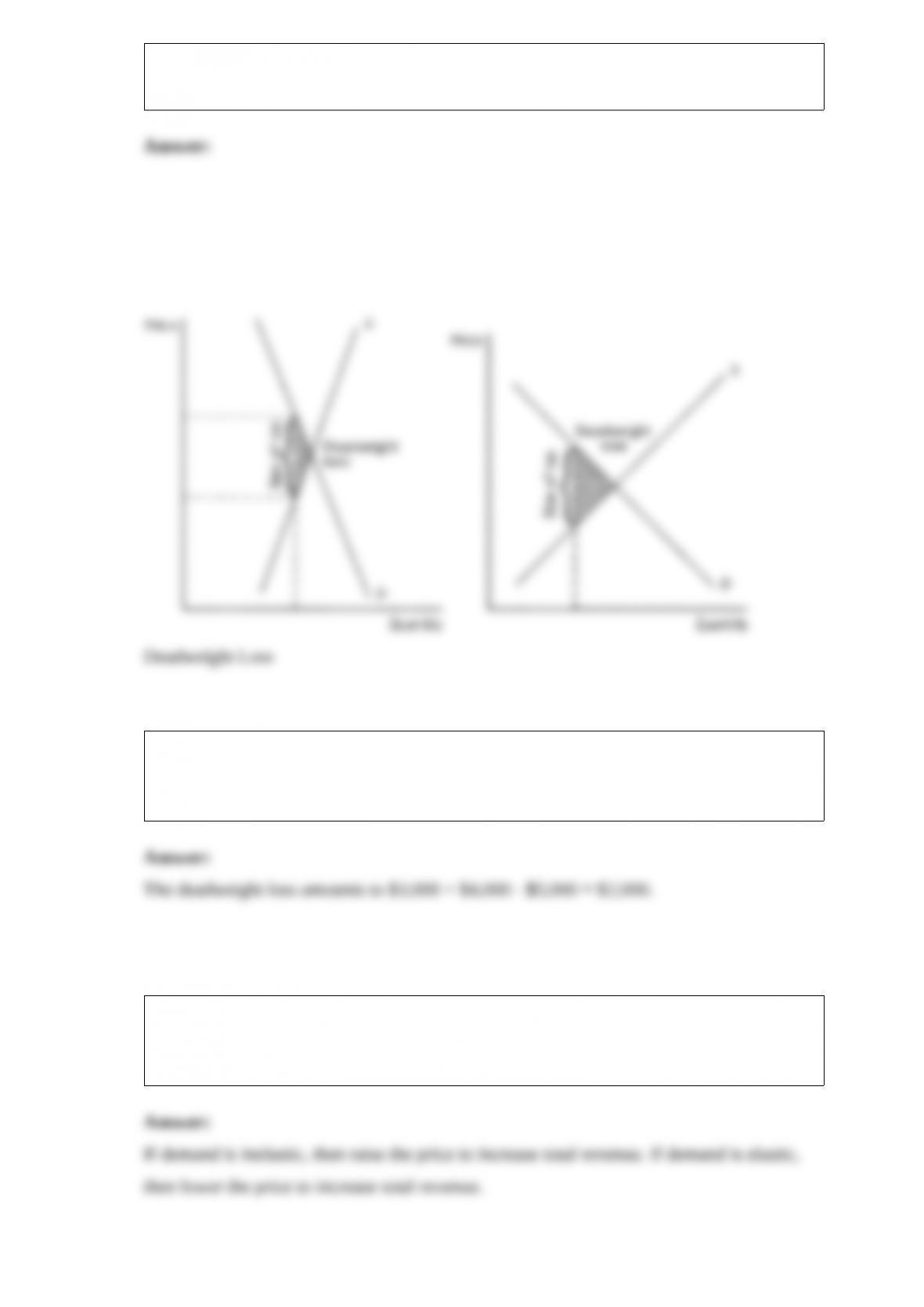
between (a) a market with inelastic demand and supply and (b) a market with elastic
demand and supply.
15) A tax is imposed on a certain good. The tax produces revenue of $5,000 for the
government. The tax reduces consumer surplus by $3,000 and it reduces producer
surplus by $4,000. What is the amount of the deadweight loss of the tax?
16) Suppose you manage a baseball stadium. To pay the salary for a star player, you
would like to increase the total revenue from ticket sales. Should you increase or
decrease the price of a ticket to increase revenue? Explain.
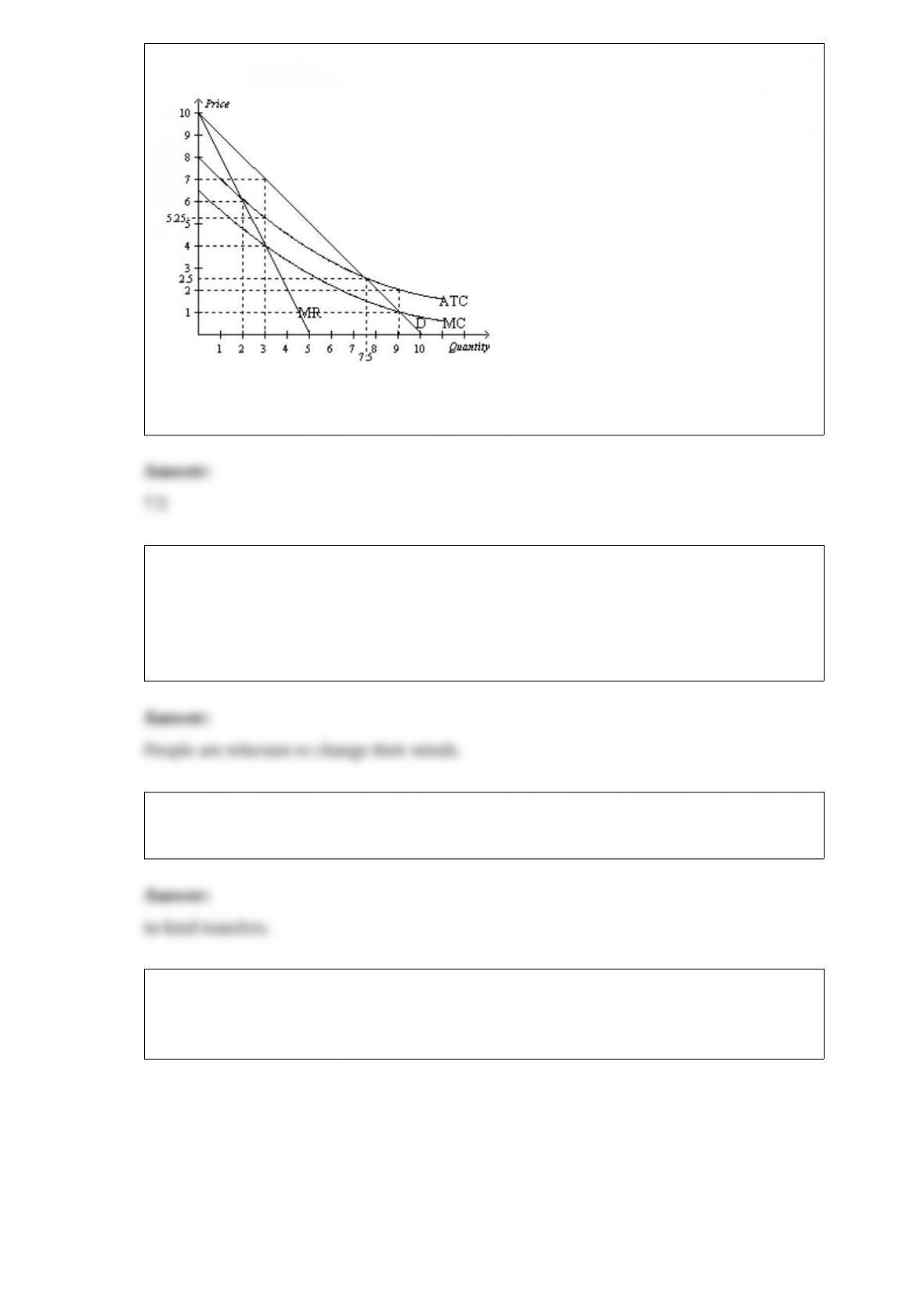
17) Figure 15-23
If a regulator requires the firm to charge an average cost price, what quantity will the
firm produce?
18) Harold has always driven cars made by Universal Motors. The last two Universal
Motors cars that Harold purchased have had major engine problems resulting in Harold
incurring significant cost. Consumer Reports has consistently given Universal Motors
poor ratings. Still, Harold plans to purchase another Universal Motors car next fall.
Harold’s behavior is an example of which systematic mistake that people make?
19) Goods and services given to the poor such as food stamps, housing vouchers, and
medical services are called
20) Figure 9-28
The following diagram shows the domestic demand and domestic supply curves in a
market.
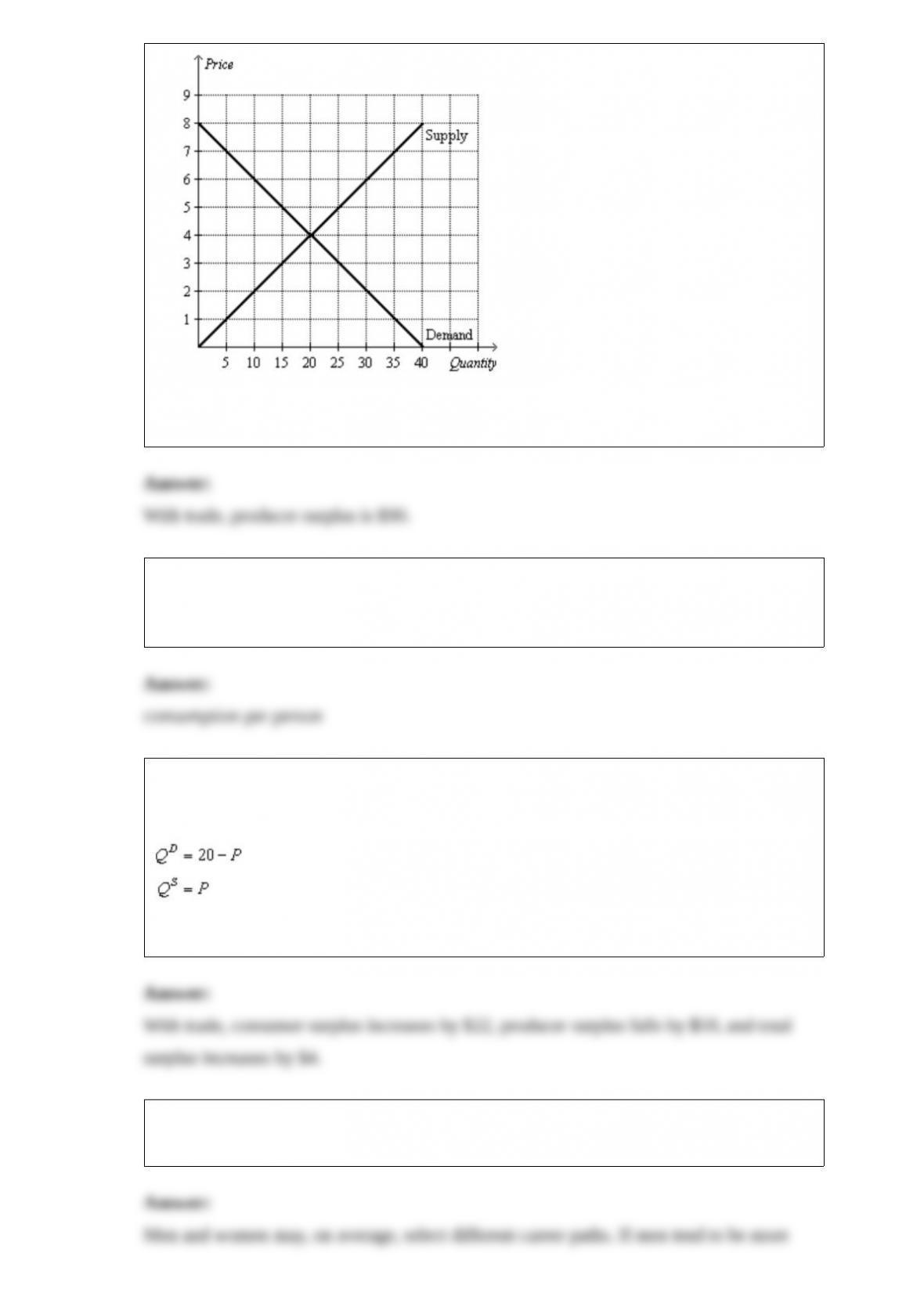
Suppose the world price in this market is $6. If the country allows free trade, how much
is producer surplus?
21) Economists Cox and Alm compared the gap between rich and poor and found that
the richest 20% was about 2 times better off than the poorest 20% when they compared
what data?
22) Scenario 9-3
Suppose domestic demand and domestic supply in a market are given by the following
equations:
Suppose the world price in this market is $8 per unit. If the country allows free trade, by
how much do consumer surplus, producer surplus, and producer surplus change?
23) Explain how compensating differentials could contribute to differences between the
average wages of men and women.