1)
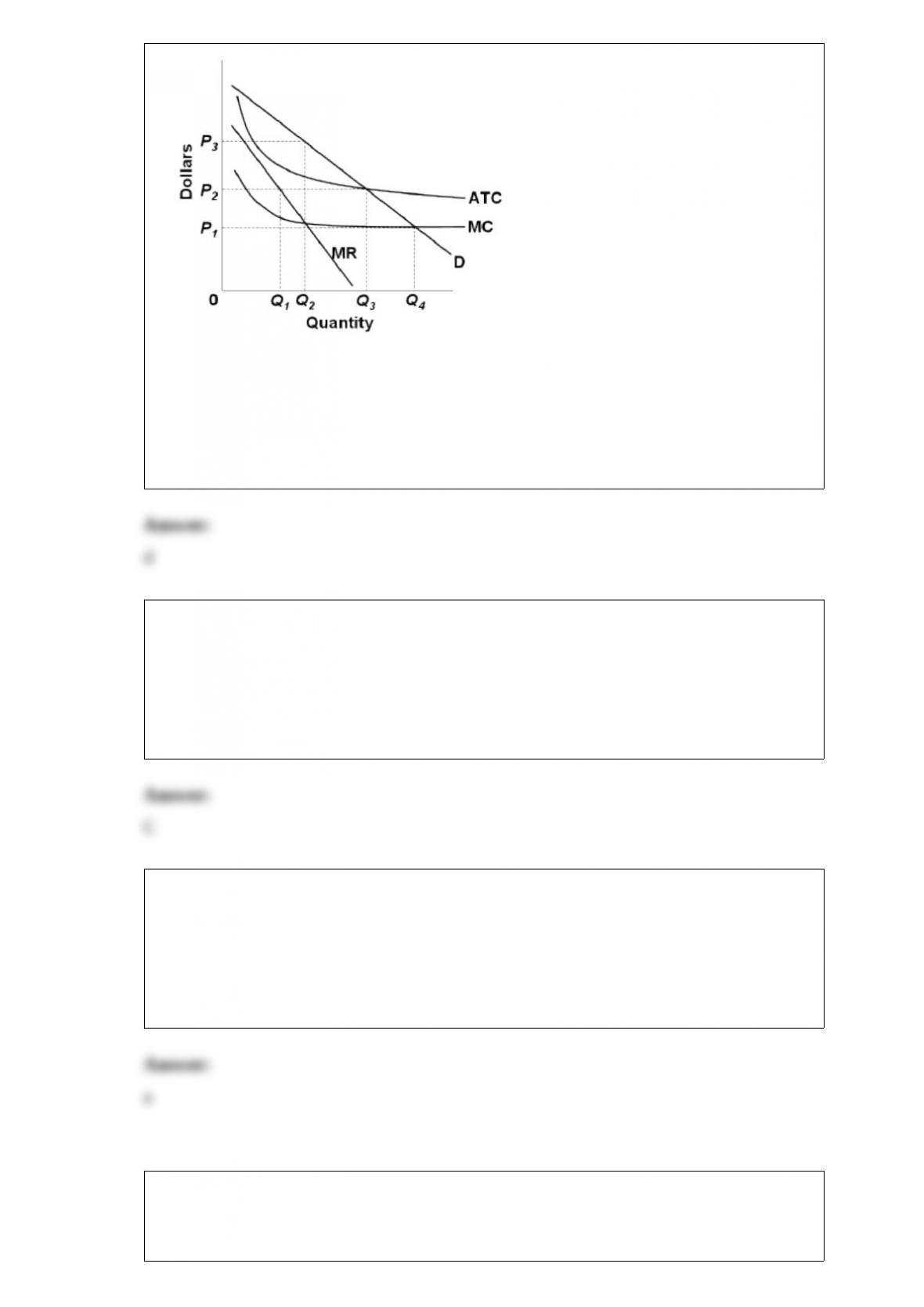
refer to the above diagram for a natural monopolist. if a regulatory commission set a
maximum price of p2, the monopolist would:
a.produce output q1 and realize an economic profit.
b.produce output q3 and realize an economic profit.
c.close down in the short run.
d.produce output q3 and realize a normal profit.
2) (Last Word) In 2005, chief executive officers (CEOs) pay at U.S. firms with around
$500 million in annual sales averaged:
A.$600 thousand.
B.$1.2 million.
C.$2.2 million.
D.$4.5 million.
3) which of the following is not a precondition for price discrimination?
a.the commodity involved must be a durable good.
b.the good or service cannot be resold by original buyers.
c.the seller must be able to segment the market, that is, to distinguish buyers with
different elasticities of demand.
d.the seller must possess some degree of monopoly power.
4) suppose that at prices of $5, $4, $3, $2, and $1 for product z, the corresponding
quantities supplied are 3, 4, 5, 6, and 7 units, respectively. which of the following would
increase the quantities supplied of z to, say, 6, 8, 10, 12, and 14 units at these prices?
a.improved technology for producing z
b.an increase in the prices of the resources used to make z
c.an increase in the excise tax on product z
d.increases in the incomes of the buyers of z
5)
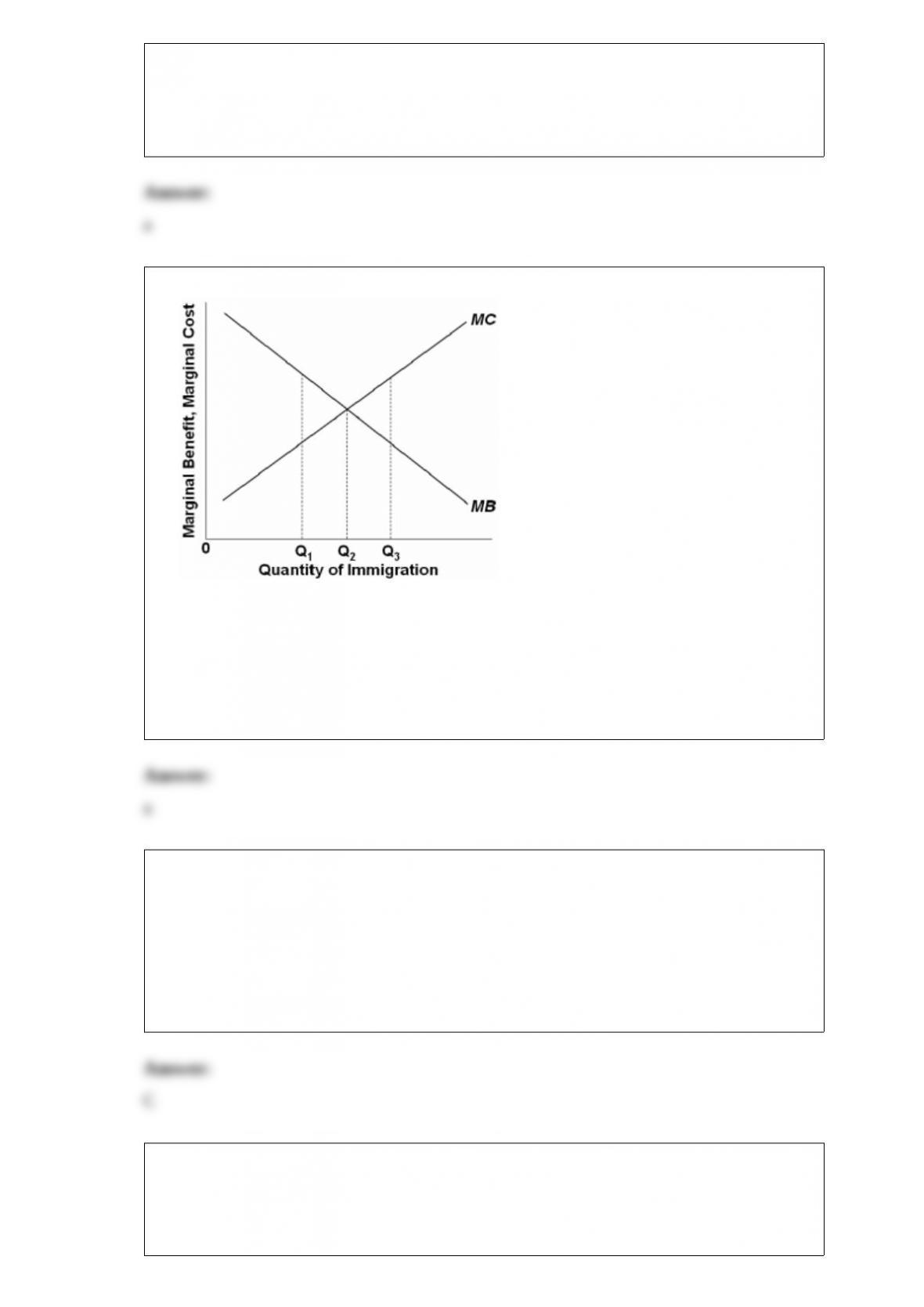
refer to the above figure. an increase in the number of highly skilled and educated
potential immigrants would:
a.increase mb and increase the optimal quantity of immigrants.
b.reduce mb and reduce the optimal quantity of immigrants.
c.increase mc and increase the optimal quantity of immigrants.
d.reduce mc and reduce the optimal quantity of immigrants.
6) Suppose the ABC bank has excess reserves of $4,000 and outstanding checkable
deposits of $80,000. If the reserve requirement is 25 percent, what is the size of the
bank’s actual reserves?
A.$16,000
B.$84,000
C.$24,000
D.$20,000
7) The government of a DVC may purposely cause inflation because:
A.a rapid rate of inflation attracts private foreign capital into a DVC.
B.there is conclusive evidence that inflation discourages people from having large
families.
C.this will strengthen the nation’s position in international markets.
D.inflation works like taxation in that it may release resources from consumption so
that they can be invested.
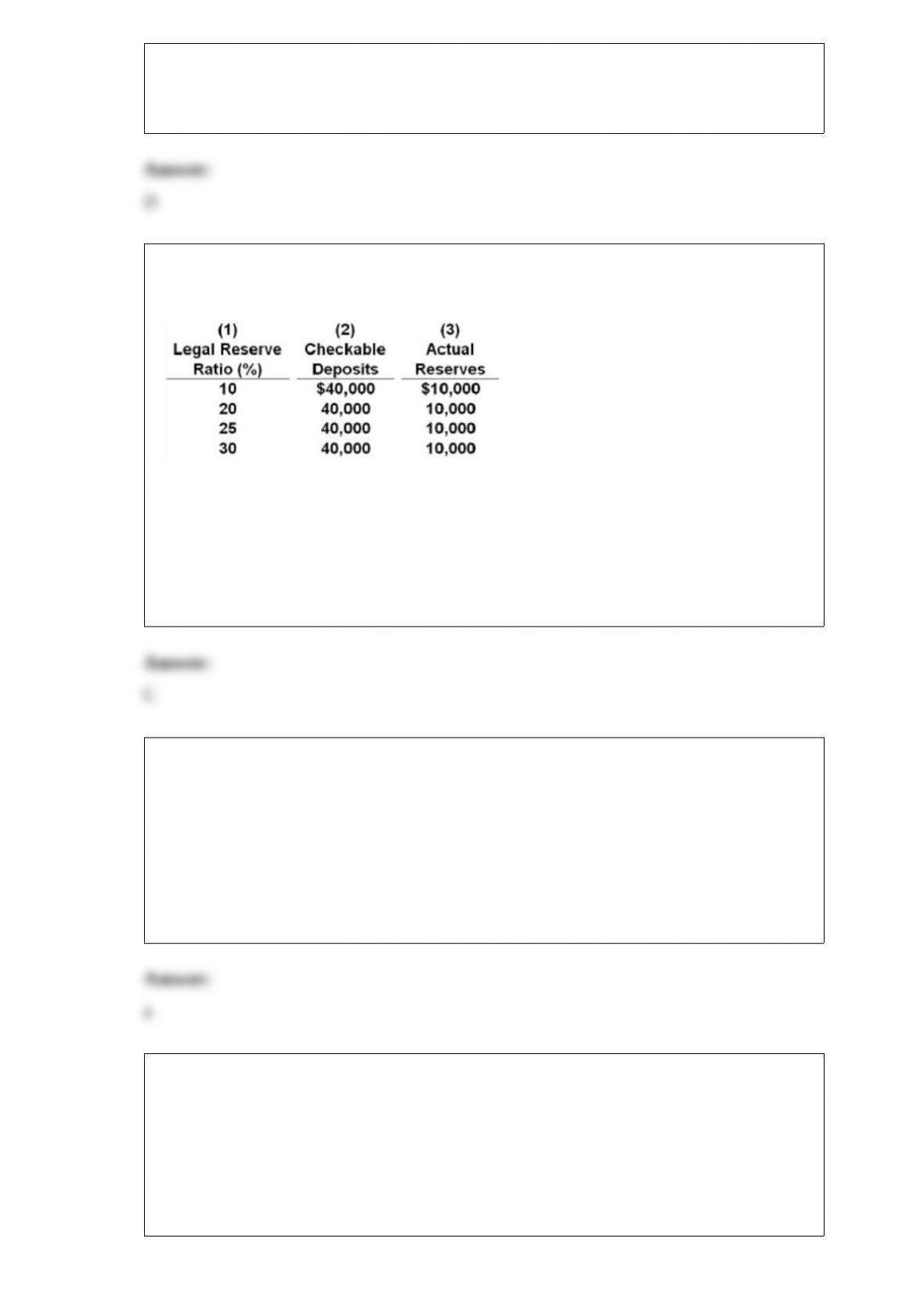
8) The following table for a commercial bank or thrift:
Refer to the above table. When the legal reserve ratio is 30 percent, the monetary
multiplier is:
A.5.
B.4.
C.3.33.
D.2.5.
9) alex sees that his neighbors’ lawns all need mowing. he offers to provide the service
in exchange for a wage of $20 per hour. some neighbors accept alex’s offer and others
refuse. economists would describe alex’s behavior as:
a.rational self-interest, because he attempting to increase his own income by identifying
and satisfying someone else’s wants.
b.greedy, because he is asking for a high wage.
c.selfish, because he is asking for a wage that is higher than others might charge.
d.irrational, because some neighbors refused his offer.
10) Patent laws are controversial because:
A.they are in legal conflict with the provisions of the Federal Trade Commission Act.
B.they are at the core of the problem of whether monopoly is based on industry
structure or behavior.
C.while patents encourage innovation, they are also a source of monopoly power.
D.any firm whose monopoly power is based on patents is automatically exempt from
the antitrust laws.