1) In the Baumol-Tobin analysis of the demand for money, either an increase in
________ or an increase in ________ increases money demand.
A) income; interest rates
B) brokerage fees; interest rates
C) interest rates; the price level
D) brokerage fees; income
2) The Second Bank of the United States was denied a new charter by
A) President Andrew Jackson
B) Vice President John Calhoun
C) President Benjamin Harrison
D) President John Q. Adams
3) Everything else held constant, a decrease in planned investment expenditure
________ aggregate ________.
A) increases; demand
B) decreases; demand
C) decreases; supply
D) increases; supply
4) The demand curve for bonds has the usual downward slope, indicating that at
________ prices of the bond, everything else equal, the ________ is higher.
A) higher; demand
B) higher; quantity demanded
C) lower; demand
D) lower; quantity demanded
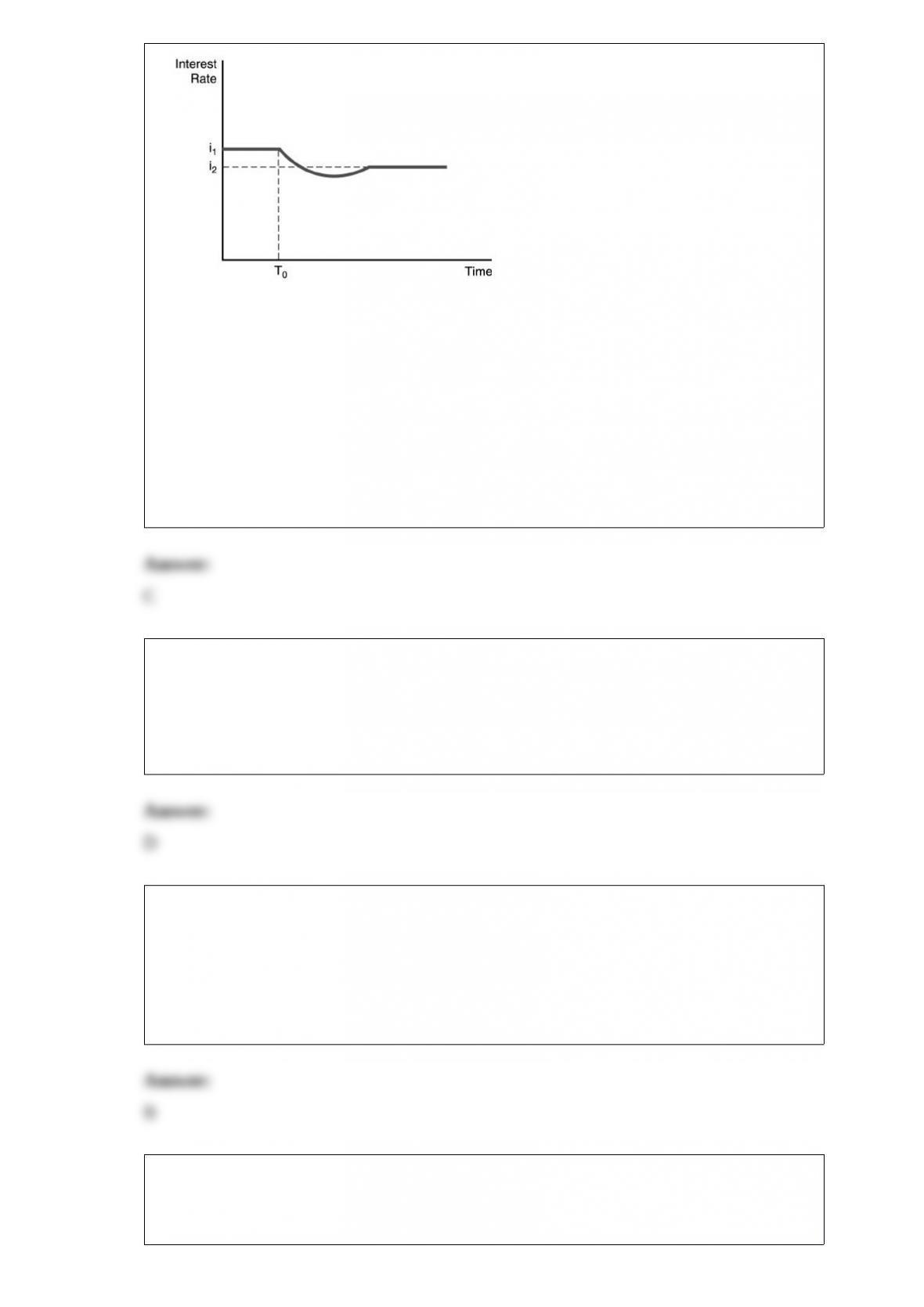
5)
The figure above illustrates the effect of an increased rate of money supply growth at
time period T0. From the figure, one can conclude that the
A) liquidity effect is smaller than the expected inflation effect and interest rates adjust
quickly to changes in expected inflation
B) liquidity effect is larger than the expected inflation effect and interest rates adjust
quickly to changes in expected inflation
C) liquidity effect is larger than the expected inflation effect and interest rates adjust
slowly to changes in expected inflation
D) liquidity effect is smaller than the expected inflation effect and interest rates adjust
slowly to changes in expected inflation
6) Which of the following would not be a way to increase the return on equity?
A) Buy back bank stock
B) Pay higher dividends
C) Acquire new funds by selling negotiable CDs and increase assets with them
D) Sell more bank stock
7) If the price level increases from 200 in year 1 to 220 in year 2, the rate of inflation
from year 1 to year 2 is
A) 20%
B) 10%
C) 11%
D) 120%
8) Under the Bretton Woods system, when a country adopted an expansionary monetary
policy, thereby causing a balance of payments ________, the country would eventually
be forced to implement ________ monetary policy.
A) deficit; expansionary
B) deficit; contractionary
C) surplus; expansionary
D) surplus; contractionary
9) To eliminate the abuses of the state-chartered banks, the ________ created a new
banking system of federally chartered banks, supervised by the ________.
A) National Bank Act of 1863; Office of the Comptroller of the Currency
B) Federal Reserve Act of 1863; Office of the Comptroller of the Currency
C) National Bank Act of 1863; Office of Thrift Supervision
D) Federal Reserve Act of 1863; Office of Thrift Supervision
10) If the required reserve ratio is 10 percent, currency in circulation is $400 billion,
checkable deposits are $800 billion, and excess reserves total $0.8 billion, then the M1
money multiplier is
A) 2.5
B) 1.67
C) 2.0
D) 0.601
11) When the inflation rate is expected to increase, the ________ for bonds falls, while
the ________ curve shifts to the right, everything else held constant.
A) demand; demand
B) demand; supply
C) supply; demand
D) supply; supply
12) If the required reserve ratio is 10 percent, currency in circulation is $400 billion,
checkable deposits are $1000 billion, and excess reserves total $1 billion, then the
monetary base is
A) $400 billion
B) $401 billion
C) $500 billion

D) $501 billion
13) The theory that monetary policy conducted on a discretionary, day-by-day basis
leads to poor long-run outcomes is referred to as the
A) adverse selection problem
B) moral hazard problem
C) time-inconsistency problem
D) nominal-anchor problem
14) The credit derivative that, for a fee, gives the purchaser the right to receive profits
that are tied either to the price of an underlying security or to an interest rate is called a
A) credit option
B) credit swap
C) credit-linked note
D) credit default swap
15) The key factor leading to the financial crises in Mexico and the East Asian countries
was
A) a deterioration in banks’ balance sheets because of increasing loan losses
B) severe fiscal imbalances
C) a sharp increase in the stock market
D) a sharp decline in interest rates
16) The difference between money and income is that
A) money is a flow and income is a stock
B) money is a stock and income is a flow
C) there is no differencemoney and income are both stocks
D) there is no differencemoney and income are both flows

17) If you purchase a $100,000 interest-rate futures contract for 105, and the price of
the Treasury securities on the expiration date is 108, your ________ is ________.
A) profit; $3000
B) loss; $3000
C) profit; $8000
D) loss; $8000
18) Of all commercial banks, about ________ percent belong to the Federal Reserve
System.
A) 17
B) 22
C) 38
D) 52
19) The Dow reached a peak of over 11,000 before the collapse of the ________ bubble
in 2000.
A) housing
B) manufacturing
C) high-tech
D) banking
20) By taking the long position on a futures contract of $100,000 at a price of 115 you
are agreeing to ________ a ________ face value security for ________.
A) sell; $100,000; $115,000
B) sell; $115,000; $100,000
C) buy; $100,000; $115,000
D) buy; $115,000; $100,000
21) Inflation targets can increase the central bank’s flexibility in responding to declines
in aggregate spending. Declines in aggregate ________ that cause the inflation rate to
fall below the floor of the target range will automatically stimulate the central bank to
________ monetary policy without fearing that this action will trigger a rise in inflation
expectations.
A) demand: tighten
B) demand; loosen
C) supply; tighten
D) supply; loosen
22) Everything else held constant, if a factor decreases the demand for ________ goods
relative to ________ goods, the domestic currency will depreciate.
A) foreign; domestic
B) foreign; foreign
C) domestic; domestic
D) domestic; foreign
23) Which bank regulatory agency has the sole regulatory authority over bank holding
companies?
A) The FDIC
B) The Comptroller of the Currency
C) The FHLBS
D) The Federal Reserve System
24) To reduce moral hazard problems, banks include restrictive covenants in loan
contracts. In order for these restrictive covenants to be effective, banks must also
A) monitor and enforce them
B) be willing to rewrite the contract if the borrower cannot comply with the restrictions
C) trust the borrower to do the right thing
D) be prepared to extend the deadline when the borrower needs more time to comply
25) Everything else held constant, an increase in currency holdings will cause
A) the money supply to rise
B) the money supply to remain constant
C) the money supply to fall
D) checkable deposits to rise

26) The higher a security’s price in the secondary market the ________ funds a firm can
raise by selling securities in the ________ market.
A) more; primary
B) more; secondary
C) less; primary
D) less; secondary
27) With a 10% reserve requirement ratio, a $100 deposit into New Bank means that the
maximum amount New Bank could lend is
A) $90
B) $100
C) $10
D) $110
28) Which of the following is a true statement?
A) Money or the money supply is defined as Federal Reserve notes
B) The average price of goods and services in an economy is called the aggregate price
level
C) The inflation rate is measured as the rate of change in the federal government budget
deficit
D) The aggregate price level is measured as the rate of change in the inflation rate