
Which of the following is a macroeconomics question?
A) What determines the unemployment rate?
B) How is the production quantity of digital cameras determined?
C) What factors determine the price of iPhones?
D) What determines the wages and benefits of flight attendants?
________ consumption is consumption that depends upon the level of GDP and
________ consumption is consumption that does not depend upon the level of GDP.
A) Autonomous; induced
B) Induced; autonomous
C) Voluntary; autonomous
D) Autonomous; voluntary
Figure 18-1
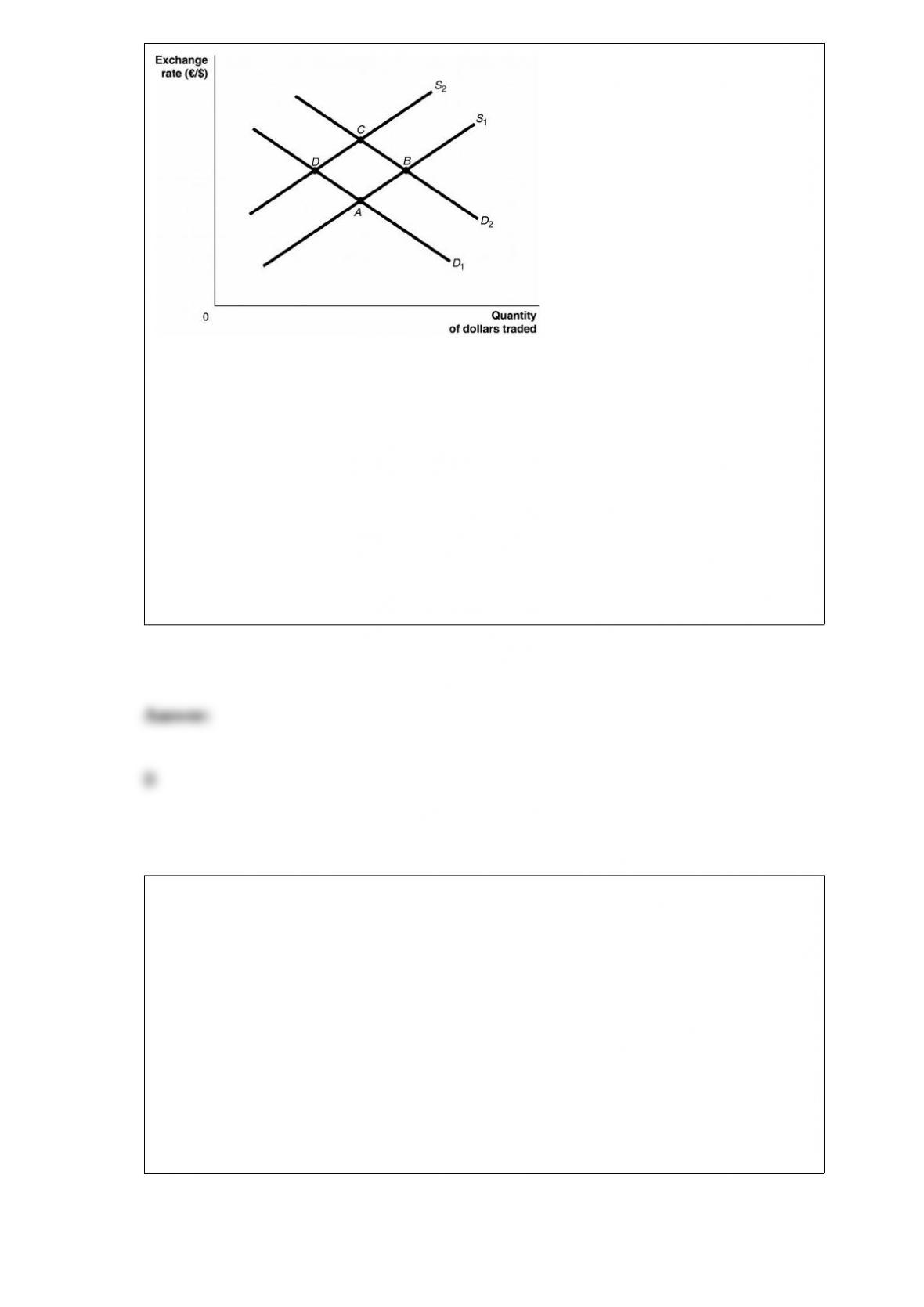
Refer to Figure 18-1. Europe suffers a recession. Assuming all else remains constant,
this would be represented as a movement from
A) D to A.
B) C to D.
C) B to C.
D) A to D.
E) A to B.
The majority of dollars spent by government prior to the Great Depression was
spending at the ________ level. In the post World War II period, two-thirds to three
quarters of all dollars spent by government in the United States are spent at the
________ level.
A) federal; state and local
B) state and local; federal
C) state and local; state
D) local; state
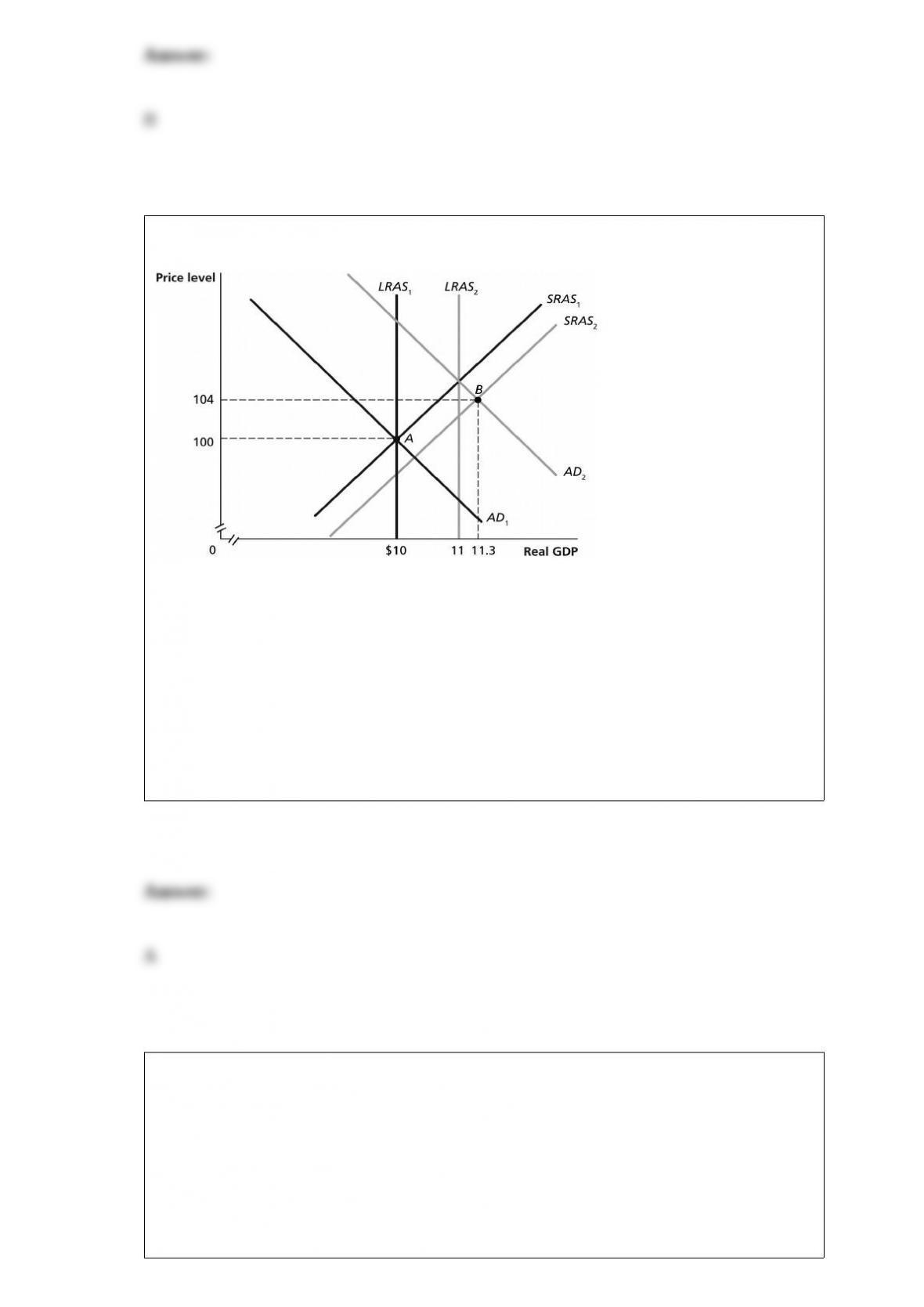
Figure 15-12
Refer to Figure 15-12. In the dynamic AD–AS model, if the economy is at point A in
year 1 and is expected to go to point B in year 2, the Federal Reserve would most likely
A) increase interest rates.
B) decrease interest rates.
C) not change interest rates.
D) increase the inflation rate.
Article Summary
For only the second time in the previous 10 quarters, China’s GDP grew at a faster rate
than from the same period a year earlier. From July through September 2013, China’s
GDP increased 7.8 percent, but a decline in exports, growing inflation, and slowing
growth in factory production all suggest that growth will be slowing down. China has
recently been attempting to restructure its economy by moving toward increasing
consumption and relying less on exports and investments as a means to achieving more

sustainable economic growth. In the first nine months of 2013, 46 percent of growth
was due to consumption, 56 percent was due to investment, and exports accounted for
negative 1.7 percent.
Source: Aileen Wang and Kevin Yao, “China’s third-quarter GDP growth fastest this
year, but outlook dim,” Reuters, October 18, 2013.
Refer to the Article Summary. The decline in export growth will hurt China’s GDP
because
A) a decrease in exports will decrease net exports, assuming no change in imports.
B) a decline in export growth indicates an increase in import growth.
C) exports are added to imports when calculating GDP.
D) exports are subtracted from imports when calculating GDP.
Contractionary monetary policy on the part of the Fed results in
A) an increase in the money supply, an increase in interest rates, and an increase in
GDP.
B) a decrease in the money supply, an increase in interest rates, and a decrease in GDP.
C) an increase in the money supply, a decrease in interest rates, and an increase in GDP.
D) a decrease in the money supply, a decrease in interest rates, and a decrease in GDP.
If the exchange rate between the U.S. dollar and the Indian rupee (rupees per dollar) is
greater than the relative purchasing power between the two countries, which of the

following would be true?
A) There are opportunities for profit by purchasing goods in India and then selling them
in the United States.
B) Purchasing power parity predicts that the value of the dollar will rise as traders take
advantage of arbitrage opportunities.
C) Purchasing power parity predicts that the dollar is undervalued as traders take
advantage of arbitrage opportunities.
D) There are no arbitrage opportunities for which traders can take advantage.
The Fed seeks to promote stability of financial markets because
A) they want to lift the self-esteem of workers.
B) Congress directed them to do so by the Employment Act of 1946.
C) resources are lost when there is not an efficient matching of savers and borrowers.
D) unstable markets result in increased efficiency.
The change in consumption divided by the change in disposable income is equal to
A) the slope of the consumption function.
B) aggregate expenditure.
C) household saving.
D) real GDP.
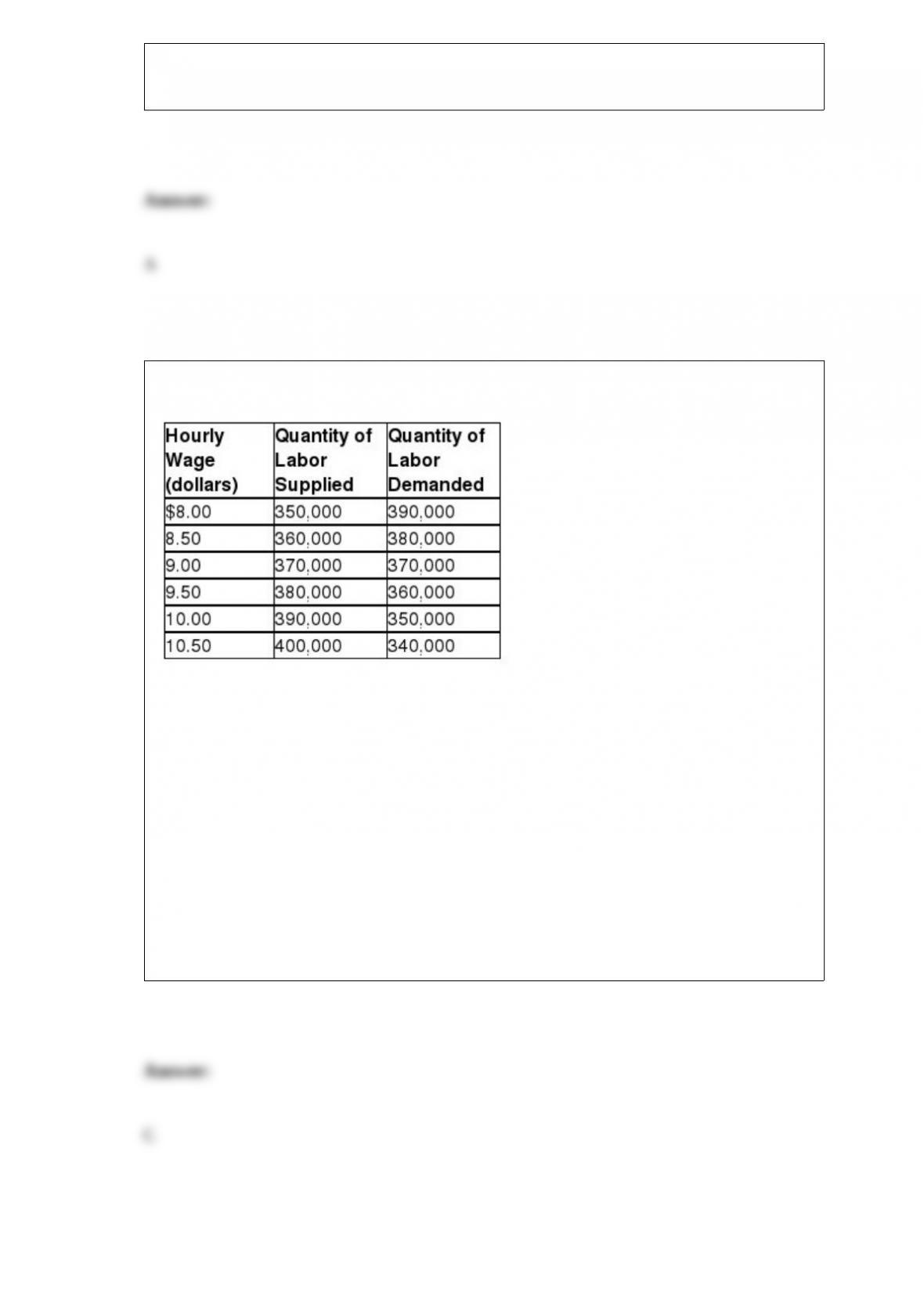
Table 4-4
Table 4-4 shows the demand and supply schedules for the low-skilled labor market in
the city of Westover.
Refer to Table 4-4. If a minimum wage of $10.00 an hour is mandated, what is the
quantity of labor demanded?
A) 390,000
B) 370,000
C) 350,000
D) 40,000