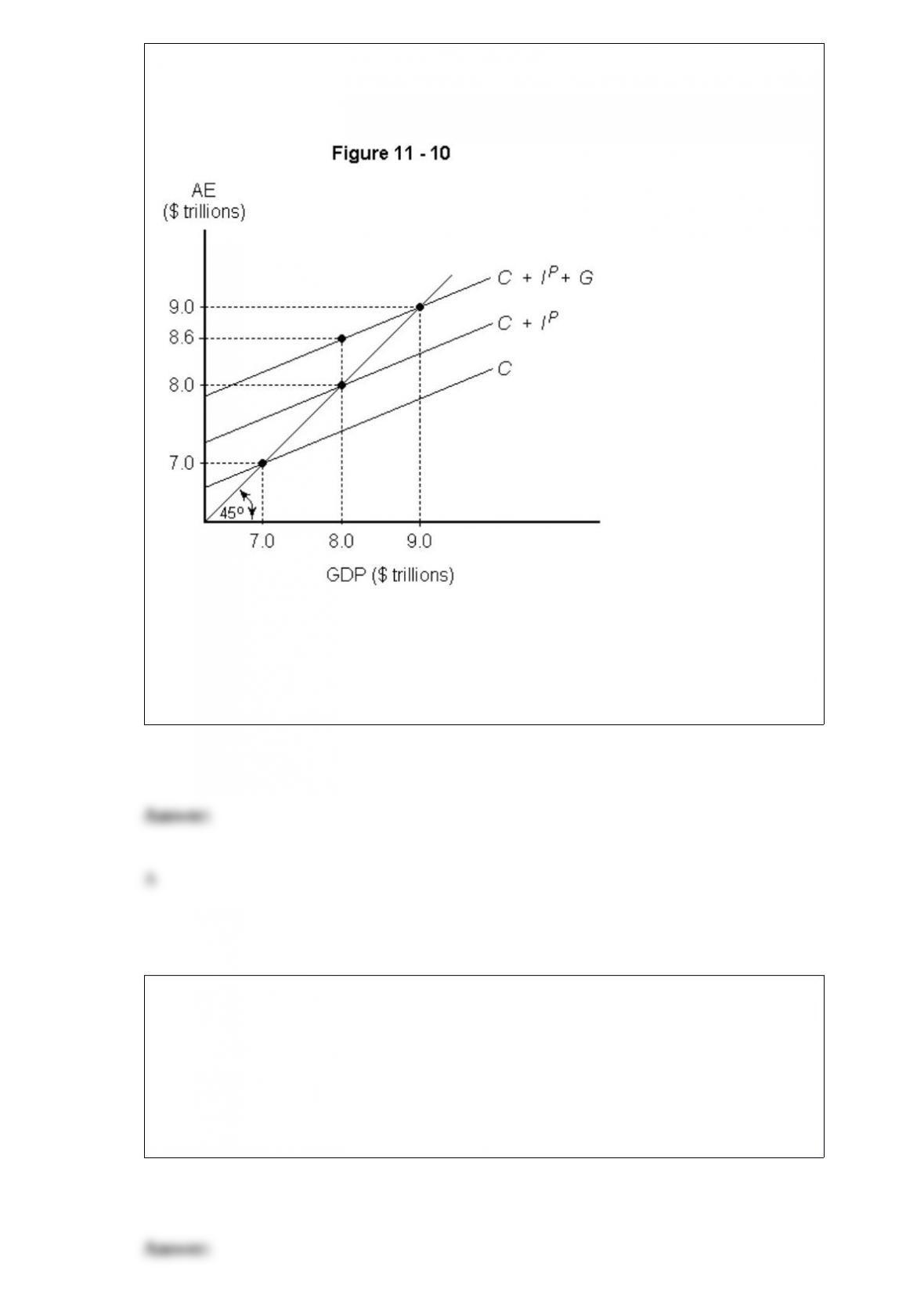
Consider Figure 11-10 above. If the full employment level of output is $9 trillion,
which of the following is true?
a. The economy is currently operating at the full employment level
b. The economy is currently operating below than the full employment level
c. The economy is currently operating above the full employment level
d. The economy is operating neither at equilibrium nor full employment
e. Prices are rising
If inflation is higher than anticipated and benefits are not indexed, which group loses
purchasing power?
a. Borrowers and lenders
b. Lenders and retirees
c. Borrowers and retirees
d. Only borrowers
e. Only lenders
Jackson is considering two different jobs, and is indifferent to both of them although
one pays $20 per hour and the other pays $25 per hour. This must mean that
According to the classical model, an increase in government purchases will
a. lead to a change in the interest rate that encourages consumers to spend more
b. lead to a change in the interest rate that encourages private businesses to invest more
c. discourage private spending by increasing the price level
d. be partially offset by a decline in consumption and investment spending
e. leave total spending and output unchanged
Whenever prices are rising, the inflation rate is rising.
The consumer price index (CPI) excludes all of the following goods and services except
one. Which type of good is included in the CPI?
a. Raw materials
b. Imported goods purchased by consumers
c. Machinery purchased by firms
d. Goods purchased by the government
e. Intermediate goods
Examples of Fed actions that could decrease money supply are making open market
a. purchases, increasing the required reserve ratio, and increasing the discount rate
b. sales, decreasing the required reserve ratio, and increasing the discount rate
c. sales, increasing the required reserve ratio, and decreasing the discount rate
d. sales, increasing the required reserve ratio, and increasing the discount rate
e. purchases, decreasing the required reserve ratio, and decreasing the discount rate
Which of the following are included in GDP?
a. Traffic congestion
b. Crime
c. Pollution
d. Underground economic activity
e. None of the above
In an efficient economy,
For the single-price monopoly, marginal revenue is
If the CPI for 2008 was 112, the typical market basket purchased that year would cost
a. 12 percent more than the same market basket purchased the previous year
b. 112 percent more than the same market basket purchased the previous year
c. 12 percent more than the same market basket purchased in the base year
d. 112 percent more than the same market basket purchased in the base year
e. more than the same market basket purchased during any previous year

The investment demand curve
a. is upward sloping
b. is downward sloping
c. is horizontal
d. begins sloping upward then flattens out
e. begins sloping downward, then flattens out
Which of the following is the best definition of the unemployment rate?
a. a percentage of people who were recently working but laid off or want to work
(willing, able, and searching for work) but without jobs.
b. a percentage of people discouraged with the labor market and without work
c. a percentage of people not working
d. a percentage of people that do not need to work
e. a percentage of people willing and able to work
Which of the following units is used to measure nominal GDP in the United States?
a. U.S. dollars
b. gold
c. percentages
d. international monetary units
e. units of physical goods and services
Which of the following would be most likely to increase the quantity of money
demanded?
a. A decrease in real income
b. An increase in real income
c. A decrease in the interest rate
d. An increase in the cost of converting other assets into money
e. An increase in the price level
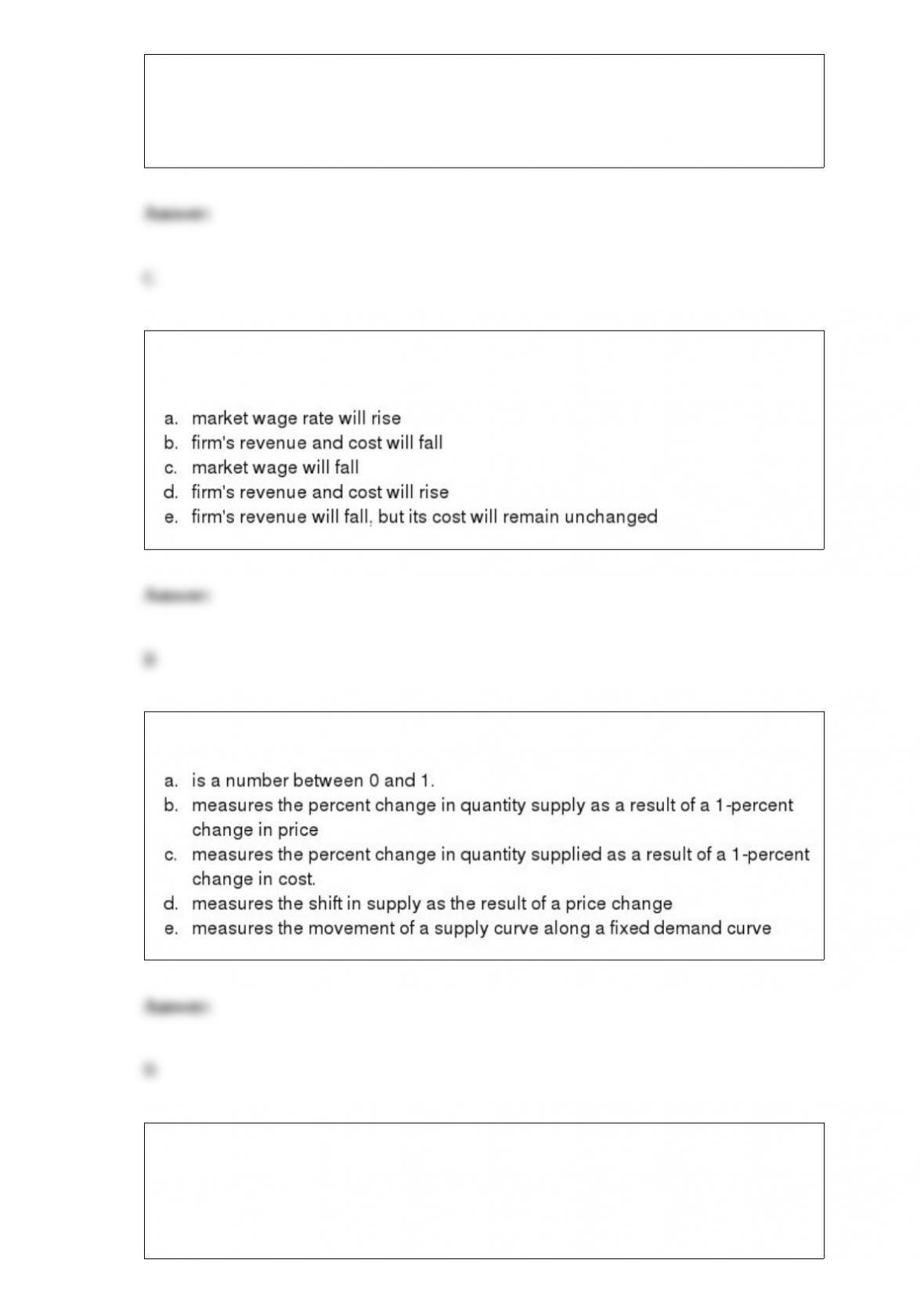
In a perfectly competitive labor market, if any one firm decreases the amount of labor it
employs, the most likely result will be that the
The price elasticity of supply
One way to describe the tax multiplier is that it equals the
a. the spending multiplier
b. the negative of the spending multiplier minus1.0
c. the GNP gap minus the GDP gap
d. the reciprocal of the marginal propensity to consume
e. the best estimate of the optimal tax rate
A pure private good has two characteristics: rivalry and excludability. Rivalry suggests
that a private market, rather than the public sector, should produce the good, and
excludability suggests a private market will provide it.