
If 1 percent inflation rather than zero percent inflation is expected by both the suppliers
and demanders of loanable funds, then the nominal interest rate will
a. fall, ceteris paribus.
b. remain constant.
c. rise.
d. rise, ceteris paribus.
The fundamental reason why most supply curves are upward sloping is that
a. consumers substitute lower-priced goods for higher-priced goods.
b. the quantity supplied increases as more firms enter the market.
c. a higher price never reduces quantity supplied by enough to lower total revenue and
so higher production is motivated.
d. higher production raises the opportunity costs of production and so price must rise to
induce more output.
Refer to Exhibit 2-7. Which of the following statements is true?
Exhibit 2-7
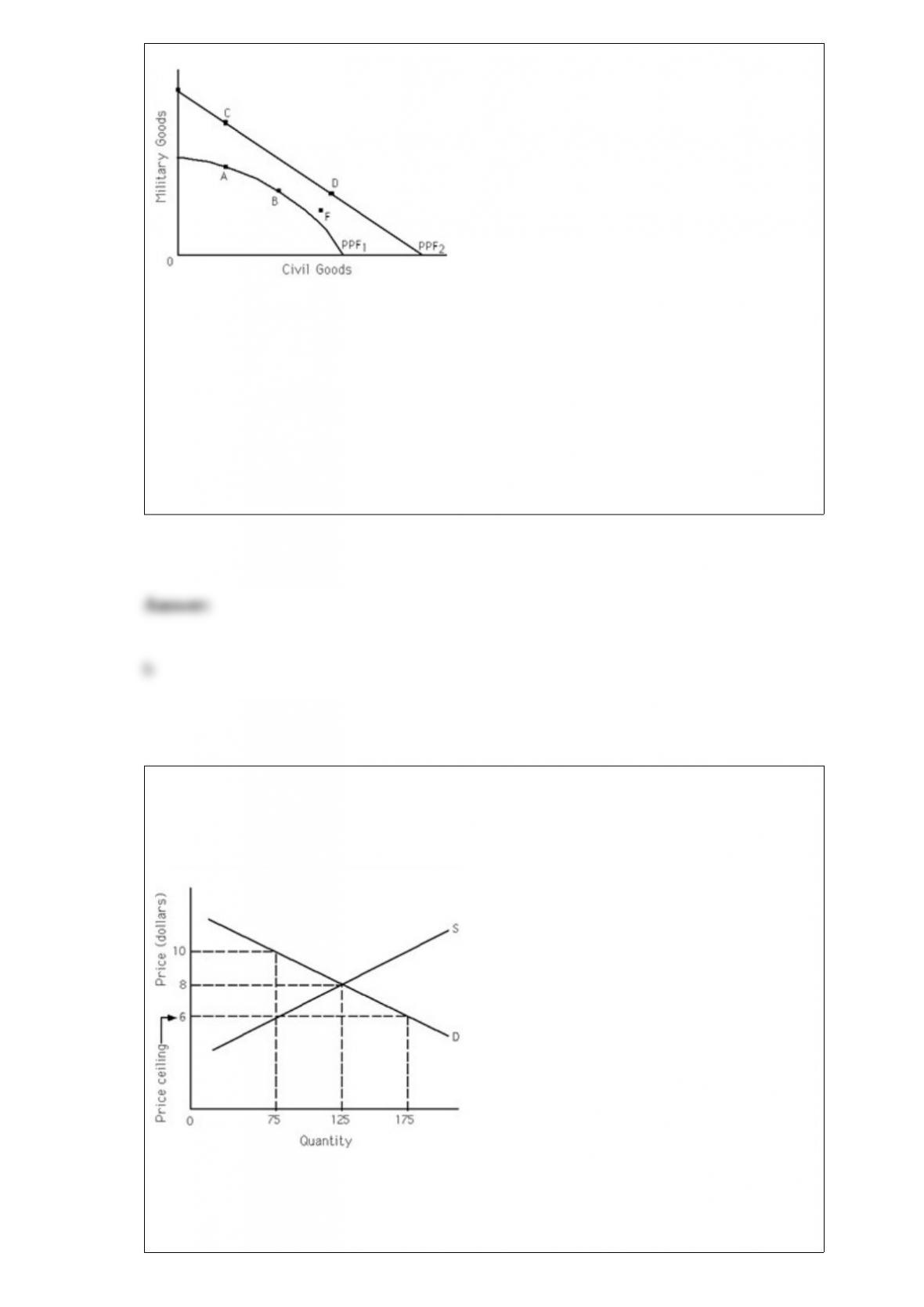
a. Points B and D are more efficient than points
A and C.
b. If the economy’s PPF is represented by PPF1, points A and B are productive efficient,
while C and D are unattainable.
c. If the economy’s PPF is represented by PPF2, points C and D are productive efficient,
while A and B are unattainable.
d. both a and c
Refer to Exhibit 4-1. Some buyers will offer sellers $7 per unit instead of the $6 price
ceiling because
Exhibit 4-1
a. $7 is closer to the equilibrium price and buyers prefer equilibrium prices to all others.
b. they think it is only fair for sellers to receive higher prices.

c. they want to increase their chances of buying a good for which there is a shortage.
d. it is customary to pay more than the price ceiling.
Suppose that all countries in the world agree that it is important to undertake policies to
reduce global warming and its associated negative economic effects.If the countries
agree to undertake these policies, the prisoner’s dilemma setting that this situation
places the countries in would lead one to conclude that
a. each country will have an incentive not to implement the agreed upon policies.
b. smaller countries will implement the agreed upon policies, but larger countries will
not.
c. each country will have an incentive to implement the agreed upon policies.
d. larger countries will implement the agreed upon policies, but smaller countries will
not.
Individuals want nonexcludable public good X, but the market does not provide it
because of the free rider problem.Government overcomes the free rider problem by
______________ individuals and then either producing good X itself or paying
someone to produce it.
a. forcing individuals to work longer hours
b. taxing
c. surveying
d. subsidizing
e. none of the above
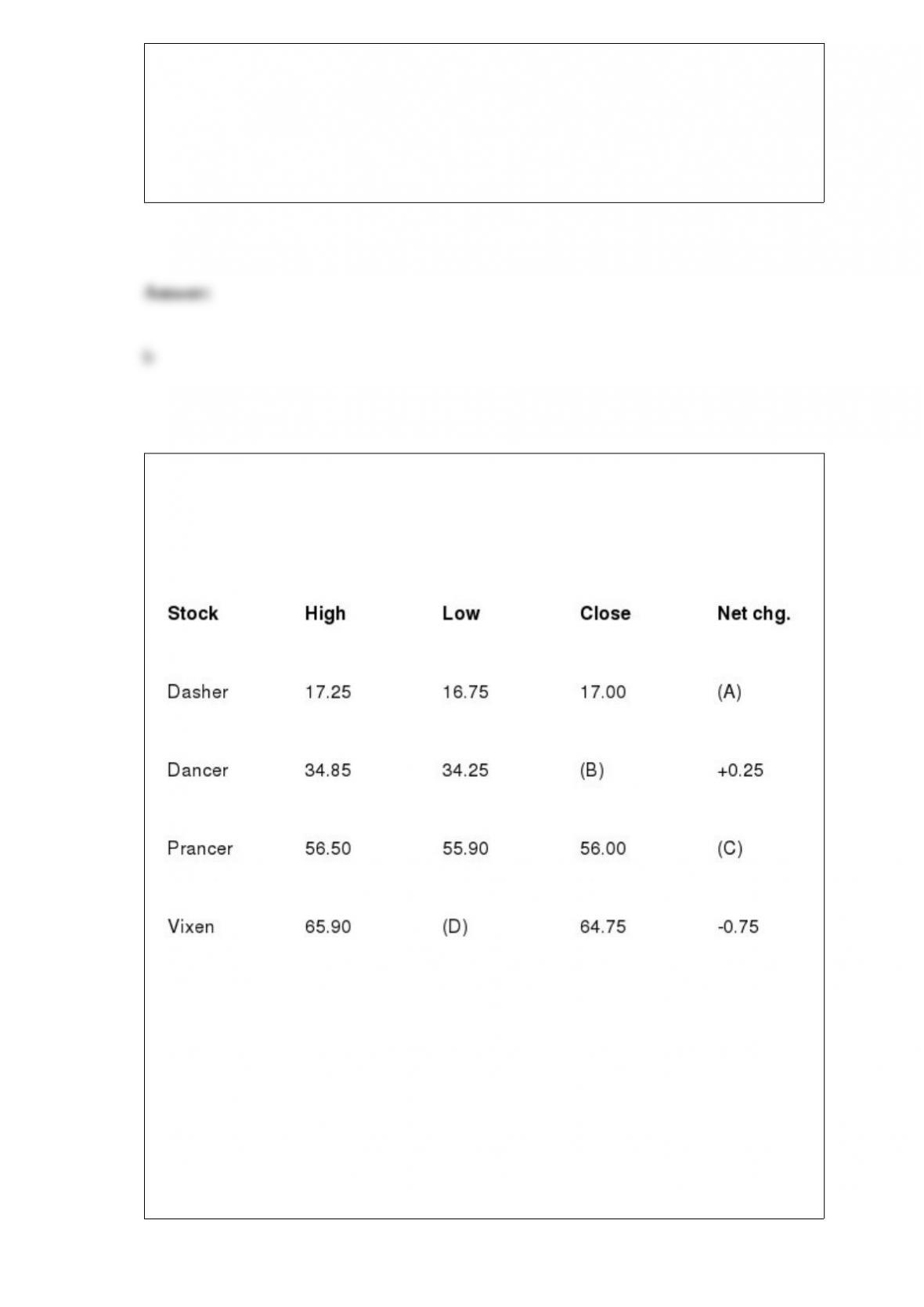
Refer to Exhibit 38-2.If the closing price of Vixen’s stock on the previous day was
$65.50, what value goes in blank (D)?
Exhibit 38-2
a. 64.00
b. 65.15
c. 65.75
d. 65.00
e. There is not enough information given to answer this question.

The law of diminishing marginal utility helps to explain
a. why people trade.
b. the law of demand.
c. why the production possibilities frontier is typically bowed-out.
d. a and b
e. all of the above
The excess capacity theorem holds for a (n) __________, and states that in the long run
the firm produces an output __________.
a. perfectly competitive firm; that is resource-allocative efficient
b. monopoly firm; that is not resource-allocative efficient
c. monopolistic competitor; smaller than the one that would minimize its costs of
production
d. oligopoly firm; larger than the one that would minimize its costs of production
e. none of the above

A perfectly competitive firm will maximize its profits by hiring factors up to the point
at which
a. MRP > MFC.
b. VMP > MFC.
c. MRP = MFC.
d. VMP = MFC.
e. c and d
The supply of loanable funds depends most directly on
a. investment expenditures.
b. people’s saving and newly created money.
c. bond and stock activity.
d. the profits of firms.

For economists, framing refers to the
a. manner in which a problem is presented.
b. degree of competition present in a given market.
c. total satisfaction a consumer derives from consuming a good.
d. level of total utility derived from consuming a good.
e. c and d
When a person buys a bond of the XYZ Corporation, he or she can expect to
a. pay the corporation a certain amount of money each quarter of the year.
b. receive the face value of the bond each year and the face value of the bond when the
bond matures.
c. receive the coupon rate times the face value of the bond each year and the face value
of the bond when the bond matures.
d. receive the face value of the bond each year in perpetuity.
For a perfectly competitive firm,

a. price equals marginal revenue only for the first unit of the good produced and sold.
b. only at a lower price can more units of a good be sold.
c. demand is perfectly inelastic.
d. a and b
e. none of the above
Refer to Exhibit 3-13.Each individual consumer’s demand curve is ________________
sloping and the market demand curve is _________________ sloping.
—————————–Quantity Demanded————————————-
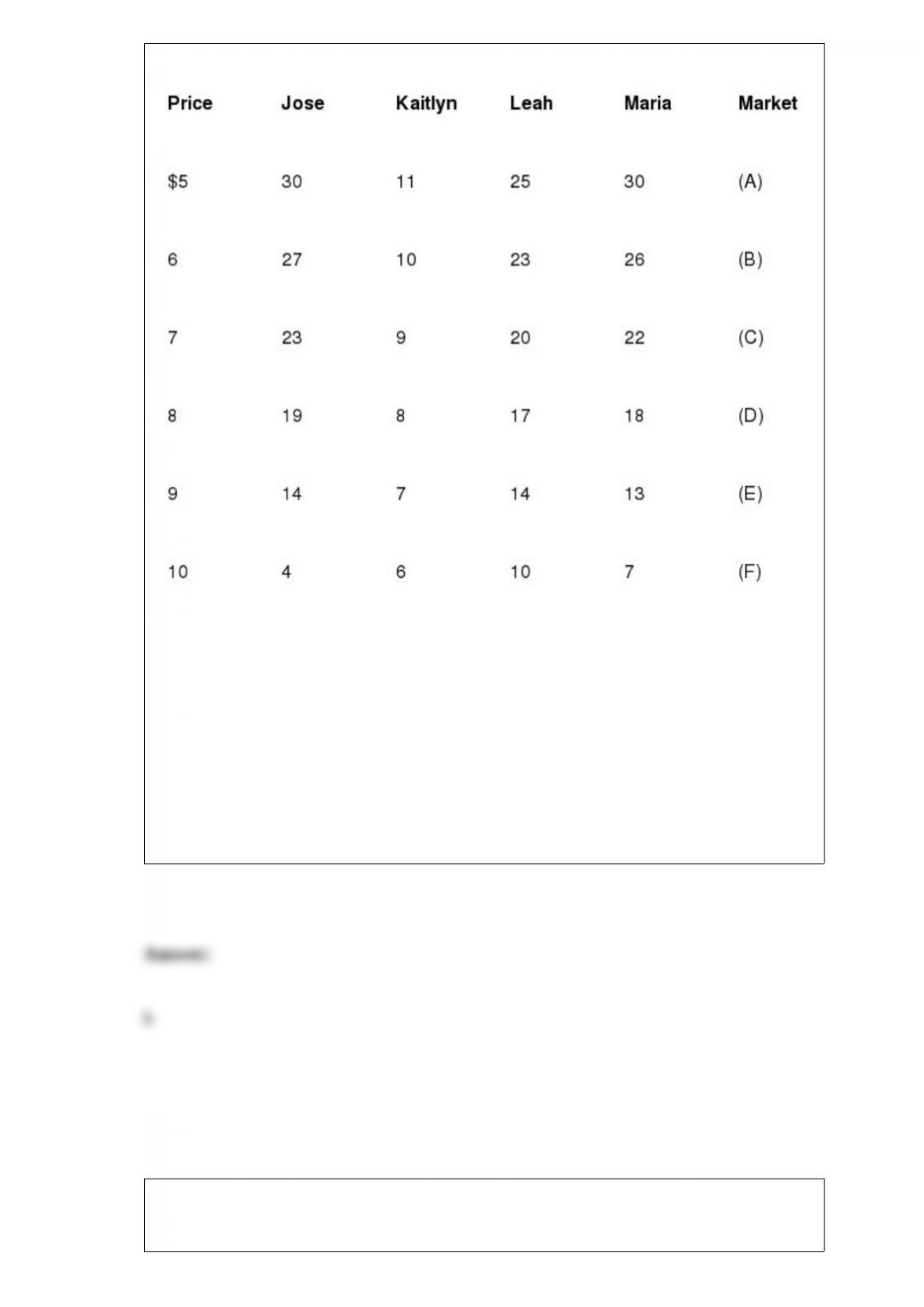
Assume that Jose, Kaitlyn, Leah, and Maria are the only buyers in this market.
a. upward; also upward
b. downward; also downward
c. upward; downward
d. downward; upward
Refer to Exhibit 24-2. The profit-maximizing monopolist produces Q0 units and charges
a price of

Exhibit 24-2
a. P0.
b. P1.
c. P3.
d. P2.
e. none of the above
The lower the elasticity of demand for a product,
a. the higher the ratio of labor costs to total costs.
b. the lower the ratio of labor costs to total costs.
c. the lower the elasticity of demand for the labor that produces the product.
d. the higher the elasticity of demand for the labor that produces the product.
e. none of the above