1) The effectiveness of the built-in or automatic stabilizers is limited because:
A.the stabilizers produce budget surpluses during recessions.
B.transfer payments and subsidies increase during inflation and decrease during
recessions.
C.the offset the stabilizers provide to a change in private spending is less than the
change in private spending.
D.the stabilizers raise the general price level regardless of the phase of the business
cycle.
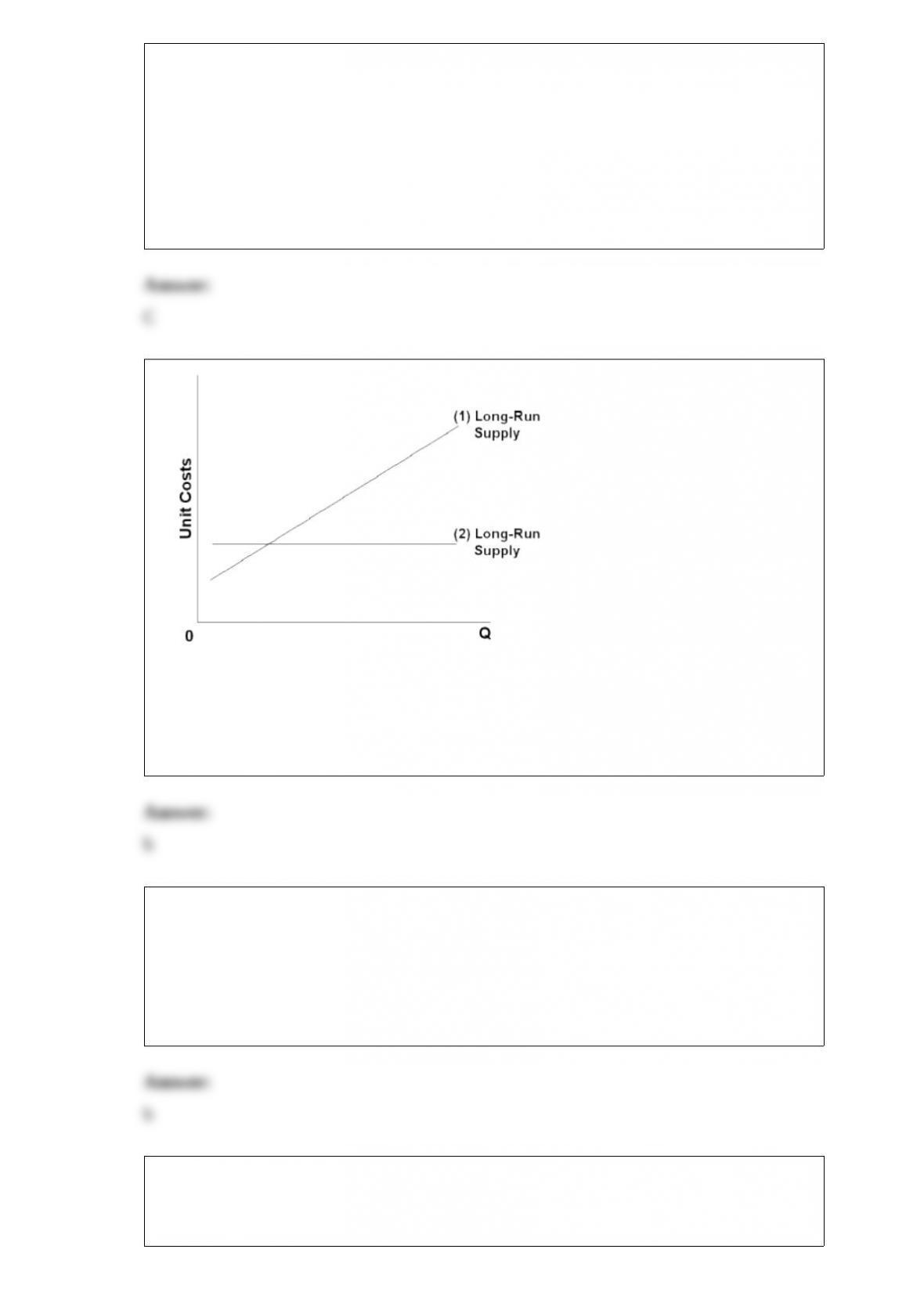
2)
refer to the above diagram. line (1) reflects a situation where resource prices:
a.decline as industry output expands.
b.increase as industry output expands.
c.remain constant as industry output expands.
d.are unaffected by the level of output in the industry.
3) a pure monopolist is selling 6 units at a price of $12. if the marginal revenue of the
seventh unit is $5, then:
a.price of the seventh unit is $10.
b.price of the seventh unit is $11.
c.price of the seventh unit is greater than $12.
d.firm’s demand curve is perfectly elastic.
4) As applied to agriculture, the special-interest effect suggests that:
A.urban legislators support farm legislation in exchange for rural legislators supporting
urban-oriented legislation.

B.a relatively small number of farmers receive large benefits at the expense of a much
larger group of taxpayers who individually suffer small losses.
C.politicians support farm subsidies because most of the associated costs are hidden
rather than explicit.
D.the size of farm subsidies should vary directly with a farmer’s earned income.
5) if a purely competitive constant-cost industry is realizing economic profits, we can
expect industry supply to:
a.increase, output to increase, price to decrease, and profits to decrease.
b.increase, output to increase, price to increase, and profits to decrease.
c.decrease, output to decrease, price to increase, and profits to increase.
d.increase, output to decrease, price to decrease, and profits to decrease.
6) Banks and thrifts have responded to their relative declines by:
A.expanding their services and merging with one another.
B.merging with computer and software manufacturers.
C.selling their ATMs to new startup firms.
D.asking for trade protection against imported of financial services.
7) Which of the following is a noncash transfer?
A.a payment to a divorced mother under TANF
B.food stamps
C.a social security payment to a retiree
D.unemployment compensation benefits
8) ben says that “an increase in the tax on beer will raise its price.” holly argues that
“taxes should be increased on beer because college students drink too much.” we can
conclude that:
a.ben’s statement is normative, but holly’s is positive.
b.holly’s statement is normative, but ben’s is positive.
c.both statements are normative.
d.both statements are positive.
9) an efficiency loss (or deadweight loss) declines in size when a unit of output is
produced for which:
a.marginal cost exceeds marginal benefit.
b.maximum willingness to pay exceeds minimum acceptable price.
c.consumer surplus exceeds producer surplus.
d.producer surplus exceeds consumer surplus.
10) Which of the following statements is consistent with evidence?
A.It is widely accepted that central planning will accelerate a DVCs growth rate.
B.It is generally agreed that a laissez-faire policy for government will maximize
economic growth.
C.The effectiveness of government policies in enhancing growth has varied from
country to country.
D.Government intervention in DVC economies has universally hampered economic
growth.
11) the natural rate of unemployment is the:
a.unemployment rate experienced at the depth of a depression.
b.full-employment unemployment rate.
c.unemployment rate experienced by the least-skilled workers in the economy.
d.unemployment rate experienced by the most-skilled workers in the economy.
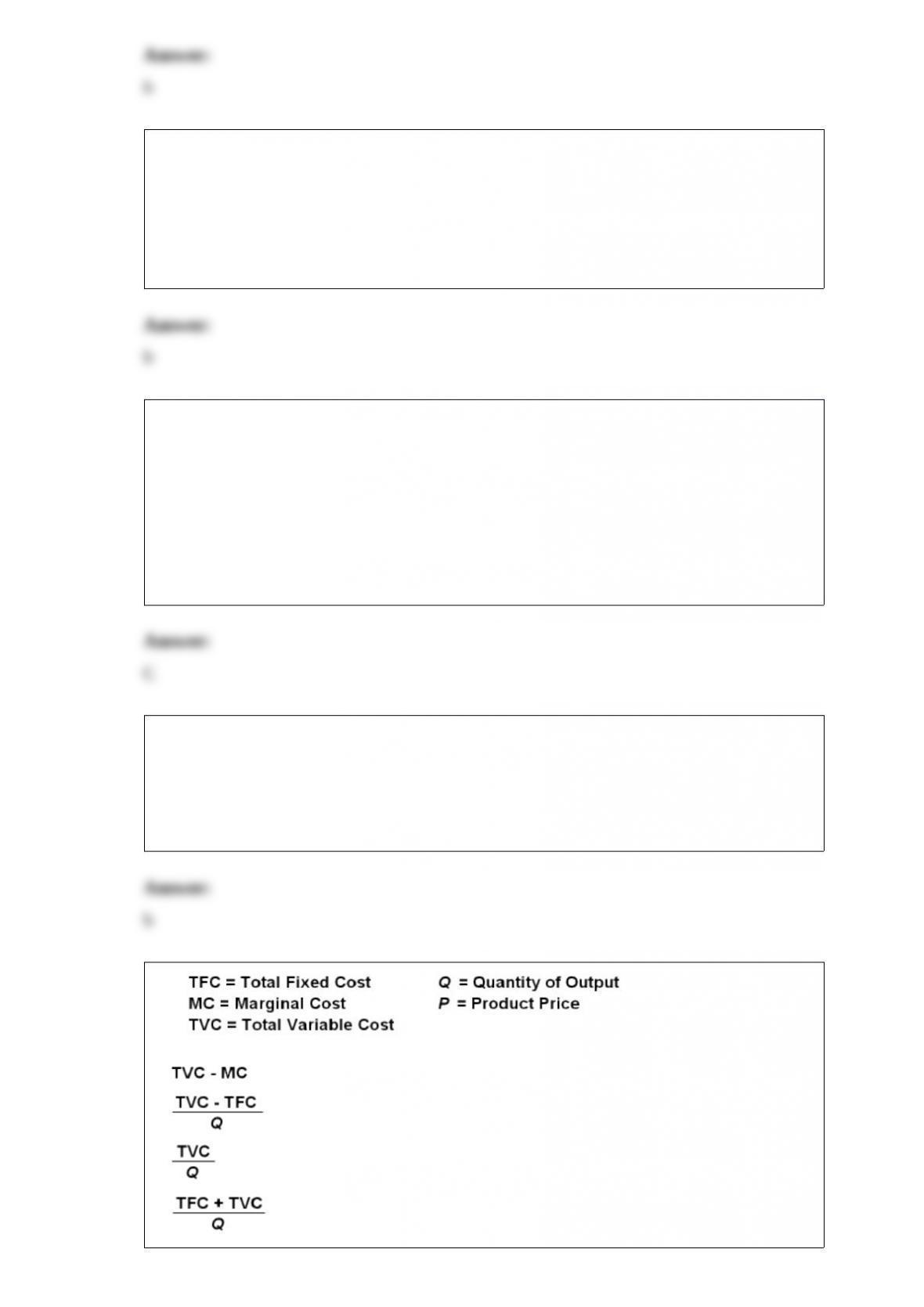
12)
refer to the above information. average total cost is:
a.
b.
c.
d.

13) illegal immigration positively contributes to the u.s. standard of living by reducing:
a.the fiscal burdens of state and local governments.
b.the average wages of domestic-born workers.
c.crime rates.
d.prices of goods and services produced with illegal immigrant labor.