1) One of the consequences of the U.S. trade deficit is that:
A.domestic inflation has resulted.
B.the accumulation of American dollars in foreign hands has enabled foreign firms to
build factories in America.
C.the distribution of income in the United States has become less unequal.
D.the system of flexible exchange rates has been abandoned in favor of a new gold
standard.
2) A coordination failure:
A.is a real-business-cycle event.
B.is a self-fulfilling prophesy.
C.results from the spending-income multiplier.
D.is a direct outcome of inappropriate fiscal policy.
3) In fisheries management, ITQ stands for:
A.International Transferable Quota.
B.Individual Transferable Quota.
C.International Tuna Quotas.
D.Individual Trolling Quotas.
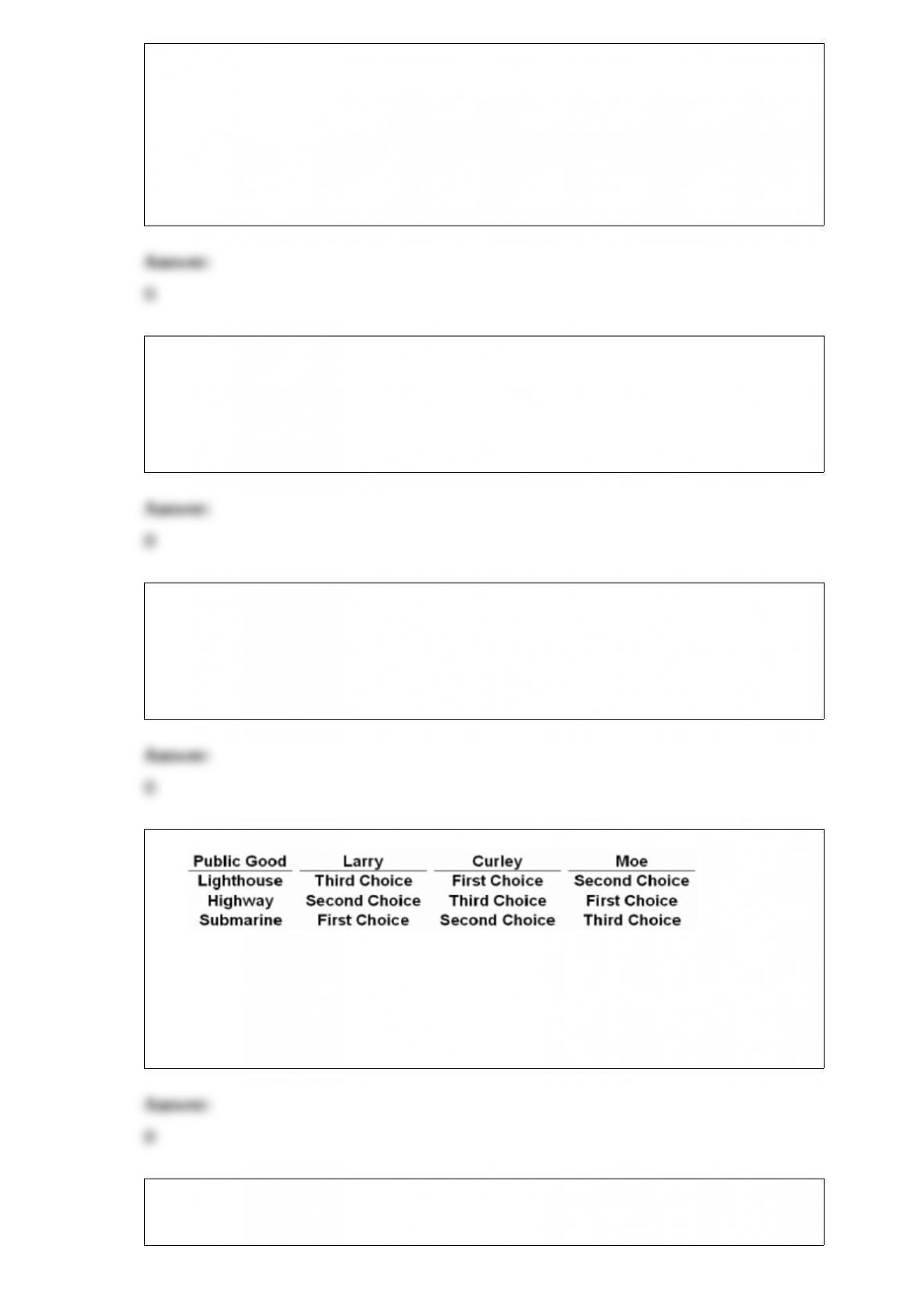
4)
Refer to the above table. In a choice between the highway and the lighthouse:
A.a majority of voters favor the lighthouse.
B.a majority of voters favor the highway.
C.the voters are indifferent as between the two.
D.no voter decision is possible.
5) A protective tariff will:
A.increase the sales of foreign exporters.

B.increase the price and sales of domestic producers.
C.increase the welfare of domestic consumers.
D.create an efficiency gain in the domestic economy.
6) The primary function of the International Finance Corporation (IFC) is to:
A.provide U.S. surplus food to low-income countries.
B.provide short-term loans to poor countries to finance international trade deficits.
C.make infrastructure loans, that is, loans for highways, schools, communication
facilities, and so forth.
D.make loans to private enterprises in the DVCs.
7) A monopsonist pays a wage rate that is:
A.less than the MRP of labor.
B.equal to the firm’s marginal resource (labor) cost.
C.equal to the MRP of labor.
D.greater than the MRP of labor.
8) The Federal funds rate is the interest rate that _______ charge(s) _______.
A.banks; other banks.
B.the Fed; commercial banks.
C.banks; their best corporate customers.
D.banks; on federal student loans.
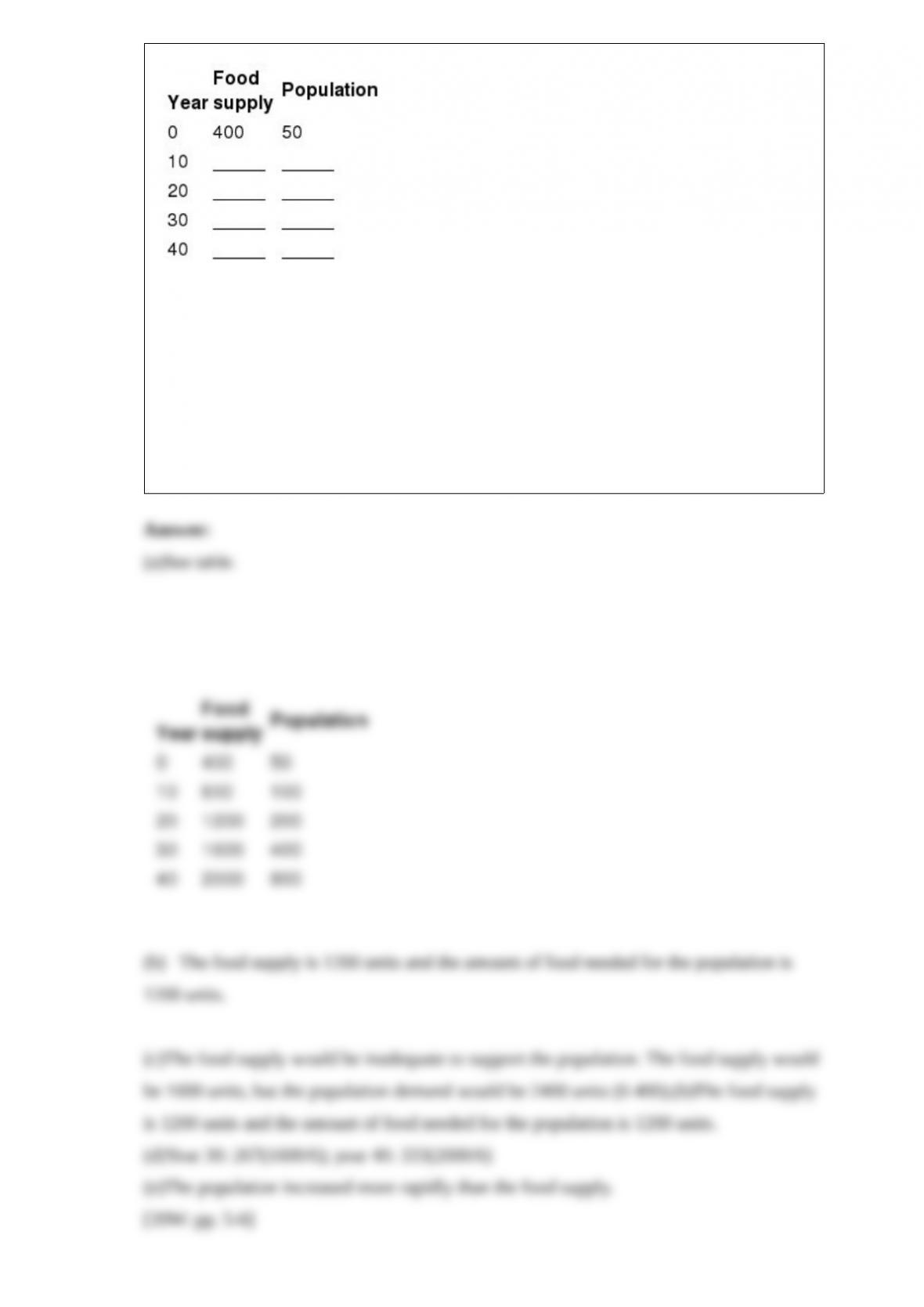
9) Suppose that it takes a minimum of 6 units of food to keep a person alive for a year,
that the population can double every 10 years, and that the food supply can increase
every 10 years by an amount equal to what it was in the beginning (year 0).
(a)Assume that both the population and the food supply grow at these rates. Complete
the following table by computing the size of the population and the food supply in years
10 through 40.
(b)What is the relationship between the food supply and the population in the 20th
year?
(c)What would actually prevent the population from growing at this rate following the
20th year?
(d)Assuming that the actual population growth in the years following the 20th year does
not outrun the food supply, what would be the size of the population in year 30 and year
40?
(e)Why did the standard of living fail to increase in the years following the 20th even
though the food supply increased between years 20 and 40?

10) if a purely competitive firm is producing at the mr = mc output level and earning an
economic profit, then:
a.the selling price for this firm is above the market equilibrium price.
b.new firms will enter this market.
c.some existing firms in this market will leave.
d.there must be price fixing by the industry’s firms.
11) the sherman act of 1890 is an example of:
a.transfer payments.
b.government attempting to redistribute income.
c.government attempting to maintain competition.
d.government providing public goods.