1) Everything else held constant, in the market for reserves, decreases in the interest
rate paid on excess reserves affect the federal funds rate
A) when the funds rate is below the interest rate paid on excess reserves
B) when the funds rate equals the interest rate paid on excess reserves
C) when the funds rate is below the discount rate
D) when the funds rate equals the discount rate
2) Money is defined as
A) bills of exchange
B) anything that is generally accepted in payment for goods and services or in the
repayment of debt
C) a risk-free repository of spending power
D) the unrecognized liability of governments
3) Prior to 2008, bank managers looked on reserve requirements
A) as a tax on deposits
B) as a subsidy on deposits
C) as a subsidy on loans
D) as a tax on loans
4) Which of the following instruments are traded in a capital market?
A) U.S. Government agency securities
B) Negotiable bank CDs
C) Repurchase agreements
D) U.S. Treasury bills
5) Under the Bretton Woods system, the IMF could encourage deficit countries to
pursue contractionary monetary policies that would ________ their currency or
eliminate their balance of payment ________.
A) strengthen; surpluses
B) strengthen; deficits
C) weaken; surpluses
D) weaken; deficits
6) One reason for the extraordinary growth of foreign financial markets is
A) decreased trade
B) increases in the pool of savings in foreign countries
C) the recent introduction of the foreign bond
D) slower technological innovation in foreign markets
7) The quantity theory of money is a theory of how
A) the money supply is determined
B) interest rates are determined
C) the nominal value of aggregate income is determined
D) the real value of aggregate income is determined
8) All of the following are common to banking crises in different countries except
A) financial liberalization or innovation
B) weak bank regulatory systems
C) a government safety net
D) a dual banking system
9) The ability to use one resource to provide different products and services is
A) economies of scale
B) economies of scope
C) diversification
D) vertical integration
10) Which of the following is most likely to lead to inflationary monetary policy?
A) Declining oil prices
B) Resolution of conflict in the Middle East
C) The enactment of a free-trade agreement with Mexico
D) Rising unemployment
11) A bank is insolvent when
A) its liabilities exceed its assets
B) its assets exceed its liabilities
C) its capital exceeds its liabilities
D) its assets increase in value
12) Property that is pledged to the lender in the event that a borrower cannot make his
or her debt payment is called
A) collateral
B) points
C) interest
D) good faith money
13) In the 1990s Japan had the lowest interest rates in the world due to a combination of
A) inflation and recession
B) deflation and expansion
C) inflation and expansion
D) deflation and recession
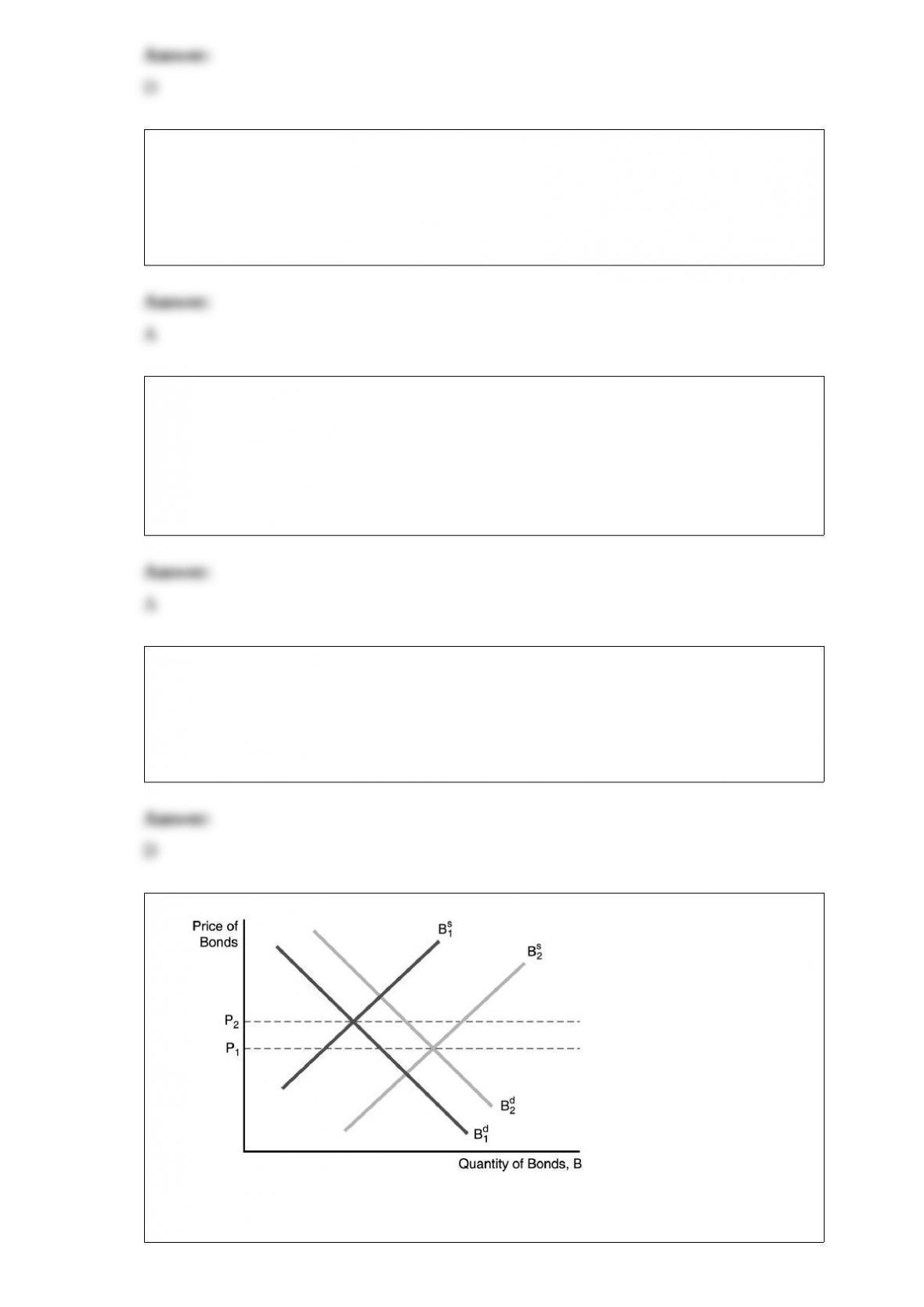
14) In the figure above, the price
of bonds would fall from P2 to P1 if
A) there is a business cycle recession

B) there is a business cycle expansion
C) inflation is expected to increase in the future
D) inflation is expected to decrease in the future
15) Everything else held constant, a weaker dollar will likely hurt
A) textile exporters in South Carolina
B) wheat farmers in Montana that sell domestically
C) automobile manufacturers in Michigan that use domestically produced inputs
D) furniture importers in California
16) The time and money spent in carrying out financial transactions are called
A) economies of scale
B) financial intermediation
C) liquidity services
D) transaction costs
17) Moral hazard in equity contracts is known as the ________ problem because the
manager of the firm has fewer incentives to maximize profits than the stockholders
might ideally prefer.
A) principal-agent
B) adverse selection
C) free-rider
D) debt deflation
18) The condition that states that the domestic interest rate equals the foreign interest
rate minus the expected appreciation of the domestic currency is called
A) the purchasing power parity condition
B) the interest parity condition
C) money neutrality
D) the theory of foreign capital mobility
19) The European System of Central Banks signals the stance of its monetary policy by
setting a target for the
A) federal funds rate
B) overnight cash rate
C) lombard rate
D) reserve rate
20) If investors expect interest rates to fall significantly in the future, the yield curve
will be inverted. This means that the yield curve has a ________ slope.
A) steep upward
B) slight upward
C) flat
D) downward
21) Disintermediation resulted from
A) interest rate ceilings combined with inflation-driven increases in interest rates
B) elimination of Regulation Q (the regulation imposing interest rate ceilings on bank
deposits)
C) increases in federal income taxes
D) reserve requirements
22) The discount rate is
A) the interest rate the Fed charges on loans to banks
B) the price the Fed pays for government securities
C) the interest rate that banks charge their most preferred customers
D) the price banks pay the Fed for government securities
23) Factors that decrease the demand for bonds include
A) an increase in the volatility of stock prices
B) a decrease in the expected returns on stocks

C) a decrease in the inflation rate
D) a decrease in the riskiness of stocks
24) Which of the following is not a nontransaction deposit?
A) Savings accounts
B) Small-denomination time deposits
C) Negotiable order of withdrawal accounts
D) Certificate of deposit
25) The term structure of interest rates is
A) the relationship among interest rates of different bonds with the same maturity
B) the structure of how interest rates move over time
C) the relationship among the term to maturity of different bonds
D) the relationship among interest rates on bonds with different maturities
26) If nominal GDP is $8 trillion, and the money supply is $2 trillion, velocity is
A) 0.25
B) 4
C) 8
D) 16
27) The high growth rate in China in the last twenty years has similarities to the high
growth rate of ________ during the 1950s and 1960s.
A) the United States
B) the Soviet Union
C) Brazil
D) Mexico
28) Why did the interest rate volatility of the 1970s spur financial innovation?
29) Why are most of the U.S. dollars held outside of the United States?
30) Discuss three ways in which U.S. banks can become involved in international
banking.
31) Explain the principal-agent problem as it pertains to equity contracts.
32) Explain the time-inconsistency problem. What is the likely outcome of
discretionary policy? What are the solutions to the time-inconsistency problem?
33) Explain dynamic and defensive open market operations. What is the purpose of
each type? Describe two situations when defensive open market operations are used.
How are defensive open market operations typically conducted?
34) How does collateral help to reduce the adverse selection problem in credit market?
35) Explain the law of one price and the theory of purchasing power parity. Why doesn’t
purchasing power parity explain all exchange rate movements? What factors determine
long-run exchange rates?
36) Describe the two methods of organizing a secondary market.
37) What two key factors trigger speculative attacks leading to currency cries in
emerging market countries?