
1) Movie producers A, B, and C secretly meet and agree to release their summer
blockbuster films in sequence, rather than at the same time. The U.S. Justice
Department learns of the agreement and files an antitrust suit. The Federal government
would most likely file charges under the:
A.Sherman Act, Section 1
B.Sherman Act, Section 2
C.Clayton Act
D.Federal Trade Commission Act
2) Which of the following is a correct statement of the impacts of a lump-sum tax?
A.Disposable income will increase by the amount of the tax and consumption at each
level of GDP will decline by the amount of the tax multiplied by the MPC.
B.Disposable income will decline by the amount of the tax and consumption at each
level of GDP will decline by the amount of the tax multiplied by the multiplier.
C.Disposable income will decline by the amount of the tax and consumption at each
level of GDP will also decline by the amount of the tax.
D.Disposable income will decline by the amount of the tax and consumption at each
level of GDP will decline by the amount of the tax multiplied by the MPC.
3) If an industrial union is formed to bargain with a monopsonistic employer, then in
this labor market:
A.the resulting wage rate will necessarily be above the competitive level.
B.employment may either increase or decrease.
C.employment will increase.
D.employment will decrease.
4) large minimum efficient scale of plant combined with limited market demand may
lead to:
a.natural monopoly.
b.patent monopoly.
c.government franchise monopoly.
d.shared monopoly.

5) In a fractional reserve banking system:
A.bank panics cannot occur.
B.the monetary system must be backed by gold.
C.banks can create money through the lending process.
D.the Federal Reserve has no control over the amount of money in circulation.
6) (Advanced analysis) Assume that the MPS is .33 in an economy that has an
aggregate supply curve with a slope of 1. An increase in investment spending of $10
billion will shift the aggregate demand curve rightward by:
A.$30 billion and increase real GDP by $15 billion.
B.$30 billion and increase real GDP by $30 billion.
C.$10 billion and increase real GDP by $30 billion.
D.$10 billion and increase real GDP by $10 billion.
7) the most important source of federal tax revenue is:
a.sales taxes.
b.personal income taxes.
c.corporate income taxes.
d.payroll taxes.
8) Assuming pure competition, which of the following are equivalents?
A.MRPL/PL = MRPC/PC and Px = 1/MC
B.MRPL/PL = MRPC/PC and Px = AVC
C.Px = MC and MRPL/PL = MRPC/PC = 1
D.Px = MC and MPL/PL = MPC/PC
9) in the united states, the rate of unemployment is highest for:
a.white teenagers.
b.african-american teenagers.
c.married women.
d.unmarried women.
10) Assume that Switzerland and Britain have floating exchange rates. Other things
unchanged, if a tight money policy raises interest rates in Britain as compared to
Switzerland:
A.gold bullion will flow into Switzerland.
B.the Swiss franc will depreciate.
C.the pound will depreciate.
D.the Swiss franc will appreciate.
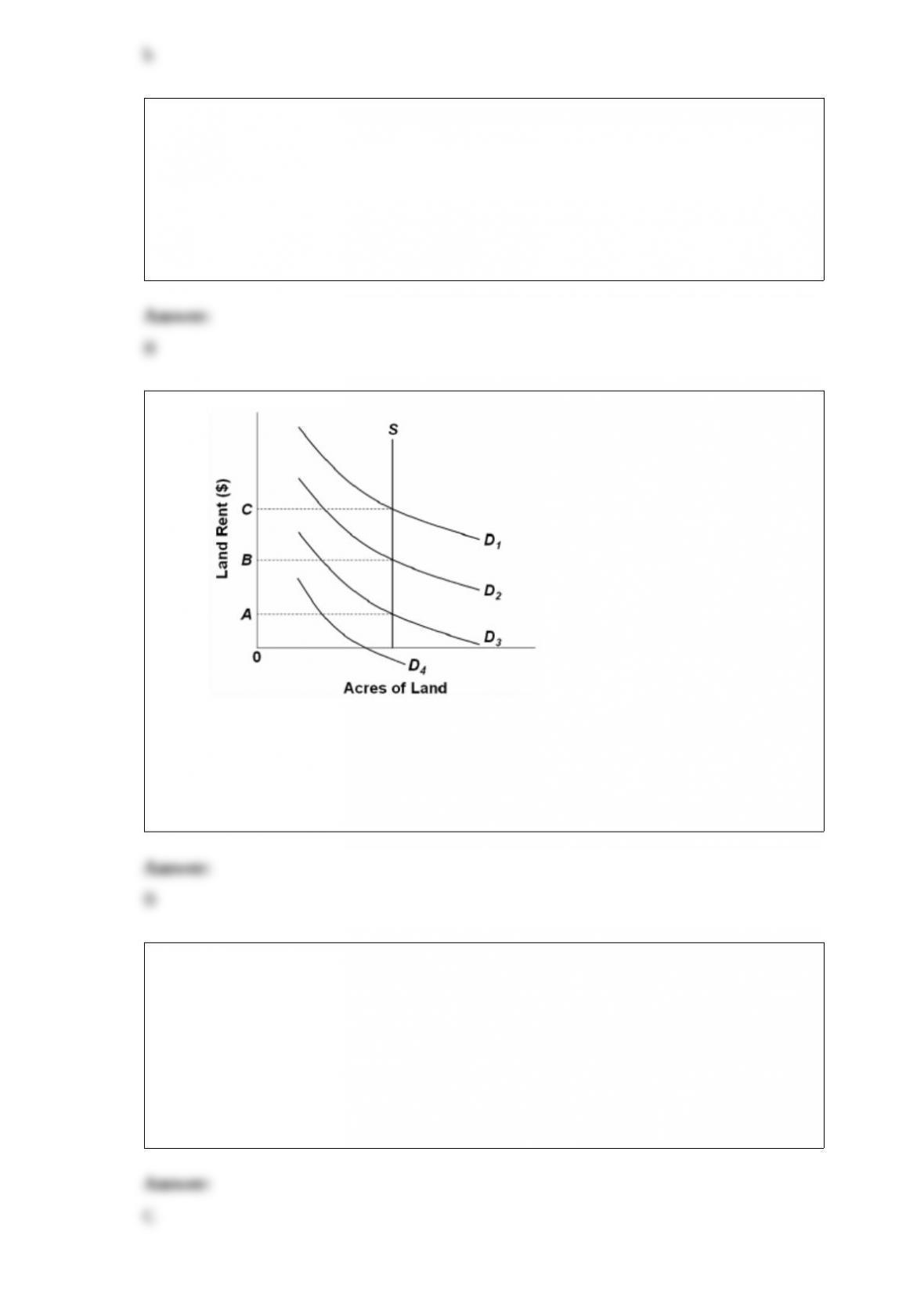
11)
Refer to the above diagram. Land:
A.will cease to be used in production if demand falls below D4.
B.would be a free resource if demand is D4 or less.
C.would be an economic (scarce) resource in the case of all four demand curves.
D.would be a free resource in the case of all four demand curves.
12) (Consider This) Which of the following methods is commonly used by farmers to
‘smooth” income over time?
A.Producing only one crop to benefit from specialization.
B.Renting land from other farmers to increase production.
C.Entering contracts with buyers of their farm output to assume themselves of a fixed
price.
D.All of these risk-management techniques are used to hedge against short-run price
and output fluctuations.

13) The Bretton Woods system of exchange rates:
A.is also known as the gold standard and met its demise in the 1930s.
B.relied heavily on floating exchange rates determined in the market for foreign
exchange.
C.was abandoned in the 1930s.
D.was a system of fixed or pegged exchange rates, which occasionally could be
adjusted.