
The economy is in long-run equilibrium:
A. when the AD and AS curves intersect at potential output, Y*.
B. when the AD and AS curves intersect, regardless of the level of output.
C. when the AD and AS curves become vertical.
D. only when the business cycle is eliminated.
Suppose Stan owns a piece of property with a large lake. Initially, Stan and his family
were the only people who swam in the lake. Then Stan started selling tickets to people
who wanted to go swimming in the lake. When Stan died, he left the lake and the land it
was on to the state, stipulating that the lake be left open to the public for swimming.
Due to the lake’s remote location, it was never crowded.
When Stan started selling tickets to the public, the lake became a ______ good.
A. private
B. commons
C. collective
D. public
If all firms in a perfectly competitive industry are earning a normal profit, then:

A. new firms will enter the industry.
B. existing firms will exit the industry.
C. there is no incentive for firms to enter or exit the industry.
D. the market supply curve will shift to the left.
Suppose it takes Paul 3 hours to bake a cake and 2 hours to move the lawn, and suppose
it takes Tom 2 hours to bake a cake and 1 hour to mow the lawn. Which of the
following statements is correct?
A. Paul has the absolute advantage in baking cakes
B. Paul has the comparative in mowing the lawn
C. Paul has the comparative in baking cakes
D. Paul has the absolute advantage in mowing the lawn.

The nominal interest rate equals the:
A. real interest rate minus the inflation rate.
B. real interest rate plus the inflation rate.
C. real interest rate divided by the inflation rate.
D. inflation rate minus the real interest rate.
If the total expenditures of a typical family equaled $35,000 per year in 2010 and the
exact same basket of goods and services cost $40,000 in the year 2015, the family’s cost
of living:
A. increased by 14 percent.
B. decreased by 12.5 percent.
C. decreased by 14 percent.
D. increased by 12.5 percent.

When the central bank sells $1,000,000 worth of government bonds to the public, the
money supply:
A. decreases by more than $1,000,000.
B. decreases by $1,000,000.
C. decreases by less than $1,000,000.
D. increases by $1,000,000.
Refer to the figure below. Total utility ______ as additional apples are consumed, but
marginal utility ______ with each additional apple consumed.
A. first decreases then increases; decreases
B. first increases then decreases; decreases
C. first decreases then increases; increases
D. first increases then decreases; increases

Suppose it takes Dan 5 minutes to make a sandwich and 15 minutes to make a
smoothie, and it takes Tracy 6 minutes to make a sandwich and 12 minutes to make a
smoothie. Which of the following statements is correct?
A. Dan has the comparative advantage in smoothies, but Tracy has the absolute
advantage in smoothies.
B. Dan has the comparative and absolute advantage in sandwiches.
C. Dan has the comparative and absolute advantage in smoothies.
D. Dan has the comparative advantage in sandwiches, but Tracy has the absolute
advantage in sandwiches.
Bank C promises to pay a compound annual interest rate of 6 percent, while Bank S
pays an 8 percent simple annual interest rate on deposits. If you deposit $1,000 in each
bank, after 10 years, your deposit in Bank C equals _____, while your deposit in Bank
S equals ______.
A. $1,060; $1,800
B. $1,600; $1,800
C. $1,600; $2,159
D. $1,791; $1,800
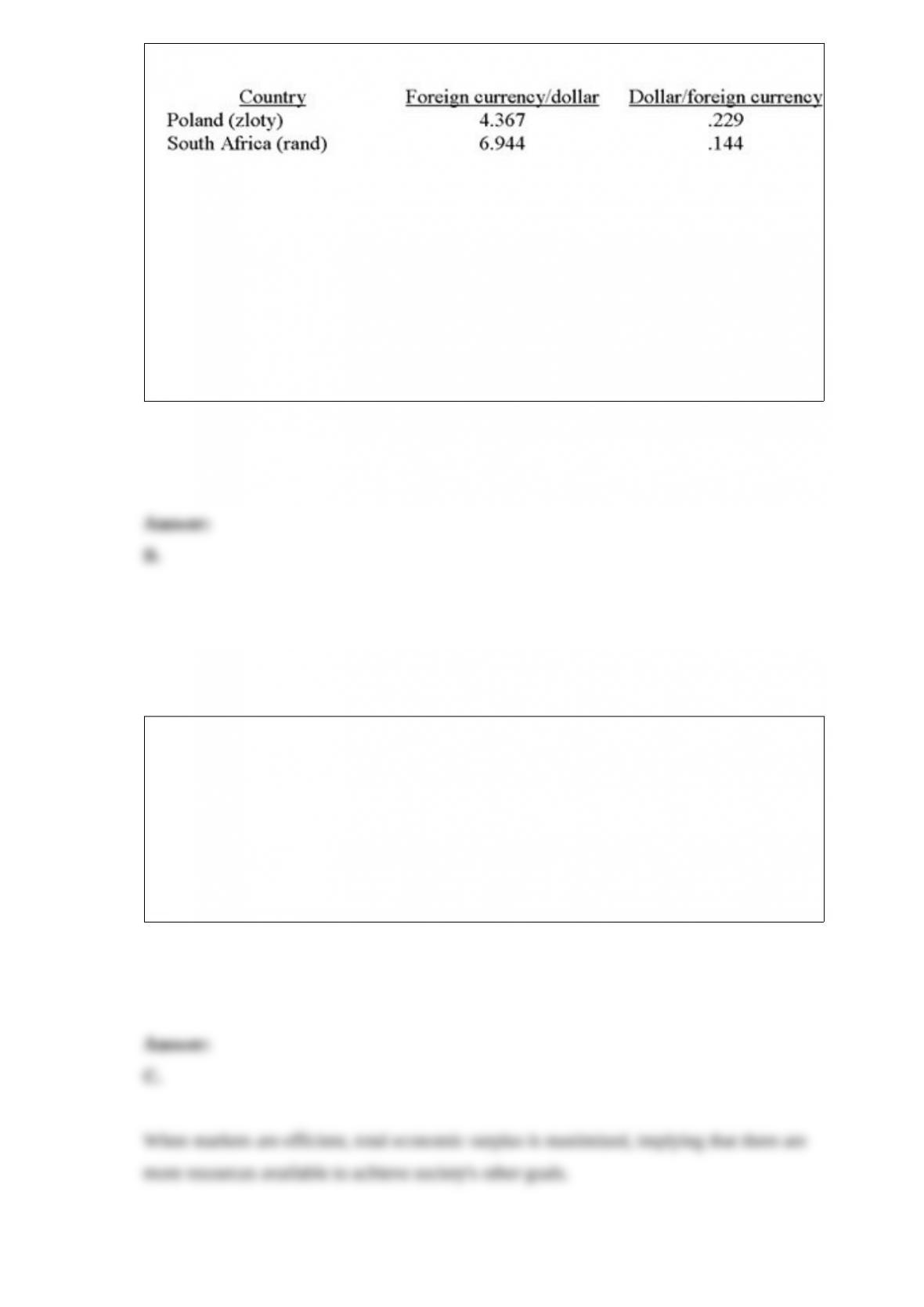
The following table provides nominal exchange rates for the U.S. dollar.
Based on these data, the nominal exchange rate equals approximately ______ zloty per
South African rand or, equivalently, ______ rand per Polish zloty.
A. 1.590; 0.629
B. 0.629; 1.590
C. 0.021; 47.640
D. 47.640; 0.021
Efficiency is an important goal because when markets are efficient:
A. there is less income inequality.
B. the poor benefit more than the wealthy.
C. there are more resources available to achieve other goals.
D. there is no need for government intervention in the economy.

Refer to the table below. According to the Cost-Benefit Principle, how many units of
this activity should be carried out?
A. 2
B. 3
C. 4
D. 5
The role that prices play in distributing scarce goods and services to those consumers
who value them the most highly is known as the ______ function of price.
A. allocative
B. multiplicative
C. equilibrium
D. rationing
Spending on durable goods, nondurable goods, and services is included in:
A. consumption expenditures.
B. investment.
C. government purchases.
D. net exports.
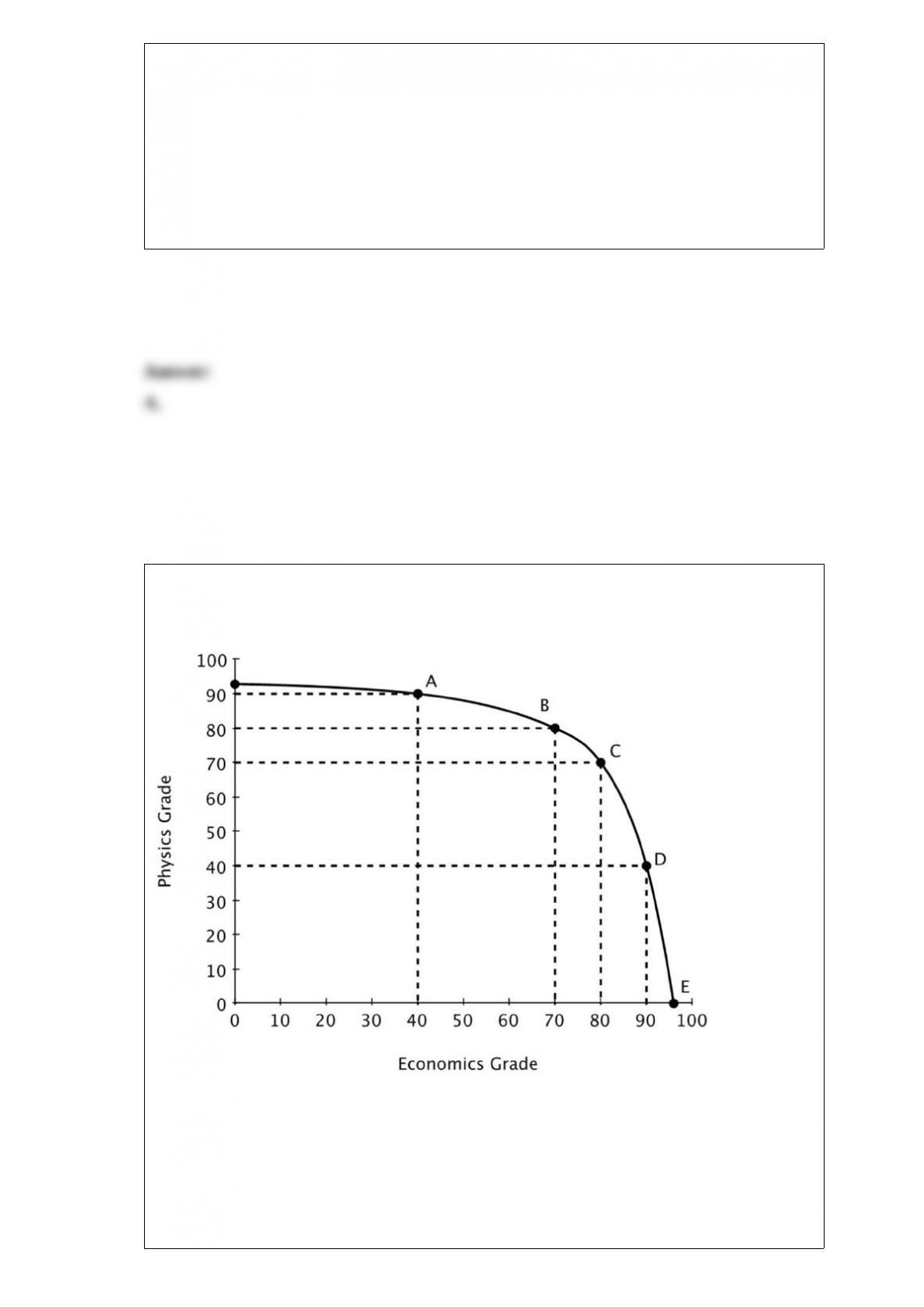
Moe divides his time between studying Physics and studying Economics. His
production possibilities curve for his final grade in each class is shown below.
The Principle of Increasing Opportunity Cost is reflected in the fact that the opportunity
cost going from 70 to 80 in economics is:
A. lower than the opportunity cost of going from 80 to 90 in economics.
B. higher than the opportunity cost of going from 80 to 90 in economics.

C. lower than the opportunity cost of going from 80 to 90 in physics.
D. the same as the opportunity cost of going from 70 to 80 in physics.
Suppose a perfectly competitive firm and a monopolist are both charging $5 for their
respective products. From this, one can infer that:
A. the marginal benefit from selling an additional unit of output is $5 for both firms.
B. the marginal benefit from selling an additional unit of output is $5 for the
competitive firm and less than $5 for the monopolist.
C. the marginal benefit from selling an additional unit of output is less than $5 for both
firms.
D. the competitive firm is charging too much, and the monopolist is charging too little.
Which of the following statements is true?

A. Accounting profit is always positive.
B. Economic profit is always positive.
C. Economic profit is greater than or equal to accounting profit.
D. Accounting profit is greater than or equal to economic profit.
The primary advantage to selling pollution permits rather than using a fixed percent
reduction for all firms is that:
A. the government can raise additional revenue.
B. pollution reduction is accomplished in the least costly way possible.
C. enforcement costs are eliminated.
D. pollution is driven to zero.
The figure below shows the demand curve, marginal revenue curve, marginal cost curve
and average total cost curve for a monopolist.
At this monopolist’s profit-maximizing level of output, the deadweight loss to society
equals:
A. $0 per day.
B. $16 per day.
C. $24 per day.
D. $64 per day.
The large increase in household wealth in the United States in the 1990s was the result
of:
A. a high saving rate.
B. a low saving rate.
C. large capital gains.
D. high rates of inflation.
Suppose the value of the CPI is 1.100 in year one, 1.160 in year two, and 1.270 in year

three. Assume also that the price of computers increases by 3% between year one and
year two, and by another 3% between year two and year three. The price level is
increasing, the inflation rate is _______, and the relative price of computers is
_________.
A. increasing; increasing
B. constant; increasing
C. constant; decreasing
D. increasing; decreasing
People who say that they would like to have a job, but have not made an effort to find a
job in the past four weeks, are called ______ workers.
A. unemployed
B. involuntary part-time
C. discouraged
D. chronically unemployed
In Macroland, potential output equals $100 trillion and the natural rate of
unemployment is 4 percent. If the actual unemployment rate is 3 percent, then the

output gap equals:
A. -1 percent.
B. -2 percent.
C. 1 percent.
D. 2 percent.
For an economy starting at potential output, an increase in autonomous expenditure in
the short run results in a(n):
A. expansionary output gap.
B. recessionary output gap.
C. increase in potential output.
D. decrease in potential output.
Dividing the total cost of n units of an activity by n reveals the:
A. average benefit.
B. marginal cost.

C. units per cost.
D. average cost.
De Beers accounts for approximately 80% of diamond sales worldwide. The source of
its market power is:
A. its exclusive ownership of South African diamond mines.
B. its patent on diamond production.
C. the perfectly inelastic demand for diamonds.
D. the engagement customs of couples in Western cultures.
In the long run, countries with higher rates of money growth usually have:
A. higher rates of inflation.
B. lower rates of inflation.
C. faster growth rates of real output.
D. smaller budget deficits.
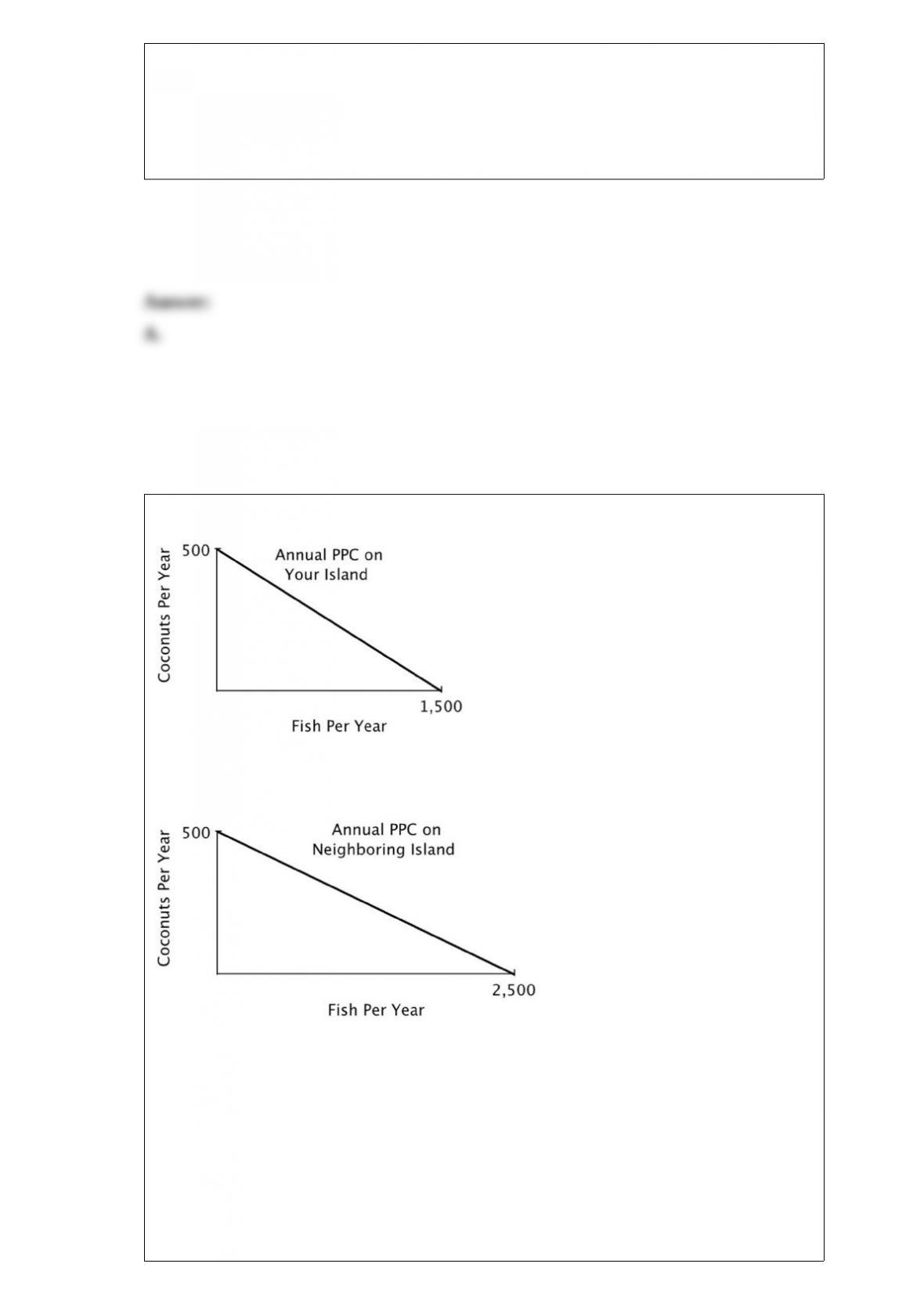
You are the Minister of Trade for a small island country with the following annual PPC:
You are negotiating a trade agreement with a neighboring island with the following
annual PPC:
Both islands specialize exclusively in the product for which they have a comparative
advantage. You have agreed to give 350 coconuts to the other island in exchange for
1,300 fish. After the trade, your island has a total of ______ coconuts and ______ fish.
A. 150; 2,800
B. 500; 1,300
C. 150; 1,300

D. 500; 1,500
Suppose Joe has a two-year old Honda Civic that’s in excellent condition and that he
would be willing to sell for $13,000. Lauren, who is risk-neutral, is considering whether
to buy Joe’s car. She’s willing to pay $14,000 for a two-year Honda Civic that’s in
excellent condition and only $10,000 for one that’s not in excellent condition. Lauren
cannot tell whether Joe’s car is in excellent condition. She believes that only 20 percent
of two-year old Hondas for sale in the market are in excellent condition and that the
other 80 percent are not in excellent condition. If other people who own two-year
Honda Civics in excellent condition are like Joe, and other buyers in the market are like
Lauren, then which of the following is likely to occur in the long run?
A. The sales price of two-year old Hondas will rise.
B. The sales price of two-year old Hondas will not change.
C. The quality of two-year old Honda Civics offered for sale will rise.
D. The quality of two-year old Honda Civics offered for sale will fall.
Suppose that the equilibrium price of DVD players increases and the equilibrium
quantity increases. Which of the following best fits the observed data?
A. An increase in demand with supply constant.
B. An increase in demand coupled with a decrease in supply.

C. An increase in demand coupled with an increase in supply.
D. A decrease in demand with supply constant.
Hotelling’s model has been used to describe differentiation in the political “market.”
Suppose that 100 voters are evenly distributed between the extreme left and the extreme
right on the political spectrum, and that all voters vote, and they always vote for the
candidate closest to them on this spectrum. The numbers on this spectrum represent the
number of voters lying to the left of the number. So, at the midpoint, fifty voters lie to
the left and fifty to the right. At the extreme right end, all 100 voters lie to the left.
If Candidate Y is running against Candidate Z:
A. Candidate Y will have an incentive to move to the left, and Candidate Z will have an
incentive to move to the right.
B. Both candidates will have an incentive to move to the left.
C. Both candidates will have an incentive to move toward each other’s position.
D. Neither candidate has any incentive to move.

If potential output equals 4,000 and short-run equilibrium output equals 3,500, there is a
______ gap and the Federal Reserve must ______ real interest rates in order to close the
gap.
A. recessionary; raise
B. recessionary; reduce
C. recessionary; not change
D. expansionary; raise