
Suppose an industry is made up of 16 firms. Three firms each sell 12 percent of the
industry’s total output; another three firms each sell 8 percent; another five firms each
sell 5 percent; and the last five firms each sell 3 percent. What is the eight-firm
concentration ratio in this industry?
a. 0.85
b. 0.50
c. 0.40
d. 0.70
e. 1.40
Suppose Valerie is consuming lipstick (L) and eye shadow (E) and nothing else. MUL =
24 and MUE = 40. The price of eye shadow is $10, and the price of lipstick is $8. What
should Valerie do?
a. Consume more eye shadow and less lipstick.
b. Consume more lipstick and less eye shadow.
c. Consume less of both.
d. Consume more of both.
e. Not change her consumption of either good.

A perfectly competitive firm should increase its level of production as long as
a. total revenue is less than total cost.
b. the total revenue curve is rising.
c. marginal revenue is greater than marginal cost.
d. the marginal revenue curve is rising.
Suppose the demand for a particular good is perfectly inelastic and the government
decides to impose a tax on the production of this good. Who will pay the greater share
of such a tax?
a. The buyers will pay the entire share.
b. The sellers will pay the entire share.
c. The buyers and the sellers will pay equal shares.
d. The sellers will bear the greater share of the tax.

For a factor price taker, the marginal factor cost curve
a. and the factor supply curve both slope upward, but are not identical.
b. and the factor supply curve are identical and horizontal.
c. is horizontal, but the factor supply curve slopes upward.
d. slopes upward, but the factor supply curve is horizontal.
e. and the factor supply curve are identical and slope upward.
If a labor union wanted to employ all its membership it would most likely negotiate for
a __________ than if it wanted to maximize the income of a limited number of union
members.
a. wage that discounted for fixed costs
b. higher wage
c. wage that accounted for a percentage of sales revenues
d. lower wage
e. none of the above
Farmers can insure themselves against adverse price swings through the __________
market.
a. bond
b. stock
c. futures
d. food
e. none of the above
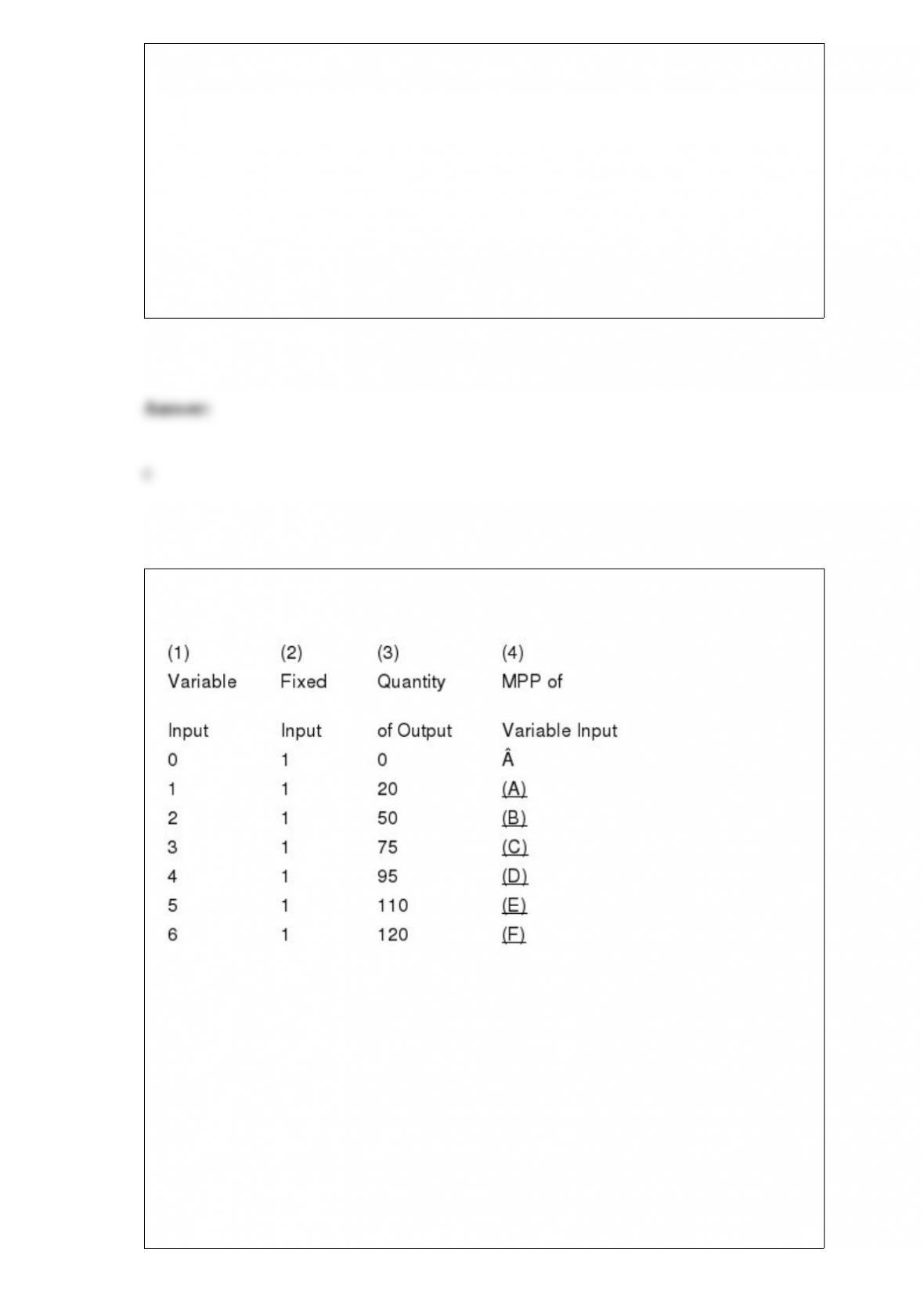
Exhibit 22-1
Diminishing marginal returns set in with the addition of which unit of the variable
input?
a. the fourth
b. the fifth
c. the sixth
d. the second
e. the third

If a monopolistic competitive firm raises its price, then
a. it should expect to lose all of its customers because there are many other sellers of the
product.
b. this is a trick question because the firm does not have the ability to change its price.
c. it should expect to lose some, but not all, of its customers.
d. it will be able to increase its profits.
e. it can sell all it wants because it faces a horizontal demand curve.
Which of the following statements is true?
a. The fewer the substitute factors for union labor, the higher the elasticity of demand
for union labor, and the smaller the cutback in union labor for any given wage increase.
b. The fewer the substitute factors for union labor, the lower the elasticity of demand for
union labor, and the larger the cutback in union labor for any given wage increase.
c. The more the substitute factors for union labor, the higher the elasticity of demand for
union labor, and the smaller the cutback in union labor for any given wage increase.

d. The more the substitute factors for union labor, the higher the elasticity of demand
for union labor, and the larger the cutback in union labor for any given wage increase.
e. none of the above
The absence of value judgments is the essence of
a. normative economics.
b. positive economics.
c. microeconomics.
d. macroeconomics.
Rising demand for an agricultural good __________ the payments government is
committed to pay farmers under a __________ program.
a. raises; production flexibility contract
b. raises; deficiency payment
c. lowers; production flexibility contract
d. lowers; deficiency payment
If the U.S. dollar appreciates in the foreign exchange market, U.S. exports will be
__________ and U.S. imports will be __________.
a. relatively less expensive; relatively less expensive

b. relatively less expensive; relatively more expensive
c. relatively more expensive; relatively less expensive
d. relatively more expensive; relatively more expensive
e. unaffected; relatively less expensive
When a positive externality exists, _______________________ and thus
_______________ intervention may be needed to achieve efficiency.
a. external costs are necessarily greater than private costs; government
b. social costs equal private costs; no government
c. social costs are less than private costs; government
d. social costs are greater than private costs; government
e. none of the above
Which of the following statements about a perfectly competitive firm is necessarily
false?
a. There are few substitutes for the firm’s product.
b. There are few complements to the firm’s product.
c. The firm produces the quantity at which marginal revenue equals marginal cost.
d. The firm sells a product that is identical in the eyes of buyers to any other product
sold in the industry.

George earns $500,000 playing baseball for team X. His next best alternative to playing
baseball is to own a fast-food restaurant, for which he would earn $100,000 a year. His
next best alternative to playing baseball for team X is playing baseball for team Y, for
which he would earn $400,000 a year. This example best illustrates the economic
principle that
a. economic rent is never zero.
b. baseball players earn higher incomes than fast-food restaurateurs.
c. economic rent exists in all situations.
d. economic rent differs depending upon the perspective from which the factor is
viewed.
According to public choice theorists, the behavior of people employed in the public
sector is likely to differ from the behavior of people employed in the private sector
because
a. the two sectors are likely to attract people of different psychological profiles.
b. government employees are likely to exhibit more civic responsibility than
private-sector employees.
c. the same objective to maximize one’s net benefit will produce different behavior in
different institutional settings.
d. all of the above
e. a and b
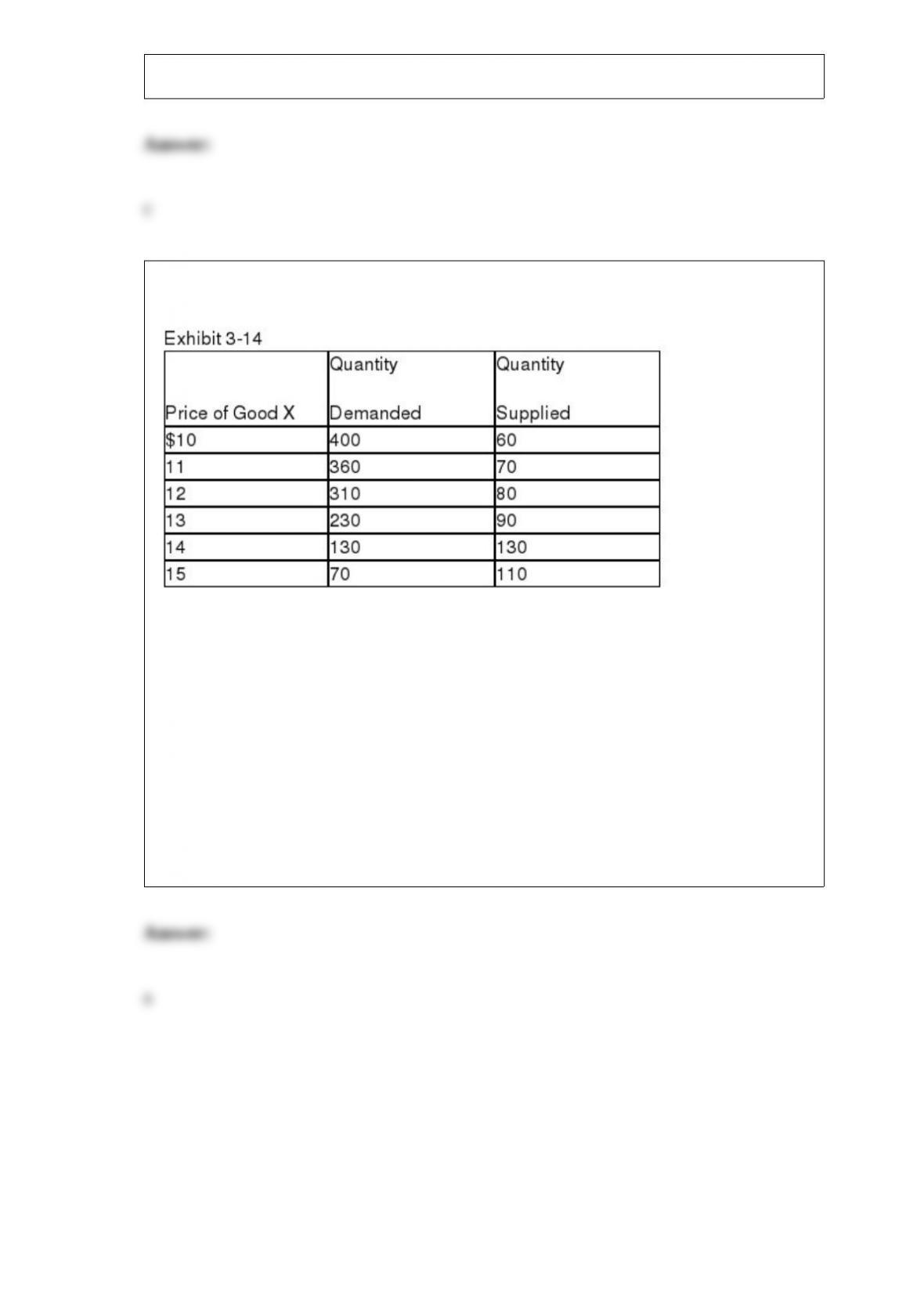
At a price of $13, there is a ____________ unit____________ of good X.
a. 140; shortage
b. 160; shortage
c. 140; surplus
d. 20; surplus
e. 100; surplus